- The paper reports that SDC335 exhibits an 'inverted' infall profile with a central peak in velocity that declines at intermediate radii before rising again.
- It employs spatially resolved observations of HCO⁺ and H¹³CO⁺ lines alongside Hill5 and radiative transfer models to quantify infall velocities and mass accretion rates.
- The findings challenge turbulence-only interpretations of linewidths, emphasizing the need to account for non-monotonic, infall-dominated accretion in massive star formation.
Overview
The study investigates the infall kinematics of the IRDC SDC335.579-0.292, a paradigmatic massive star-forming region. Using spatially resolved observations of HCO+ J=1–0 and H13CO+ J=1–0, quantitative analysis is performed via the semi-analytic Hill5 model as well as comprehensive radiative transfer (RT) modeling with LIME, RADMC-3D, and RATRAN codes. The research uniquely characterizes the radial structure of infall velocities and explores the implications for accretion and fragmentation processes in high-mass star formation.
Observational Framework
SDC335 is a centrally condensed clump of ∼5500 M⊙ at 3.25 kpc, with infall signatures previously observed over parsec scales. Mopra 22-m telescope data provides high-resolution spatial and spectral mapping of HCO+ and H13CO+ lines, complemented by N2H+ for systemic velocity determination. The blue asymmetric profile of HCO130 J=1–0 is evident over a 1313 pc region, marking extensive infall.
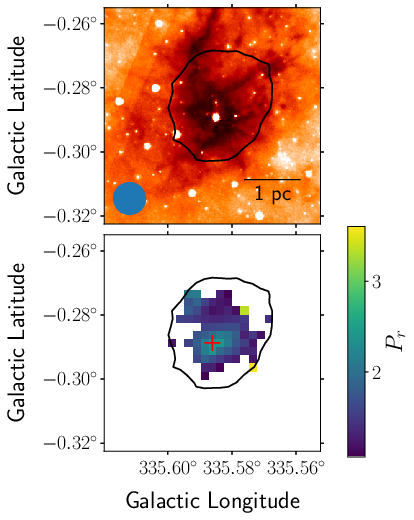
Figure 1: Spatial distribution of the blue/red peak ratio (132) in SDC335, tracing infall signatures across the clump.
Semi-Analytic Modeling: Hill5 Analysis
The Hill5 model fits the excitation structure and line profiles, yielding robust constraints on infall velocity (133), optical depth, velocity dispersion, and peak excitation temperature. At the clump center, best-fit infall velocities are 134 km s135, with velocity dispersions 136 km s137.
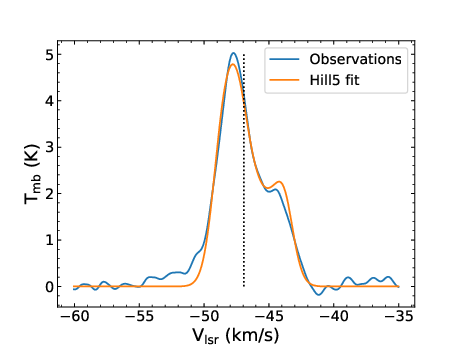
Figure 2: HCO138 spectrum at the central pixel with Hill5 fit overlay, parameters tightly constrained via MCMC sampling.
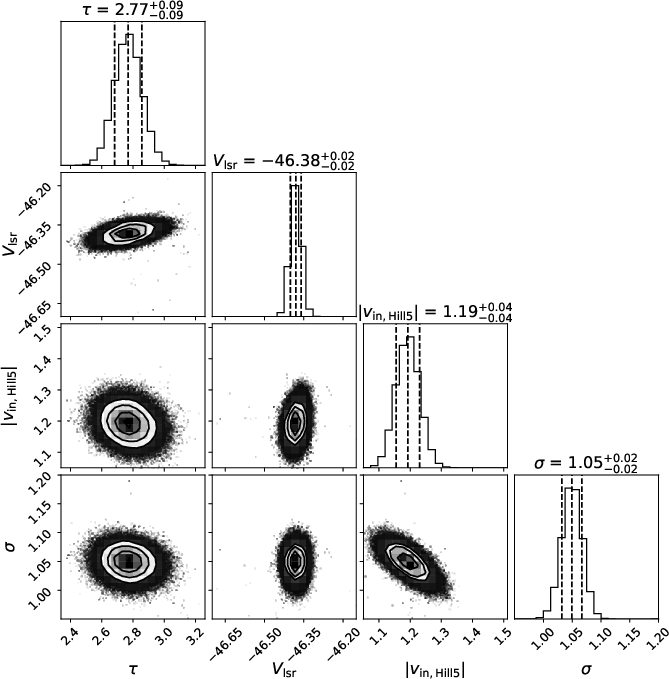
Figure 3: MCMC corner plot: distributions and covariances among Hill5 parameters for the central spectrum.
Spatially, Hill5 fits reveal an “inverted” infall profile. The magnitude of infall velocity is maximal at the center (139 km s+0), decreases to a minimum (+1 km s+2) at +3 pc, and increases again at larger radii.
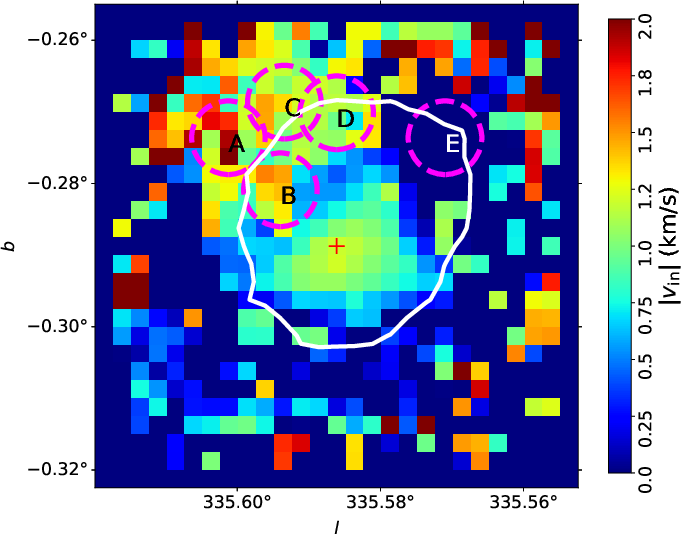
Figure 4: Map of infall velocity magnitude (+4) derived from Hill5 fits across SDC335.
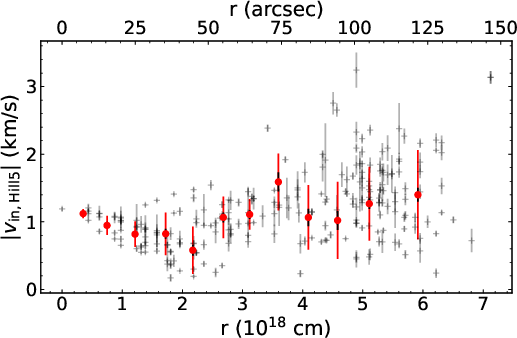
Figure 5: Radial profile of Hill5-fitted infall velocity, highlighting the “inverted” trend: central maximum, intermediate minimum, outer rise.
Annularly averaged spectra confirm the radial velocity reversal, consistent with pixel-based fits.
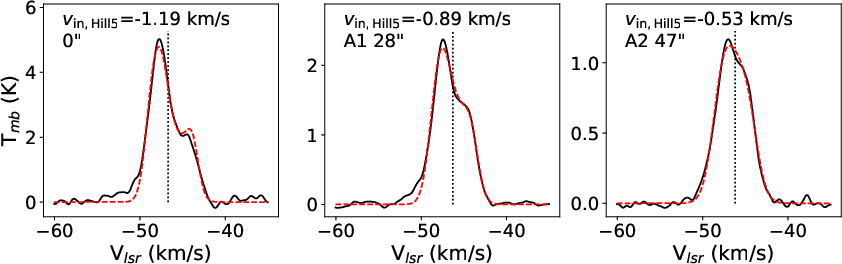
Figure 6: Annular averages of HCO+5 spectra and Hill5 fits for radii 0, 28, 47 arcsec: each exhibits decreasing infall velocity with radius.
Radiative Transfer Modeling and Comparison
RT models utilize spherical symmetry with power-law density profiles (+6, +7), temperature gradients (minimum 20 K, central source +8 K, +9 ∼0), and fixed HCO∼1 abundances. Infall velocity profiles are parameterized for various radial dependencies, including uniform, increasing, and decreasing cases.
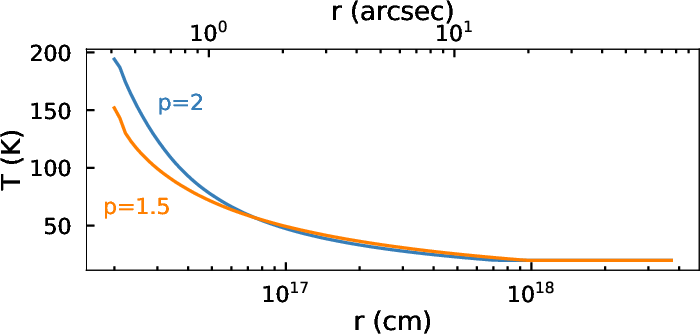
Figure 7: RADMC-3D computed temperature profiles for ∼2 and ∼3 density laws, matching IRDC thermal structure.
RT fits at the central pixel, using LIME, RADMC-3D, and RATRAN, show best-fit infall velocities between ∼4 and ∼5 km s∼6, with mass inflow rates of a few ∼7 to ∼8 ∼9 yrM⊙0, largely insensitive to density power-law but sensitive to infall structure.
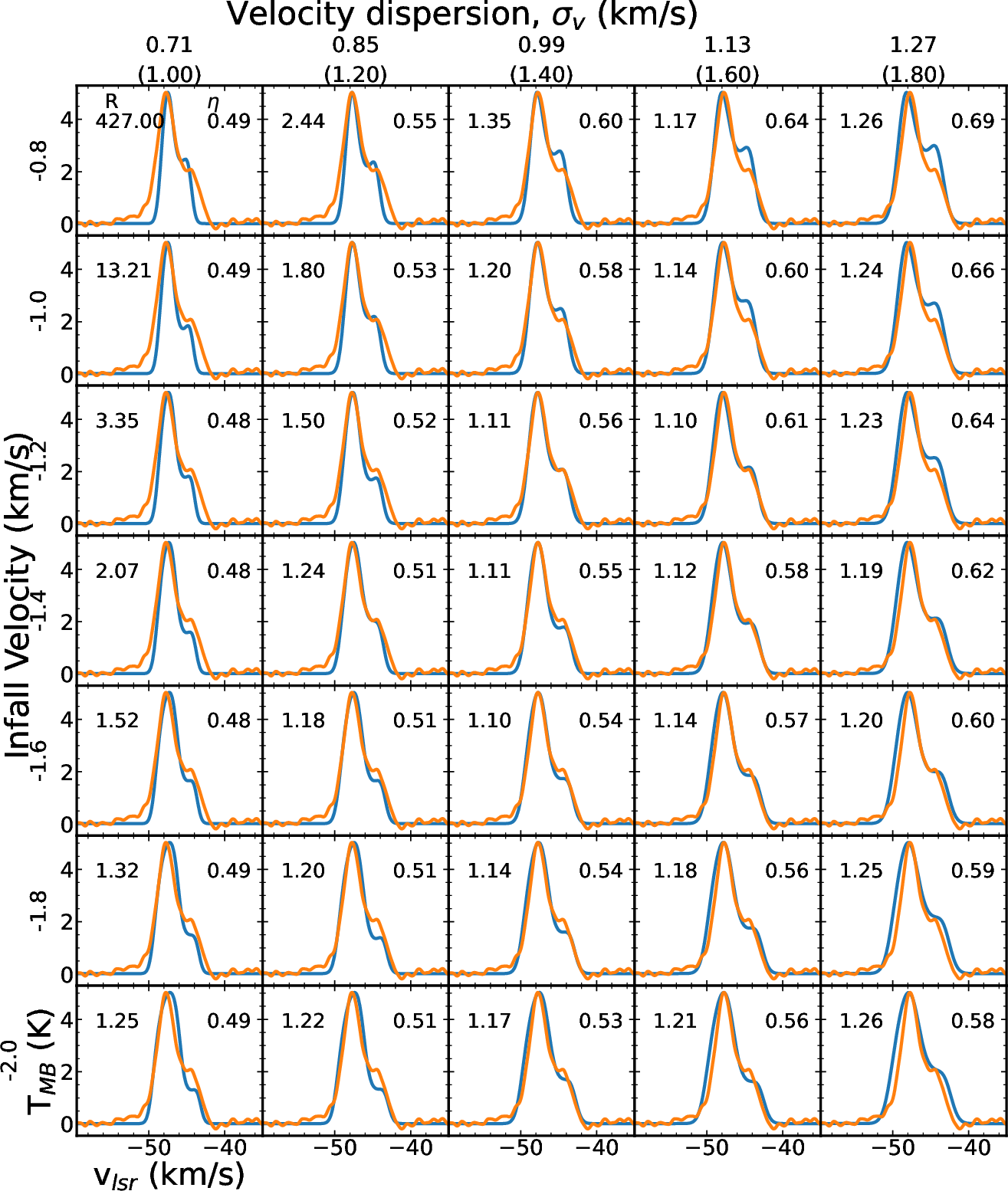
Figure 8: LIME model grid comparison to central pixel data, with velocity and turbulence parameters assessed by M⊙1 fit statistics.
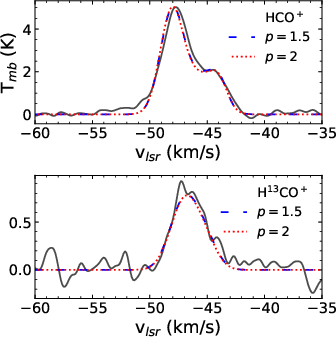
Figure 9: RT central pixel line profile fits for M⊙2 and M⊙3 models; M⊙4 statistics indicate robust agreement.
The degeneracy in infall radial structure is highlighted: both increasing and decreasing infall velocity profiles can match global line shapes, but only higher-J transitions or optically thin tracers (HM⊙5COM⊙6) distinguish the physical scenarios.
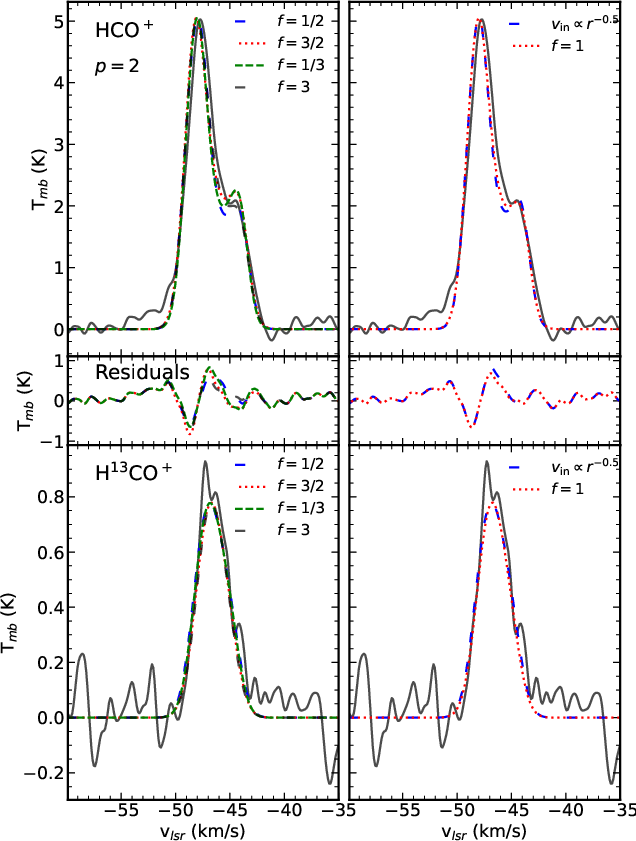
Figure 10: Comparison of J=1–0 and J=3–2 synthetic spectra: higher-J transitions accentuate differences between infall models.
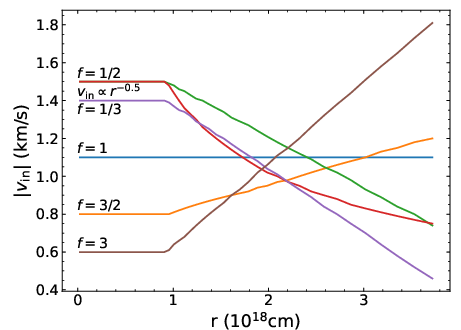
Figure 11: Velocity profiles for best-fit models: “inverted” (outside-in), uniform, and inside-out collapse structures contrasted.
Linewidths and Evidence for Ordered Motion
The spatially constant line width of HM⊙7COM⊙8 J=1–0 across the clump is incompatible with purely turbulent broadening. RT modeling shows unresolved infall dominates the linewidth, contrary to standard turbulence interpretations.
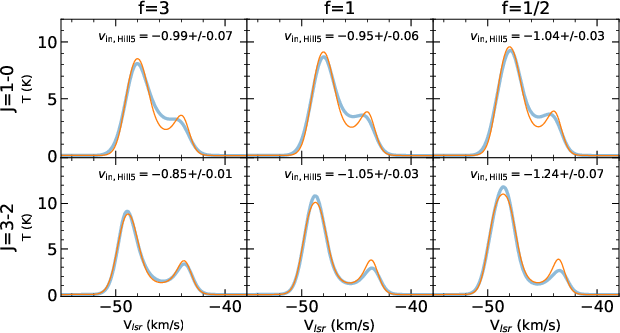
Figure 12: Synthetic spectra for LIME models with varying infall profiles: J=1–0 and J=3–2 responses to infall structure.
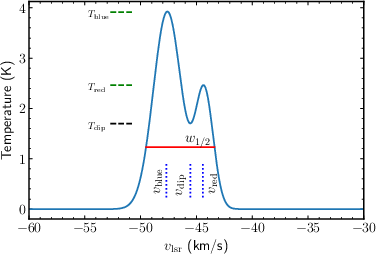
Figure 13: Line profile characterization schematic; observed profiles show blue asymmetry quantified by M⊙9 and dip ratios.
This result challenges the prevailing assumption that optically thin molecular line widths exclusively probe turbulent velocities in dense clumps.
Mass Accretion Rates and Structural Implications
Derived accretion rates are substantial (+0–+1 +2 yr+3), with spatial variation dictated by infall velocity profile and density law. The “inverted” profile physically implies mass flux is higher at larger radii. This necessitates intermediate-scale fragmentation or filament formation to channel material to the clump core.
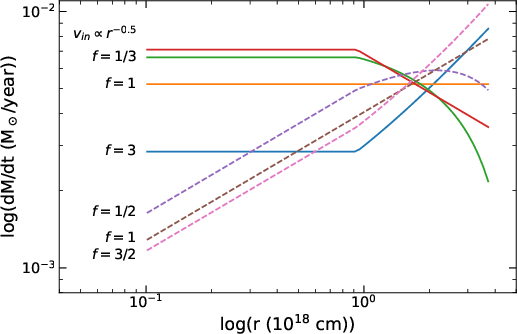
Figure 14: Radial mass accretion rate profiles: dashed/solid lines for +4, +5 parameterizes the velocity structure.
Model Degeneracy and Hill5 Limitations
Hill5 estimates align closely with RT outputs for uniform velocity but increasingly deviate as radial structure becomes complex. Systematic under-/over-estimation of true velocity occurs; results must be interpreted with caution, and Hill5 fitting is best understood as a lower limit for infall velocities.
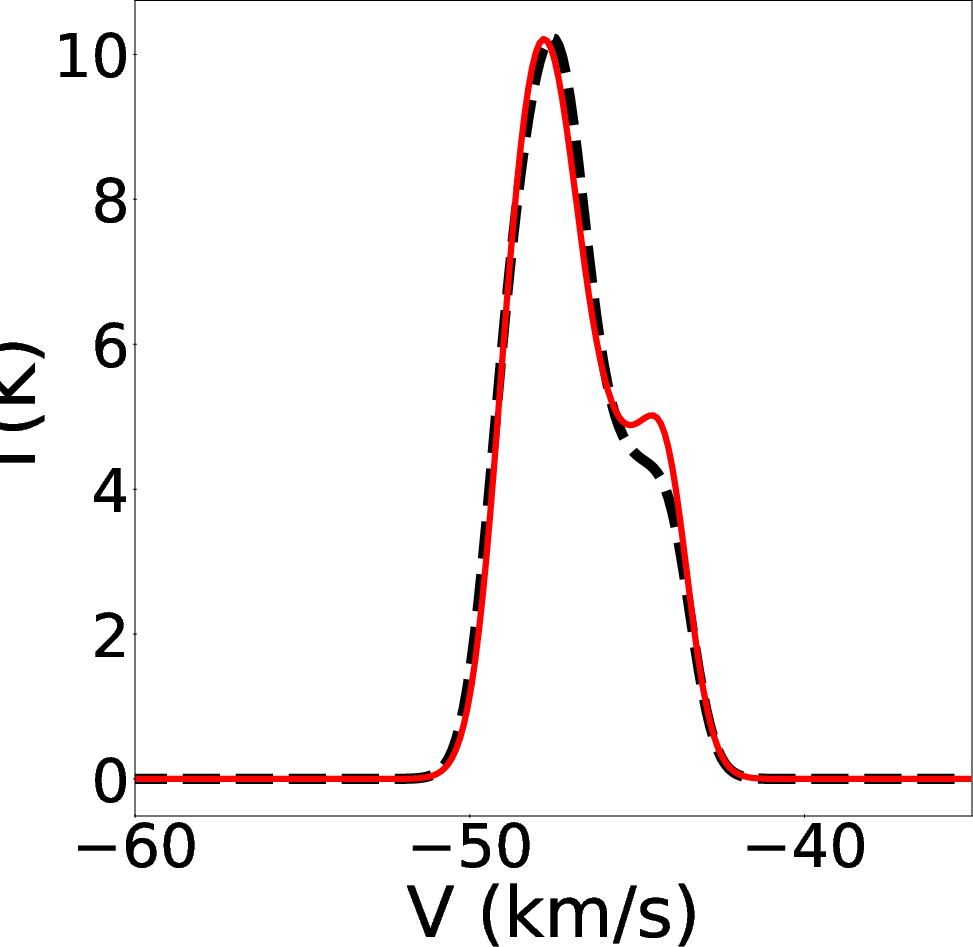
Figure 15: Hill5 fits to RATRAN, LIME, and RADMC-3D synthetic spectra; model line shapes matched, but input velocities misestimated.
Implications and Future Directions
The study robustly establishes that large-scale infall in SDC335 deviates from free-fall or uniform velocity paradigms; an “inverted” profile is observed with central minima in infall velocity. This has profound significance for theories of massive star formation, indicating non-monotonic accretion and requiring intermediate fragmentation processes. The mass inflow rates and spatially constant line widths observed mandate reconsideration of clump stability analyses and virial parameter estimates, as infall motions can masquerade as turbulence.
Future work is suggested to resolve degeneracies via multi-transition, high-angular resolution observations, and extended RT analyses on larger samples. The impact of infall-dominated linewidths for the interpretation of star-forming region dynamics warrants systematic survey.
Conclusion
This comprehensive, quantitative study of SDC335 highlights the necessity of spatially resolved infall analyses and advanced RT modeling in massive star-forming regions. The identification of an “inverted” infall profile, significant mass inflow rates, and infall-dominated linewidths fundamentally inform models of accretion, fragmentation, and feedback in high-mass IRDCs. The methodology sets new standards for kinematic inference and challenges established turbulence-centric paradigms in the dense ISM.