- The paper demonstrates a novel gravitational phase in 1/16-BPS black holes induced by instanton condensation within the superconformal index formulation.
- It employs detailed saddle point analysis and Fourier mode truncations to identify instabilities leading to multi-cut matrix model transitions.
- The study clarifies the link between partial deconfinement and non-perturbative instanton effects, offering insights into holographic dual descriptions.
Instanton Condensation and a New Phase of BPS Black Holes
Introduction and Motivation
This work analyzes the microcanonical description of $1/16$-BPS black holes in AdS5×S5, leveraging the superconformal index to reveal a novel thermodynamic instability along the small black hole saddle. The analysis identifies this instability with instanton condensation in the matrix model description of the index, demonstrating that below a critical charge, corresponding to black holes with radii slightly below the AdS scale, the conventional single-cut matrix model saddle becomes unstable. The results strongly support the emergence of a previously unidentified gravitational phase, with compelling evidence suggesting its correspondence with the partially deconfined phase in the boundary N=4 SYM theory. This assignment addresses a central ambiguity concerning the locus and interpretation of partial deconfinement in the BPS black hole phase diagram.
Partial Deconfinement and Matrix Model Diagnostics
The partial deconfinement paradigm prescribes a division of the gauge group into confined and deconfined subsectors at large N (Figure 1). This organization is elucidated using the eigenvalue distribution of the Polyakov loop, ρ(θ), yielding standard phase regimes: uniform (confined), non-uniform ungapped ("partial deconfinement"), and gapped (completely deconfined). The Gross-Witten-Wadia (GWW) transition demarcates the boundary between complete and partial deconfinement, characterized by the closure of the eigenvalue gap (Figure 2).
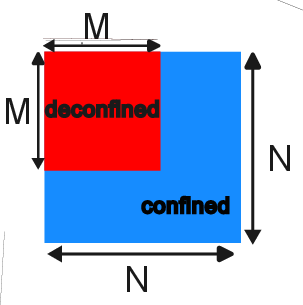
Figure 1: Schematic depiction of partial deconfinement at large N, separating color degrees between confined and deconfined subsectors.
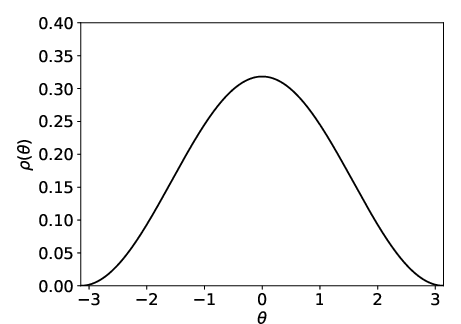
Figure 2: The Gross-Witten-Wadia (GWW) transition in eigenvalue space—marking the critical distribution between gapped and ungapped matrix model phases.
Instanton condensation, manifest as vanishing instanton actions in the path integral's transseries expansion, signals non-perturbative instabilities that can precipitate phase transitions—now interpreted as harbingers of partial deconfinement. The physical mechanism traces back to configurational enhancement of gauge-invariant states correlated with the Vandermonde determinant in the reduced matrix model.
The superconformal index for N=4 SYM can be formulated as an N×N matrix model in the holonomy eigenvalue basis. In the large N limit, the effective action features a potential term (including the full tower of chemical potentials) and a Vandermonde-induced eigenvalue repulsion, promoting confinement.
Saddle point analysis is performed using a continuum eigenvalue density ρ(z) supported on a collection of contours in the complex plane. The physical black hole branches correspond to particular (single-cut) saddle solutions, with "large" and "small" black hole regimes mapped to distinct regions in the free energy phase diagram.
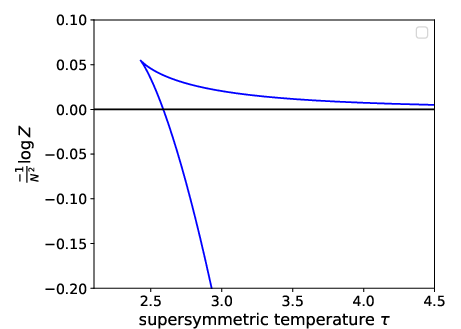
Figure 3: Phase diagram of the BPS black hole free energy versus supersymmetric temperature AdS5×S50, showing the cusp at which large and small black hole branches merge.
Instanton Instabilities and Multicut Transitions
By systematically analyzing matrix model truncations up to AdS5×S51 Fourier modes, the study identifies an instability on the microcanonical black hole saddle near and below the cusp, indicated by the vanishing and subsequent sign change of the leading (π-type) instanton action. The saddle then ceases to be global, yielding dominance to multi-cut configurations. This process constitutes a genuine non-analytic phase transition of the matrix model (Figures 8, 13, 18, 19).
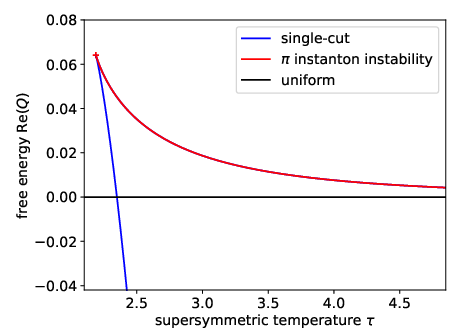
Figure 4: Free energy and instanton instability locus for black hole saddle in AdS5×S52 truncation, showing onset of multicut instability below the cusp.
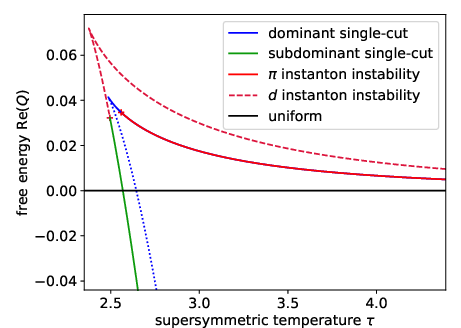
Figure 5: Free energies for two AdS5×S53 single-cut saddles, with instability against π-type and AdS5×S54-type instantons highlighted.
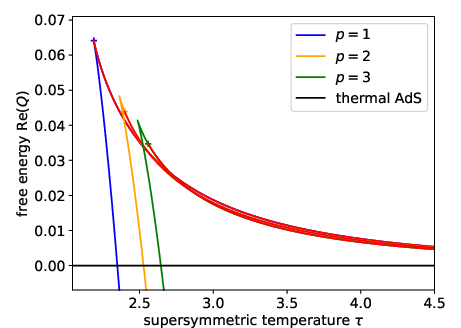
Figure 6: Comparison of instanton instability regions along dominant microcanonical saddles for AdS5×S55 truncations.
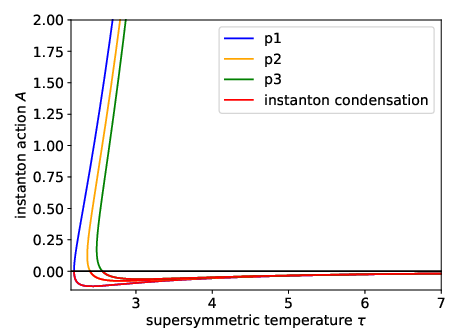
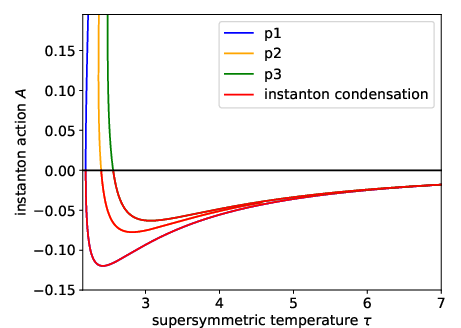
Figure 7: Instanton actions for π-type tunneling for dominant microcanonical saddles at increasing truncation levels.
A prominent numerical signature is the robust persistence of the π-type instanton instability across truncation levels, with subleading corrections (AdS5×S56) found to be negligibly small near the instability threshold. This provides strong evidence against the instability being a truncation artifact.
In addition, higher truncations reveal the appearance of further instanton species (d-type) associated with new pinching points in the spectral curve. Their condensation can potentially destabilize otherwise stable solutions, though the leading physical transition is consistently associated with π-type instantons.
Relation to Holographic Phases and Field Theory Duals
The findings support the interpretation that the emergence of a dominant multi-cut solution corresponds holographically to the partially deconfined phase. The transition is underpinned by the eigenvalue distribution fragmenting, naturally corresponding to a separation of active color sectors. The matrix model analysis here ties the transition to instanton condensation rather than the GWW transition per se, resolving a noted paradox in the BPS phase diagram: the GWW transition occurs deep in the small black hole/string phase, rather than at the transition to partial deconfinement.
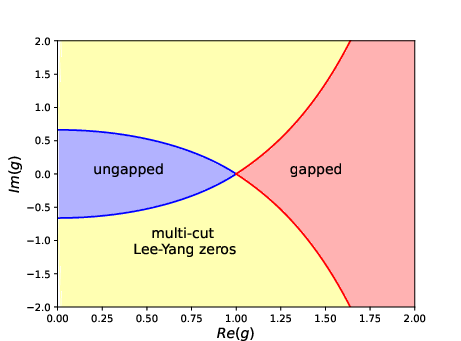
Figure 8: GWW model phase diagram at complex coupling: regions of gapped, ungapped, and multi-cut dominance, with instanton condensation curves and Lee-Yang zero accumulation loci.
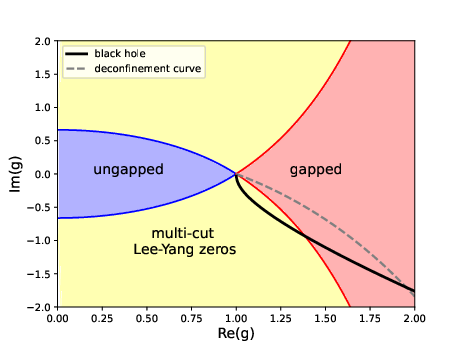
Figure 9: Trajectories in the GWW coupling AdS5×S57 for the physical black hole saddle and deconfinement curve, showing intersection with the instanton condensation boundary.
Possible dual gravitational interpretations for the new phase include black holes localized on AdS5×S58 via a Gregory-Laflamme-type transition or D3-brane nucleation into giant graviton or dual giant graviton configurations. This is consistent with eigenvalues condensing away from the principal cut as color degrees "fragment"—a process reflected in the opening of new cuts in the eigenvalue plane.
Theoretical and Practical Implications
The robust identification of an instanton condensation-induced phase transition in the BPS black hole phase diagram clarifies the mechanism by which partial deconfinement emerges in supersymmetric settings, extending its connection to non-perturbative topological sectors at finite chemical potential. The transition introduces a non-trivial, color-segregated saddle dominating the microcanonical ensemble, challenging the prior locality and continuity of the black hole phase structure. On the theoretical side, this advances understanding of the holographic mapping of color degrees, partial Higgsing, and potential connections to D-brane nucleation and confinement dynamics.
Practically, the framework offers a precise diagnostic for emergent phases in the strongly coupled regime via matrix model methodology. The tractability of the model across multiple truncations and ensembles (microcanonical versus grand canonical) enables controlled study of the interplay of thermodynamics, color structure, and non-perturbative dynamics within the duality paradigm.
Future Directions
Several open problems remain. Chief among these are (1) the identification of the explicit bulk solutions corresponding to the dominant multi-cut saddle (including the possible realization as localized or hairy black holes), (2) a complete Lefschetz-thimble analysis to enumerate all contributing saddles and clarify the role of AdS5×S59-type instanton instabilities, and (3) a direct mapping between eigenvalue condensation and D-brane nucleation processes. Extensions to finite N=40, more general charge assignments, and more general chemical potentials are also warranted. Mapping out the quantitative consequences for color deconfinement dynamics in QCD-like theories is another promising avenue.
Conclusion
This work provides rigorous evidence for a new phase in the microcanonical ensemble of BPS black holes in N=41, induced by instanton condensation in the matrix model formulation of the superconformal index. The findings synthesize the non-perturbative mechanisms underpinning partial deconfinement with the holographic encoding of black hole entropy and configuration space organization, offering meaningful progress toward a microscopic and semi-classical narrative for black hole phase transitions and the boundary gauge theory structure.