- The paper introduces a robust 3D envelope Maxwell model using DPG discretization to capture bend-induced confinement loss in optical waveguides.
- It validates the method against analytical benchmarks and semi-analytic Bessel solutions across various fiber geometries and bend radii.
- The study demonstrates effective mesh adaptivity and PML integration to resolve full 3D guided and radiative field interactions in bent fibers.
Finite Element Analysis of Bent Optical Waveguides via 3D Envelope Maxwell Models
Introduction and Context
The modeling and quantification of bend-induced confinement loss in coiled optical waveguides is critical for designing advanced photonic devices, particularly for large-mode-area (LMA) fiber lasers and amplifiers where differential mode suppression and thermal management are essential. The paper "Bent optical waveguide finite element analysis with a 3D envelope Maxwell model" (2604.00155) introduces a high-fidelity computational framework for directly solving the full vectorial Maxwell boundary value problem (BVP) in physically realistic, fully three-dimensional, toroidal fiber geometries. The approach leverages an envelope-based reformulation of Maxwell's equations coupled with a discontinuous Petrov-Galerkin (DPG) discretization and residual-driven hp-adaptivity.
The authors target the robust extraction of mode confinement loss—distinguishing guided versus radiative optical energy—in bent fibers, explicitly modeling the interaction of guided and radiative field components with all relevant material interfaces. Notably, the loss mechanism associated with geometric bending is captured without resorting to modal decomposition or paraxial approximations, enabling the assessment of arbitrary fiber cross-sections and the accommodation of real-world refractive index distributions.
Physical and Mathematical Model
The problem geometry is that of a step-index optical fiber segment spliced into a toroidal (circularly bent) extension, with the bend radius r0 substantially exceeding the fiber radius a, as depicted in (Figure 1).
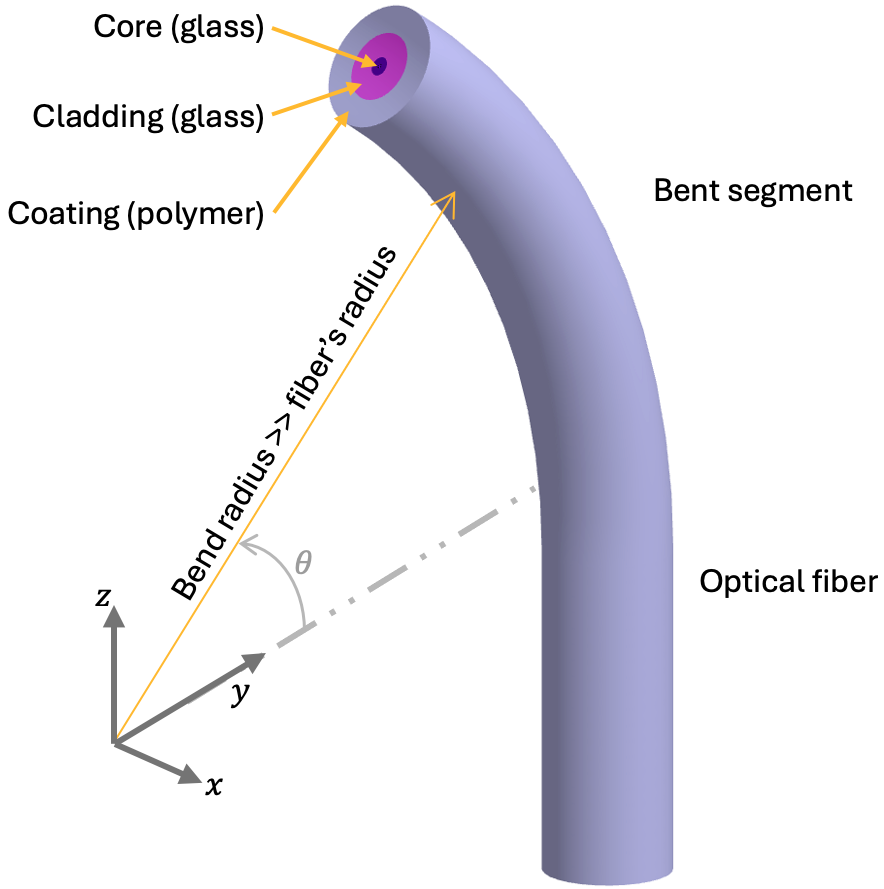
Figure 1: Schematic of a straight fiber spliced to a bent fiber segment, illustrating the transition from a perfectly guiding regime to a geometry supporting confinement loss due to curvature.
The physical fiber consists of a high-index glass core, lower-index glass cladding, and an outer polymer coating, with their characteristic dimensions and refractive index step structure illustrated in (Figure 2).
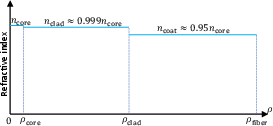
Figure 2: Cross-sectional step-index fiber structure with core, cladding, and coating regions and the associated refractive index profile.
Maxwell's equations are cast in a time-harmonic, full-vectorial form with complex-valued, spatially varying permittivity and permeability. Crucially, the field ansatz employs a full-envelope shift in the θ angular coordinate—E(x,r,θ)=e−ikr0θE(x,r,θ)—where the envelope model reduces oscillatory behavior for improved numerical tractability in long-domain simulations. This ansatz leads to modified curl and material tensors that naturally encode the geometric effects of curvature.
To handle the unbounded nature of physical domains (where radiative modes escape radially and longitudinally), specialized perfectly matched layers (PMLs) are developed for both the longitudinal (θ) and transverse (radial r and ρ) coordinates. The envelope Maxwell system is then formulated as an ultraweak variational problem and discretized using the DPG finite element method. The DPG approach equips the scheme with robust residual-based adaptivity and a posteriori error control, essential given the multiscale nature of bent fiber physics.
The ultraweak variational formulation places the domain in [L2(Ω;C3)]2 (pairs of electric and magnetic fields), with test functions in a broken [H(curl,T)]2 space. The DPG method introduces interface trace unknowns and employs optimal test functions generated locally, which simultaneously enhance stability and provide sharp residual-based error indicators.
The bulk computation proceeds on exact geometry meshes supporting non-affine, e.g., true toroidal mappings—a crucial feature for avoiding geometric dispersion errors that quickly dominate in high-frequency, strongly curved domains. The implementation utilizes the r00 codebase, featuring static condensation and scalable hybrid parallelism, allowing for the solution of very large 3D fiber problems.
Numerical Experiments: Convergence and Loss Extraction
Three main classes of numerical experiments are presented:
1. Verification via 2D Vacuum and Slab Waveguides
The first set of experiments considers a bent vacuum slab waveguide with perfect electric conducting (PEC) boundaries. The system admits analytic solutions via separation of variables, serving as a stringent benchmark for the DPG discretization. Uniform r01-refinements, coupled with polynomial orders r02, r03, and r04, yield DPG residuals and field errors converging at the theoretically expected rates, confirming the soundness of the formulation.
2. Confinement Loss in Open Step-Index Slab Waveguides
The second set addresses step-index slab waveguides with a radiation boundary condition implemented via a PML in the radial direction (see Figure 3).
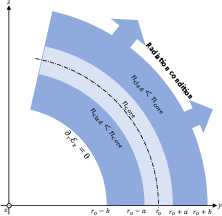
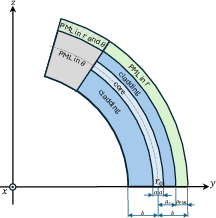
Figure 3: Domain setup for open bent slab waveguide with marked regions for core, cladding, coating, and corresponding PMLs in radial and longitudinal directions.
Transverse electric (TE) modes are imposed as input conditions, and the simulations assess the attenuation of guided power due to curvature-induced loss. The convergence of the DPG residual is shown for several modes and bend radii. Loss exponents (twice the imaginary part of the propagation constant extracted from the integrated Poynting vector flux) computed numerically are found to match semi-analytic results from high-precision Bessel equation solvers to high accuracy:
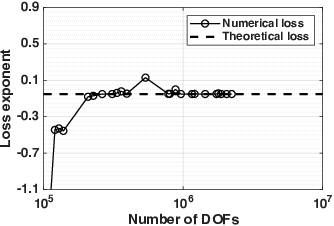
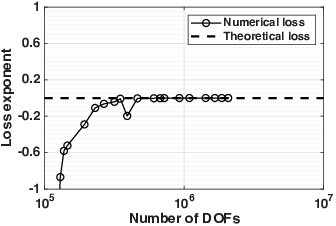
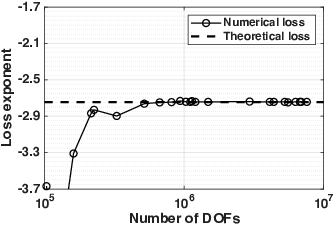
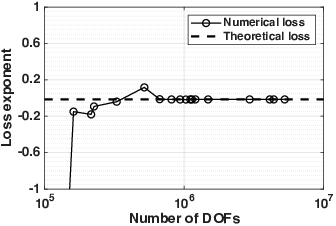
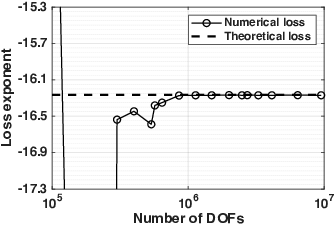
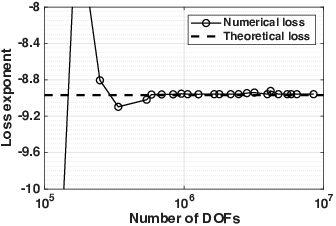
Figure 4: Comparison between numerically extracted (via power decay) and theoretical loss exponents for the first even mode with r05, demonstrating nearly exact correspondence.
The agreement holds for a range of modes and bend radii, except at extremely low-loss regimes where numerical estimation approaches machine precision.
3. Full 3D Bent Fiber Simulations
The final, most computationally demanding experiment simulates LPr06 mode propagation in a realistic bent step-index fiber. The 3D geometry allows for a PML in both r07 and r08, and utilizes full mesh adaptivity to resolve the detailed escape of the field from the core into the cladding and coating regions.
The field distributions and mesh refinement patterns are visualized in (Figure 5) and (Figure 6):
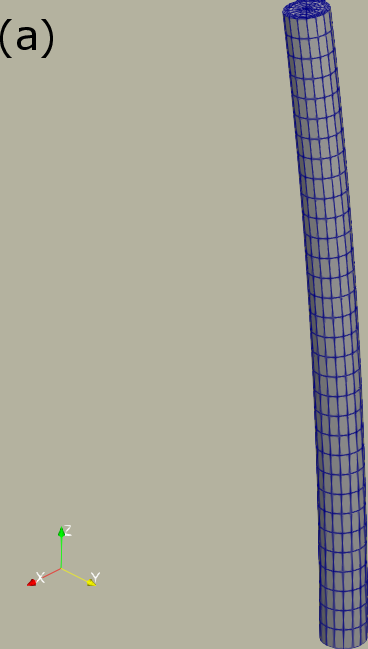
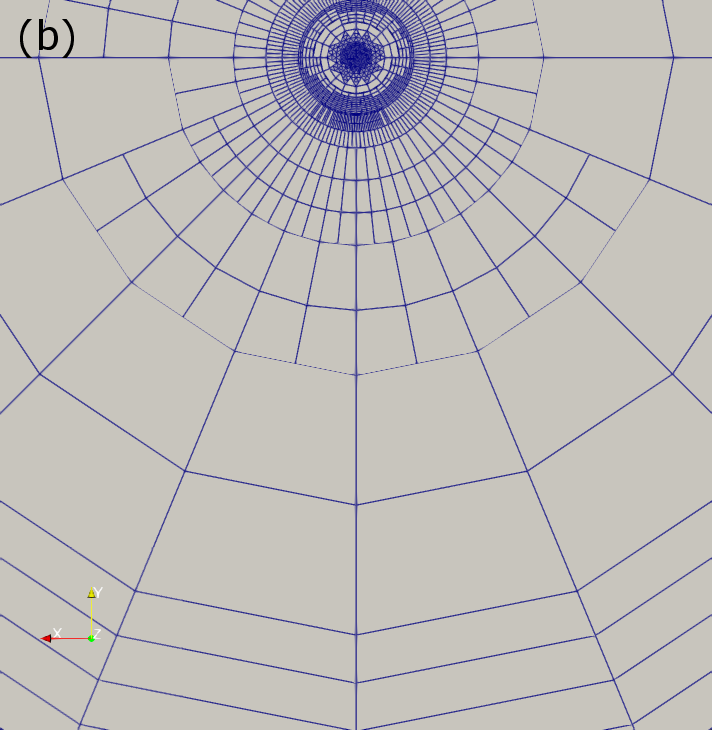
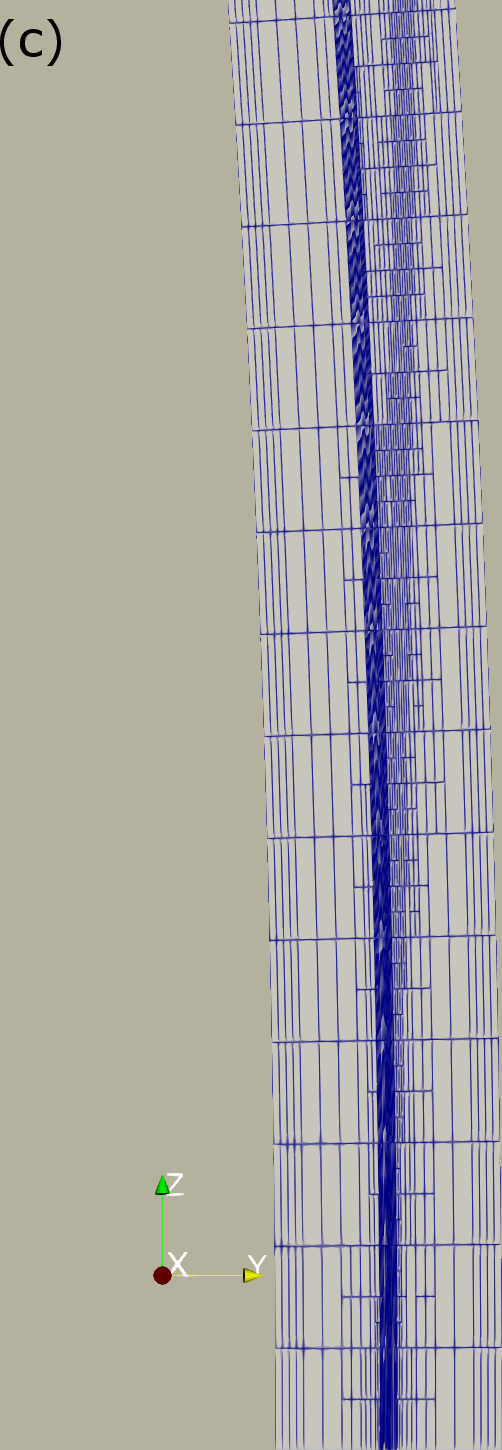
Figure 5: Visualization of the final adapted mesh including 3D domain view, transverse input cross-section, and longitudinal slice, demonstrating anisotropic, physics-aware refinement in critical regions.
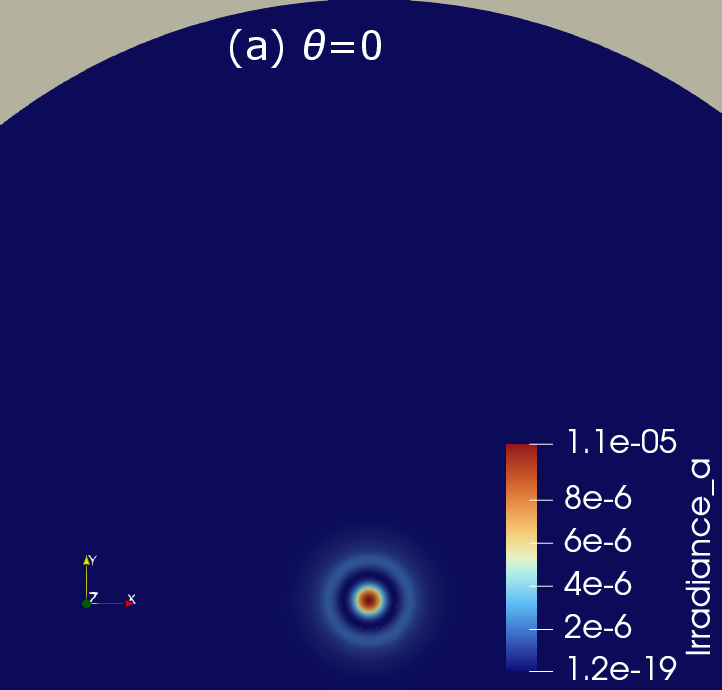
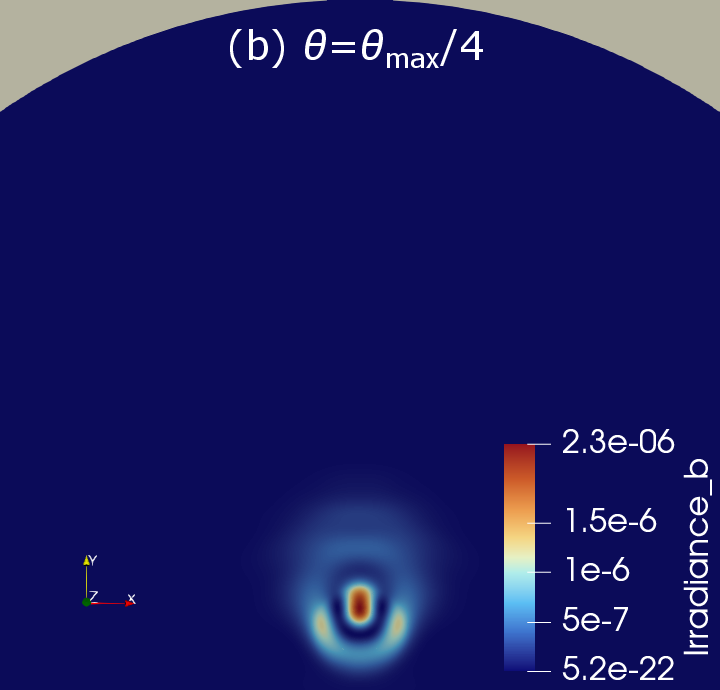
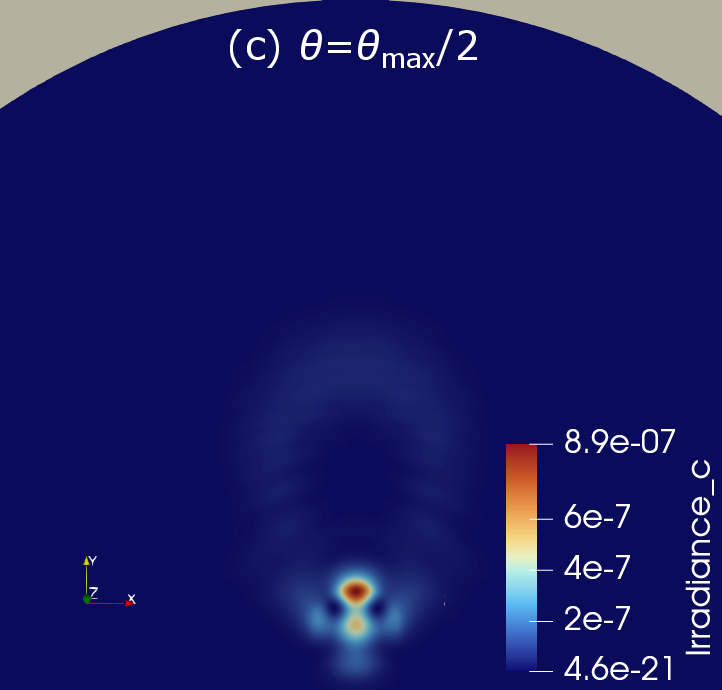
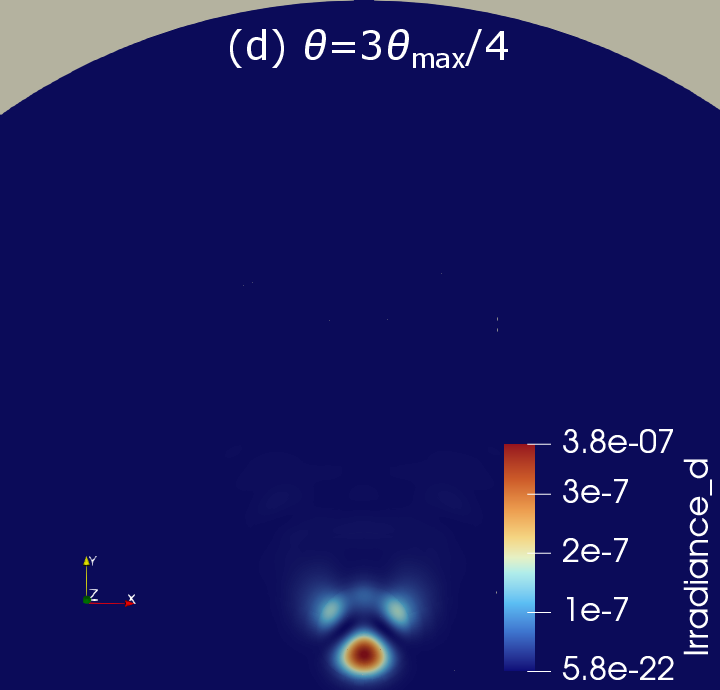
Figure 6: Irradiance profile at multiple cross sections along the fiber, capturing the progressive leakage of optical power as the mode traverses the bent region.
The loss of guided power is plotted as a function of arc length for two bend radii, showing significant differential confinement loss magnitudes (Figure 7):
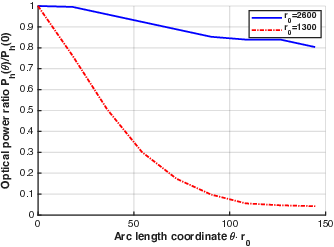
Figure 7: Decay of optical power for input LPr09 mode in 3D bent fiber, with rapid attenuation for tighter bend radii compared to more gentle bending.
Implications and Future Directions
This work demonstrates, via direct simulation, that DPG-based ultraweak formulations provide a tractable and robust tool for quantifying geometric confinement loss in complex fiber systems without modal or paraxial approximations. The ability to accurately and efficiently extract the radiative loss exponents directly from 3D simulations is essential for future advances in fiber laser design, mode-filtering via coiling, and high-power amplifier TMI modeling. The methodology can accommodate further extensions, including incorporation of elasto-optic perturbations (strain-induced refractive index anisotropy) and full nonlinear gain and thermal coupling.
On the computational side, significant scalability and efficiency challenges remain as one approaches kilometer-scale fibers or nonlinear multi-physics couplings. On the theoretical front, a rigorous stability analysis for PML-truncated, curved fiber domains is highlighted as ongoing work.
Conclusion
The study establishes the viability and accuracy of full-envelope finite element Maxwell solvers for 3D bent optical fibers, including robust PML-treated open boundaries and adaptivity via DPG residuals. The direct computation of bend-induced mode loss in complex domains signals a significant methodological advance for high-power fiber device simulation and paves the way for addressing more complicated physics (such as TMI onset, strain-optic effects, and nonlinear gain), which are of profound technological interest in photonics and laser engineering.