- The paper introduces TRACED, a Delta-based ELCC methodology that integrates network flows, climate trends, and stochastic events to accurately quantify effective load carrying capability.
- The paper employs a rolling horizon unit commitment approach combined with dynamic weather/load models to capture spatiotemporal variability in renewable energy systems.
- The paper demonstrates that strategic transmission upgrades and portfolio-consistent allocation avoid double-counting benefits, ensuring reliable capacity market operations.
Advanced Capacity Accreditation under Deep Uncertainties: The TRACED Method
Introduction
The proliferation of renewable energy sources (RES), especially wind and photovoltaics (PV), introduces significant challenges for power system reliability and capacity planning due to their inherent variability and correlation structures. As RES penetration increases, accurately quantifying their effective load carrying capability (ELCC) becomes paramount, particularly for reliability compliance and capacity market operations. Conventional marginal ELCC methods exhibit substantial drawbacks, such as underestimation of resources' contributions due to failure to capture complementarities and locational effects, while neglecting key factors like transmission constraints and evolving climate trends. "Advanced Capacity Accreditation of Future Energy System Resources with Deep Uncertainties" (2604.00173) proposes TRACED (TRansmission And Climate Enhanced Delta), a portfolio-consistent Delta-based ELCC methodology that directly internalizes spatiotemporal uncertainties, network constraints, and climate evolution.
Methodological Innovations
TRACED fundamentally extends the Delta ELCC approach by integrating both network-constrained optimal power flow and dynamically adjusted weather/load models. The method computes the ELCC via a set of transmission-constrained unit commitment (UC) models, preserving operational realism, where the following are key technical innovations:
- Transmission-Aware ELCC: Network flow limits and ambient-adjusted ratings (AAR) are explicitly internalized, with DC power flow and temperature-dependent branch deratings, moving beyond previous two-node approximations or regionally averaged methods.
- Temporal Evolution via Weather/Socio-Technical Trend Modeling: Historical weather and demand traces are stochastically sampled and adjusted with empirically regressed climate trends. Specifically, monthly temperature change rates (βτ,m) drive corrections to nodal demands, line ratings, and generator derates in the UC problem to reflect anticipated future operating conditions.
- Stochastic Extreme Event Integration: Hurricane and storm impacts are driven by regressed frequency/duration models, incorporated probabilistically into wind generator forced outages, and further used in scenario Monte Carlo sampling.
- Delta-ELCC Portfolio Consistency: The Delta method is used for apportioning portfolio interactive effects (PIE), calculated as the difference between the system ELCC and the sum of last-in (LI) marginal ELCCs across the generator set. This avoids double-counting complementary effects and preserves additivity across the resource portfolio.
- Computationally Efficient Rolling Horizon UC: To manage the scale of the unit commitment search under real-world system sizes, a rolling horizon approach is implemented (weekly solve with daily overlap), preserving cost-optimality and chronological limitations.
The resulting TRACED workflow establishes bounds on additional load (LA) for target LOLE levels for each system state (portfolio, FI, LI), and computes CCs for each generator via proportional allocation from first-in (FI), LI, and the calculated PIE.
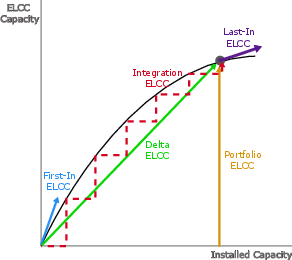
Figure 1: Marginal, Delta, and Integration ELCC approaches for capacity allocation.
Data-Driven Spatiotemporal System Modeling
The methodology is validated on a modified IEEE 118-bus system, with high penetrations of wind, PV, and battery energy storage systems (BESS). Key physical inputs include:
- Nodal loads, derived from New Jersey's historical demand patterns and regressed against weather.
- Ambient temperature, irradiance, and wind-speed profiles: sampled from historical databases (Open-Meteo, NREL Wind Database, NOAA).
- Transmission line ambient deratings and distinct generator forced outage rates as polynomial functions of temperature.
Weather-driven uncertainty is projected for multiple future years, with Monte Carlo sampling over overlapping weather/load profiles to obtain robust system-level adequacy results.
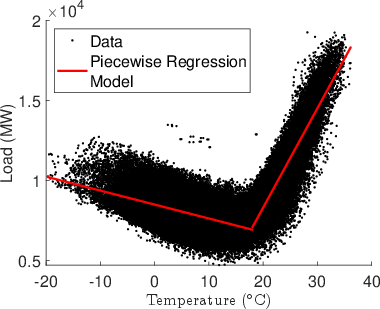
Figure 2: Piecewise regression model for system load versus temperature, illustrating non-linearities relevant for future climate adaptation.
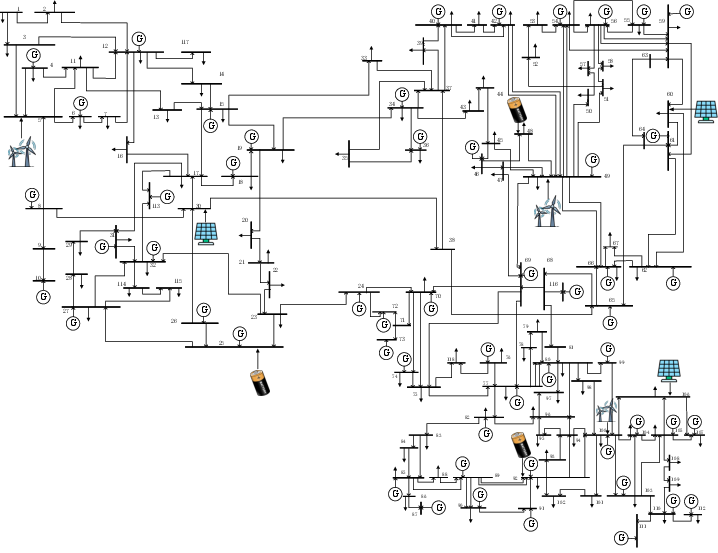
Figure 3: Modified IEEE 118-bus system with placements of thermal, wind, PV, and BESS assets.
Results: Comparative Assessment and Sensitivities
TRACED's impact is analyzed by resource class, season, and system configuration.
Wind and Solar Generators
Decisive locational and temporal differences are observed in generator CCs:
- Wind (Case 1): Offshore wind at high wind periods (December) achieves a portfolio CC up to 995 MW (26.9% of nameplate), but inland wind CCs are heavily constrained by network congestion in summer (June), reducing system reliability margin. TRACED yields up to 26.1% higher accredited capacity over marginal LI ELCC in high wind seasons, but can yield lower credits (up to -11.4%) when complementary effects and congestion predominate.
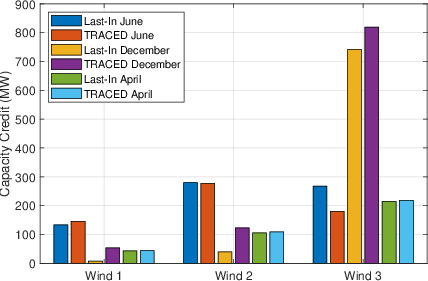
Figure 4: Capacity credits (CCs) of wind generators across months, illustrating seasonality and transmission impacts.
- Solar (Case 2): Solar CCs are non-monotonic with respect to resource availability. In June (high irradiance), total solar CC is 657 MW (17.8%), but individual plant CCs diverge due to congestion (e.g., Solar 3). TRACED mitigates over-crediting, revising CCs down where LI ELCC otherwise double-counts system relief due to locationally coupled production.
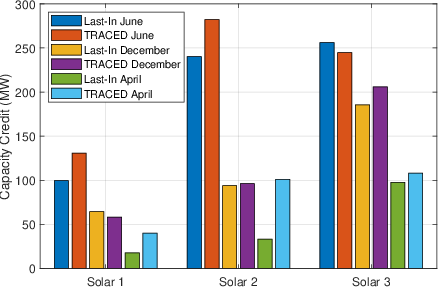
Figure 5: CCs for solar generators, revealing major transmission and seasonal effects.
- Hybridization Effects (Case 4): The addition of BESS produces strong positive externalities for solar CCs in winter and shoulder months (up to +75%), but this complementarity is attenuated under high load/congestion regimes (June), where BESS efficacy is stifled by network limitations.
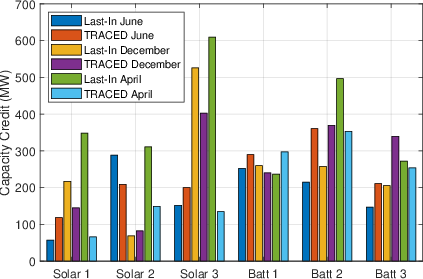
Figure 6: Seasonal CC variations and solar-BESS complementarity; high BESS lifting in December, suppressed by transmission in June.
Portfolio Interaction and Double-Counting Avoidance
TRACED systematically avoids double-counting reliability benefits among complementary resources, a notable failure mode of the marginal LI approach, especially when hybridized portfolios (e.g., solar + BESS) are present. In Case 4 (April), marginal LI ELCC over-accredits solar by 72.5% versus TRACED due to misattributed interactive value, with TRACED ensuring additivity by distributing PIE proportional to the generator's interactive effect (IIE).
Transmission Constraint and Upgrade Sensitivities
Targeted transmission upgrades were found to disproportionately affect individual generator CCs, but the overall portfolio gain depends nonlinearly on the location and the underlying resource profiles:
- Generator-Centric Upgrades: Upgrading branches connected to congestion-constrained RES can result in limited or even negative CC changes due to complex system-wide flow rerouting—e.g., Solar 3 upgrades reduce its own CC while boosting BESS 3 response.
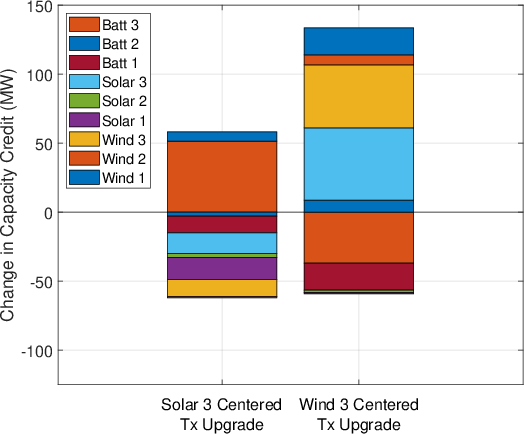
Figure 7: Effects of generator-centered transmission upgrades on portfolio CCs; CC improvements are not necessarily aligned with the upgraded generator.
- System-Centric Upgrades: Strategic system-wide upgrades yield higher return-on-capacity (ROC) for reliability, but returns are highly diminishing as upgrade size increases (e.g., 7.1% ROC for 825 MW, only 1.1% ROC for wholesale reinforcement).
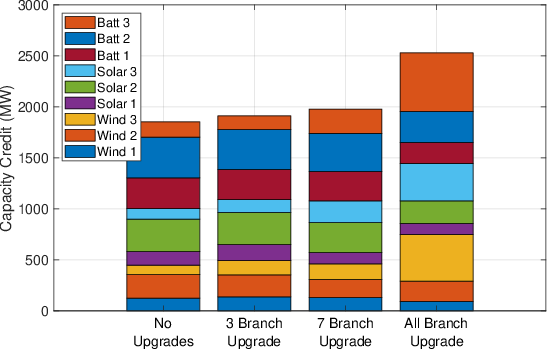
Figure 8: Portfolio CC benefits versus incremental transmission upgrade—optimal targeting is critical for cost-effective resource adequacy.
Climate Trend Sensitivities
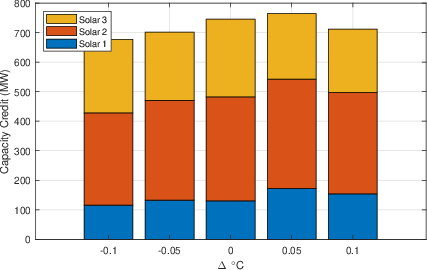
Simulation of temperature trends (βτ) demonstrates non-monotonic impacts:
Implications and Future Research Directions
The TRACED framework operationalizes portfolio-consistent, scenario-robust capacity accreditation under deep operational uncertainties. Key implications for theory and practice include:
- Avoidance of Reliability Under-Provisioning: TRACED prevents under-procurement risk in capacity markets that arises from marginal LI double-counting failure modes, which is critical for system operators transitioning to high-RES portfolios.
- Necessity of Spatiotemporal Fidelity: Both locational (network topology, congestion) and temporal (seasonal/climate evolution, extreme events) factors produce large, non-trivial redistributions in accredited capacity, requiring their integration in ELCC calculations.
- Optimized Infrastructure Investment: Results highlight that indiscriminate transmission investment yields low additional reliability; sophisticated targeting with TRACED-based analysis can maximize reliability return per unit investment.
- Scalability and Future Operationalization: The computational burden of TRACED—due to multiple UC/LOLE solves—remains a barrier for real-time or extremely large-scale systems. Inference-efficient extensions, transfer learning across stable year pairs, and integration of advanced weather generators or ML-based uncertainty models are promising research directions.
Conclusion
TRACED demonstrates clear superiority over conventional marginal ELCC in assigning fair, portfolio-consistent, and reliability-constrained capacity credits for diverse, uncertain resource portfolios. Through explicit modeling of transmission, weather evolution, and resource complementarity, TRACED avoids under-procurement, misallocation, and economic inefficiency. These advances are essential as decarbonized grids navigate deepening uncertainty and increasingly non-linear reliability drivers. Continued work in computational efficiency, advanced climate/weather scenario generation, and empirical market application remains critical for widespread industry adoption.