- The paper introduces a spectral framework using the no-jump superoperator ℒ0 to extract a unique eigenvalue that governs anomalous waiting-time distributions in a monitored quantum half-chain.
- It combines analytical derivations and numerical diagonalization to demonstrate that the anomalous tail scaling is influenced by measurement strength and system size, contrasting with Poissonian whole-system statistics.
- The findings show that postselection-free measurements provide universal signatures of many-body effects, offering a robust diagnostic tool for experimental quantum dynamics.
Spectral Diagnostics of Anomalous Waiting-Time Distributions in Monitored Quantum Many-Body Dynamics
Overview of Problem and Motivation
The paper "Anomalous waiting-time distributions in postselection-free quantum many-body dynamics under continuous monitoring" (2604.00358) addresses a fundamental question in quantum statistical mechanics: how many-body effects manifest in the statistics of quantum jumps, particularly through waiting-time distributions (WTDs), in systems where measurements drive the evolution towards a trivial infinite-temperature state. Traditional approaches to measurement-induced dynamics often rely on postselection, limiting experimental accessibility. Here, the authors circumvent postselection by exploiting the full spacetime record of quantum jumps, which is directly measurable in modern quantum simulators. The focus is on subsystems, notably the half-chain, and the spectral analysis of the associated superoperator L0 governing no-jump evolution within that subsystem.
The investigation centers on a chain of hard-core bosons (equivalently spin-1/2 particles via the Jordan-Wigner transformation) under a Heisenberg Hamiltonian with periodic boundary conditions. Continuous monitoring of local particle number is implemented via a stochastic Schrödinger equation, unraveled from the Lindblad master equation. Measurement strength γ parametrizes the interplay between coherent dynamics and dissipation. The system's unconditional steady state is maximally mixed—an infinite-temperature state—regardless of γ, for particle-number measurements.
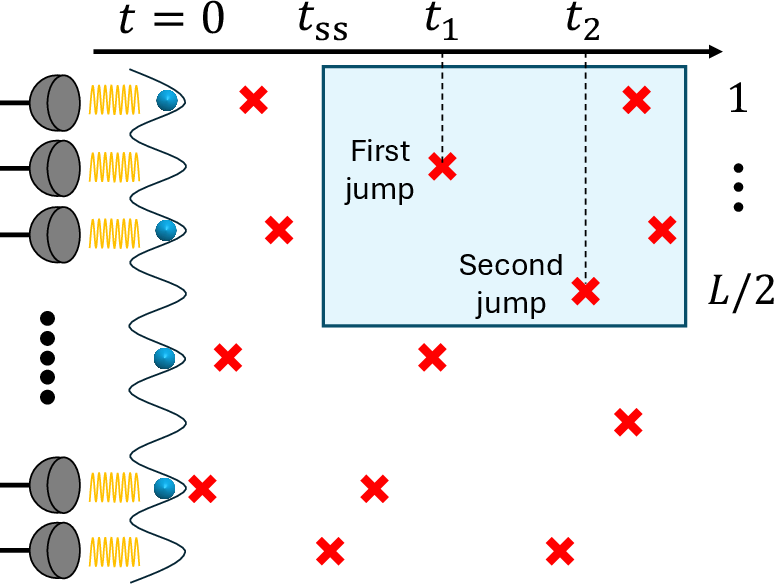
Figure 1: Schematic of the monitoring setup, focusing on waiting times τ=t2−t1 between jumps in a half-chain subsystem in steady-state trajectories.
The WTD is defined as the distribution of time intervals τ between consecutive quantum jumps localized to a monitored subsystem M, accessible directly from the quantum jump spacetime record {ti,xi} without postselection.
The key advance is the introduction of the superoperator L0, constructed by excluding jump terms in the subsystem M from the full Liouvillian L. This operator governs no-jump evolution in γ0 and its spectral properties dictate the asymptotics of WTDs for γ1. Unlike γ2, which has a zero eigenvalue corresponding to the steady state, γ3 possesses a unique eigenvalue γ4 with maximal real part (strictly negative), controlling the exponential tail of the WTD. The spectral decomposition is explored rigorously, establishing the biorthogonality, completeness, and positivity of the map generated by γ5.
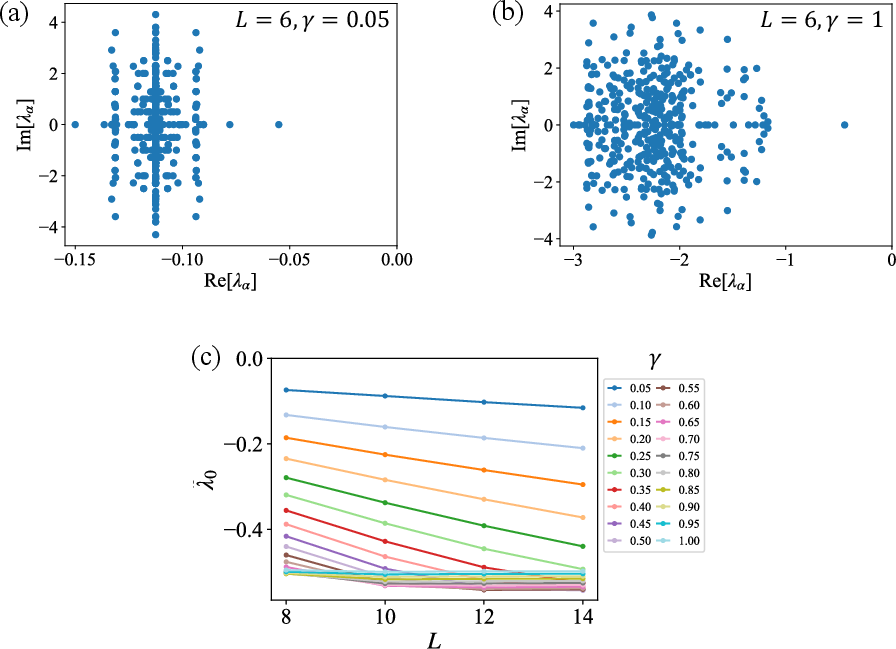
Figure 2: Eigenspectrum of γ6 for the Heisenberg model; γ7 exhibits marked dependence on measurement strength and system size.
Numerical diagonalization demonstrates that all eigenvalues of γ8 are negative, signifying no steady state within the restricted no-jump dynamics. Importantly, system-size scaling of γ9 bifurcates by measurement strength: for weak γ0, γ1, while for strong γ2, γ3 is independent of γ4, establishing that anomalous WTDs persist even in the thermodynamic limit.
Analytical and Numerical Results: WTDs for Whole System vs Subsystem
For the whole system, the WTD can be solved analytically and is strictly Poissonian with a decay rate proportional to system size. By contrast, the half-chain WTD is non-Poissonian, featuring an anomalous tail whose exponential slope is set by γ5 rather than the Poissonian rate.
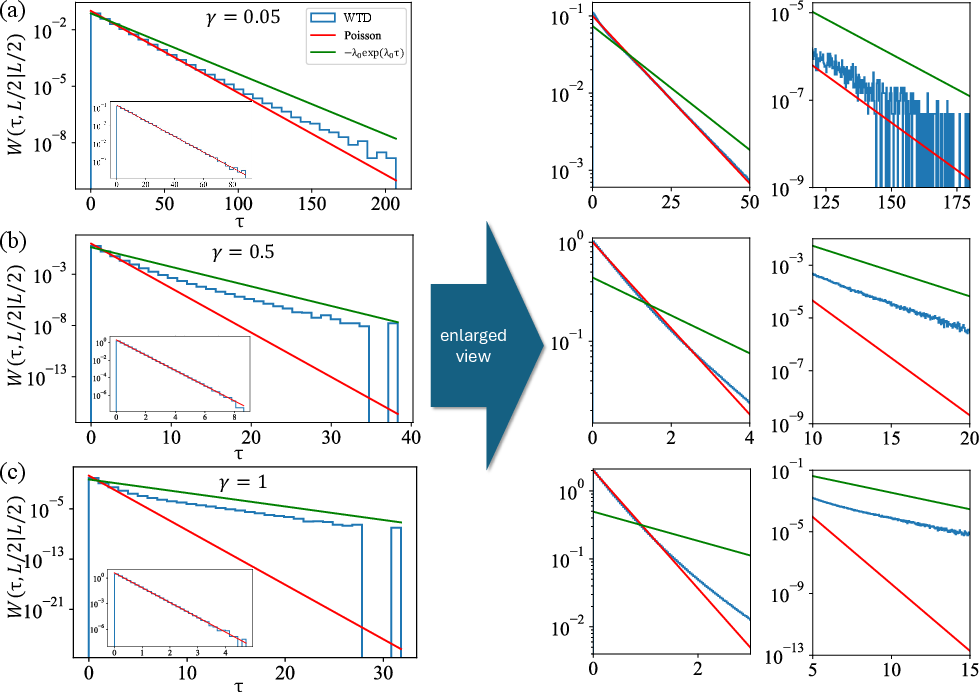
Figure 3: WTDs for γ6; blue histograms (half-chain) show anomalous slow tails, green lines (γ7) precisely capture their slope, and red lines (Poisson) describe the whole system, matching numerical data.
For short waiting times, subsystem WTDs approximate Poissonian behavior, but at long times cross over to the slower decay governed by γ8. Numerically, this crossover becomes more pronounced as measurement strength increases. Enlarged views reveal that strong measurement strengths extend the interval dominated by the anomalous tail, reinforcing theoretical predictions.
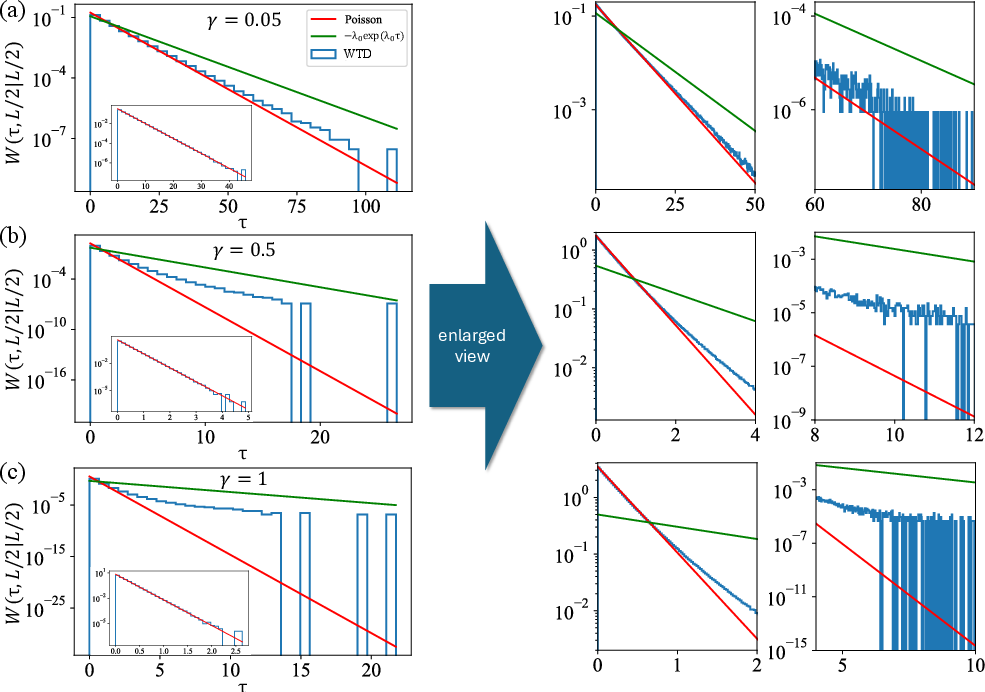
Figure 4: Anomalous tails in half-chain WTDs for γ9 persist in larger systems, with behavior concordant with spectral predictions for τ=t2−t10.
Implications and Theoretical Significance
The primary implication is the identification of subsystem WTDs as direct, postselection-free probes of many-body effects in monitored quantum systems. The spectral approach provides a robust diagnostic tool for distinguishing trivial and nontrivial quantum measurement-induced phenomena—even when global observables appear trivial (infinite-temperature or Poisson statistics). The persistence of anomalous tails with strong measurement in the thermodynamic limit suggests the existence of universal measurement-induced features in subsystems, warranting further investigation. The accessibility of WTDs via quantum gas microscopy and probe-light techniques makes these results relevant for current quantum simulation platforms.
Future Directions
The paper opens several routes for both theoretical and experimental exploration. The role of subleading eigenvalues τ=t2−t11 in shaping intermediate-time WTD behavior remains to be elucidated, including possible crossover or correction structures. Exceptional points—where eigenvalues and eigenvectors coalesce in dissipative many-body spectra—could induce nontrivial dynamical matrix effects, potentially observable in WTDs. Extension to broader classes of interacting models and measurement schemes may reveal universal features, enriching the taxonomy of quantum statistical effects in monitored many-body systems.
Conclusion
This study establishes a spectral framework for understanding anomalous waiting-time statistics in subsystems of continuously monitored quantum many-body dynamics, advancing both theoretical and experimental quantification of measurement-induced effects. The analysis of the superoperator τ=t2−t12 and its dominant eigenvalue τ=t2−t13 provides precise predictions for the anomalous tails observed in subsystem WTDs, which remain robust in large systems and strong measurement regimes. These findings enhance the toolbox for diagnosing many-body quantum dynamics using experimentally accessible, postselection-free statistics.