- The paper quantifies the welfare loss when agents rely on uniform algorithmic advice, establishing a Price of Anarchy bound of 2 in matching markets.
- It introduces stochastic consistency in ranking technologies, ensuring that higher-quality candidates are more likely to be correctly ranked even under externalities.
- The analysis extends to correlated equilibria and no-regret learning, offering practical insights for policy design in algorithm-driven hiring and resource allocation.
Price of Anarchy of Algorithmic Monoculture: A Technical Perspective
Introduction and Problem Setting
The paper "Price of Anarchy of Algorithmic Monoculture" (2604.00444) addresses the welfare implications of algorithmic monoculture in one-sided matching markets where agents make decisions based on advice from shared algorithmic sources as opposed to diverse, potentially less accurate private information. The central theme involves quantifying the inefficiency—via the Price of Anarchy (PoA)—that emerges when self-interested agents collectively adopt a common high-accuracy algorithmic signal, as opposed to maintaining heterogeneity in advice sources. This is motivated by scenarios such as algorithmic hiring, where multiple firms compete to hire from a candidate pool, guided by rankings produced by either a shared algorithm or independent human advisors.
The model extends the foundational work of Kleinberg and Raghavan, who showed that although it may be individually rational for each firm to follow a more accurate algorithmic ranking, the collective effect of monoculture might degrade aggregate welfare, contradicting the individually optimal strategy. However, Kleinberg and Raghavan did not provide explicit welfare loss bounds. This paper resolves that open question by providing a quantitative characterization of such inefficiency under generalized and technically robust modeling assumptions.
Agents (firms) participate in a Random Serial Dictatorship (RSD) mechanism, each seeking to optimally select one item (candidate) from a pool based on sampled rankings from available advice sources. The key innovation lies in the modeling of advice: firms have access to ranking technologies, which are distributions over rankings parameterized by their accuracy, including both public (algorithmic) and private (human) options.
A fundamental technical property introduced is stochastic consistency for ranking technologies. This property—naturally satisfied by broad classes such as Mallow's model with Kendall-Tau, Spearman distances, and any additive i.i.d. log-concave noise rankings (Gaussian, Laplacian, etc.)—guarantees that higher-valued candidates are more likely to be ranked correctly, even conditional on arbitrary externalities. The equilibrium analysis focuses on both Obedience-Constrained and Unconstrained RSD, with incentive compatibility hinging on candidate distributions that are permutation-invariant.
Main Results: Price of Anarchy Bound
The central contribution is the establishment of a tight, constant upper bound of 2 on the Price of Anarchy for the relaxation of monoculture in this class of games, under the assumption of stochastic consistency for the advice space. This holds across arbitrary numbers of agents and advice sources, and is robust to generalizations, including correlated and mixed equilibria.
The core proof strategy involves partitioning the welfare in an optimal strategy profile into two components—candidates "snatched" in the equilibrium and those still available for unilateral deviations—and leveraging the equilibrium condition along with stochastic consistency to construct a tight welfare bound.
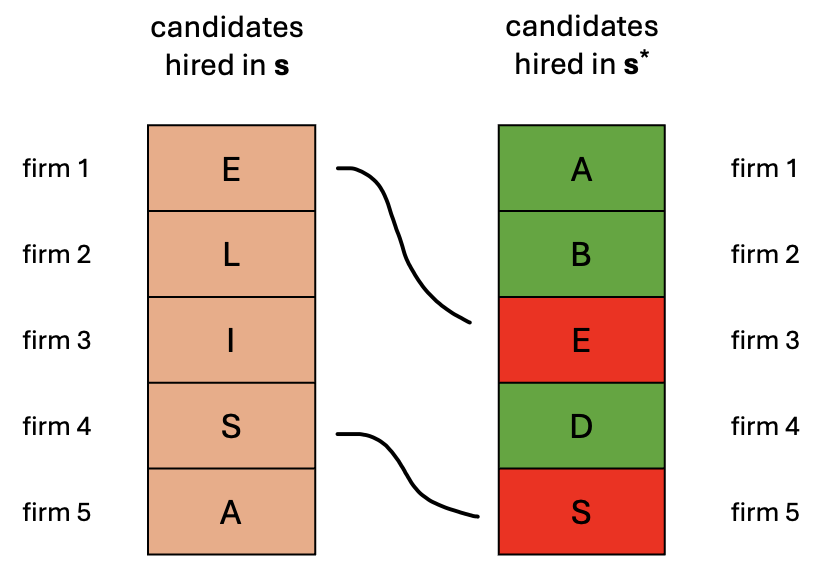
Figure 1: Illustrative instance showing candidates "snatched" under equilibrium, coloring **red
* for those no longer available and
green for those remaining under a deviation.*
The paper demonstrates formally that if at least half the optimal welfare is due to candidates "snatched" in the equilibrium, the PoA is at most 2. Otherwise, agents can guarantee at least half the optimal welfare through appropriate deviations, maintaining the bound. The analysis also shows the result extends smoothly to correlated equilibria and no-regret learning processes due to the smoothness of the game induced by stochastic consistency.
Generality and Robustness of Assumptions
A significant strength of the work is the breadth of ranking technologies covered by the stochastic consistency framework. Mallow's model with inversion-increasing distances, additive noise rankings with log-concave distributive components, and various Schur-concave settings are all shown to satisfy the required property. Notably, this encompasses nearly all ranking models in practical and theoretical use for stochastic choice and social decision-making problems.
The analysis also addresses practical strategic considerations. In realistic environments where candidate quality distributions are permutation-invariant, it is shown that trusting the (sampled) ranking is incentive compatible even when agents can choose arbitrarily at selection time, simplifying strategic reasoning for participants.
Lower Bounds and Limits of Stochastic Consistency
The PoA bound of 2 is shown to be asymptotically tight. The paper constructs explicit instances where the equilibrium welfare approaches half of optimum as the market size grows, establishing that no further improvement is generally possible within the considered class.
Furthermore, the necessity of stochastic consistency is underscored: in pathological cases where ranking technologies are arbitrarily inconsistent, the PoA can scale linearly in the agent count, and dominant strategies may lead to welfare vastly inferior to the optimum. Thus, the constant bound crucially depends on the technical behavior of the underlying ranking mechanisms.
Relaxation: Quantifying the Impact of Inconsistency
Recognizing that real-world algorithmic advice and human decision-making may exhibit systemic biases or violations of ideal statistical consistency, the framework introduces a relaxation parameter δ to quantify the degree of stochastic inconsistency. The resulting PoA degrades gracefully as a function of δ, satisfying the bound:
PoA≤1+(1−δ)21
This analytic extension provides a direct method to assess welfare loss in systems where algorithmic or social bias is measurable but not overwhelming.
Implications and Future Directions
Practically, the results provide reassurance that, under mild and broadly satisfied technical conditions on information sources, algorithmic monoculture or other forms of decentralized selfish behavior induce at most a constant-factor welfare loss in matching markets. This guides policy and mechanism design in environments susceptible to convergence on shared algorithmic recommendations, such as online hiring or resource allocation platforms.
Theoretically, the work prompts further investigation into the impacts of monoculture in richer market models, such as two-sided matching or more complex signaling structures. The results suggest that smoothness-type arguments, leveraging natural probabilistic regularity in information, may yield tractable welfare bounds even outside the specific one-sided matching context.
Conclusion
This paper resolves a prominent open question on the cost of algorithmic monoculture within the equilibrium landscape of matching markets, rigorously characterizing both the robustness and the limits of collective welfare efficiency in the presence of widespread adoption of algorithmic advice. By grounding the analysis in a broad technical framework amenable to real-world ranking technologies and admitting controlled relaxations for stochastic inconsistency, the work delivers both theoretical sharpness and substantive practical insight for algorithmically mediated social systems.