- The paper constructs a general method to build convex cocompact hyperbolic reflection groups with prescribed three-dimensional limit sets using explicit combinatorial subdivisions.
- The construction employs right-angled Coxeter groups, Lorentzian forms, and arithmetic lattices to realize boundaries with exotic topological types including non-standard Čech cohomology spheres.
- The approach resolves Kapovich's query and broadens the catalog of limit sets, offering new examples with controlled geometric finiteness and thinness.
Convex Cocompact Hyperbolic Reflection Groups with Three-Dimensional Limit Sets
Introduction
The paper "Convex cocompact groups with three-dimensional limit sets" (2604.00466) develops a general, explicit construction of convex cocompact right-angled reflection groups in real hyperbolic spaces, with a focus on those whose limit sets are three-dimensional compacta with interesting topological properties. The results establish that for any simplicial complex L (with dimension at most 3 and n vertices), there exists a reflection group acting on Hn, whose nerve is a specific flag-no-square subdivision of L. Consequently, the limit set of this reflection group has the topological type prescribed by L and its subdivision. This work settles a question communicated by Kapovich regarding the realization of Cˇech cohomology spheres, distinct from standard spheres, as limit sets of convex cocompact hyperbolic groups.
Context and Motivation
The Gromov boundary of a hyperbolic group encapsulates much of the group's asymptotic geometry and is a compact metrizable space. While boundaries of dimension one are understood (resulting in Menger curves, Sierpiński carpets, and circles), higher-dimensional cases are less accessible. The problem is particularly striking in relation to discrete subgroups of Isom(Hn), where the topological characterization of possible limit sets for convex cocompact groups is largely unresolved for dimension greater than one. Known examples include spheres and a handful of Menger, Sierpiński, and Pontryagin compacta but little else.
Limit sets are objects of both geometric and dynamical interest, encoding critical aspects of group action and parameterizing visual boundaries in CAT(0) or negatively curved settings. Kapovich posed the natural question of whether there exist convex cocompact subgroups of hyperbolic isometry groups whose limit sets are cohomology spheres not homeomorphic to standard spheres. This paper answers this positively with a very general and transparent construction.
Combinatorial Foundations: Subdivisions and Nerves
A central ingredient is the Przytycki--Świątkowski subdivision, which transforms an arbitrary d-dimensional simplicial complex L (with d≤3) into a flag-no-square complex n0—the required combinatorial property for the nerve of a Gromov-hyperbolic right-angled Coxeter group (RACG). For n1, this is Dranishnikov’s subdivision, illustrated below.
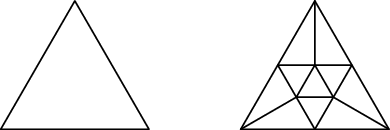
Figure 1: Dranishnikov's subdivision procedure for 2-dimensional simplicial complexes.
The subdivision proceeds by a deterministic, local replacement of simplices, using the combinatorics of the icosahedron and the 600-cell for dimensions 2 and 3, respectively. This preserves the topological type but ensures the absence of induced squares (every square has a diagonal), a necessary condition for Gromov hyperbolicity of the associated RACG. The process generalizes standard "hyperbolization" by generating cubical complexes whose links are the input complex and thus controls the boundary behavior of the resulting group.
Construction of Reflection Groups
Given a simplicial complex n2 of dimension at most 3 with n3 vertices, the authors construct a right-angled reflection group n4 whose nerves correspond to the appropriate subdivision n5. The approach is algebraic and geometric:
- They define an explicit Lorentzian form n6 over n7, with signature n8, to model real hyperbolic space.
- The arithmetic lattice n9 with Hn0 the golden ratio, acts cocompactly on Hn1.
- Using the combinatorics of the high-dimensional regular polytopes (notably, the 600-cell and associated right-angled polytopes), a system of spacelike vectors in Hn2 is constructed, associating vectors canonically to vertices of Hn3.
- The group Hn4 is then constructed as the subgroup generated by reflections in the hyperplanes determined by these vectors.
The Gram matrix analysis verifies that commutator relations correspond to adjacency in the subdivided complex, ensuring that the group’s nerve is precisely Hn5. For any given Hn6, this construction embeds the process into a higher dimension using a master complex, but the authors highlight this dimension is likely non-optimal.
Geometric Finiteness and Thinness
Every finitely generated hyperbolic reflection group is geometrically finite. Since the constructed reflection groups are contained in a cocompact lattice, they are convex cocompact by construction. These groups are shown to be Zariski-dense in the isometry group for dimension Hn7, and, due to their infinite covolume within the lattice, are "thin" in Sarnak's sense.
A key observation is that no reflection group constructed in this manner can be a lattice, i.e., have cofinite volume, unless Hn8 triangulates a genuine sphere—as otherwise the nerve does not correspond to the boundary of a convex polytope in Hn9.
Topological Types of Limit Sets
The topologies realized as limit sets include:
- Trees of manifolds (Jakobsche spaces) L0 for any closed connected manifold L1 admitting an L2-vertex triangulation. For non-orientable L3 these may, for instance, yield (nonorientable) Pontryagin surfaces.
- In particular, by choosing L4 to be homology spheres not homeomorphic to L5 (e.g., the Poincaré homology sphere using a 16-vertex triangulation [BL00]), the limit set is a L6ech cohomology 3-sphere not homeomorphic to L7, answering Kapovich's question.
- For certain mapping cylinder complexes (dunce hats), the limit set is a Pontryagin surface L8 for any prime L9, with explicit vertex bounds for the construction.
- The subdivision mechanism allows, when appropriate, for the extraction of standard quasiconvex subgroups whose boundary is the Menger curve.
Moreover, the construction yields infinitely many pairwise non-homeomorphic L0ech cohomology 3-spheres as limit sets, for example, by varying L1 among the infinite family of Brieskorn homology spheres.
Numerical and Structural Results
The method is effective, yielding concrete examples in arbitrary high dimension with explicit vertex and dimension bounds. For example:
- The Pontryagin surface L2 appears as the limit set of a convex cocompact reflection group in L3.
- The orientable Pontryagin sphere appears for groups in L4.
- There exists a convex cocompact group in L5 whose limit set is a L6ech cohomology 3-sphere, but not homeomorphic to L7.
The construction is robust with respect to the chosen complex and its embedding, only constrained by the combinatorial data of the triangulation/subdivision.
Implications and Outlook
The construction demonstrates that the class of topological spaces realized as limit sets of convex cocompact reflection groups in hyperbolic space is substantially broader than previously observed, encompassing three-dimensional L8ech spheres not homeomorphic to the standard sphere and a host of classical indecomposable compacta. The result engages deeply with the topology of manifolds, group theory, and arithmetic reflection groups.
Theoretically, these findings highlight the flexibility of right-angled reflection groups for constructing Gromov-hyperbolic groups with prescribed low-dimensional boundaries. They clarify fundamental geometric relationships between nerves, combinatorial subdivisions, and group-theoretic properties within arithmetic settings.
Practically, they provide explicit methods for realizing prescribed boundaries in geometric group theory, potentially influencing understanding of boundary phenomena in dynamics, rigidity, and low-dimensional topology.
An open question remains about the minimal dimension in which a given compactum can be realized as the limit set, i.e., whether the construction can be optimized to lower dimensions, or even in settings beyond real hyperbolic spaces (complex, quaternionic, etc.). The methodology may extend to other classes of polytopes and reflection groups or alternative flag-no-square subdivision processes.
Conclusion
This paper offers a definitive solution to Kapovich's question of realizing exotic (non-standard sphere) L9ech cohomology spheres as convex cocompact group boundaries. The construction leverages combinatorial subdivision, explicit algebraic reflection group generation, and arithmetic lattice embeddings to systematically build right-angled hyperbolic reflection groups in prescribed dimensions with three-dimensional limit sets of almost any desired topological type. The work significantly expands the catalog of known geometrically finite hyperbolic groups with prescribed boundary behavior and opens new avenues for both constructive and structural investigations in higher-dimensional geometric group theory.

