- The paper demonstrates that the BKT transition temperature (T_BKT) varies with the in-plane current direction at the EuO/KTaO₃ (111) interface.
- Comprehensive transport measurements and Halperin-Nelson analysis confirm anisotropic superconducting behavior, with higher T_BKT along the [11̄2] axis.
- The study suggests that ferromagnetism, strong Rashba SOC, and multiorbital physics induce a spontaneous nematic stripe phase that breaks rotational symmetry.
Directional-Dependent BKT Transition at the EuO/KTaO3(111) Interface
Introduction and Context
This work systematically investigates the emergence of a directional-dependent Berezinskii-Kosterlitz-Thouless (BKT) transition in superconductivity at the ferromagnetic EuO/KTaO3(111) interface. In two-dimensional superconducting systems, phase coherence is established via the BKT mechanism, characterized by the dissociation of bound vortex-antivortex pairs, with TBKT set by the global superfluid stiffness. The present study reveals that for the EuO/KTaO3(111) interface, TBKT not only departs from isotropy but exhibits a pronounced dependence on the direction of in-plane current, which is inconsistently explained by standard BKT theory.
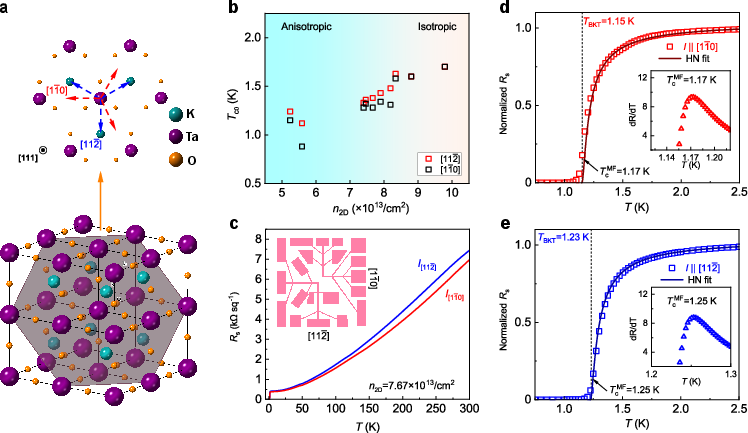
Figure 1: Transport and crystalline structure characterization of EuO/KTaO3(111) interfaces and evidence for directional disparity in superconducting transitions.
The system displays the highest TBKT when current is applied along a specific [112ˉ] axis, indicating spontaneous breaking of the crystalline threefold rotational (C3) symmetry and the emergence of unconventional electronic phases at oxide interfaces proximitized by ferromagnetism.
Experimental Evidence for Anisotropic BKT Transition
Comprehensive transport measurements (van der Pauw and Hall-bar geometries) were carried out on a series of EuO/KTaO3(111) heterointerfaces with varying 2D carrier density (30). In all superconducting 2DEGs with 31 cm32, the zero-resistance (33), BKT (34), and mean-field (35) transition temperatures are direction-dependent, with all three systematically higher for 36\,[1137] compared to 38\,[1390]. Halperin-Nelson analysis of paraconductivity validates BKT criticality but unambiguously reveals directionality of TBKT0. Moreover, corresponding anisotropy is observed in the upper critical field TBKT1.
Rotational Symmetry Breaking in the Superconducting State
To directly probe the correspondence between superconducting anisotropy and lattice symmetry, “double-tri-beam” and radial six-beam Hall-bar devices were fabricated, enabling resistance measurements along all symmetry-equivalent axes. The data show that only one of the three [11TBKT2] channels consistently manifests the highest TBKT3, with its perpendicular [1TBKT40] exhibiting the lowest TBKT5. Thus, emergent twofold (rather than threefold) anisotropy arises in the superconducting state, manifesting as a nematicity not dictated by the underlying TBKT6 electronic structure.
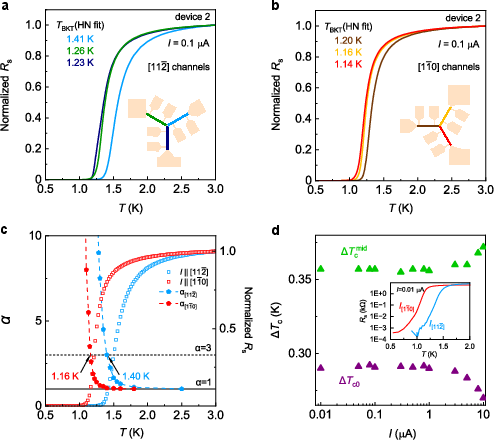
Figure 2: Evidence for broken rotational symmetry in superconducting transitions—only one [11TBKT7] channel shows maximal TBKT8.
Analysis of the TBKT9-30 characteristics further corroborates directional criticality, as the nonlinear exponent 31 satisfies 32 (BKT criterion) at different 33 for orthogonal channels, with 34 remaining finite down to zero bias, ruling out nonequilibrium current effects.
Nonreciprocal Charge Transport and Superconducting Fluctuations
Nonreciprocal charge transport, a signature of inversion and time-reversal symmetry breaking, is probed via second-harmonic resistance (35) under in-plane magnetic field. An appreciable and highly anisotropic rectification coefficient 36 emerges close to 37, exhibiting a 38 divergence as predicted for vortex-mediated nonreciprocity.
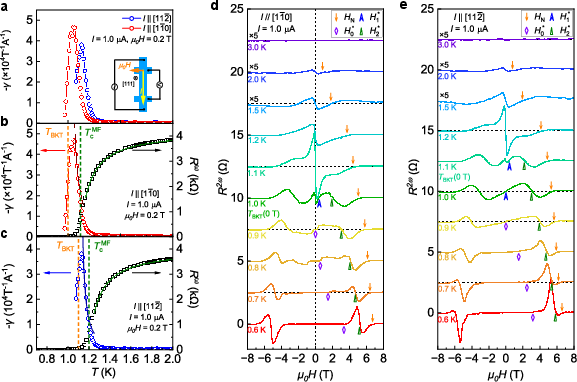
Figure 3: Strong, direction-sensitive nonreciprocal charge transport in the fluctuation regime; 39 exhibits critical divergence above the BKT transition.
The direction with higher TBKT0 (and TBKT1), again [11TBKT2], is consistently distinguishable under these fluctuation-sensitive probes. The field dependence of TBKT3 shows complex sign reversals, demarcating multiple fluctuation regimes, with all critical fields and temperatures showing similar directional enhancements.
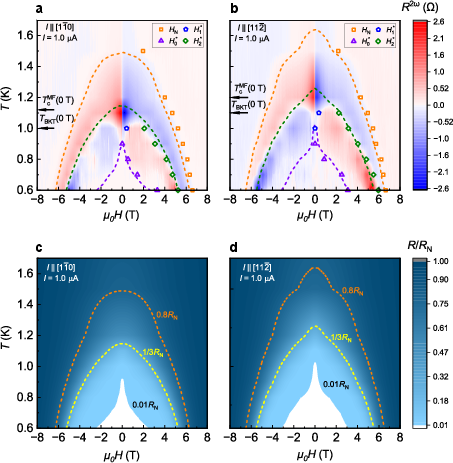
Figure 4: TBKT4-TBKT5 contour plots of nonreciprocal and linear resistance, revealing structured sign changes and their correspondence to the superconducting phase with pronounced directional asymmetry.
Theoretical Implications and Interpretation
The observed directionality in TBKT6 is distinct from conventional expectations: for a homogeneous 2D superconductor (XY model), TBKT7 is tied to a global superfluid stiffness and must be isotropic. The measured data are inconsistent with explanations based on direction-dependent vortex core energy or randomly inhomogeneous Josephson networks.
Instead, the results point toward a self-organized phase segregation at the interface, where the higher-TBKT8 phase organizes into quasi-one-dimensional “stripe” textures aligned preferentially along one [11TBKT9] direction. This microscopic nematicity emerges out of competition between ferromagnetism, strong Rashba SOC, and multiorbital 2DEG physics unique to KTaO30 interfaces. The widths of these filamentary regions substantially exceed the coherence length, excluding true 1D superconducting nanowire behavior.
Numerical fits and multilayer comparison across device geometries establish that such stripes do not act as isolated nanowires but as extended 2D segments whose connectivity ensures anisotropic global phase coherence without enforcing full isotropy. The orientation-specific criticality is reinforced by tight coupling to the underlying electronic band structure, which is inherently different between KTaO31(110) and (111) terminations.
Experimental Implications and Outlook
The ubiquity of anisotropic superconducting transitions in KTO-based interfaces with ferromagnetism, and their disappearance at high carrier density (where ferromagnetic signatures fade), suggest an intricate interplay between superconductivity, spontaneous spin order, and crystal symmetry. The data strongly suggest that the coexistence regime favors spatially modulated and directionally-selective superconductivity.
Given analogous findings in other oxide and nickelate heterointerfaces and the revelation of finite-momentum and mixed-parity pairing in the presence of SOC and Zeeman fields, these results raise the possibility that the observed anisotropy is a general feature whenever electronic nematicity and magnetic proximity are combined in strongly 2D interfaces.
Conclusion
This study reveals directional-dependent BKT criticality at the EuO/KTaO32(111) interface, which cannot be captured by scalar order parameter models or uniform superfluid stiffness. The emergence of a preferential [1133]-aligned superconducting stripe phase demonstrates an electronically-driven spontaneous rotational symmetry breaking. The interplay of interfacial ferromagnetism, strong Rashba SOC, and KTO band structure produces an exotic interfacial superconducting state, representative of a broader class of unconventional 2D superconductors.
Theoretical models addressing the cooperative roles of magnetic proximity, spatial phase segregation, and inter-stripe Josephson coupling are needed to fully characterize the collective phase dynamics and vortex structure in such systems. This work lays a foundation for future studies on the control of superconducting nematicity, vortical excitations, and nonreciprocal transport in engineered oxide interfaces and related 2D quantum materials.

