- The paper shows that remote phonon scattering from BN ZO modes sets a measurable high-temperature mobility limit in ultraclean graphene devices.
- It combines controlled experiments, ab-initio simulations, and many-body transport formalisms to link temperature-dependent resistivity with carrier density.
- The study establishes a scalable framework for analyzing extrinsic scattering effects in van der Waals heterostructures, providing benchmarks for future device optimization.
Electronic Transport in BN-Encapsulated Graphene Limited by Remote Phonon Scattering
Introduction
This work presents a comprehensive investigation into the role of remote phonon scattering in determining the electronic transport properties of graphene encapsulated in hexagonal boron nitride (BN). While the encapsulation of graphene in BN is established as the most effective route to achieve high-mobility, ultraclean devices, this study systematically demonstrates that even in this regime, interaction with polar phonon modes of the BN environment sets a practical high-temperature mobility limit. By combining controlled low-disorder device experiments, advanced many-body phonon calculations, and ab-initio simulations of phonon-electron coupling and transport, the authors quantitatively dissect the extrinsic mechanisms constraining the carrier mobility in such systems.
The paper’s results elucidate the interplay of intrinsic and extrinsic scattering mechanisms and present a formalism that accurately matches experimental temperature-dependent mobility data as a function of carrier concentration, disorder, and encapsulation configuration.
Device Fabrication and Transport Characterization
BN-encapsulated graphene Hall bars were fabricated and characterized under variable thermal conditions and carrier densities.
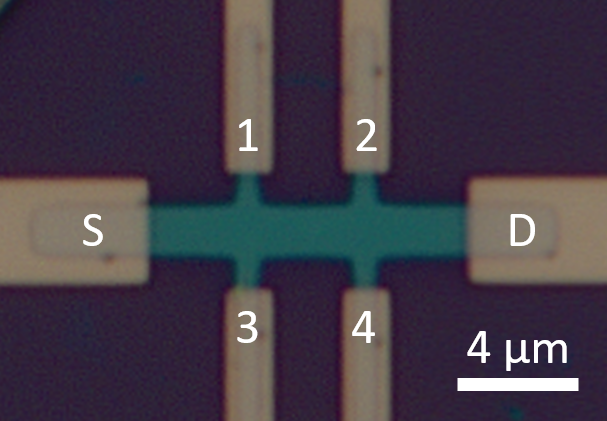
Figure 1: Optical image of the Hall bar device presented in the main text.
The measurements establish the high quality of the devices: FET and Hall mobility extractions (from 10K to 300K) display consistency, and post-annealing residual doping was maintained at minimal levels. Across three different annealing cycles, the temperature coefficient of resistivity and the extracted optical phonon energy exhibited remarkable reproducibility (see Figure 2 and Figure 3), demonstrating device stability and analytical repeatability.
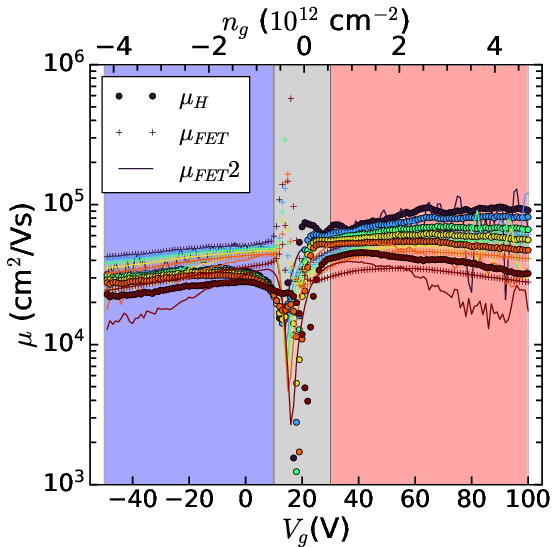
Figure 2: Comparison of Hall mobility and FET mobility determined using multiple methods across a broad temperature range; the region where Hall and gate-injected carriers disagree is highlighted.
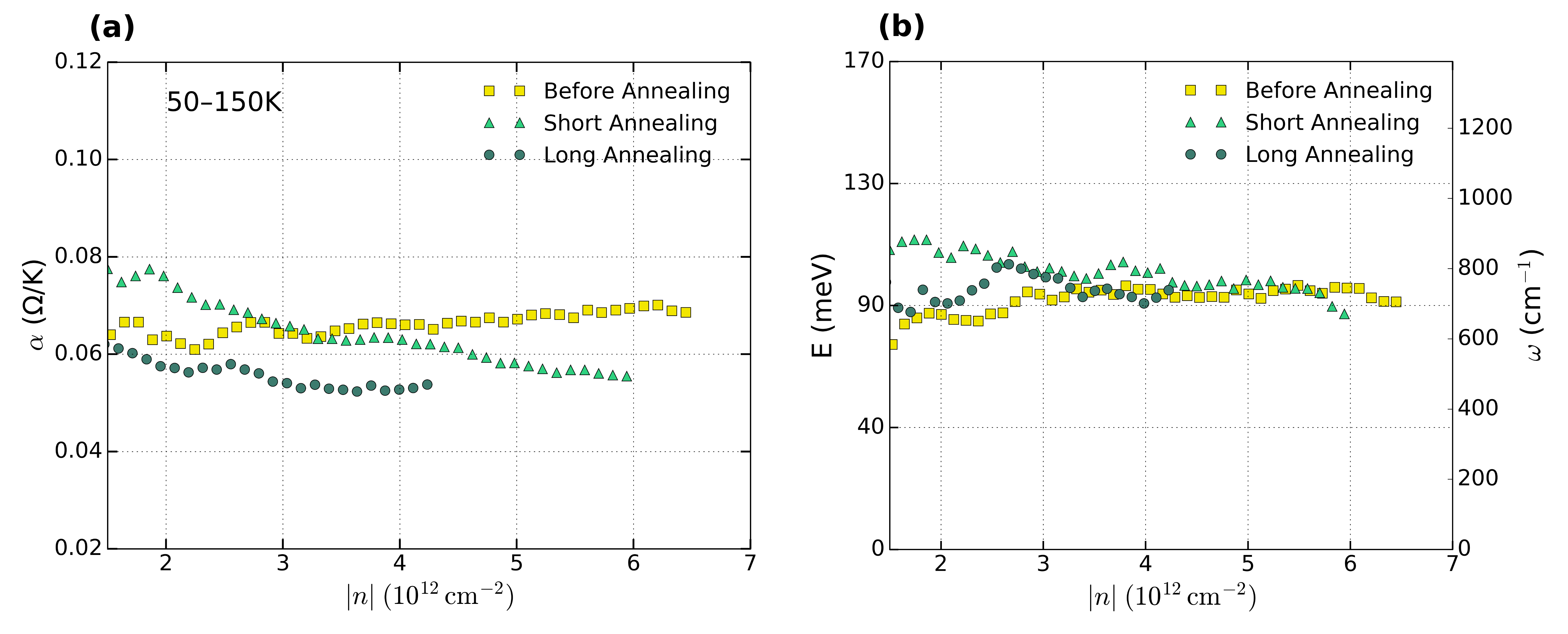
Figure 3: (a) Temperature slope of resistivity versus carrier density for subsequent annealing cycles; (b) Extracted optical phonon energy showing consistency of fitted energy scales across preparation protocols.
Theoretical Framework: Electron-Phonon Interactions in Encapsulated Graphene
A central aspect of the study is the rigorous ab-initio treatment of electron-phonon scattering, including the environmental screening effects specific to BN encapsulated configurations. The authors adapt the Bethe-Salpeter equation (BSE) formalism, taking into account both statical and dynamical polarizabilities within a tight-binding model framework fitted to first-principles DFT data. The core of the formalism is the explicit computation of the phonon self-energy accounting for electron-electron and electron-phonon many-body effects, and the influence of the BN dielectric environment via a semi-analytical model.
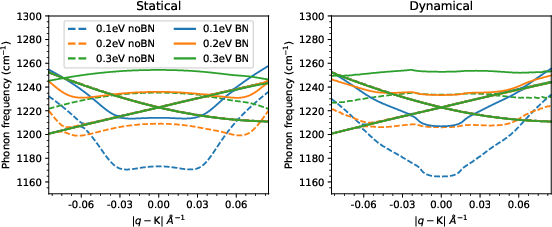
Figure 4: Phonon dispersion around q=K for graphene, comparing statical and dynamical calculations at different doping levels and with/without encapsulation; only the A1′ mode shows significant encapsulation and doping dependence.
The analysis reveals that the most substantial environment-induced modification is a rigid blue-shift of the A1′ phonon near K by ∼100 cm−1, with negligible change to the E2g mode at Γ. As a result, the A1′ BN-encapsulated phonon energy is consistently found in the range 300K0.
Modeling Remote Phonon Scattering and Charge Transport
To capture the resistivity induced by remote polar phonons in BN, the study utilizes the van der Waals electrodynamics (VED) method, accounting for layer thickness, phonon content, dynamic screening, and anharmonic phonon broadening. The collective coupling of electrons to both longitudinal optical (LO) and out-of-plane (ZO) polar modes in multiple BN layers is explicitly computed. The spectral structure of the coupling function 300K1 shows that, while LO coupling dominates in interaction strength, the lower energy ZO phonons provide a non-negligible contribution to low-temperature scattering.
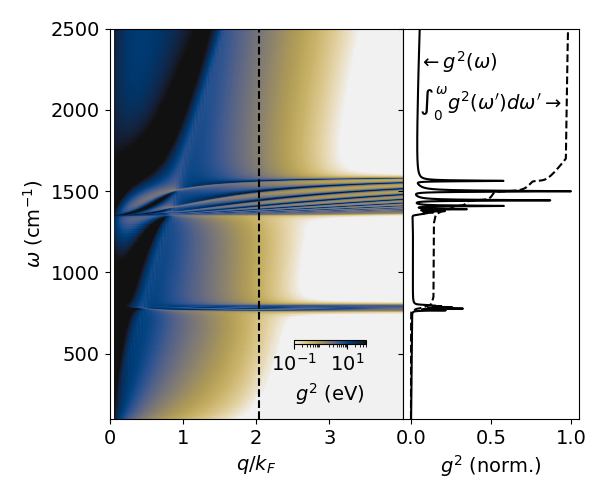
Figure 5: Mode-resolved electron-electrodynamic coupling for 20 BN layers shows the cumulative coupling mainly arises from LO and ZO modes, with the ZO peak located at lower frequencies.
The resistivity’s dependence on the number of BN layers and carrier density was found to be non-trivial: increasing BN layers leads to a saturation of ZO phonon contribution, while resistivity decreases with increased Fermi level, primarily due to the dominance of carrier number over increased phase space for phonon scattering.
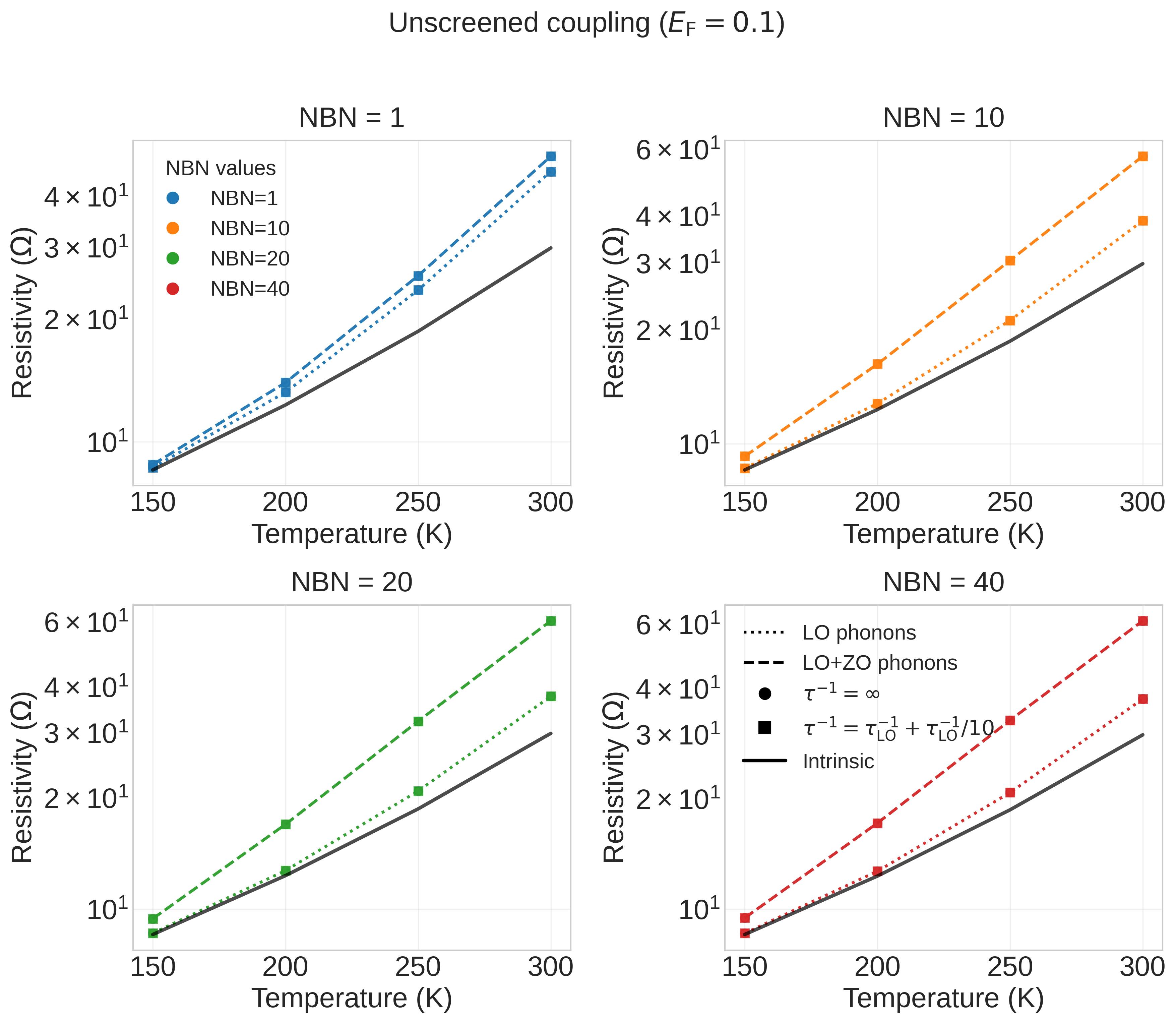
Figure 6: Computed graphene resistivity for varying NBN showing the evolution of resistivity with layer count and Fermi energy, and distinguishing the separate roles of LO and ZO phonons.
Inclusion of dynamic screening due to graphene’s free carriers and detailed anharmonic phonon broadening modifies quantitative values but not the dominant physical trends. Anharmonic effects become more pronounced for low NBN but are less significant for thick encapsulation.
Experimental-Theoretical Comparisons and Fitting Procedure
A major focus is the direct comparison of experimental and theoretical temperature-dependent resistivity, involving careful subtraction of residual disorder contributions and explicit fitting to extract phonon-electron coupling strengths. The authors critically analyze common phenomenological fits in the literature and demonstrate the inadequacy of additive resistivity models for accurate extraction of phonon energies, underlining the necessity of a Boltzmann transport analysis with a frequency-resolved electron-phonon kernel.
For experimental, simulated, and theoretical systems, the extracted coupling to the BN ZO optical phonons is consistent within scaling factors, with experiments revealing slightly reduced coupling (see Figure 7).
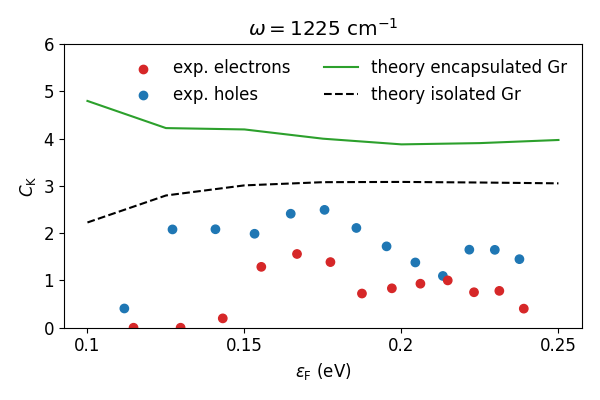
Figure 7: Extracted coupling strengths for the graphene 300K2 mode from fits to experiments and simulations, demonstrating that encapsulation enhances the effective coupling relative to isolated graphene, while experimental values remain slightly below theory.
Critical Analysis and Implications
A key numerical outcome is the demonstration that remote phonon scattering by BN ZO modes sets a measurable, extrinsic high-temperature limit for the resistivity of BN-capped graphene, even in highly clean devices. This finding demonstrates that, even with suppression of disorder, ripples, and intrinsic impurity effects, the extrinsic environment cannot be neglected when describing dissipation in ultraclean graphene.
Furthermore, the demonstrated formalism and quantitative agreement between theory and experiment set a new accuracy standard for environmentally-limited transport analysis in van der Waals heterostructures.
Future Perspectives
The presented approach provides a blueprint for further work on engineered substrate effects, variable environmental screening, and the manipulation of phonon-mediated transport channels. These insights are directly relevant for device optimization at the mobility limits and for the design of low-dissipation, high-frequency graphene-based electronics. The approach is readily extendable to other 2D heterostructures where heterointerface phonon coupling is relevant, and for accounting for layer number, dielectric engineering, and collective phononic excitations in more complex device geometries and stacked systems.
Conclusion
This paper offers a quantitative, experimentally validated analysis of phonon-limited transport in BN-encapsulated graphene, emphasizing the significant role of remote BN phonons in determining high-temperature mobility. The advanced many-body transport formalism, critically benchmarked to experiment, exposes the unavoidable extrinsic nature of remote phonon scattering, providing both a challenge for materials-by-design approaches and a reference for future efforts targeting ultimate mobility in van der Waals devices (2604.00678).