- The paper demonstrates that the min-partition rank method cannot prove superpolynomial lower bounds for mABPs by showing a full-rank multilinear polynomial is computable by a polynomial-size mABP.
- It introduces a novel combinatorial framework featuring two-block steering and supermartingale potential analysis to tightly control imbalances and gap excursions.
- The result shifts the focus in algebraic complexity, indicating that new, non rank-based techniques are needed to separate mABPs from more powerful circuit classes.
Unconditional Limitations of the Min-Partition Rank Method for Multilinear ABP Lower Bounds
Introduction and Context
The paper analyzes the prospects for separating computational power within the multilinear algebraic complexity hierarchy, specifically between multilinear algebraic branching programs (mABPs) and more powerful circuit classes. After Raz’s superpolynomial lower bounds for multilinear formulas, the primary remaining open question has been whether similar bounds (i.e., superpolynomial) can be shown for mABPs, a task for which the only plausible techniques have been rank-based partition arguments, often formalized as the "min-partition rank" method. All substantial bounds for formulas and mABPs, including the most recent near-quadratic lower bounds, rely on variants of this method.
The work demonstrates, unconditionally, that the min-partition rank method cannot yield superpolynomial lower bounds for mABPs or set-multilinear ABPs. This advances the state of the art both technically and meta-mathematically: it proves an unconditional barrier on a natural, widely used lower bound strategy.
Main Result: An Unconditional Barrier
The central result is that for every sufficiently large n, there exists a full-rank multilinear polynomial (i.e., one which has maximum min-partition rank with respect to any balanced partition) which is computable by a polynomial-size mABP. Formally,
N(n)=nO(1),
where N(n) is the smallest size of a $1$-balanced-chain set system, the combinatorial core governing the power of the min-partition rank method in the mABP setting. This directly implies that the min-partition rank method cannot prove superpolynomial mABP lower bounds.
Corollaries include:
- For every infinite field F, there exists an n-variate full-rank multilinear polynomial over F computed by a polynomial-size mABP.
- The optimal lower bound provable by the min-partition rank method is polynomial for mABPs.
No progress toward separating mVBP from mVP can be made by this approach.
Combinatorial Framework and Proof Overview
The critical technical ingredients arise from a combinatorial translation of the rank argument: to obtain hard instances for mABPs via min-partition rank, one must construct large families of set systems so that for every balanced coloring of [n], there is a chain in the set family remaining balanced at each prefix. This is enshrined as the N(n)=nO(1),0-balanced-chain set system, with N(n)=nO(1),1 as the minimal cardinality.
Fabris, Limaye, Srinivasan, and Yehudayoff [FLSY26] reduced the lower bound question for mABPs to the growth rate of N(n)=nO(1),2. Prior upper bounds were quasipolynomial, N(n)=nO(1),3, limited by the recurrence properties of random walks. This paper improves it polynomially, by a new construction that combines two main ideas:
- Two-block steering: Rather than process N(n)=nO(1),4 as a linear order, the elements are split into two blocks, and at each step the builder can choose which block to extend, greedily minimizing the growth of the running imbalance.
- Supermartingale potential analysis: The process of imbalances can be modeled as a supermartingale with negative drift, allowing one to sharply control the maximum imbalance and gap excursions via concentration inequalities.
These ideas yield polylogarithmic maximal imbalance and narrow gap regions, so the recursion depth in the combinatorial construction is bounded, and the overall set system size is polynomial.
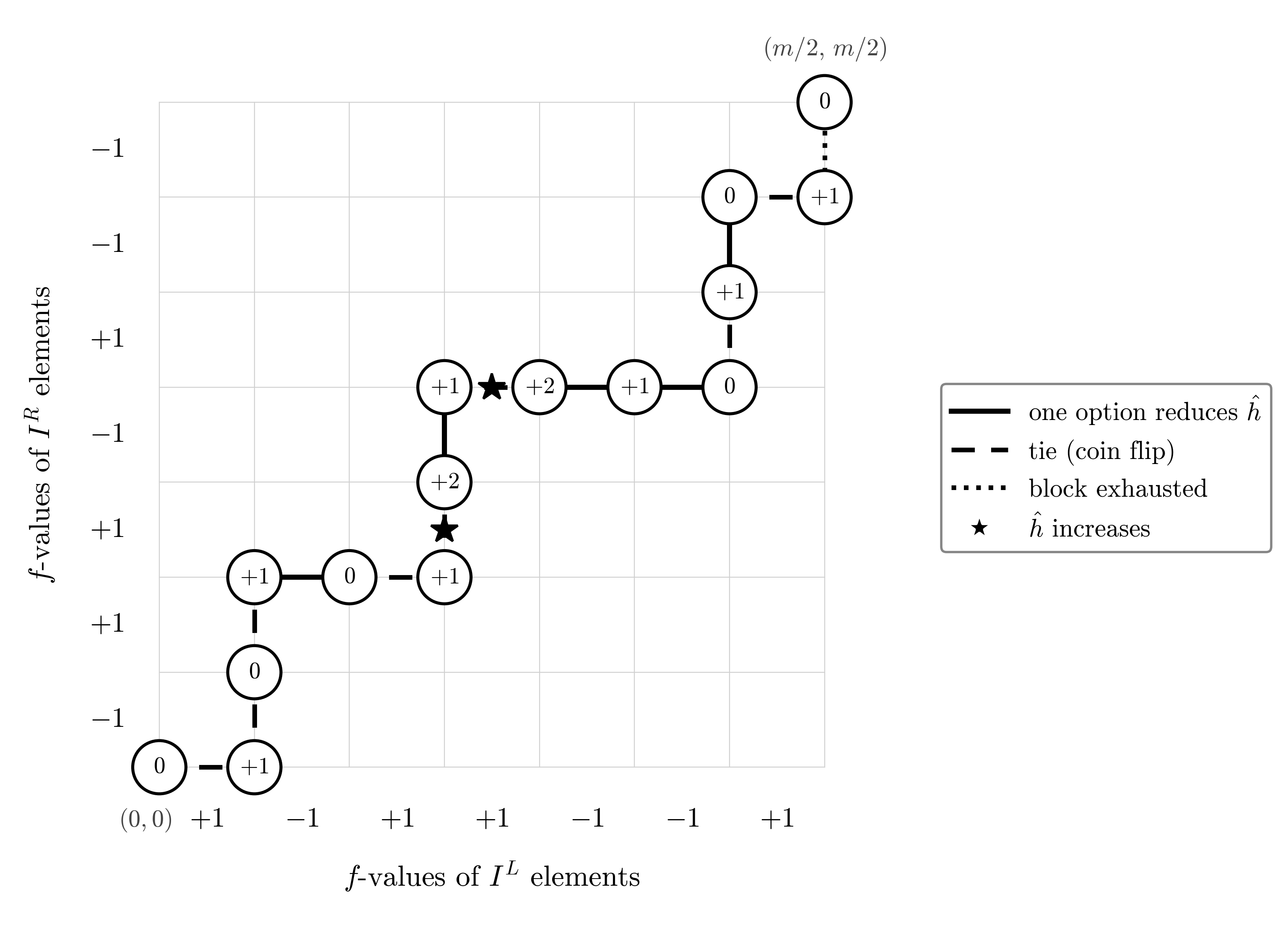
Figure 1: An example of a steered path on the two-interval grid showing how two-block steering allows the builder to minimize imbalance at each step.
The Barrier for Min-Partition Rank
The technical core is the proof that the full-rank property (with respect to min-partition rank) is not indicative of inherent mABP complexity. For every N(n)=nO(1),5,
- There exists a full-rank N(n)=nO(1),6-variate multilinear polynomial computable by an mABP of size N(n)=nO(1),7.
- The set-multilinear case is handled identically, so the same barrier exists for set-multilinear ABPs.
The prior barrier was only conditional on the properties of random walks; this work resolves the critical combinatorial parameter completely.
From a complexity-theoretic perspective, this means that full-rankness—the only algebraic property leveraged by all prior rank-based methods—is too weak to imply mABP lower bounds, and thus new approaches are necessary.
Technical Construction
Two-Block Steering and Excursion Control
The method partitions the variable set into two blocks and processes them in a steered fashion, with the following critical properties:
- At each step, extension is biased toward decreasing imbalance, reducing the upward drift compared to a one-block random walk.
- The probability that the absolute imbalance increases is bounded by N(n)=nO(1),8, yielding strong negative drift.
- This is formalized by analyzing the relevant birth-death Markov chain, with the moment-generating function for first-passage times delivering tight control over excursion lengths.
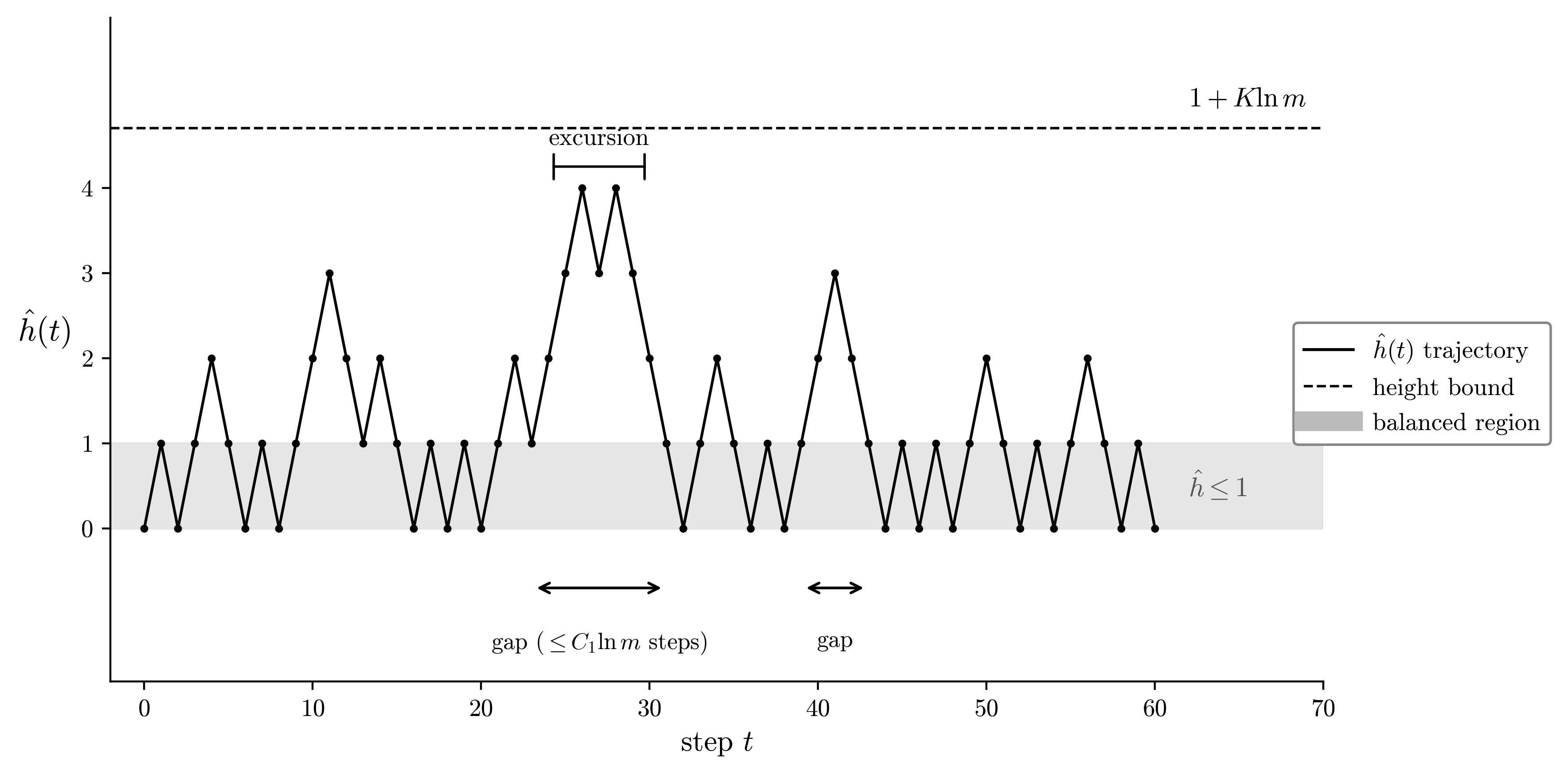
Figure 2: Schematic illustration of the absolute imbalance N(n)=nO(1),9 over time, depicting frequent returns to the "balanced region" and polynomially bounded excursions.
The recursive structure ensures that the unprocessed segment shrinks rapidly in each block, reducing the recursion depth to N(n)0, with local overheads never exceeding polynomial.
Gap Filling and Set System Construction
The process of balancing across all possible colorings is converted into set system enumeration, where at every stage the number of possible chain sets that might yield a balanced chain for any coloring is polynomially bounded. At the core is the deterministic lemma guaranteeing that the gap elements can always be ordered to maintain balance, exploiting the structure imposed by the steering method and pool constraints.
Explicitly, the final set system N(n)1 (of size N(n)2) can be constructed in polynomial time, and subsequent derandomization ensures the existence of the required full-rank polynomials over any infinite base field.
Implications
The meta-mathematical implications are immediate and unconditional:
- Any proof of N(n)3, or any superpolynomial lower bound for mABPs, must step outside the min-partition rank framework (and similarly for set-multilinear ABPs).
- Given that all current formula and ABP lower bounds in this regime use variants of the min-partition rank technique, the barrier is robust.
In practical terms, to make further progress in the theory of algebraic hardness (specifically, for separating mABPs from general circuits), new, genuinely different combinatorial or algebraic approaches are required—such as leveraging more global structural properties or fundamentally new partial derivative, lopsided, or geometric techniques.
Theoretical Consequences and Open Questions
This result solidifies the separation between multilinear formula and mABP complexity (since full-rank polynomials require superpolynomial-size formulas but polynomial-size mABPs), but also signals that known "hard" instances for formulas are not hard for mABPs.
It also exposes future directions:
- Is it possible to extend or generalize the lopsided partial derivative method, used successfully in set-multilinear formula lower bounds, to ABPs and thereby circumvent this barrier?
- Can variants of the steering idea, possibly with more than two blocks, lower the exponent for N(n)4 further, perhaps achieving tight bounds?
- What new algebraic or geometric invariants could witness mABP hardness, given the failure of full-rankness to do so?
Conclusion
This work decisively demonstrates that the min-partition rank method, and by extension all methods reliant on full-rankness under partitions, cannot yield superpolynomial lower bounds for multilinear algebraic branching programs. The polynomial upper bound on N(n)5 closes an open problem and forces a pivot in the methodology of algebraic complexity lower bounds. Further advances will necessarily require new foundational techniques beyond the current rank-based paradigm.

