Abstract: The approximate coherent state rank is the minimal number of (classical) coherent states required to approximate a continuous-variable bosonic quantum state and directly relates to the classical complexity of simulating bosonic computations. Despite its importance, little is known about lower bounds on this quantity, even for basic families of states. In this work, we initiate a systematic study of lower bounds on the approximate coherent state rank. Our contributions are as follows. (i) We introduce a technique based on low-rank approximation theory yielding generic lower bounds on the approximate coherent state rank of arbitrary single-mode states. (ii) Using this technique, we find a complete characterization of all single-mode states of finite approximate coherent state rank, and we obtain in particular analytical expressions for the approximate coherent state rank of squeezed states and of finite superpositions of Fock states. (iii) We further show that our single-mode lower bounds can be lifted to multimode lower bounds for finite superpositions of multimode Fock states. (iv) Finally, we prove a super-polynomial lower bound on the approximate coherent state rank of the $n$-mode Fock state $|1\rangle{\otimes n}$, by exploiting a connection to the permanent. To do so, we show that the algebraic complexity of approximate multi-linear formulas for the permanent is super-polynomial, building upon the proof of a lower bound for exact formulas due to [Raz, JACM 2009]. Our results establish an unconditional barrier to efficient classical simulation of Boson Sampling via coherent state decompositions and connect non-classicality of bosonic quantum systems to central questions in algebraic complexity.
The paper establishes rigorous lower bounds on the coherent state rank needed to approximate bosonic quantum states.
It introduces a methodology using Hankel matrices and linear recurrence relations to quantify non-classicality.
Results show super-polynomial lower bounds for multi-mode Fock states, linking simulation complexity to the hardness of computing the permanent.
Lower Bounds on Coherent State Rank: An Expert Analysis
Introduction and Motivation
This work establishes rigorous lower bounds on the (approximate) coherent state rank (CSR) of bosonic quantum states—a quantitative measure of non-classicality, crucial for understanding the classical simulability of bosonic quantum computations. The minimum number of coherent states required to approximately express a target quantum state directly governs the cost of classical simulation algorithms utilizing such decompositions. While prior work investigated upper bounds for this quantity, notably for stabilizer and coherent state ranks in discrete- and continuous-variable systems, general lower bounds, especially for families of highly non-classical states like Fock or squeezed states, were largely unknown.
This paper systematically develops lower bounding techniques, both via algebraic structures in state amplitudes and connections to central objects in algebraic complexity (notably the permanent), and derives a range of strong, in several cases tight, lower bounds for relevant classes of quantum states. The results unconditionally rule out efficient classical algorithms for simulating large classes of non-Gaussian bosonic computations based on coherent state decompositions.
Lower-Bounding Framework for Coherent State Rank
The authors introduce a general method to lower bound the ε-approximate CSR via properties of the matrix of rescaled Fock amplitudes, specifically the Hankel structure arising from linear recurrence relations. The key technical statement is:
For a single-mode state ∣ψ⟩, if the rescaled Fock coefficients (n!ψn) do not admit a linear recurrence of order ≤r, then any superposition of r (or fewer) coherent states cannot approximate ∣ψ⟩ to within a fidelity1−ε, where the achievable ε is lower bounded by a computable function of the singular values of the Hankel matrix HN(ψ).
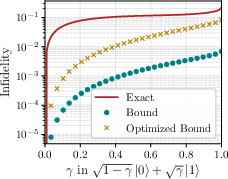
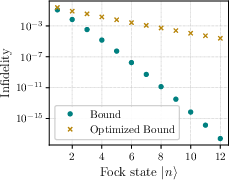
Figure 1: Lower bounds on the infidelity between a target state and its optimal approximation by a superposition of k coherent states, illustrating both analytical and optimized bounds for Fock and low-excitation superpositions.
The crucial insight is that the rescaled amplitudes of any superposition of ∣ψ⟩0 coherent states must satisfy an order ∣ψ⟩1 linear recurrence, a structural property that strongly restricts the expressive power of such superpositions. This allows reducing the CSR problem to questions in low-rank approximation and the spectral theory of Hankel matrices, where the classical Eckart–Young–Mirsky theorem determines the non-approximability by low-rank structured objects.
Single-Mode Results
Characterization Theorem: The paper fully characterizes all pure single-mode states of finite approximate CSR. Such a state ∣ψ⟩2 has finite CSR ∣ψ⟩3 if and only if ∣ψ⟩4 satisfies an order-∣ψ⟩5 linear recurrence relation. Equivalently, ∣ψ⟩6 is a finite superposition of displaced Fock (core) states, possibly with differing amplitudes (displacements).
Explicit results:
The ∣ψ⟩7th Fock state ∣ψ⟩8 has ∣ψ⟩9, and more generally, any finite superposition of Fock states with maximal occupation (n!ψn)0 requires at least (n!ψn)1 coherent states.
Single-mode squeezed states cannot be approximated to arbitrary precision by any finite superposition of coherent states: their CSR is infinite. This follows from the fact that their Fock amplitudes fail to satisfy any linear recurrence.
Optimized bounds: The authors also refine their method to yield numerically optimized bounds, mitigating the loose scaling introduced by factorials and capturing the relevant behavior for larger (n!ψn)2.
Multimode Results and Complexity-Theoretic Implications
A lifting argument shows that for (n!ψn)3-mode core states (finite superpositions of Fock product states) with total occupation number (n!ψn)4, the CSR is at least (n!ψn)5. However, for product Fock states such as (n!ψn)6, the authors obtain dramatically super-polynomial lower bounds.
Permanent Connections
The crucial observation is the known equivalence between the transition amplitudes of Fock states through linear optical networks and the matrix permanent—a (n!ψn)7-hard function. Any efficient ((n!ψn)8-size) decomposition of (n!ψn)9 into superpositions of coherent states would yield a sub-exponential algorithm for the permanent, collapsing the polynomial hierarchy.
Main technical result: Any sequence of multi-linear arithmetic formulas converging to the permanent must have super-polynomial size, including so-called "border complexity." This is proven by adapting Raz’s lower bound for the permanent to the approximate (border) case, arguing via partial derivative matrices and rank arguments.
Theorem: The approximate CSR of ≤r0 is at least ≤r1. Thus, any algorithm simulating bosonic quantum computations (such as Boson Sampling) based on decompositions into coherent states will, in the worst case, have super-polynomial complexity.
Implications and Theoretical Outlook
These results establish unconditional limitations for approaches to classical simulation rooted in coherent state (i.e., phase-space) decompositions. The authors' framework also offers a clear hierarchy of non-classicality: Core states' CSR increases linearly with photon number, while squeezed states are so non-classical as to be outside the reach of this hierarchy entirely. Fock product states (e.g., ≤r2) are fundamentally separated from classical states by super-polynomial barriers.
Furthermore, the result highlights the tight interplay between quantum simulation complexity and questions in algebraic/arithmetic complexity theory, suggesting that significant advances in one imply breakthroughs in the other.
Future Directions
Extension of these methods to multimode decompositions beyond product structures—possibly via Hankel tensors and more powerful tensorial low-rank theory. Current barriers include the lack of a general analog of the Eckart–Young theorem for tensors.
Tightening bounds for generic non-Gaussian states; assessing the relation of coherent state rank with other resource-theoretic measures, e.g., Gaussian rank, stellar rank.
Progress on the comparable open problem for stabilizer rank in qubit systems; adaptation of algebraic complexity approaches to the stabilizer context may provide new lower bounds.
The connection between permanent and determinant complexities raises the prospect of analogous barriers in fermionic quantum systems.
Figure 1: Lower bounds on infidelity for Fock states (right) show a much tighter scaling with the optimized method, demonstrating the severe limitations of coherent-state approximations for higher-photon-number states.
Conclusion
This work provides the first systematic and in many cases tight lower bounds on the approximate coherent state rank for key families of bosonic quantum states. The connection between CSR and algebraic complexity (notably the permanent) leads to robust, unconditional intractability results for the classical simulation of non-Gaussian bosonic quantum computations using coherent-state-based methods. The techniques here clarify the hierarchy of non-classicality in continuous-variable systems and open several avenues for further advancement in continuous-variable quantum information theory and resource theory.