- The paper presents a comprehensive RG analysis of 297 dimension-7 BNV operators in SMEFT, establishing robust nucleon decay constraints.
- It employs one-loop RG evolution that incorporates Yukawa, gauge, and flavor effects to match SMEFT operators onto the low-energy effective theory.
- Results reveal effective scales in the 10^9–10^11 GeV range and highlight the significance of operator mixing for higher-generation fermion fields.
Renormalization-Group-Improved Limits on Dimension-7 Baryon-Number-Violating Operators in SMEFT
Overview
The paper "Renormalization-group-improved constraints on dimension-7 baryon-number-violating operators" (2604.00952) presents a comprehensive renormalization group (RG) analysis of all Standard Model Effective Field Theory (SMEFT) dimension-7 baryon number violating (BNV) operators. The work leverages current nucleon decay bounds to provide constraints on the full basis of 297 independent Wilson coefficients (WCs), incorporating one-loop RG effects from the scale of new physics (ΛNP) to the electroweak scale (ΛEW). The approach enables indirect limits on operators involving second and third generation fields that are inaccessible in a purely tree-level analysis, primarily via operator mixing induced by Yukawa couplings.
The SMEFT parametric extension analyzed here includes six classes of dimension-7 BNV operators, each with flavor and Lorentz structure symmetries fully resolved. In total, after accounting for their symmetry properties and all fermion generation combinations, the complete non-redundant basis contains 297 operators. The paper follows the conventions of the D7RGESolver framework for definition and RGE calculations.
Details include:
- Explicit forms and flavor symmetries for OLˉdudH~, OLˉdddH, OeˉQddH~, OLˉdQQH~, OLˉQdDd, and OeˉddDd.
- Classification of operators into ψ4H and ψ4D categories.
- Careful application of (anti-)symmetrization over flavor indices per operator class.
The analysis focuses on two-body nucleon decay processes into light mesons and leptons, using the most constraining experimental bounds available.
Operator Matching and RG Evolution
The core technical advance is the consistent treatment of RG evolution from ΛEW0 down to ΛEW1, including:
- Basis conversion between SMEFT and the low-energy effective field theory (LEFT), including matching of operator coefficients with explicit flavor basis dependence.
- Matching relations for each dimension-7 SMEFT operator onto LEFT are given both in the up- and down-quark flavor bases to account for CKM-induced off-diagonal mixings.
- RG running effects are solved using the D7RGESolver code, taking into account the nontrivial mixing and evolution induced by Yukawa, gauge, and flavor structures.
The role of RG evolution is crucial for constraining operators that only connect to first-generation (light) quarks via mixing with heavier-generation structures at subleading order. For derivative operators such as ΛEW2, integration by parts and use of SM equations of motion are implemented to facilitate the LEFT projection.
RG equations of the form
ΛEW3
with explicitly calculated anomalous dimensions ensure correct resummation of logarithms and operator mixing.
Decay Width Computation Framework
To relate operator coefficients to measurable nucleon decay rates, the analysis employs:
- Chiral perturbation theory (ChPT) for mapping LEFT quark-level operators to hadronic transitions.
- Up-to-date lattice QCD extractions of low energy constants and matrix elements for nucleon to meson transitions.
- Complete treatment of contact and pole diagrams for decay amplitudes, including contributions from operators with derivatives on external fields.
The final decay width expressions are functions of operator coefficients at the matching scale, renormalized by QCD running down to the hadronic scale.
RG-Improved Constraints: Results
The central results are exclusion limits on all WC combinations at ΛEW4 GeV, both with and without RG running effects. Constraints are presented as
- Lower bounds on an effective scale ΛEW5.
- Upper bounds on the dimensionless coefficient ΛEW6 for each operator and generation assignment.
- Direct comparison between constraints in up- and down-quark flavor bases, revealing nontrivial basis dependence primarily for LEFT operators containing third generation fermions.
Operators directly contributing to nucleon decay receive the strongest limits, with ΛEW7 in the ΛEW8–ΛEW9 GeV range, while those requiring RG mixing for indirect contributions have weaker, but still phenomenologically significant, bounds, often exceeding the reach of direct searches for BNV involving heavy quarks or OLˉdudH~0 leptons.
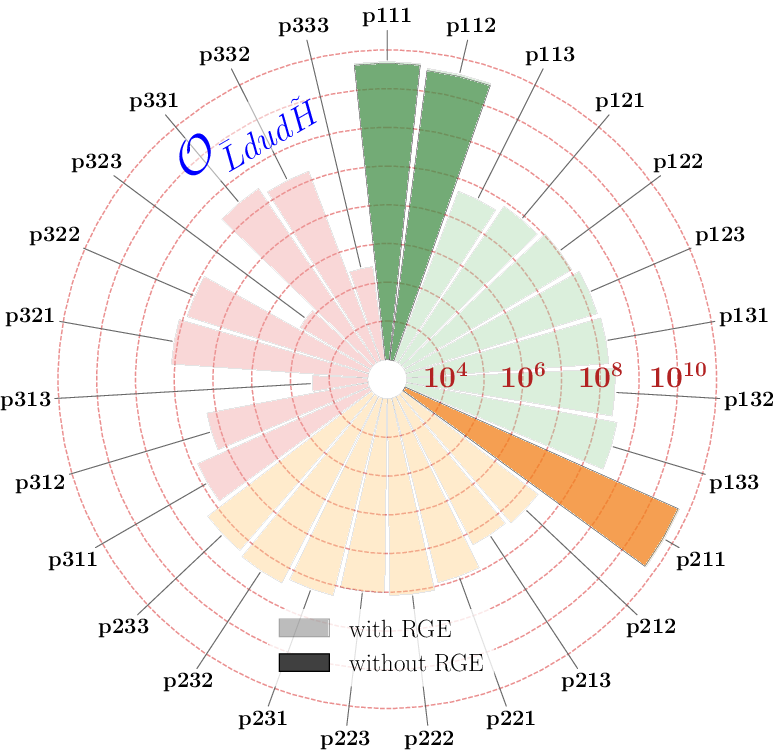
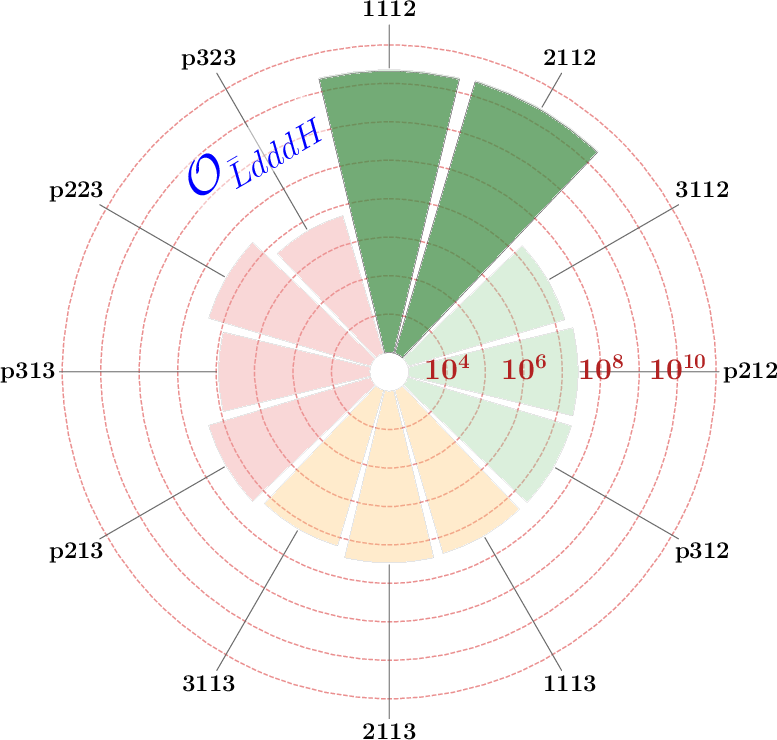
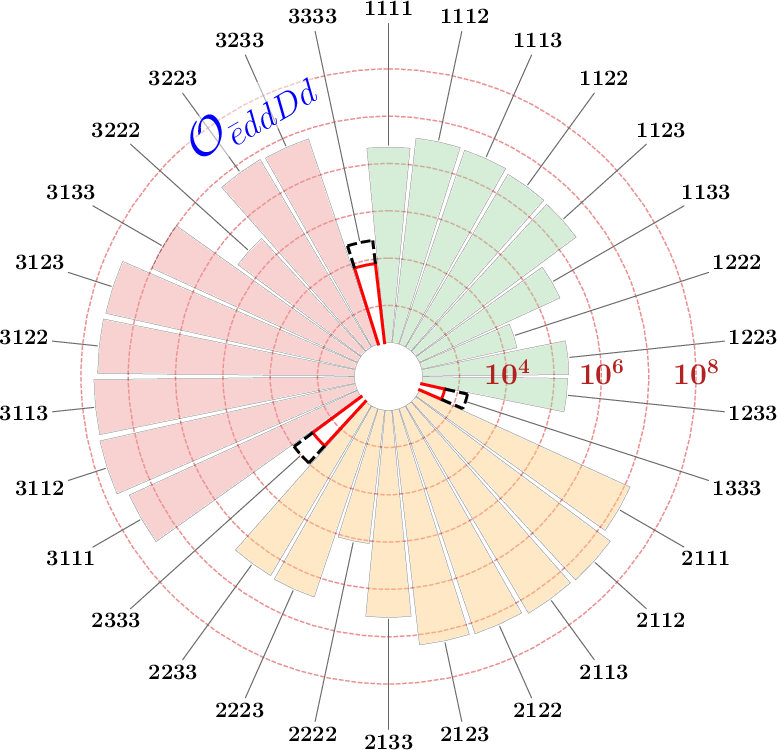
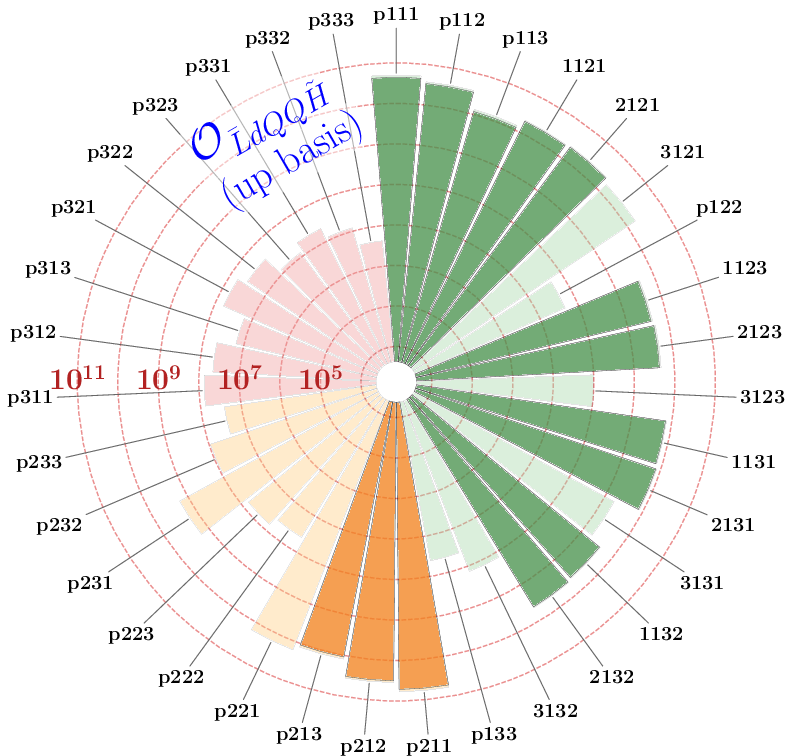
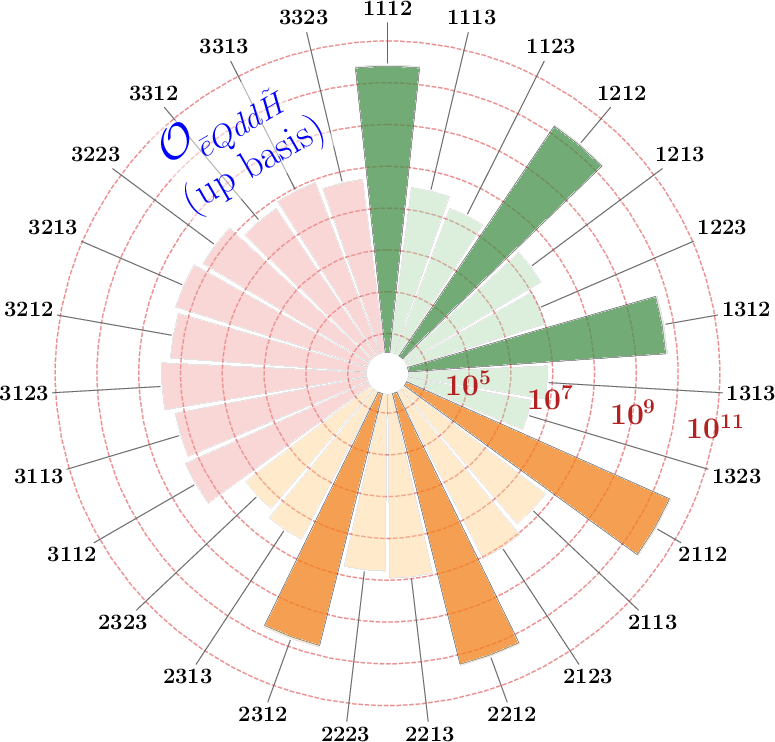
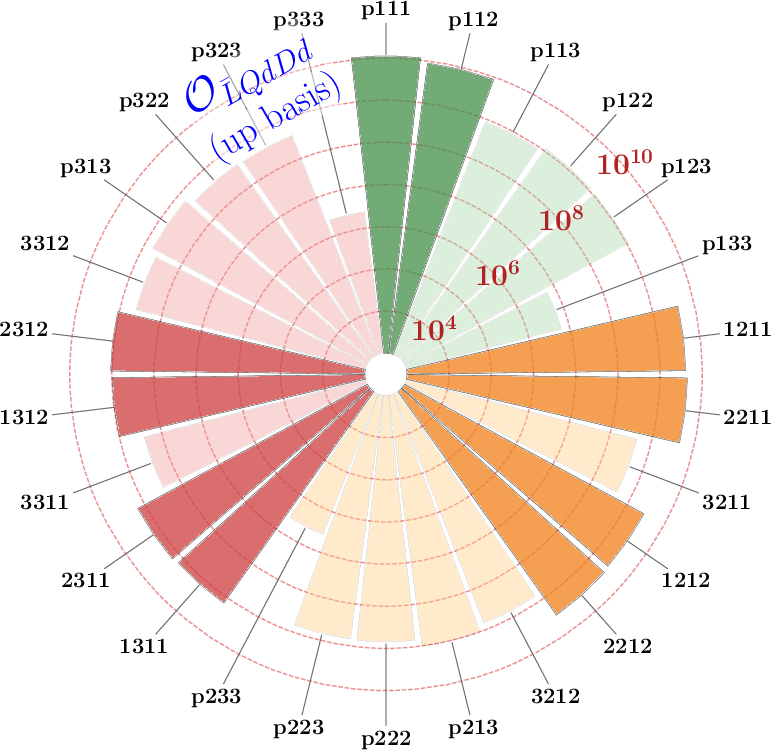
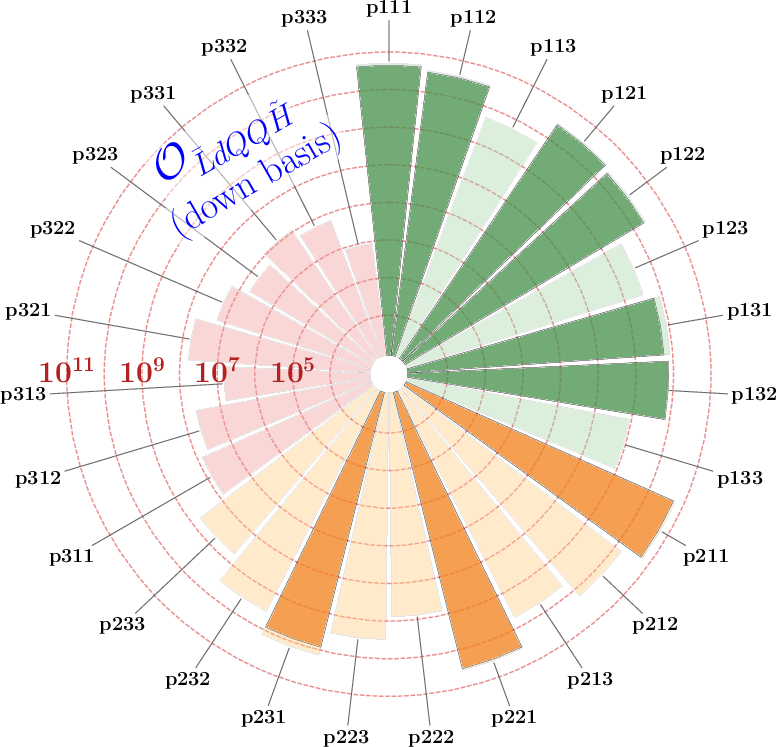
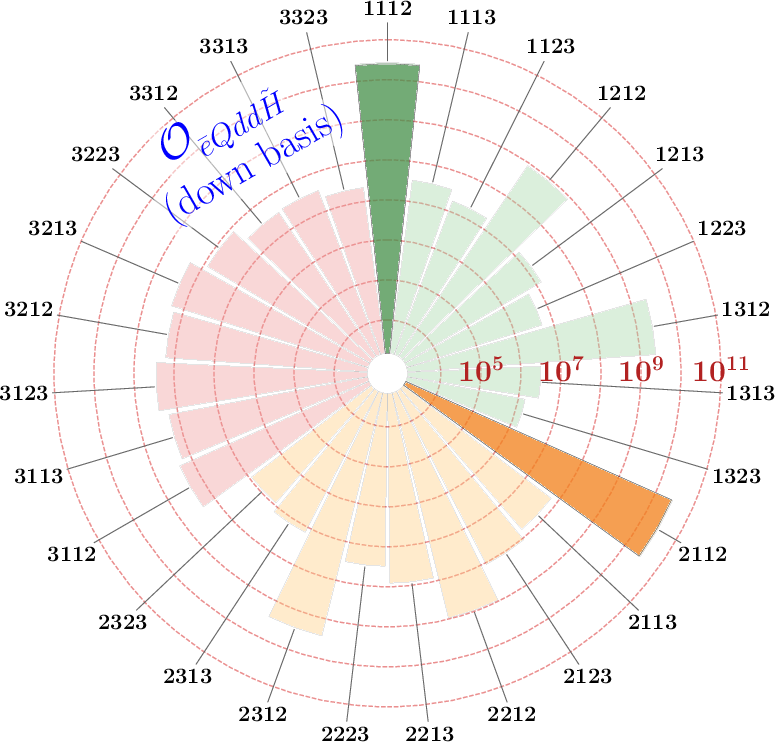
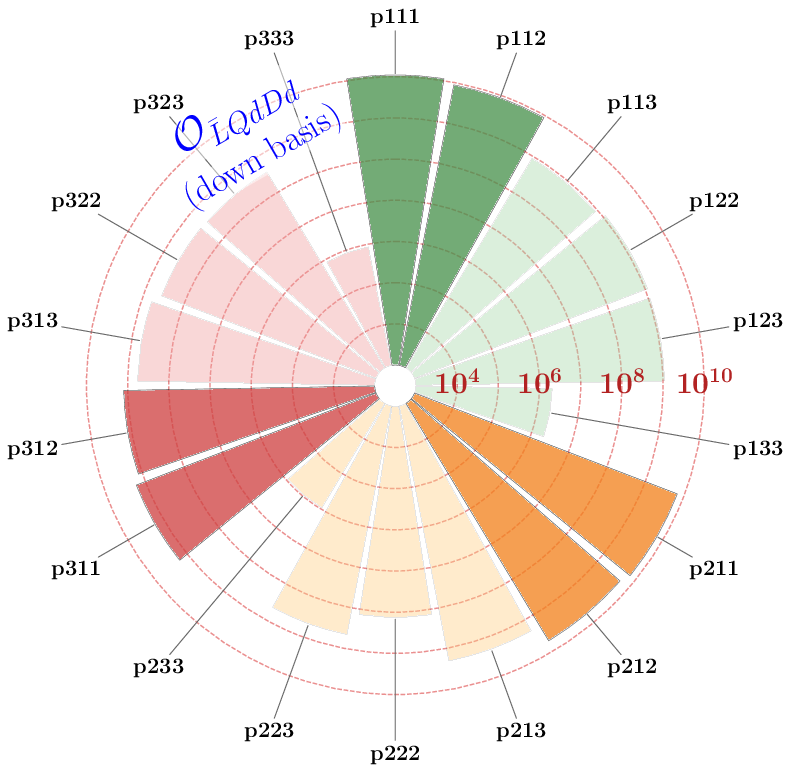
Figure 1: RG-improved lower bounds on the effective scale OLˉdudH~1 for each SMEFT dimension-7 BNV operator as a function of fermion generation structure and quark flavor basis.
Additionally, the analysis presents a detailed example in the Appendix, demonstrating how a WC that's unobservable at tree-level for nucleon decay induces observable effects at one-loop via RG mixing, resulting in competitive limits.
Phenomenological and Theoretical Implications
RG-improved limits significantly extend the reach of low-energy nucleon decay experiments into parameter space for multi-generation and third-generation operator structures, filling gaps left by earlier tree-level SMEFT analyses. This highlights:
- The necessity of incorporating operator mixing and full RG evolution to obtain robust model-independent limits on new physics scenarios that might generate baryon-number-violating interactions only in non-first-generation fermion sectors at high scale.
- For operators involving third-generation fields, the nucleon decay bounds, after mixing is included, often exceed direct search limits for OLˉdudH~2 or top decays by several orders of magnitude.
The demonstrated formalism and computational pipeline can be directly generalized to other rare process constraints on higher-dimensional SMEFT operators, and to evaluations of projected sensitivities in future nucleon decay and large-volume neutrino experiments.
Anticipated future theory developments include:
- Systematic inclusion of loop-level matching contributions for both dimension-7 and higher-dimension operators.
- Extension to nucleon decay channels with more complex final states, including those requiring exchange of heavy quarks or leptons in intermediate steps.
- Unified global fits combining nucleon decay, flavor, and collider constraints on extended operator bases.
Conclusion
This study achieves a complete, RG-improved limit-setting exercise for all independent SMEFT dimension-7 baryon-number-violating interactions, obtaining robust model-independent bounds using current nucleon decay data. The results demonstrate the critical necessity of one-loop RG treatment for operators involving higher-generation fields, and provide a new standard for interpreting rare process constraints in effective field theory approaches to baryon number violation.