- The paper introduces quadratic quasi-normal modes (QQNMs) by extending traditional linear perturbation theory to capture nonlinear effects in gravitational wave ringdown.
- It employs numerical relativity simulations and Fisher forecast analyses to quantify the significance and detectability of QQNMs in post-merger signals.
- The study shows that including QQNMs improves fit residuals and parameter estimation, paving the way for stringent tests of General Relativity with future detectors.
Nonlinear Gravitational Wave Ringdown: Quadratic Quasinormal Modes in Black Hole Physics
Overview and Motivation
The precise modeling of gravitational wave (GW) ringdown is essential for performing stringent tests of General Relativity (GR), particularly in the post-merger regime of compact binary coalescence. Traditional approaches have relied heavily on linear perturbation theory, predicting the emission of GWs at quasi-normal mode (QNM) frequencies that depend solely on the remnant black hole’s mass and spin. However, the fundamentally nonlinear structure of GR ensures that higher-order effects, such as quadratic quasinormal modes (QQNMs), are inevitably present and may contribute non-negligibly to the observed signal. This work rigorously reviews theoretical foundations, numerical evidence, and the detectability prospects of nonlinear effects, with emphasis on quadratic modes, establishing their significance for forthcoming detector data and advanced GR tests.
The archetypal linear ringdown model represents the GW strain as a sum of damped sinusoids at QNM frequencies ωℓmn, weighted by amplitudes Aℓmn. These modes are characterized by their angular numbers (ℓ,m), overtone index n, and are functions only of the BH’s mass and spin. The polarizations are superpositions of these modes via spin-weighted spheroidal harmonics.
Second-order (quadratic) perturbation theory generalizes this by considering the Einstein equations perturbed up to O(h2). The resulting equation for the second-order metric perturbation is sourced by products of first-order solutions—a structure that generically produces new oscillatory content at quadratic combinations of the linear QNM frequencies,
ωLMN(2)=ωℓmn+ωℓ′m′n′
This can be interpreted as a bilinear interaction wherein pairs of QNMs source a daughter QQNM via angular selection rules that determine the allowed multipole properties.
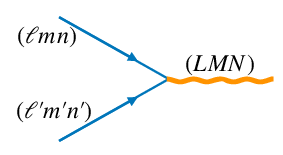
Figure 1: Schematic Feynman-like diagram illustrating the bilinear interaction of two parent QNMs sourcing a QQNM.
Numerical Confirmation: Nonlinear Modes in Simulated Merger Events
Numerical relativity simulations—solving the full nonlinear Einstein equations—permit direct measurements of QQNMs in post-merger GW signals. Analyses of waveform data from the SXS catalog, such as the BBHX:0305 simulation (which closely models GW150914), demonstrate that including the dominant QQNM (with frequency 2ω220 and angular harmonic (4,4)) in ringdown fits significantly improves agreement with the simulation. Specifically, residuals are reduced by an order of magnitude compared to fits using linear modes alone, and the QQNM amplitude is found at approximately 10% of the primary (220) QNM amplitude.
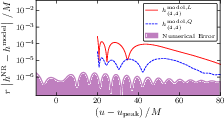
Figure 2: Residuals from GW150914-like simulation fits: the residuals are notably reduced when accounting for the QQNM compared to a purely linear model.
The fitting protocol clearly shows that quadratic corrections are not only present, but their amplitude makes them numerically significant, particularly at u−upeak>20M post-merger. These effects are robust across a range of simulations, especially for nearly equal-mass, non-precessing binaries.
Amplitude and Frequency Relations: Consistency with Perturbation Theory
Theoretical and numerical work now provides a stable prediction for the amplitude of the dominant QQNM in the typical (4,4) harmonic of nearly equal-mass binaries:
Aℓmn0
This quadratic dependence, validated in nonspinning and moderate-spin cases, means QQNMs test not only the presence of nonlinearities but the structure of mode-mode coupling in GR. Detection of both frequency (Aℓmn1) and amplitude (Aℓmn2 with the predicted constant) forms the basis of a powerful null test of the Einstein field equations in strongly curved, dynamic spacetimes.
Detectability Prospects with Next-Generation Detectors
Modern and forthcoming GW observatories, such as the Einstein Telescope (ET), Cosmic Explorer (CE), and LISA, feature sufficient strain sensitivity to measure QQNMs in multiple classes of binary events. Characteristic strain analyses indicate that, for GW150914-like events, the SNR for the QQNM can surpass that of several linear subdominant modes and reach levels (Aℓmn3 in ET) making them observable in a significant fraction of expected events.
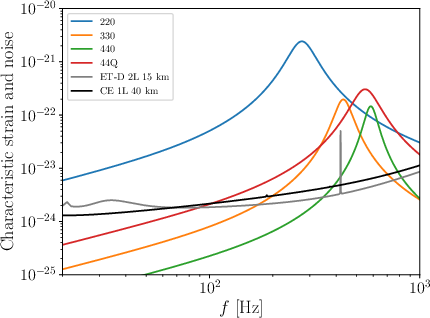
Figure 3: Projected characteristic strains for the Aℓmn4, Aℓmn5, Aℓmn6, and Aℓmn7 QNMs compared to ET and CE noise curves for GW150914-like sources; Aℓmn8 is clearly detectable.
Population studies predict tens of ground-based detections per year (with Aℓmn9), and potentially thousands with LISA over its mission. Precise measurement of the QQNM parameters allows both independent tests of mode frequencies and improved constraints on the linear mode spectrum by breaking degeneracies in multi-mode ringdown fits.
Quantitative Parameter Estimation and Impact on Future Constraints
Fisher forecasts for high-SNR events show that the QQNM frequency is typically measured with smaller uncertainties than the (ℓ,m)0 mode and only moderately worse than (ℓ,m)1. If the QQNM is enforced as a dependent mode (using the GR-predicted amplitude-frequency relationship), fitting degeneracies are reduced, yielding factor-of-two improvements in the estimation of linear subdominant QNM parameters.
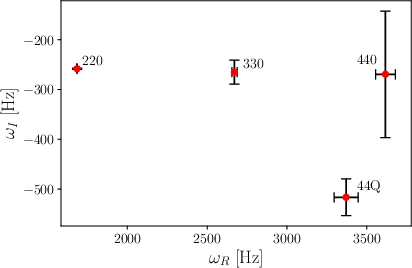
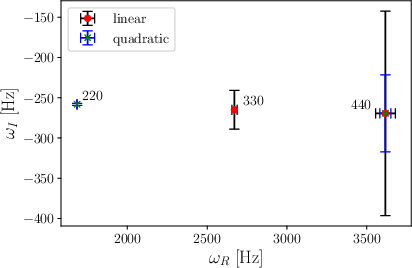
Figure 4: Expected real and imaginary frequency uncertainties for key QNMs in high-SNR ET detections; applying GR constraints tightens parameter bounds, most notably for the (ℓ,m)2 mode.
This dual use—testing QQNM existence per se and enhancing linear mode parameter inference—elevates qqnm modeling to a core component of precision GW phenomenology.
Open Problems and Theoretical Implications
While recent progress on QQNMs has solidified their theoretical and observational relevance, several open issues remain. The amplitude scaling and detectability of QQNMs in subdominant harmonics such as (ℓ,m)3 require further forecast studies. The implications for modified gravity theories are unknown; calculating QQNM spectra in alternative theories remains an outstanding problem. Additional nonlinear contributions (e.g., from non-stationary remnant mass/spin evolution immediately post-merger) could further refine ringdown modeling, especially in the early ringdown regime where SNR is maximal.
Conclusion
Quadratic QNMs represent an inevitable and detectable signature of gravity’s nonlinear structure in post-merger black hole GW signals. With projected SNRs surpassing those of several subdominant linear QNMs, their detection will soon be routine in advanced observatories, facilitating both direct tests of GR’s nonlinear dynamics and improved precision in linear mode studies. Theoretical interpretation of QQNM amplitudes and frequencies offers stringent null benchmarks for GR, but future work must expand to alternative theories and less-explored binary configurations. The inclusion of nonlinear effects in ringdown marks a necessary step for the next generation of gravitational wave astronomy and the pursuit of strong-field gravity phenomenology.