- The paper demonstrates high-precision NIR abundance analysis of 46 solar analogs through differential, line-by-line calibration.
- It employs robust spectral synthesis and telluric correction methods, achieving median uncertainties below 0.05 dex for most elements.
- The study reveals a notably steep age trend in [P/Fe], challenging conventional nucleosynthetic models and informing Galactic chemical evolution.
High-Precision Near-Infrared Abundances of Solar Analogs in the YJ Bands
Introduction and Scientific Context
This study delivers a comprehensive near-infrared (NIR) abundance analysis of 46 solar analogs using WINERED WIDE-mode spectroscopy (R=28,000) targeting the YJ bands ($0.976$--$1.089$ and $1.182$--1.319 μm). The primary motivation is to empirically extend the precise element-by-element abundance framework established by optical spectroscopy into the NIR. This is particularly significant for phosphorus (P), which lacks accessible lines in the optical for solar-like dwarfs, and for potassium (K), for which high-precision constraints have lagged due to severe blending in the optical.
The sample overlaps with the homogeneous, high-S/N solar analog studies of Bedell et al. (2018), leveraging well-determined stellar parameters and ages. The approach employs strictly differential, line-by-line abundance calibration utilizing stars in the 3--7 Gyr age interval, exploiting their highly uniform abundance patterns to establish the zero-point and minimize systematic errors.
Observational Approach and Data Handling
High-S/N NIR spectra were obtained via WINERED on Magellan/Clay, covering 46 stars with typical per-pixel S/N of 250--350, and up to 1000 in a combined spectrum. The observational protocol ensures robust telluric correction, employing a tailored PCA-based procedure, TerraPCA, with A0V standard libraries and the removal of residual stellar features prior to telluric fitting. This statistical procedure is critical for continuum normalization and for minimizing the impact of telluric contamination on systematic abundance errors.
Abundance Analysis Pipeline
The methodology consists of:
- Empirical Line Selection and Calibration: Candidate atomic transitions are curated from VALD and MB99 data, and pruned using depth and blending diagnostics. Empirical zero-point corrections (Δline) and per-line uncertainties (σline) are derived by examining the root-mean-square residuals between observed and synthetic spectra in reference calibrators.
- Spectral Synthesis: Elemental abundances are computed using synthetic spectra from MOOG (2019 version), informed by ATLAS9-APOGEE atmosphere models and stellar parameters from optical literature sources. The quantitative minimization approach integrates over residual curves across a grid of trial abundances for each candidate line.
- Combined Residual Curve Construction: For each star and element, residuals from all robust NIR lines (post zero-point calibration) are merged with their empirically propagated uncertainties, yielding high-precision abundance estimates. Bootstrap simulations confirm the internal statistical consistency of the derived errors.
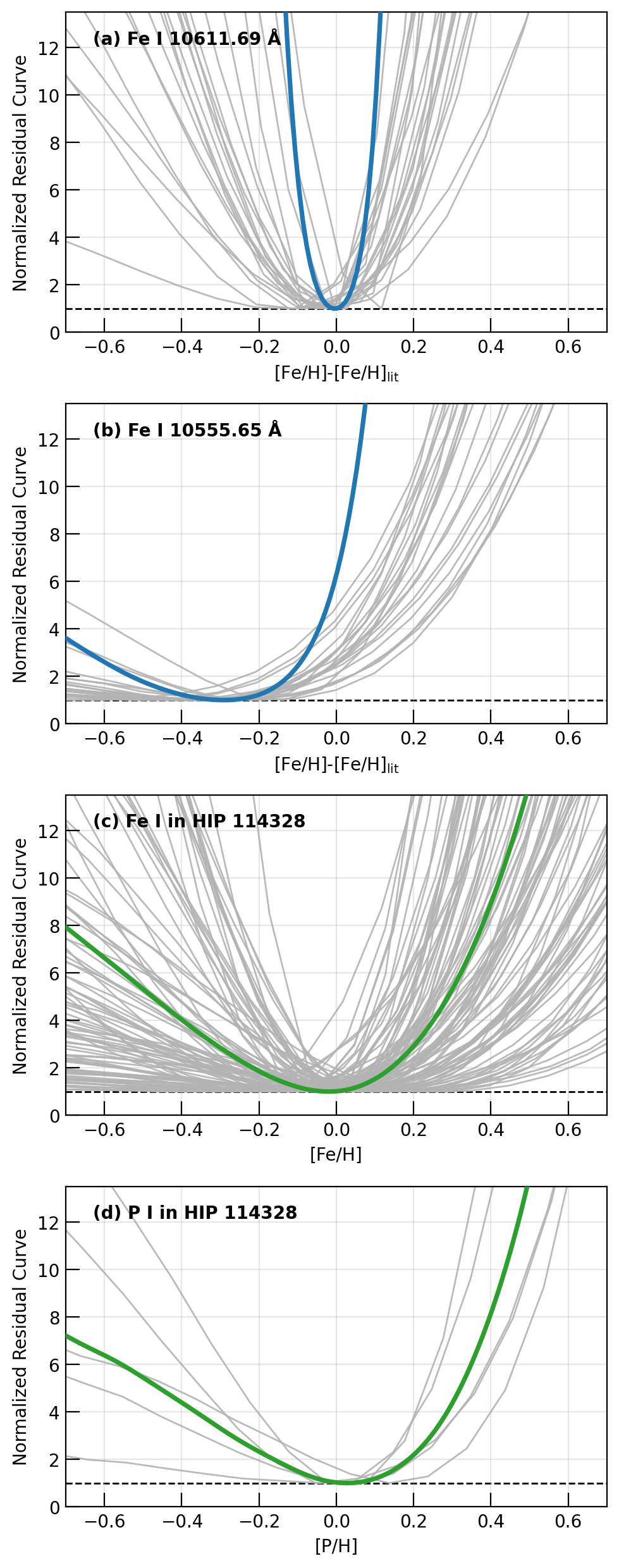
Figure 1: Illustrative residual curves for Fe I and PI lines, demonstrating the precise constraining power of the methodology for both strong and weak features.
Key Technical Results
Line List Validation: 256 VALD and 237 MB99 lines remain after stringent empirical selection. The majority of per-line zero-points fall within ±0.2 dex, and the median random errors for most elements are well below 0.05 dex. Strong lines are retained, with per-line zero-point calibration empirically compensating for non-LTE and 3D effects due to the homogeneous stellar parameter space.
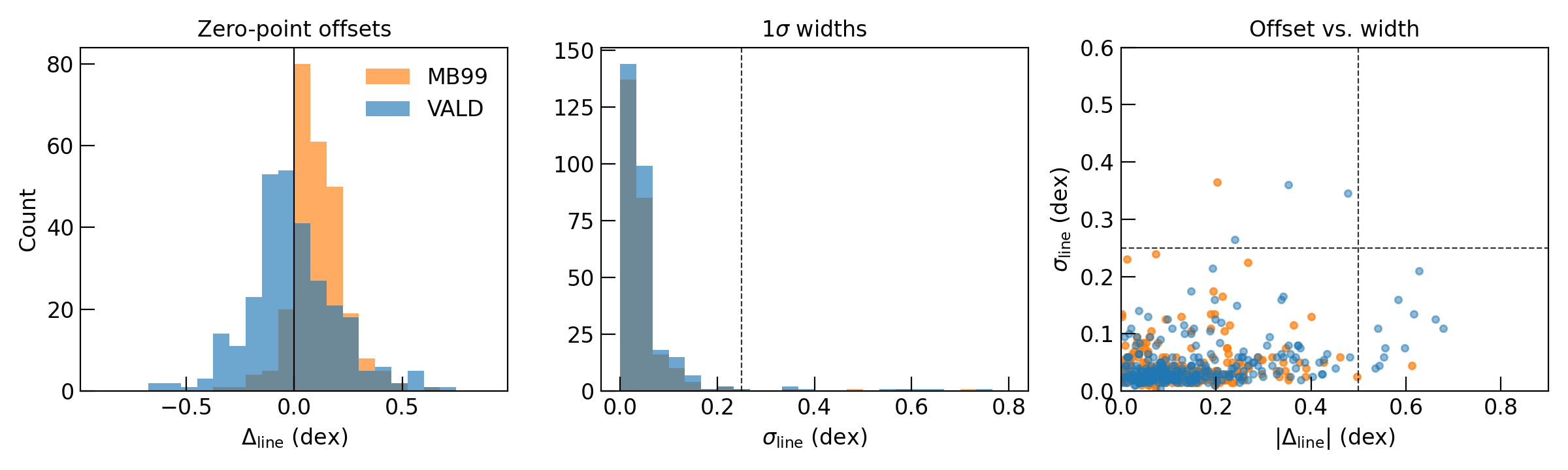
Figure 2: Distribution of per-line zero-point offsets (Δline) and uncertainties, characterizing the quality of the calibrated line list.
Abundance Consistency: Comparison with optical precision studies yields RMS residuals of 0.03--0.2 dex (element dependent), with iron and silicon abundances agreeing within 0.03 dex. The internal errors for Fe and Si are <0.01 dex, demonstrating that NIR determinations can match state-of-the-art optical analyses in relative precision.
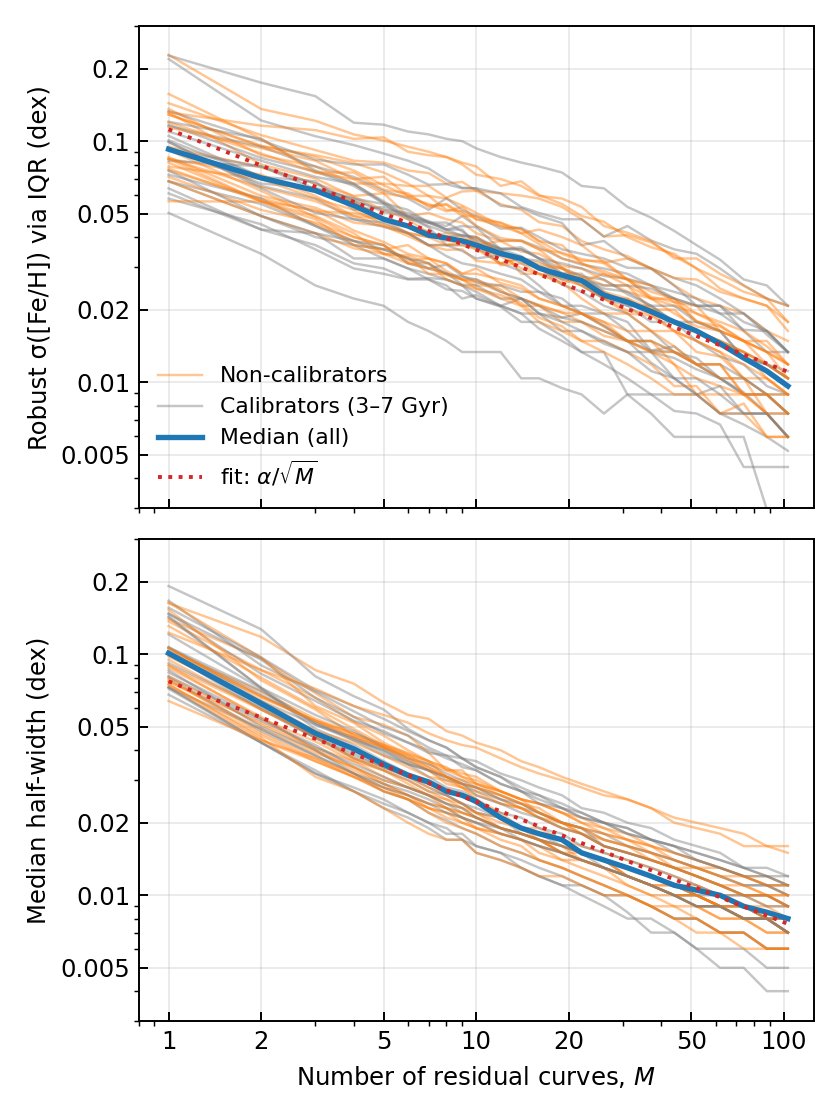
Figure 3: Bootstrap test validating that measurement uncertainties on [Fe/H] scale appropriately with the number of Fe I lines incorporated.
Phosphorus Abundances: Five Pi lines deliver a median uncertainty of 0.03--0.04 dex per star. These lines are intrinsically weak (typical depths $0.976$00.05, equivalent width $0.976$130 mÅ) but are robustly measured due to the stacking and differential calibration pipeline.
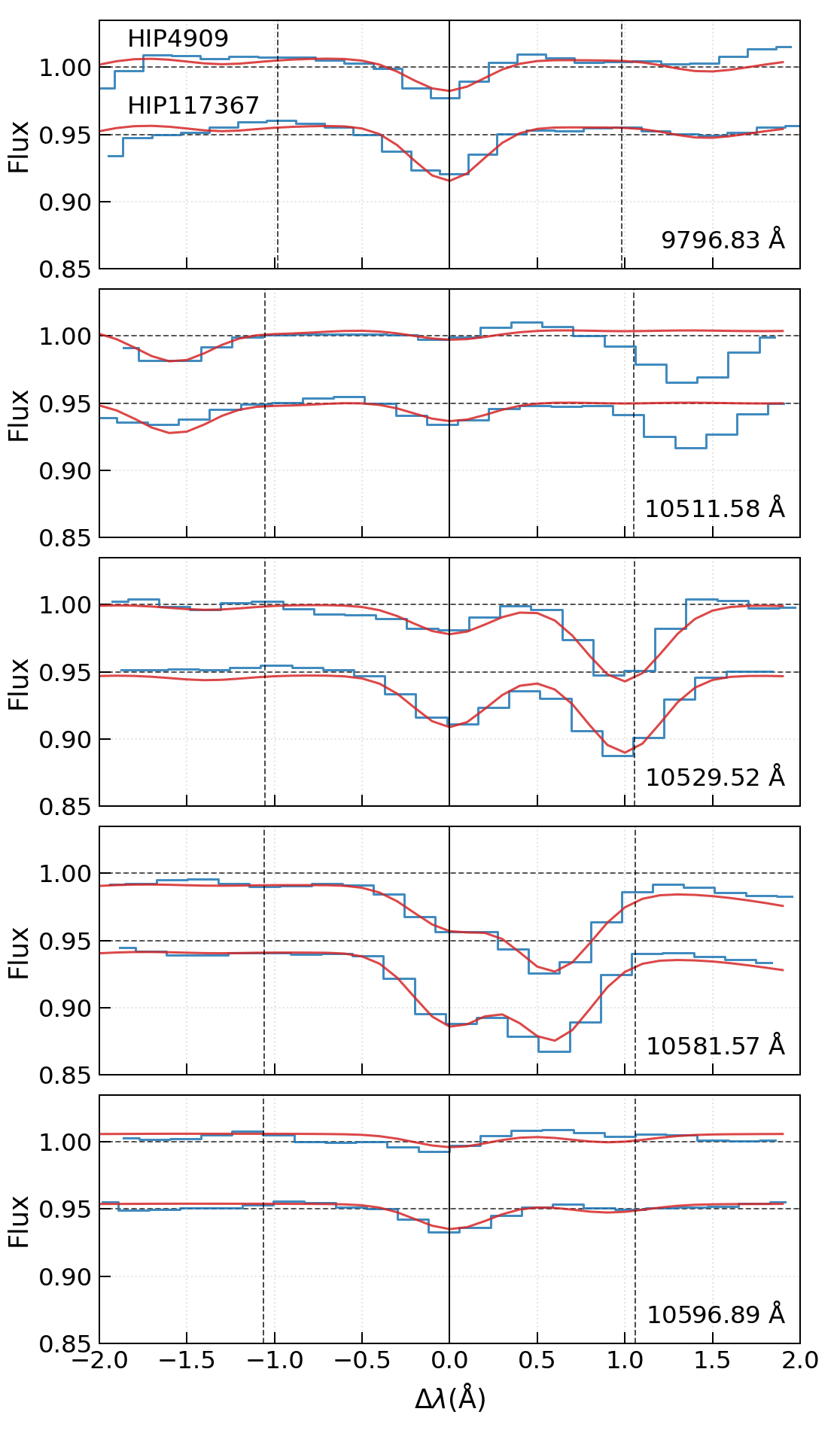
Figure 4: NIR P I lines in solar analogs with synthetic fits, demonstrating line detectability and quality of model fitting at high S/N.
Empirical Age--Abundance Trends
A core output is the characterization of age--[X/Fe] relations for 15 elements, with the time derivatives of [X/Fe] compared to prior optical work. While most elements reproduce the trends from Bedell et al. (2018), phosphorus, for the first time, is rigorously constrained in solar analogs. The age--[P/Fe] slope ($0.976$2 dex Gyr$0.976$3) is found to be significantly steeper than for $0.976$4-elements (e.g., Mg, Si), empirically excluding models where P evolves identically to canonical massive star nucleosynthetic products.
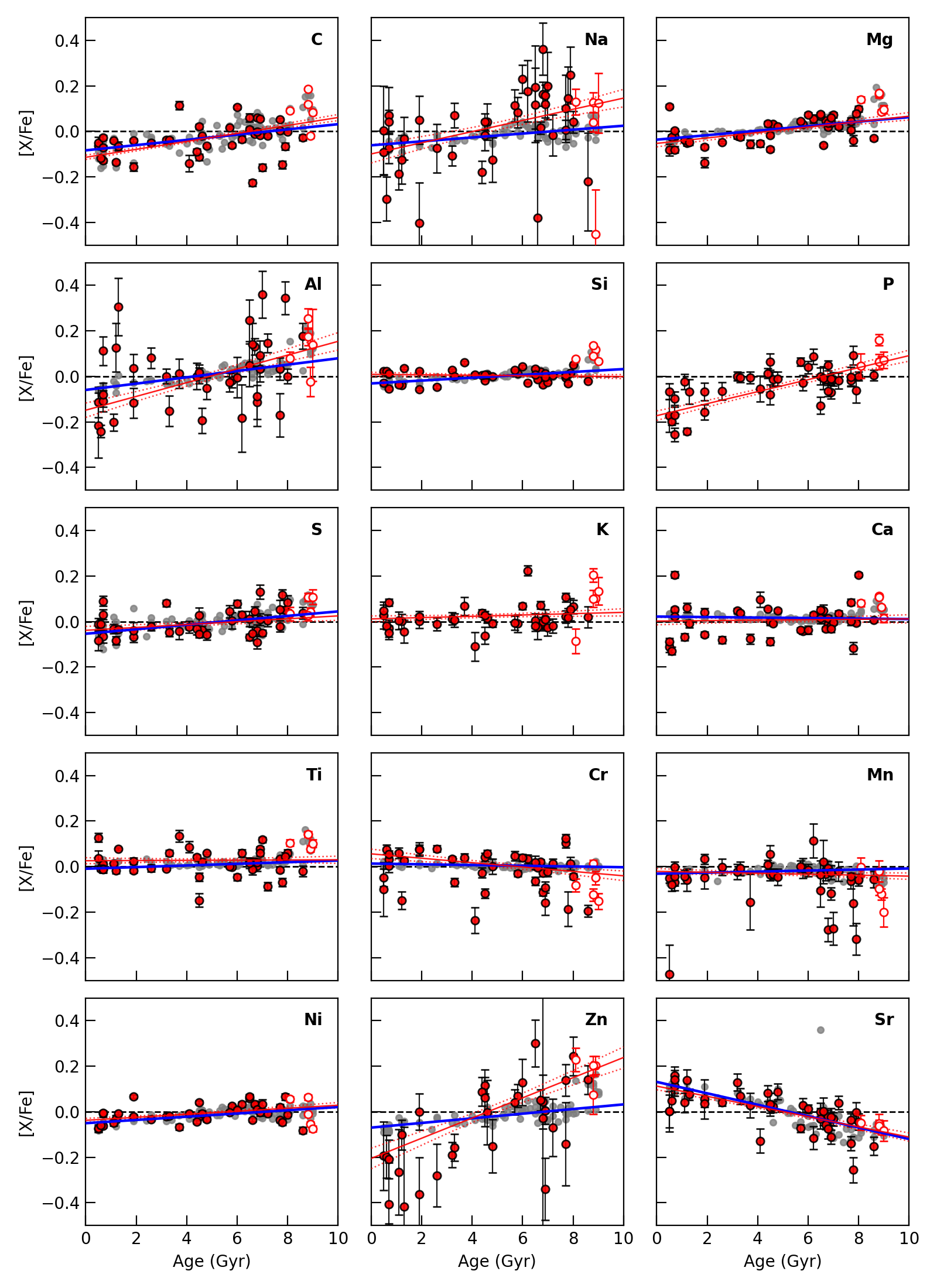
Figure 5: Age--[X/Fe] relations for all measured elements; the steepness of the [P/Fe] trend is apparent and statistically significant.
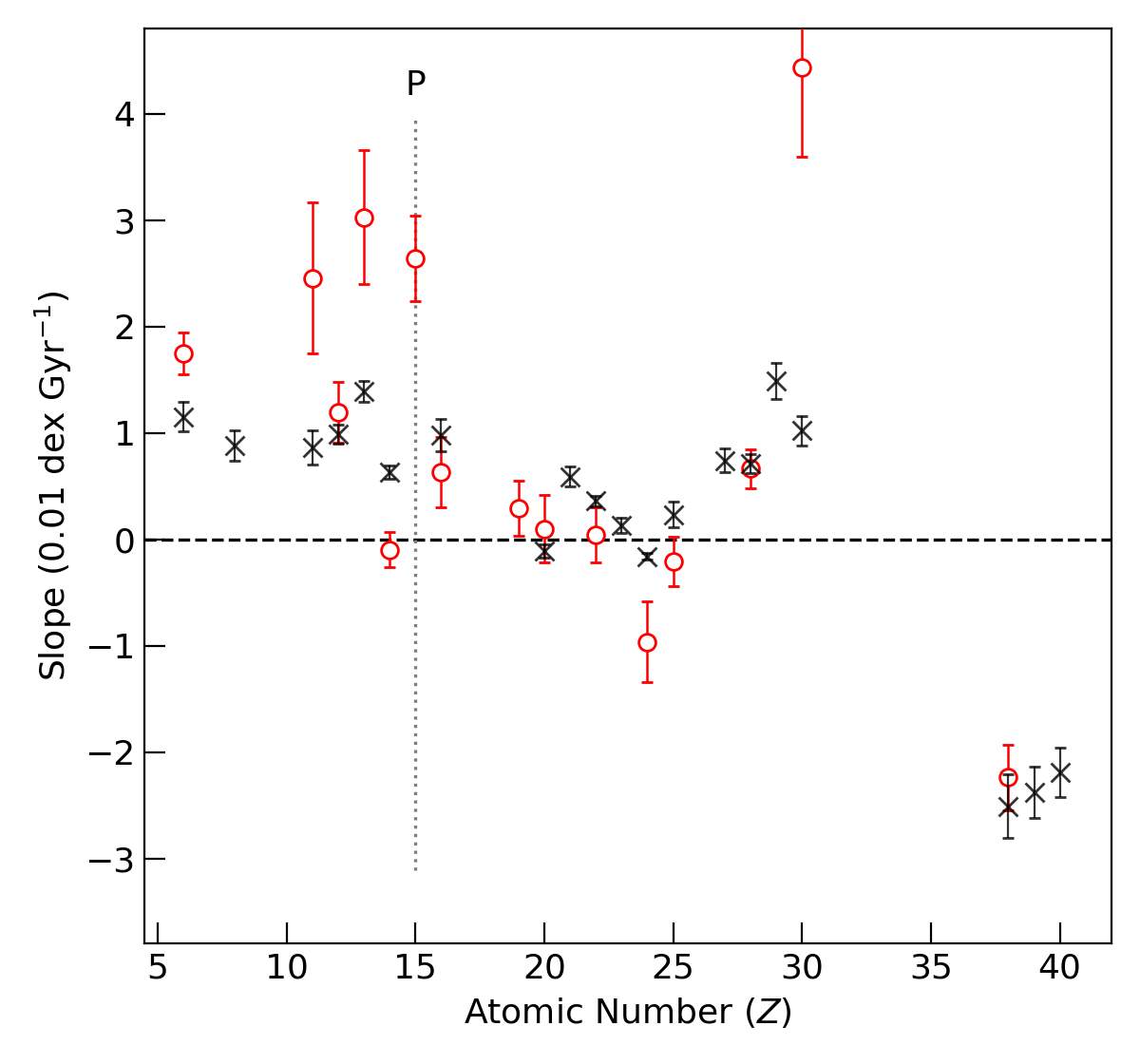
Figure 6: Direct comparison of derived age--[X/Fe] slopes to literature; the P trend is steeper than all $0.976$5 species.
For K and S, the age trends are insignificant, emphasizing element-dependent GCE dependencies. The steep negative correlation of [Sr/Fe] with age is also reproduced and matches s-process timescale expectations.
Systematics and Empirical Calibration
Systematic uncertainties from atomic data (oscillator strengths, blending, non-LTE effects) are empirically suppressed through the zero-point calibration using chemically homogeneous calibrators. Validation against optical solar analog measurements demonstrates that internal (relative) NIR abundances are robust to $0.976$60.05 dex. The publication includes a high-S/N combined reference spectrum (S/N$0.976$71000) of calibrators for benchmarking and future line profile studies.
Implications for Galactic Chemical Evolution and Stellar Physics
The empirically derived, steep age evolution of [P/Fe] in solar analogs directly constrains GCE models. The trend is inconsistent with simple CCSNe+SNe Ia enrichment prescriptions and requires an additional time-dependent component, such as metallicity- or progenitor-mass-dependent P yields, or nonstandard contributions from sources like ONe novae. These findings provide a critical anchor for models attempting to reconcile low [P/Fe] in the early Galaxy, the non-monotonic [P/Fe]–[Fe/H] observed trend, and the solar-neighborhood age dependencies.
Pragmatically, the access to K, P, and other NIR-only elements at high precision opens new parameter space for time-resolved GCE and exoplanet host star chemistry studies. The released calibrated line list and reference spectrum will facilitate reproducible and comparable NIR abundance work, providing a route toward population-scale mapping of chemical signatures inaccessible to optical work.
Conclusion
This work empirically establishes NIR abundance analysis of solar analogs, demonstrating parity with optical methods for internal precision and consistency, but strongly extending the accessible element set—especially for P and K. The main findings are:
- Empirical per-line calibration in a chemically tight and well-characterized sample enables high-fidelity abundance scales mitigating atomic data systematics.
- NIR measurements of P in solar analogs are robust and reveal a statistically significant, steep age trend in [P/Fe], stricter than any $0.976$8 element, providing new constraints for models of P synthesis and GCE.
- The pipeline and data products support the adoption of NIR high-resolution spectroscopy for future studies of Galactic and stellar evolution, exoplanet hosts, and the role of "life elements" across cosmic time.
The framework and data provided here set a new standard for NIR stellar abundance work and highlight the necessity of multidimensional, empirical calibration for harnessing next-generation NIR spectroscopic datasets.
References
(2604.00981)

