- The paper demonstrates that ultrafast laser excitation drives a metastable hidden state in LCMO, exhibiting an 8% resistivity drop and a 170 meV polaron softening.
- The methodology integrates femtosecond near-infrared laser pulses with in-situ transport, XAS, and RIXS to elucidate orbital, charge, and phonon interactions under different strain conditions.
- The findings validate the Holstein small-polaron model as a robust predictor of electron–phonon coupling and suggest pathways for nonvolatile oxide electronics and quantum information transduction.
Excitations Across Equilibrium and Photoinduced Hidden States in Magnetoresistive Manganites
Introduction
The study addresses the microscopic nature of long-lived photoinduced phases in La2/3Ca1/3MnO3 (LCMO), a prototypical manganite system exhibiting colossal magnetoresistance. The focus is on the antiferromagnetic insulating (AFI) phase, which, under specific ultrafast optical excitation parameters, transitions into a long-lived, reversible, and metastable state—the so-called "hidden" phase. This essay reviews the experimental approach, the key spectroscopic findings on polarons and phonons, and the broader theoretical implications for the photo-manipulation of strongly correlated oxides.
Experimental Methodology
The comprehensive experimental setup integrates femtosecond near-infrared (1.2 eV, 1030 nm) ultrafast laser excitation with in-situ transport, x-ray absorption spectroscopy (XAS), and resonant inelastic x-ray scattering (RIXS). The films, strained on NdGaO3 substrates, allow for the stabilization of both ferromagnetic metallic (FMM) and AFI phases, providing a tunable ground state manifold via epitaxial strain.
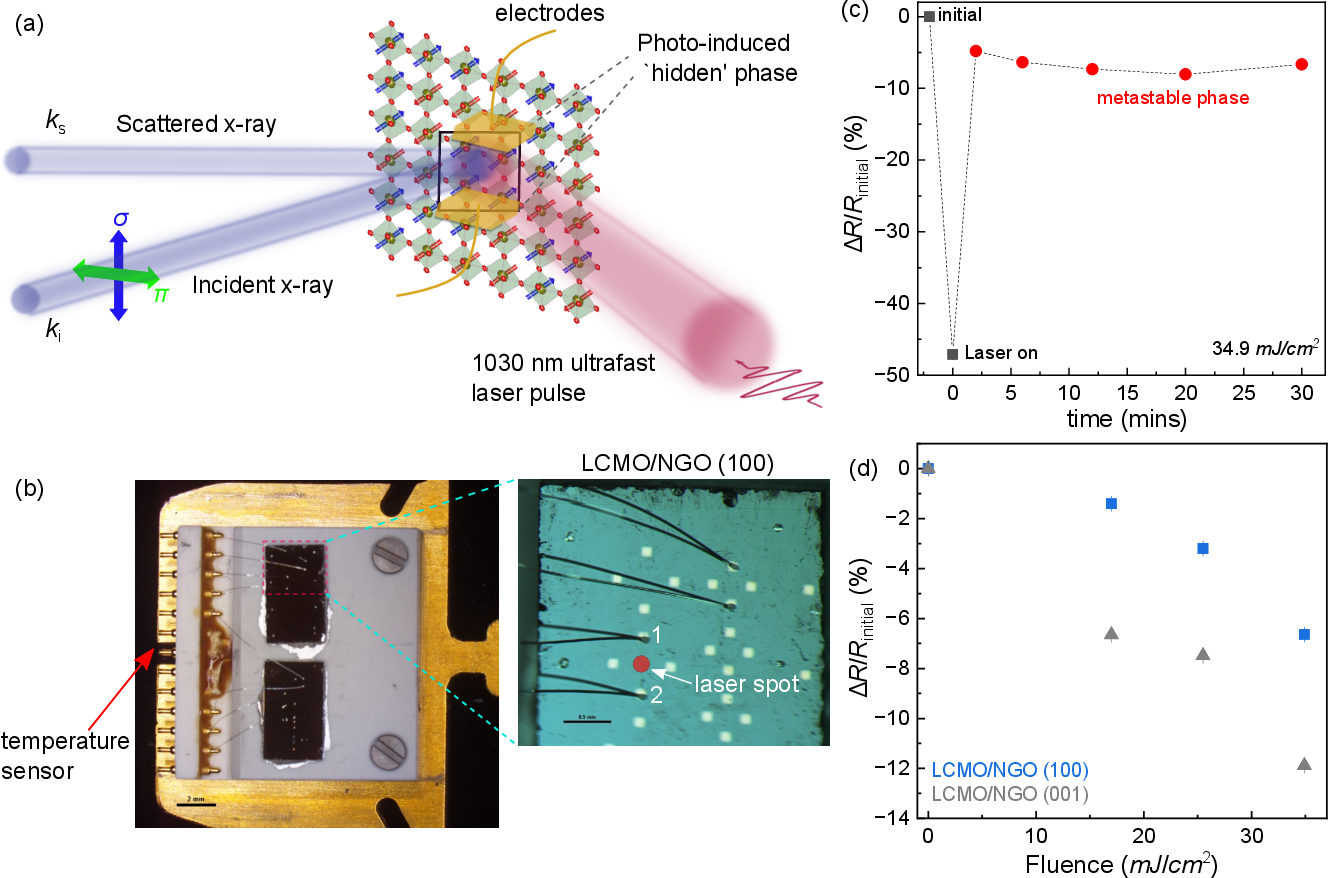
Figure 1: Schematic of the in-situ laser-transport-RIXS measurement platform, emphasizing the spatial overlap and concurrent probing of transport and spectroscopic response in LCMO thin films.
This integrated scheme enables access to electronic transport properties, orbital polarization (via XAS), and elementary charge-lattice excitation spectra (via RIXS) in both equilibrium and photo-perturbed conditions.
Characterization of Equilibrium Phases: Strain, Jahn-Teller Effect, and Polaron Physics
In equilibrium, LCMO displays an FMM ground state in bulk, which switches to AFI under substantial epitaxial tensile strain. The AFI state exhibits enhanced Jahn-Teller (JT) distortion, as observed by the broadening and shifting of O-K XAS features associated with hybridized Mn 3d–O 2p states.
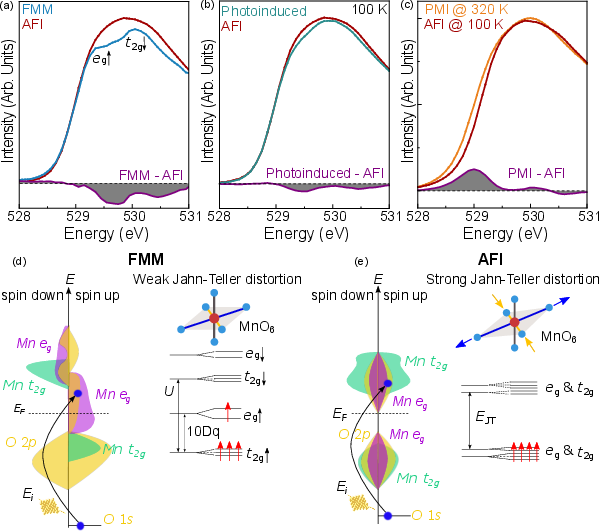
Figure 2: O-K edge XAS and derived density-of-states, showing contrasting orbital occupation and JT distortion between FMM and AFI phases.
RIXS reveals that the central low-energy excitations are polarons (manifested as prominent peaks at 400–950 meV depending on phase and tuning), Jahn-Teller-active phonons (around 60 meV), and higher-energy orbital/charge transfer excitations.
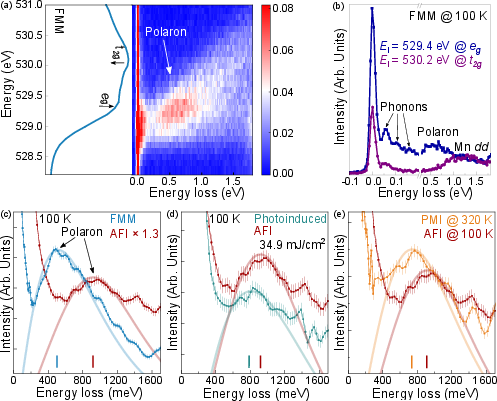
Figure 3: RIXS energy-momentum map and representative spectra in equilibrium, defining spectral signatures of FMM, AFI, and high-T paramagnetic insulating (PMI) phases.
Detailed temperature and strain dependence of the polaron responses indicate that all equilibrium phases reside in the strong-coupling limit of the Holstein small-polaron regime, with polaron energy tracks controlling the exponential temperature dependence of the macroscopic resistivity.
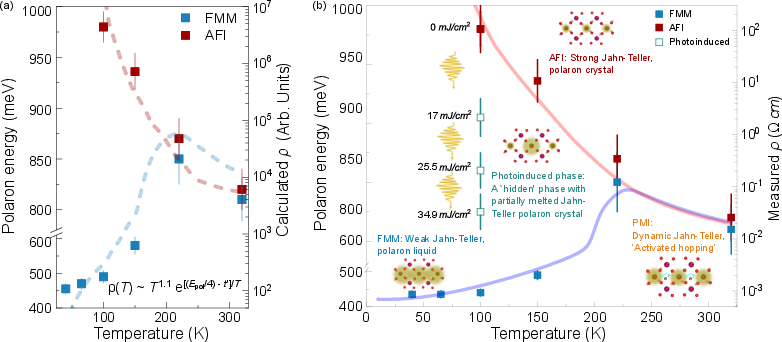
Figure 4: Temperature and phase diagram of extracted polaron energies and corresponding resistivity. Data highlight the Holstein strong-coupling scenario and delineate the distinct phase trajectories accessible by strain, temperature, and photo-excitation.
Photoinduced Hidden Phase: Transport and Spectroscopic Signatures
Upon 1.2 eV ultrafast laser excitation of AFI films, a metastable state emerges with persistently reduced resistivity (by ≈ 8% relative to equilibrium AFI, long-lived beyond 30 minutes) but retains insulating character—contrasting with prior reports of full metallization under different excitation conditions. The photoinduced state displays:
- Robust softening of the polaron excitation by 170 meV (peak shift from ≈ 960 to 790 meV at highest fluence).
- Partial suppression of the O-K XAS features associated with the JT distortion but no complete restoration to FMM doublet splitting.
- Minimal changes in the JT-active 60 meV phonon frequency and intensity compared to the much more pronounced (and metallicity-associated) softening and intensity loss observed with the equilibrium FMM state.
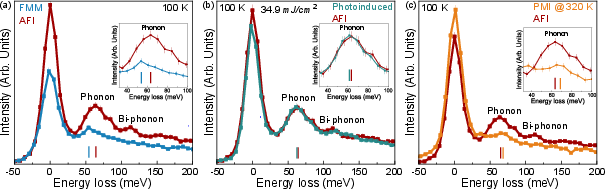
Figure 5: RIXS phonon sector for FMM/AFI, AFI/photoinduced, and AFI/PMI, showing distinct persistence and energy positions of the 60 meV mode.
Laser fluence systematically tunes the magnitude of polaron softening, but the phonon response remains nearly invariant, ruling out trivial heating effects and equilibrium-like phase separation.
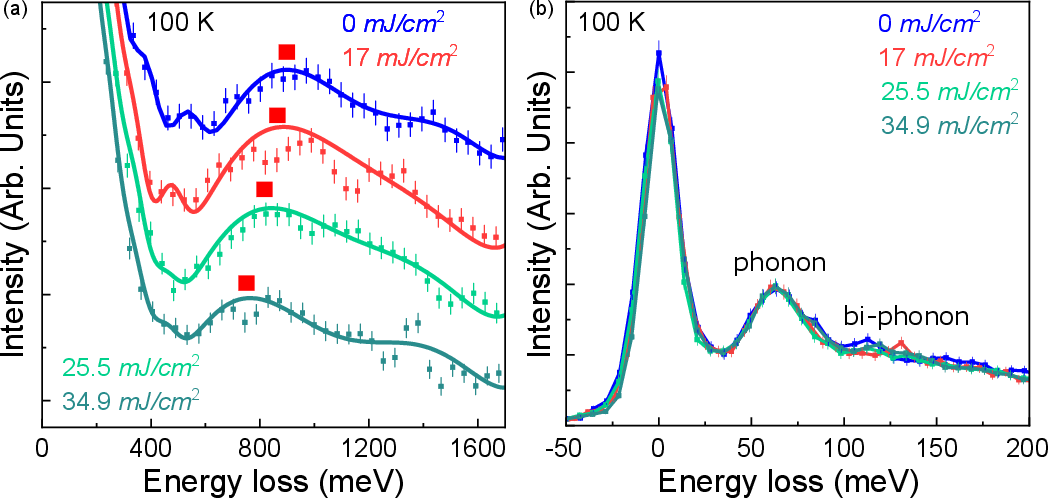
Figure 6: Fluence-dependent evolution of broad polaron and specific phonon features in AFI films following 1.2 eV photoexcitation.
Theoretical Interpretation and Strong Statements
Key numerical results and statements include:
- The photoinduced phase never exhibits polaron softening, phonon suppression, or XAS evolution consistent with a metallic liquid; it is not a photoinduced transition into the FMM state for these excitation parameters.
- The polaron energy is a quantitative indicator for the local electron-phonon coupling strength; its exponential correlation with resistivity upholds over four orders of magnitude, validating the predictive power of the Holstein small-polaron model for transport in all LCMO states.
- The hidden state’s microstructure cannot be reproduced by any equilibrium combination of strain or thermal broadening axes; it is a unique, non-ergodic configuration best described as a partially melted JT polaron “crystal,” with reduced long-range orbital/charge order but largely locally intact JT distortion.
Implications and Future Directions
The results indicate that discrete and controllable hidden quantum states in manganites can be stabilized and interrogated via orbital- and charge-selective photoexcitation, analyzed with ultrafast, non-stroboscopic RIXS. These observations reinforce the sensitivity of phase selection to the precise excitation wavelength, pulse protocol, and experimental geometry, mandating systematic control in any phase competition landscape.
Practically, this work demonstrates new strategies for manipulating quantum-functionality in correlated electron materials—for example, nonvolatile resistive switching in oxide electronics and the realization of hidden orders for memory or quantum information transduction. Theoretically, it establishes the polaron energy as a robust microscopic order parameter for non-equilibrium correlated states, decoupling local lattice from large-scale electronic phase transitions.
Prospective directions include wavelength- and pulse-length resolved laser-RIXS studies, spatially resolved micro-RIXS to map phase heterogeneity, and time-domain approaches to separately track the evolution of orbital, charge, and vibrational degrees of freedom across the non-thermal free-energy landscape.
Conclusion
This work elucidates the microphysics of a photoinduced metastable phase in LCMO, demonstrating that strong electron-phonon coupling and cooperative Jahn-Teller distortion control the phase evolution accessible by non-equilibrium laser excitation. The polaron softening and persistent phonon response uniquely fingerprint the photoinduced state as a nonergodic, strongly-coupled polaron configuration that cannot be reached via temperature or strain alone. High-resolution laser-RIXS constitutes a decisive methodology for advancing the nonequilibrium quantum materials field, providing essential insight into the interplay of orbital, lattice, and transport phenomena in strongly correlated compounds.

