Robust Multidimensional Chinese Remainder Theorem (MD-CRT) with Non-Diagonal Moduli and Multi-Stage Framework
Published 1 Apr 2026 in eess.SP | (2604.00995v1)
Abstract: The Chinese remainder theorem (CRT) provides an efficient way to reconstruct an integer from its remainders modulo several integer moduli, and has been widely applied in signal processing and information theory. Its multidimensional extension (MD-CRT) generalizes this principle to integer vectors and integer matrix moduli, enabling reconstruction in multidimensional signal processing scenarios. However, since matrices are generally non-commutative, the multidimensional extension introduces new theoretical and algorithmic challenges. When all matrix moduli are diagonal, the system is equivalent to applying the one-dimensional CRT independently along each dimension. This work first investigates whether non-diagonal (non-separable) moduli offer fundamental advantages over traditional diagonal ones. We show that under the same determinant constraint, non-diagonal matrices do not increase the dynamic range but yield more balanced and better-conditioned sampling patterns. More importantly, they generate lattices with longer shortest vectors, leading to higher robustness to vector remainder errors, compared to diagonal ones. To further improve the robustness, we develop a multi-stage robust MD-CRT framework that improves the robustness level without reducing the dynamic range. Due to the multidimensional nature and modulo matrix forms, it is challenging and not straightforward to extend the existing one-dimensional multi-stage robust CRT. In this paper, we obtain a new condition for matrix moduli, which can be easily checked, such that a multi-stage robust MD-CRT can be implemented. Both theoretical analysis and simulation results demonstrate that the proposed multi-stage robust MD-CRT achieves stronger error tolerance and more reliable reconstruction under erroneous vector remainders than that of single-stage robust MD-CRT.
The paper demonstrates that while diagonal modulus matrices optimize dynamic range, non-diagonal moduli yield superior robustness by producing lattices with longer shortest vectors.
It introduces a scalable multi-stage reconstruction framework that effectively cascades error correction to manage bounded vector remainder errors.
The research provides a theoretical blueprint for designing error-resilient multidimensional sampling systems, benefiting applications in distributed sensing and digital conversion.
Robust Multidimensional Chinese Remainder Theorem (MD-CRT) with Non-Diagonal Moduli and Multi-Stage Framework
Introduction and Motivation
The presented work investigates the multidimensional extension of the classical Chinese Remainder Theorem (CRT), termed the multidimensional CRT (MD-CRT), focusing on two principal axes: the impact of non-diagonal moduli matrices and the design of a multi-stage robust reconstruction framework. While the 1D CRT’s robustness and dynamic range properties have been thoroughly explored, the extension to the multidimensional scenario introduces both algebraic and geometric complexity due to non-commutativity of matrix multiplication and more intricate lattice structures. This paper provides novel theoretical results on the comparative properties of diagonal (separable) versus non-diagonal (non-separable) modulus matrices and develops a scalable multi-stage approach for robust reconstruction under bounded vector remainder errors.
Dynamic Range Analysis: Diagonal vs. Non-Diagonal Moduli
Maximum Dynamic Range under Determinant Constraint
A central question in the design of multidimensional undersampling systems using MD-CRT is how to maximize the reconstructible range (the "dynamic range") given a constraint on the determinants of the modulus matrices (corresponding to physical sampling limitations). The authors prove that the dynamic range, defined as the absolute determinant of the least common right multiple (lcrm) of all modulus matrices, is maximized by an arrangement of diagonal (separable) matrices whose diagonal elements are pairwise coprime integers. Constructive proofs using tools from Smith normal form, Hermite normal form, and elementary divisor theory confirm that non-diagonal matrices do not increase the maximal dynamic range over diagonal arrangements given an identical determinant constraint; this result generalizes the optimality from the 1D to the multidimensional case.
However, diagonal moduli induce highly unbalanced and ill-conditioned sampling lattices, as they typically concentrate the sampling rate along specific axes. The authors show that by leveraging non-diagonal constructions, the sampling geometry can be made considerably more isotropic, yielding improved conditioning of the lattice basis and more balanced sampling across all dimensions, beneficial for numerical stability and reduced susceptibility to quantization and error amplification.
Robustness Analysis: Shortest Vector and Error Tolerance
The Lattice-Theoretic Foundation
The robustness of MD-CRT in presence of bounded errors in the observed vector remainders is not determined by determinant-scale properties but by the length of the shortest vector in the lattices defined by the greatest common left divisors (gclds) of the modulus matrices. Specifically, when each remainder error ∥Δri∥ is bounded by τ, robust reconstruction is possible up to:
τ<i=jmin41λL(Gi,j)
where λL(Gi,j) is the minimum nonzero Euclidean norm in the lattice generated by the gcld of moduli i and j.
Non-Diagonal Moduli: Geometric Advantage
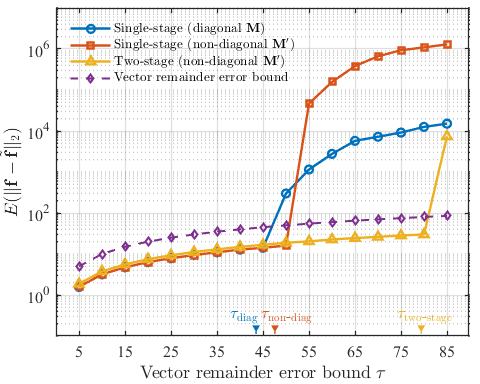
The critical—and empirically supported—insight is that non-diagonal matrices, while not increasing the dynamic range, can generate lattices whose shortest nonzero vector significantly exceeds the maximum attainable by diagonal matrices with the same determinant, exploiting the richer structure of integer matrix spaces. In two dimensions, for example, for prime determinant p, the optimal diagonal arrangement achieves shortest vector length ⌊p⌋, but specific non-diagonal Hermite normal forms yield strictly longer vectors, with improvement verified via exhaustive enumeration up to p<105.
Figure 1: Mean reconstruction error versus vector remainder error bound τ in diagonal, non-diagonal, and two-stage configurations, demonstrating the higher tolerance attained by non-diagonal moduli and further by the multi-stage framework.
Robust MD-CRT with maximally conditioned non-diagonal matrices is thus shown to be strictly more error-tolerant under the same sampling budget, justifying the use of non-separable modulus selection in applications where worst-case error control is crucial.
Multi-Stage Robust MD-CRT: Framework and Analysis
Motivation and Complexity
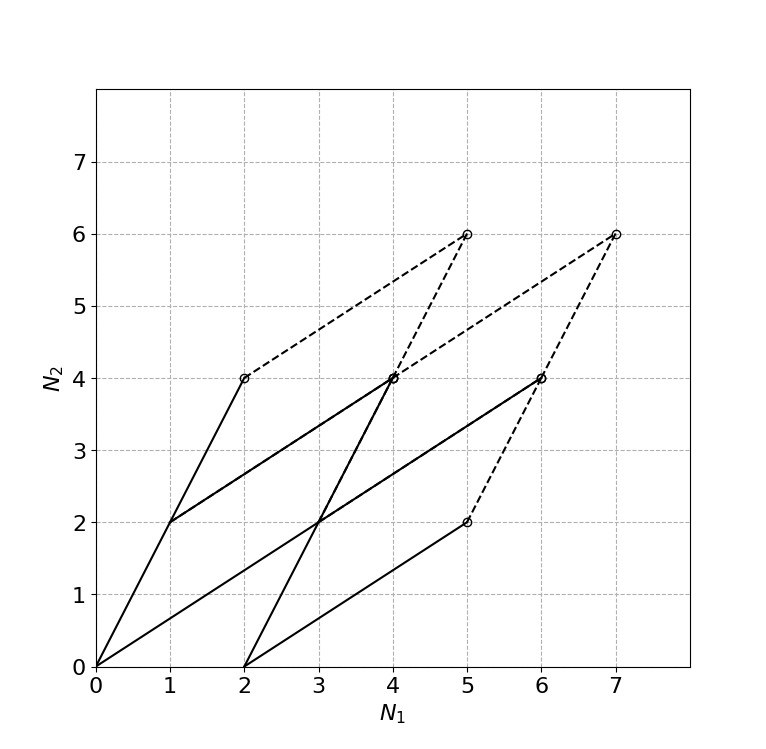
Replacing the 1D robust CRT’s strategy of grouping moduli and cascading error correction stages is nontrivial in the multidimensional context because the robustly determinable range no longer, in general, coincides with a fundamental parallelepiped (FPD), complicating the concatenation of robust reconstructions.
Figure 2: The robustly determinable range in Example 1, illustrating a union of shifted FPDs rather than a single contiguous region.
However, the authors develop sufficient (albeit not necessary) algebraic conditions—most tractably, requiring the Hermite normal form of the normalized lcrm to be diagonal—under which the robustly determinable region at each stage does coincide with an FPD. If, for every intermediate grouping at each stage, this condition holds, the cascading of robust reconstructions is valid, and robust estimation propagates correctly.
Formal Multi-Stage Protocol
The multi-stage procedure involves partitioning the full modulus set into subgroups, each processed by (single-stage) robust MD-CRT to obtain intermediate estimates. These are then treated as new remainders with new right-multiplied moduli in the next stage, iterating until full reconstruction. The authors provide concrete, tight bounds for the overall robustness at each stage. Stronger, more uniformly distributed gcld lattices (with greater shortest vectors) can be obtained by judicious partitioning, and the grouping can be optimized to maximize reconstruction error bounds.
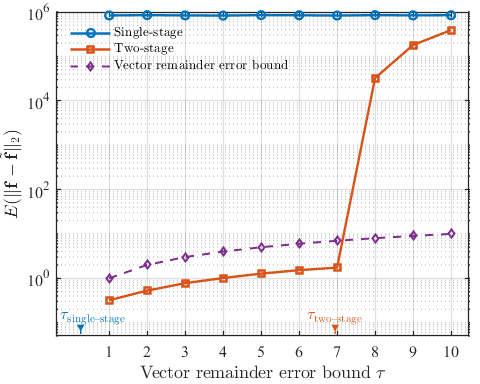
Figure 3: Mean reconstruction error versus vector remainder error bound τ0 in single-stage and two-stage frameworks using a six-modulus testbed, highlighting the strict gain in robustness with the proposed two-stage protocol.
When the grouping and lcrm selection conditions are met, the multi-stage framework is strictly more powerful than single-stage robust MD-CRT, allowing reliable recovery in regime where no single-stage method is robust, and increasing the tolerable error bound τ1 even when single-stage methods are feasible. Special cases where the multi-stage brings no gain (e.g., collections defined as common left factors times coprime structures) are also precisely characterized.
Practical and Theoretical Implications
This research yields two central impacts. First, it rigorously establishes that the optimality of diagonal modulus selection in dynamic range does not extend to robustness, supporting the use of non-separable modulus structures in multidimensional CRT applications requiring error resilience, such as distributed sensing, coding for storage, and analog-to-digital converters employing self-reset strategies. Second, by enabling the design of multi-stage robust MD-CRT systems, practitioners can systematically increase noise tolerance in high-dimensional integral inference, even with the same modulus determinant budget and without dynamic range loss.
The theoretical results provide a blueprint for future work in several directions. These include jointly optimizing modulus partitioning for maximal robustness across multiple stages, establishing necessary and sufficient algebraic conditions for FPD-structured robustly determinable regions, and synthesizing non-diagonal integer matrices with provable conditioning, coprimality, and minimal lattice basis norm.
Conclusion
The paper delivers a comprehensive algebraic and geometric analysis of robust MD-CRT in signal processing. Non-diagonal modulus matrices offer provable superiority in robustness over diagonal matrices, and the introduction of multi-stage reconstruction frameworks extends error tolerance without trading off the dynamic range. Simulation studies confirm the theoretical findings, including marked improvements in practical reconstruction error and error-bound thresholds in high-noise scenarios. This work thus advances the foundational understanding and sets the engineering blueprint for next-generation multidimensional CRT-based systems.