- The paper demonstrates that extending soft spins from scalar to vector models via dimensional annealing substantially improves success probabilities for finding global optima in NP-hard problems.
- Methodologies such as Anisotropic Gain Annealing, Metric Annealing, and Generalized Cross-Product Penalty effectively guide spins from multidimensional landscapes to Ising configurations.
- Simulation results show that vector spins in d≥2 consistently overcome local minima barriers, suggesting practical advantages without added hardware complexity.
Soft Vector Spins with Dimensional Annealing for Combinatorial Optimization
Introduction
This work introduces a multidimensional generalization of soft Ising spins, denoted as soft vector spins, aimed at enhancing combinatorial optimization via analog dynamical systems that naturally inhabit vectorial degrees of freedom. The authors model these spins as continuous Rd variables and analyze the efficacy of several dimensional annealing protocols in lifting the intrinsic optimization limitations imposed by traditional (scalar) soft Ising spin systems. The motivation builds on the observation that various analog platforms—including parametric, polaritonic, and electronic oscillator Ising machines—are inherently vectorial in their dynamics, typically supporting d≥2 amplitude and phase degrees of freedom. The aim is then to leverage this extended phase space to escape local minima endemic to the Ising energy landscape and thus more efficiently find global optima for Ising-encoded NP-hard problems.
Model and Dimensional Annealing Mechanisms
The base model comprises N coupled soft vector spins, each xi∈Rd, evolving according to a gain- and coupling-driven nonlinear ODE. For fixed-dimensionality d, their dynamics interpolates between Coherent Ising Machines (CIM, d=1) and gain-dissipative XY-like models (d=2). At large positive gain, the dynamics forces amplitudes onto Sd−1, effectively recovering vector spin Hamiltonian minimization.
Three principal dimensional reduction mechanisms are systematically developed:
- Anisotropic Gain Annealing (AGA): Introduces a quadratic anisotropy in the gain profile, explicitly favoring alignment along a prescribed vector axis. Operationally, this protocol mimics experimentally implemented second-harmonic injection-locking, biasing the system toward Ising-like collinear fixed points by ramping up the gain anisotropy.
- Metric Annealing (MA): Imposes a time-dependent anisotropic metric on the inter-spin coupling, again breaking the O(d) symmetry in coupling space and incrementally collapsing the dynamics into the Ising manifold. This protocol generalizes the hyperspin machine’s approach to dimensional annealing.
- Generalized Cross-Product Penalty (GCPP): Extends prior art (e.g., VISA) by introducing an antisymmetric tensor penalty enforcing collinearity for any d≥2. This acts as a nonlinear soft constraint, energetically penalizing non-collinear spin pairs.
These mechanisms are parameterized by annealing schedules dictating the temporal profile of anisotropy introduction, typically after initial vector spin relaxation.
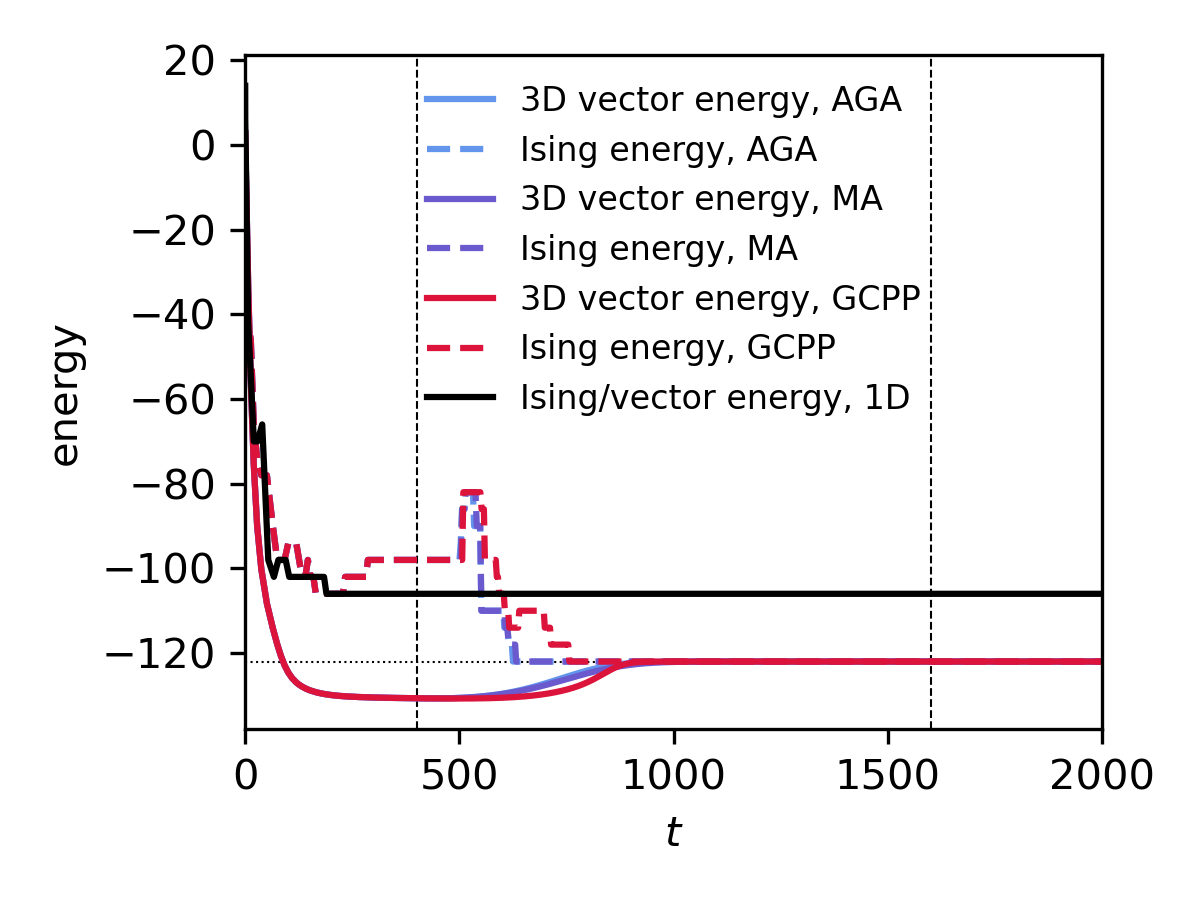
Figure 1: Example of d≥20 soft vector spins traversing the Ising energy landscape, highlighting energy jumps facilitated by dimensional annealing that are inaccessible to scalar (d≥21) systems.
Simulation Methodology and Trajectory Analysis
Simulation studies implement the aforementioned mechanisms on benchmark Ising problem classes, including tile planted ensemble (2D/3D TPE), Wishart planted ensembles (WPE), and random sparse matrices. Both linear and feedback-driven gain annealing schedules are considered, and the effect of the vector dimension d≥22 is systematically probed (d≥23 through d≥24).
Key aspects of the numerical procedure include adaptive ODE integration, projection of vector spins to Ising configurations, and comparison over multiple randomized problem instances to extract success probabilities—defined as fraction of trials yielding the true ground state (within tolerance).
Trajectory analysis reveals that vectorial soft spin systems, when subject to dimensional annealing, routinely escape energy barriers confining scalar systems to metastable states. The added degrees of freedom render formerly stable local minima into saddles in the enlarged configuration space, catalyzing barrier crossing and improved global search.
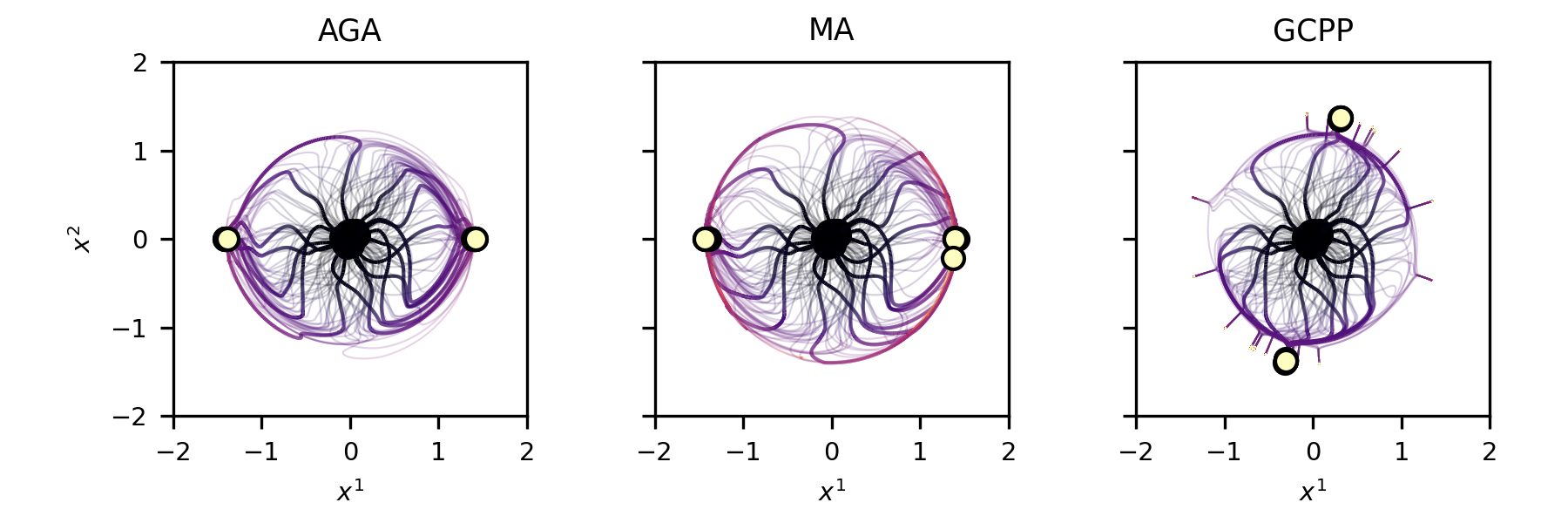
Figure 2: Representative trajectories in d≥25 soft vector spin systems under different dimensional annealing protocols, visualizing alignment and convergence behaviors.
Statistical evaluation of optimization performance demonstrates that all three dimensional annealing protocols significantly boost ground state success probabilities relative to scalar soft spin dynamics, particularly in d≥26 and d≥27. The improvement is robust across both easy and hard instance ensembles, annealing schedules, and is not highly sensitive to protocol details.
Quantitatively, the most pronounced increase in success probability occurs when increasing d≥28 from d≥29 to N0, with further—though diminishing—gains up to N1. Beyond N2, performance improvements plateau. Among the tested mechanisms, the GCPP tends to yield slightly higher success rates, but this effect is generally modest compared to the dominant impact of dimensionality.
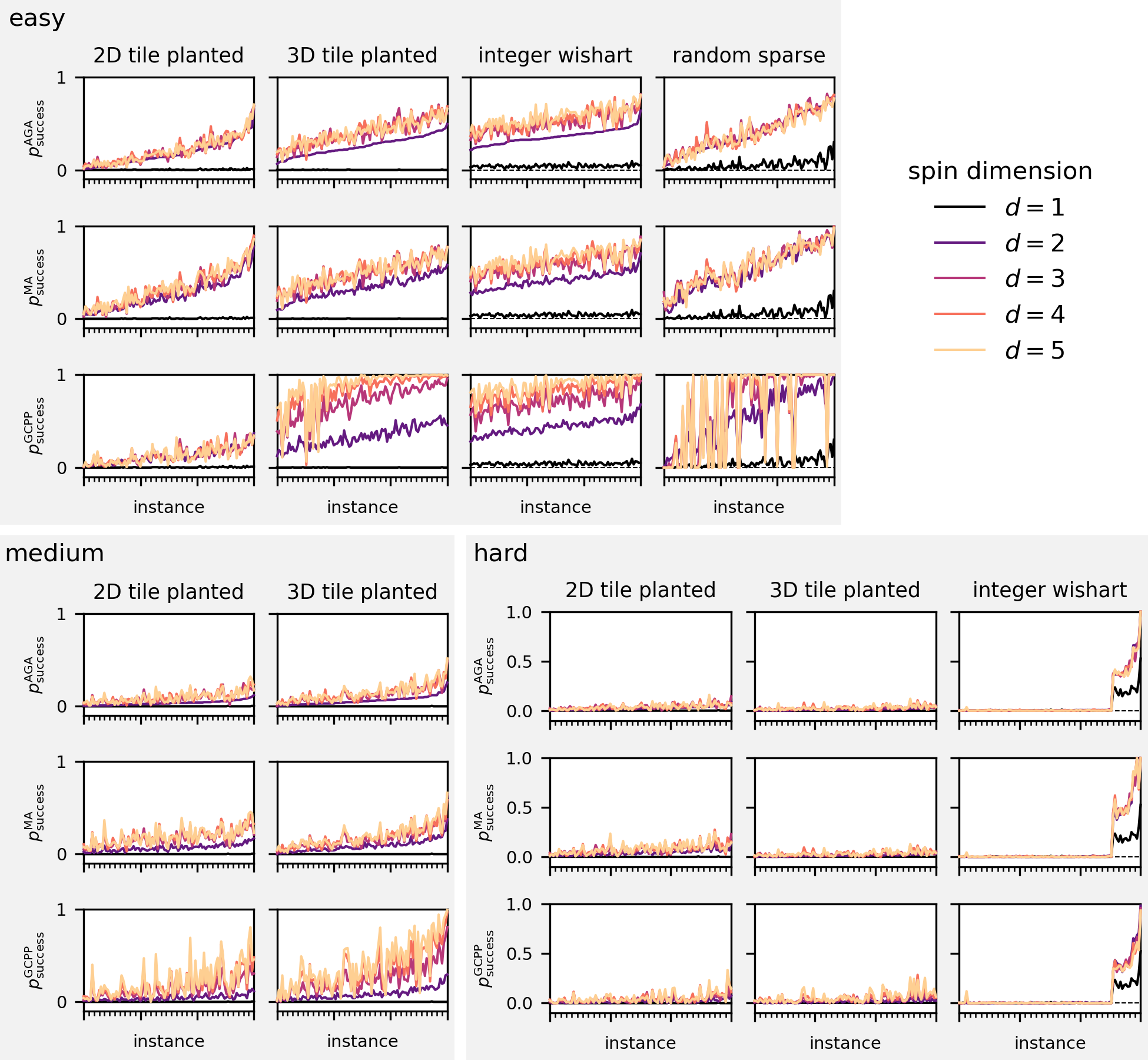
Figure 3: Success probabilities for finding ground states of "easy", "medium", and "hard" instances, showing a marked increase for vectorial spin systems (N3) and various annealing protocols.
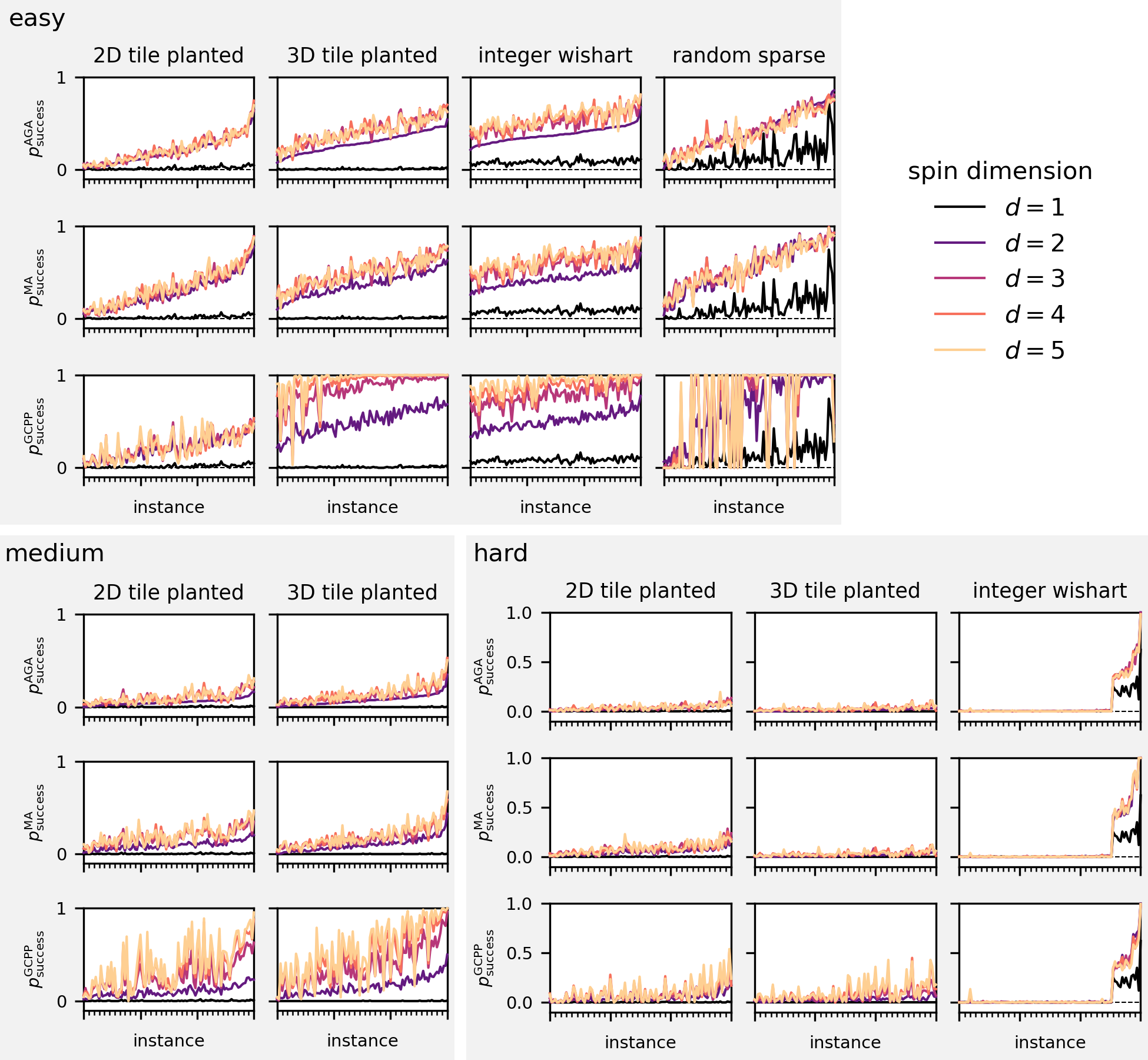
Figure 4: Instance-wise comparison of success probabilities stratified by annealing protocol and dimension, evidencing robust improvement across instance classes with dimensional annealing.
Additionally, performance gains persist as the total anneal time is increased, with feedback-driven gain control (which enforces amplitude homogeneity) marginally outperforming linear schedules.
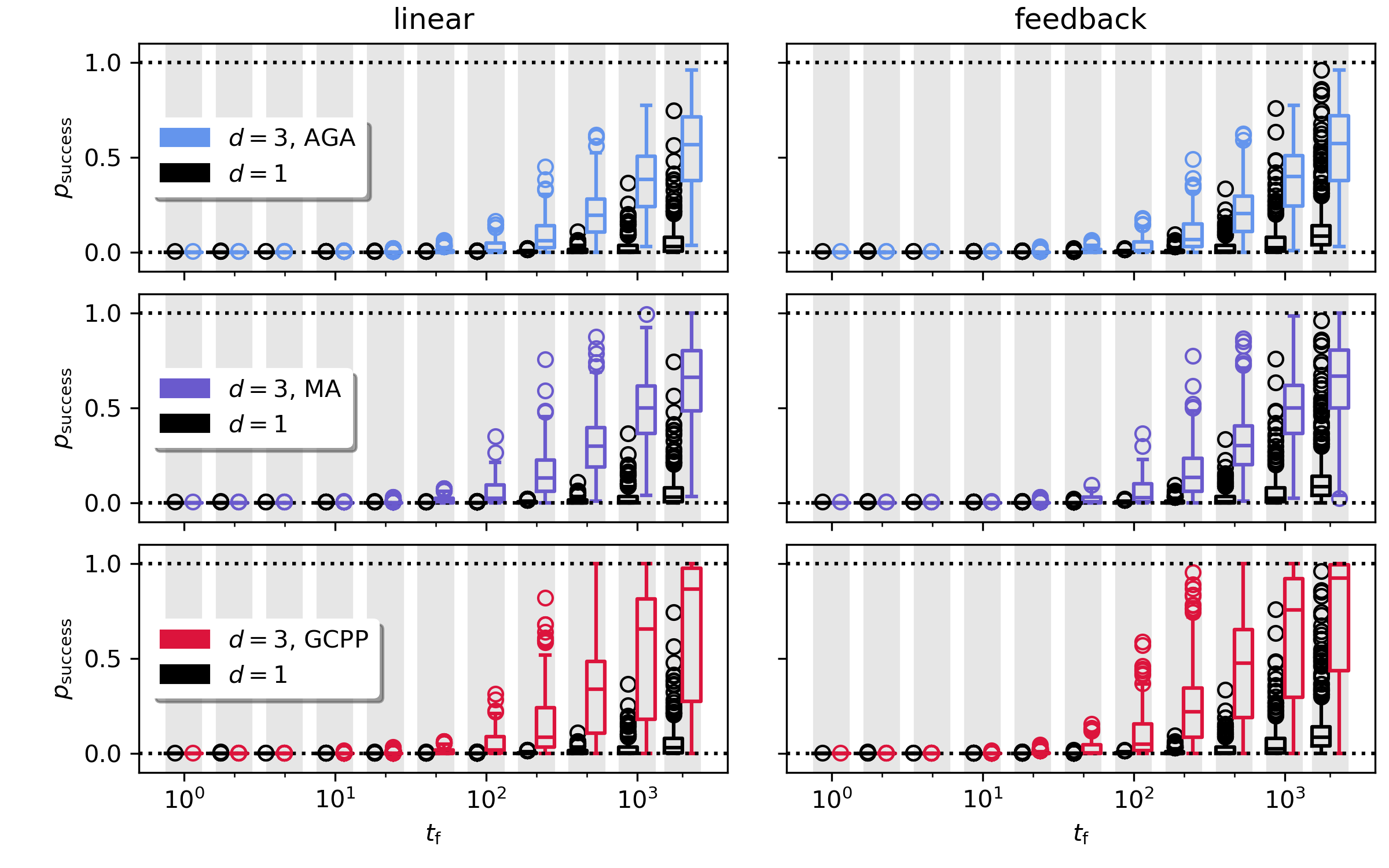
Figure 5: Scaling of success probabilities with total simulation (anneal) time, confirming robustness of dimensional annealing advantages for N4.
Implications and Future Directions
The demonstrated enhancement in optimization efficacy for N5 vector spins validates and expands on previous proposals for hyperspin and vectorial analog optimization platforms [calvanesestrinati2022MultidimensionalHyperspinMachine, calvanesestrinati2024HyperscalingCoherentHyperspin, cummins2025VectorIsingSpin]. This indicates a practical paradigm for next-generation analog Ising machines: hardware platforms capable of at least N6 (amplitude and phase) degrees of freedom, operated under appropriate dimensional annealing schedules, can achieve significant algorithmic performance increases at minimal added hardware complexity. Crucially, such platforms can readily accommodate AGA/MA mechanisms via parametric or injection-locking controls, while GCPP-style constraints, though experimentally more challenging due to their nonlinear couplings, represent a frontier for hardware innovation.
On the theoretical side, these results underscore the centrality of landscape topology modification—transforming barriers and minima—via phase space expansion and constraint annealing. For the hardest instances, some residual algorithmic limitations remain, as vectorial methods still fail to attain planted solutions in extremely rugged landscapes, establishing a clear boundary for the methodology.
Future avenues involve systematic benchmarking against state-of-the-art classical (simulated annealing, parallel tempering) and quantum (QA and its surrogates) solvers, as well as optimizing anneal schedules and hybrid feedback protocols—e.g., chaotic amplitude control [leleu2021ScalingAdvantageChaotic]. Analytical energy landscape studies could further refine algorithmic protocol design for various matrix ensembles, and extensions to higher-dimensional systems may shed light on universal features of high-dimensional disordered nonlinear dynamics.
Conclusion
This study rigorously establishes that soft vector spin models with dimensional annealing, implemented via anisotropic gain, metric, or cross-product penalty protocols, consistently and substantially outperform traditional scalar soft Ising spin analog optimizers on a wide range of combinatorial optimization problems. The principal practical implication is the feasibility of realizing these gains without increased hardware complexity in physical systems already operating in N7. The work consolidates multidimensional analog optimization as a promising and theoretically grounded path forward for both algorithmic and hardware developments in physics-inspired computation.
(2604.01003)