- The paper presents a novel superconducting qubit design that hybridizes Andreev and fluxonium states to achieve dual hardware-level protection against relaxation and dephasing.
- The methodology employs a high-impedance LC circuit and a highly transparent weak-link to exponentially suppress transition matrix elements linked to noise.
- Results demonstrate a broad, experimentally feasible regime where noise susceptibilities are reduced by orders of magnitude, paving the way for robust quantum computation.
FerBo: A Noise-Resilient Superconducting Qubit Hybridizing Andreev and Fluxonium States
Introduction and Motivation
Coherence of superconducting qubits is fundamentally limited by environmental noise, with both charge and flux fluctuations inducing relaxation and dephasing, respectively. While the transmon and fluxonium architectures mitigate dephasing in one channel via charge or phase delocalization, they exacerbate sensitivity to dissipation via increased transition matrix elements. Fault-tolerant quantum computation thus demands circuits supporting simultaneous hardware-level protection against both relaxation and dephasing, without the prohibitive overhead of quantum error correction.
This work introduces the FerBo qubit, a hybrid superconducting circuit that embeds a highly transparent Josephson weak link supporting Andreev bound states (ABS) into a high-impedance LC environment. The coupling of the fermionic ABS to the bosonic circuit mode and the engineering of wavefunction disjointness in Andreev space create eigenstates with low sensitivity to both charge relaxation and flux dephasing, surpassing the dual-protection limitations of conventional designs. The analysis elucidates the mechanism, delineates the viability regime, and outlines realistic experimental pathways.
Physical Principle and Circuit Architecture
The fluxonium qubit achieves flux-noise-resilient operation by extending the wavefunction over multiple phase wells, implemented via a large L and small C, but this inevitably increases the charge matrix element and thus dissipation. In the FerBo circuit, the Josephson tunnel junction is replaced with a highly transmitting weak link supporting ABS, described by a quasi-resonant level model (JQRL). The ABS, with energies ∓cos(φ^/2), hybridize with the bosonic LC degree of freedom, creating state manifolds indexed by the even-occupation ABS.
The key is that, in the "light" regime (Z≫RQ), the lowest two eigenstates, separated in the Andreev sector, are strongly delocalized in phase but have negligible overlap in the ABS space. Thus, the transition matrix elements for dissipative operators coupling the two sectors are exponentially suppressed. The result is both dephasing and relaxation immunity over wide, realistic parameter ranges.
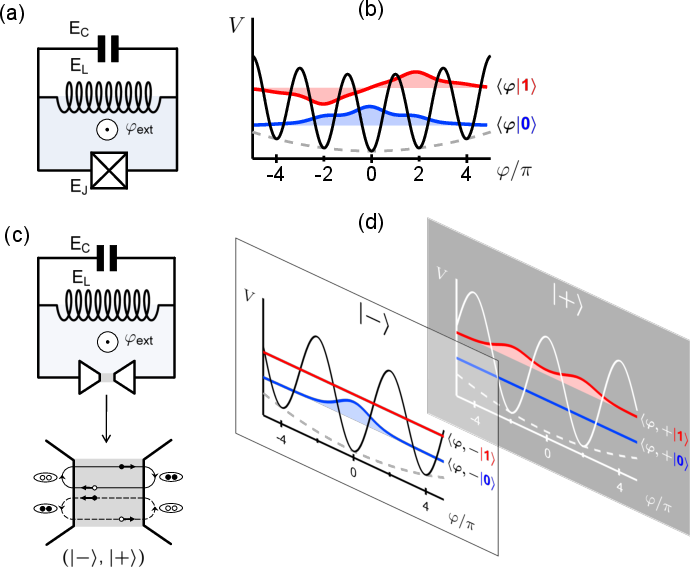
Figure 1: Schematic of protection in light-fluxonium (a, b) versus FerBo (c, d), highlighting phase delocalization and disjoint support in the Andreev sector for ∣0⟩ and ∣1⟩.
Effective Model and Spectral Properties
The effective Hamiltonian consists of the LC oscillator and the Andreev weak link:
H^=4ECn^2+21EL(φ^−φext)2+HWL(φ^)
with the weak link modeled by
L0
where the L1 act in the ABS even-parity space.
The transition frequency L2 between L3 and L4 shows flux dispersion suppressed exponentially with increased impedance L5 (controlled by L6 and L7), analogous to fluxonium but now with the relaxation channel also suppressed. The external flux tunes the ABS energies, and the delocalization threshold is readily calculated; phase dispersion and thus dephasing vanish for L8.
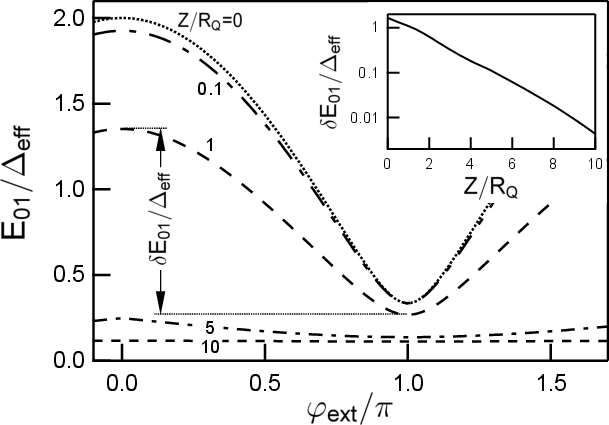
Figure 2: Transition energy L9 between ground and first excited states versus flux and impedance, illustrating exponential suppression of flux dispersion in the high-C0 regime.
Relaxation and Dephasing Susceptibility: Numerical and Analytical Results
The relaxation susceptibility, characterized by the charge matrix element C1, and the second-order flux dephasing susceptibility C2 serve as quantitative metrics for qubit protection. Numerical diagonalization across parameter space reveals two sharply separated regions: a protected phase where both susceptibilities are orders of magnitude below the unprotected value, and an unprotected phase akin to ordinary fluxonium.
In the optimal regime (high junction transmission, large C3, small C4), the relaxation matrix element is suppressed by up to four orders of magnitude at flux sweet spots (particularly C5). The boundary is analytic, given by C6. Dephasing protection tracks the exponential suppression of phase curvature with increased impedance.
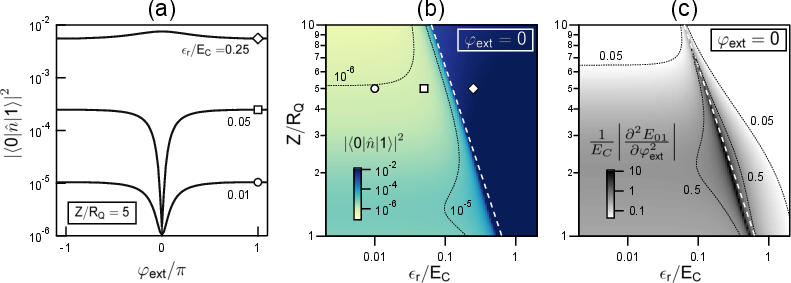
Figure 3: Relaxation (a–b) and dephasing (c) susceptibilities, as functions of impedance and weak-link detuning, highlighting the protected regime with simultaneous suppression of both noise channels.
The wavefunctions, projected in the Andreev basis, reveal that in the protected phase the ground and first excited states reside primarily in opposite ABS manifolds (same parity under phase inversion), hence negligible transition matrix elements. When C7 or C8 moves the system across the boundary, the states hybridize, and parity structure is lost, leading to increased susceptibility.
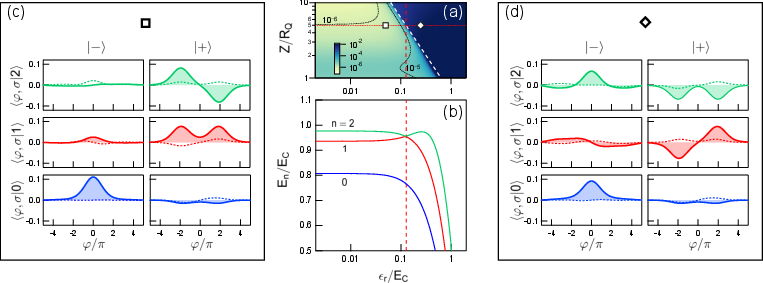
Figure 4: Symmetry transition and the associated protection mechanism—(a) boundary map, (b) eigenenergies, and (c–d) wavefunction structure below and above the protection threshold.
Andreev Basis and Extended Modeling
The transition to the Andreev basis, via diagonalization of the ABS Hamiltonian, enables analysis beyond the ballistic limit (C9, ∓cos(φ^/2)0 finite). The effective circuit supports adiabatic potentials for the two Andreev branches, and the interplay of circuit and weak-link parameters determines the protection and matrix element suppression. The detailed modeling, including Berry connection corrections and higher-order ABS, confirms robustness of the dual-protection regime, and microscopic Bogoliubov-de Gennes calculations validate the analytical results.
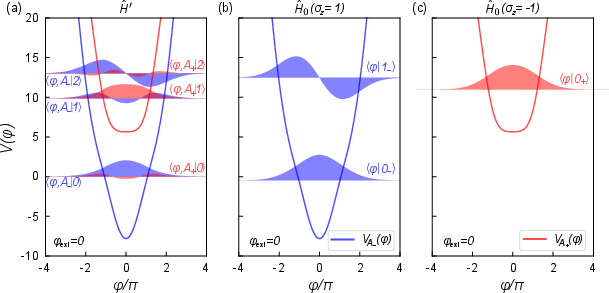
Figure 5: Adiabatic potentials and wavefunctions for an intermediate-transmission FerBo, showing support in distinct Andreev sectors for protected eigenstates.
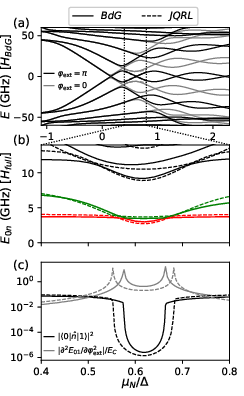
Figure 6: Extended microscopic model (BdG calculation): spectrum, transitions, and matrix elements as a function of junction doping, confirming the transition between protected/unprotected regimes.
Practical Implementation and Experimental Realizability
FerBo is experimentally feasible: long nanowire weak links with high transparency (e.g., InAs/Al), embedded in superinductor arrays or high-kinetic-inductance circuits, can achieve the required large ∓cos(φ^/2)1 and low capacitance, handling the primary implementation constraint. Nanowire-based fluxonium qubits have been demonstrated, though typically below the high-impedance threshold; FerBo proposes operation above ∓cos(φ^/2)2 with ∓cos(φ^/2)3 tunable via gating.
Secondary channels—capacitive coupling to gates, population leakage into higher Andreev or bosonic states—require engineering trade-offs and careful filtering, but do not compromise the main mechanisms. Post-selection strategies and thermal management mitigate leakage issues.
Parameter Dependence and Optimization
The protected regime persists for ∓cos(φ^/2)4 from 0.25 to 2, but increasing ∓cos(φ^/2)5 enhances the width of the protected phase, while larger asymmetry ∓cos(φ^/2)6 increases the overlap and susceptibility quadratically. The design guideline is maintaining large ∓cos(φ^/2)7, high transmission, low asymmetry, and operation near sweet spots.
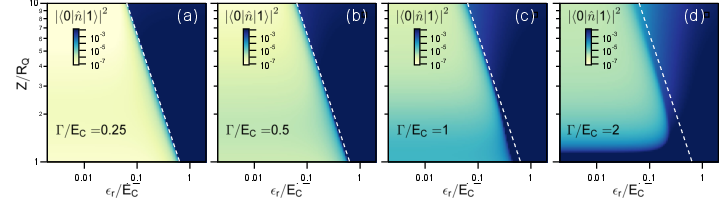
Figure 7: Systematic mapping of charge relaxation susceptibility as a function of impedance and detuning for different ratio ∓cos(φ^/2)8.
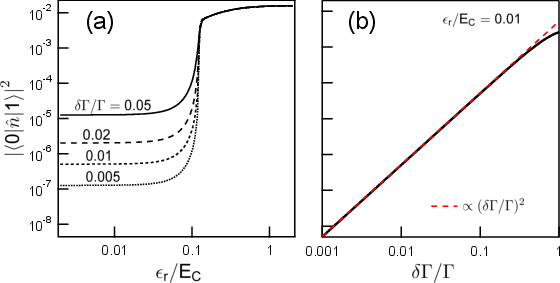
Figure 8: Asymmetry dependence of relaxation susceptibility demonstrating optimal protection for small ∓cos(φ^/2)9.
Conclusion
The FerBo qubit architecture achieves hardware-level protection against both relaxation and dephasing via hybridization of ABS with a high-impedance bosonic mode. The regime of protection is broad, readily accessible, and sharply separated from unprotected regions by symmetry-driven spectral crossings. The key mechanism is the creation of eigenstates with disjoint support in Andreev space and equal parity under phase inversion, resulting in the suppression of matrix elements for typical noise operators. Realization using nanowire-based weak links integrated into high-LC0 circuits is experimentally viable with existing techniques. The FerBo qubit offers a scalable path toward robust quantum information processing without reliance on active error correction.
(2604.01145)