- The paper presents a novel variational method using a Husimi-Q based v-MCS ansatz to capture negative mixture weights and genuine quantum correlations.
- It benchmarks the approach on one- and two-dimensional transverse-field Ising models, achieving exact steady-state agreement with reduced computational costs.
- The method scales to larger systems and offers an efficient, sampling-free simulation tool for driven-dissipative quantum hardware and non-equilibrium phenomena.
Variational Simulation of Open Quantum Spin Systems in Phase Space
Introduction
The paper "Variational Dynamics of Open Quantum Spin Systems in Phase Space" (2604.01165) presents a novel variational method for simulating the dynamics and steady-state behavior of interacting open quantum spin systems. The framework targets efficient, high-fidelity replicability of non-equilibrium phenomena in lattices governed by the Lindblad master equation—specifically, systems where environmental dissipation plays a significant dynamical role. The approach is based on the phase-space Husimi-Q function and uses a variational ansatz composed of mixtures of spin-coherent states, with analytically tractable equations of motion derived from the Dirac-Frenkel principle. This addresses longstanding limitations in scaling existing quantum many-body simulation techniques to large and high-dimensional open spin systems.
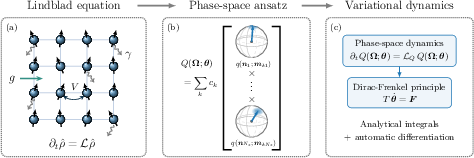
Figure 1: Schematic of the variational phase-space approach, illustrating driven-dissipative spin lattices, the Husimi-Q function variational encoding, and the analytical variational evolution scheme.
The described method reformulates the dynamics of a lattice of spin-21 particles, coupled to Markovian baths, in terms of the Husimi-Q function defined over the product of Bloch spheres associated with each spin. The Husimi-Q function is represented variationally as a multi-component mixture of coherent-state product distributions—referred to as the v-MCS (variational Multi-Coherent State) ansatz. Unlike semiclassical or trajectory-based methods, the v-MCS approach allows the mixture coefficients to take negative values, thus capturing genuine quantum correlations and coherences inaccessible to positive-definite stochastic mixtures.
The dynamics of the variational parameters are projected onto the variational manifold via the Dirac-Frenkel variational principle, producing a system of first-order ODEs for the evolution of all ansatz parameters. Both the quantum geometric tensor (metric) and the force vector governing these ODEs are computed analytically (with automatic differentiation), ensuring sampling-free, numerically robust simulations.
Benchmarking: One- and Two-Dimensional Transverse-Field Ising Models
As a primary application, the method is benchmarked on the dissipative transverse-field Ising model—a canonical platform for exploring many-body non-equilibrium quantum phenomena. The variational framework is compared against exact diagonalization and leading neural-network-based ansatzes, including CNNs and Transformer architectures.
For a 16×1 one-dimensional chain, the v-MCS ansatz with only Nc=16 components per spin (784 total parameters) exactly reproduces the steady-state expectation values ⟨σ^x⟩ and ⟨σ^y⟩ across a range of g/γ, whereas neural networks fail to achieve comparable precision. The absence of stochastic sampling eliminates fluctuations in the results and drastically reduces computational costs—full quantum evolution and steady-state extraction for the Q0-site system is obtainable in around a minute on a standard CPU.
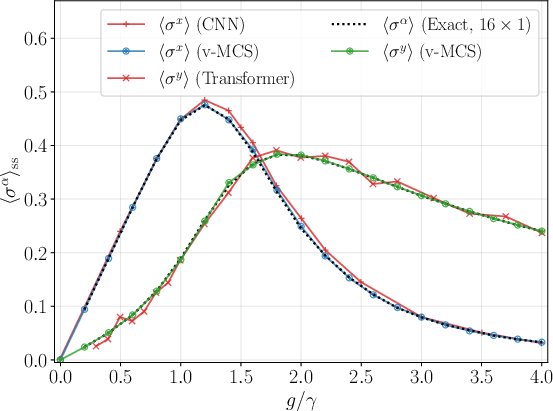
Figure 2: Steady-state results for Q1 and Q2 in a 1D Q3 dissipative Ising chain, highlighting exact agreement between v-MCS and direct simulation benchmarks.
Scaling to two dimensions, the method efficiently simulates both real-time non-equilibrium dynamics and steady states for Q4 and Q5 lattices. Results confirm that the transient and steady-state observables remain in precise agreement with exact diagonalization, using Q6–Q7 components per spin. Competitive neural architectures are outperformed, particularly in reproducing real-time quantum trajectories, a regime where Monte Carlo sampling becomes costly and imprecise due to entanglement entropy growth and high-dimensional correlations.
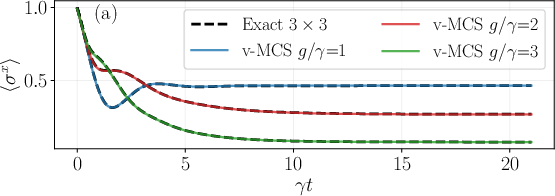
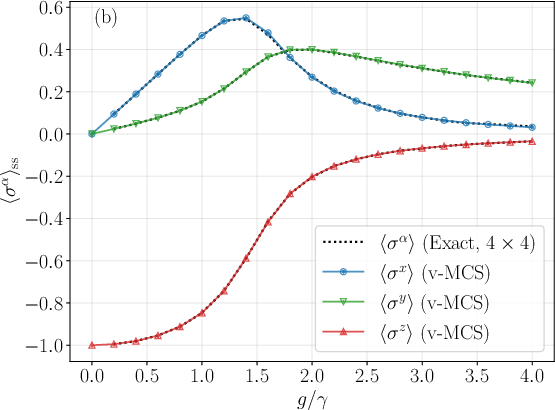
Figure 3: (a) Real-time dynamics and (b) steady-state expectations in 2D Ising lattices, confirming v-MCS accuracy against exact solutions for varying Q8.
The approach further demonstrates systematic convergence for an Q9 two-dimensional lattice (64 spins). Here, increasing 210 extends the expressive power and fidelity: both transient and steady-state results converge, and the regime 211 is sufficient for capturing steady-state observables (with only 212400 parameters).
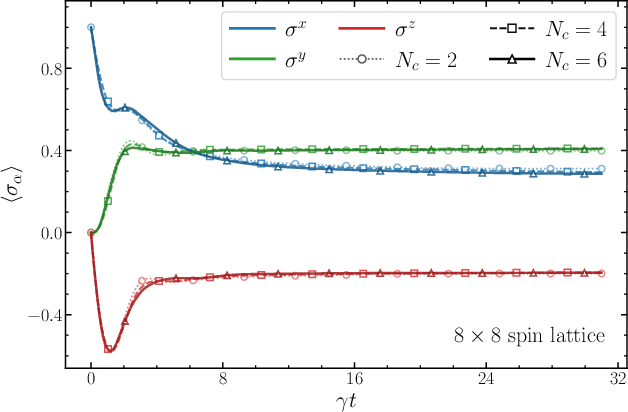
Figure 4: Variational dynamics in an 213 lattice showing systematic convergence of observables 214 with increasing 215.
Theoretical and Practical Implications
This work identifies the sampling-free, analytically tractable variational phase-space ansatz as an efficient and accurate mechanism for the simulation of open quantum systems. The ability of the v-MCS method to encode negative mixture weights permits modeling beyond semiclassical or mean-field limits, incorporating entanglement and non-trivial quantum correlations. The scalability to large 2D lattices with modest computational budgets marks a significant advance over both tensor network and neural network methods, which generally face exponential scaling, poor dynamical accuracy, or prohibitive sampling requirements in high dimensions.
Practically, this approach is immediately applicable to driven-dissipative quantum hardware platforms, including quantum annealers and Ising machines. It allows efficient exploration of both equilibrium and non-equilibrium phases, and provides a flexible template for benchmarking, control, and error-mitigation strategies in noisy quantum simulators.
Theoretically, the method lays the groundwork for further incorporating system-specific symmetries and for extending phase-space variational approaches to higher-spin systems, more complex Hamiltonians, and dissipative critical phenomena. Combining the v-MCS approach with more intricate ansatz families—encoding explicit many-body entanglement within ansatz components—could push the variational accuracy into regimes relevant for open-system quantum phase transitions and dynamics near criticality.
Conclusion
The paper establishes a scalable and sampling-free variational paradigm for simulating the dynamics of open quantum spin systems. By leveraging the Husimi-216 function and negative-coefficient spin-coherent state mixtures, the method achieves excellent agreement with exact results in scenarios where existing standards, including neural-network-based approaches, perform suboptimally. The analytic structure and phase-space construction enable efficient access to the full dynamical evolution and steady-state properties in one- and two-dimensional lattices. These attributes position the method as a valuable tool for state-of-the-art quantum simulation, with clear paths for generalization to more complex systems and for benchmarking quantum hardware under realistic dissipative conditions.