A Posteriori Error Analysis of Runge-Kutta Discontinuous Galerkin Schemes with SIAC Post-Processing for Nonlinear Convection-Diffusion Systems
Published 1 Apr 2026 in math.NA and math.AP | (2604.01200v1)
Abstract: We develop reliable a posteriori error estimators for fully discrete Runge-Kutta discontinuous Galerkin approximations of nonlinear convection-diffusion systems endowed with a convex entropy in multiple spatial dimensions on the flat torus Td, with a focus on the convection-dominated regime. In order to use the relative entropy method, we reconstruct the numerical solution via tensor-product Smoothness-Increasing Accuracy-Conserving (SIAC) filtering which has superconvergence properties. We then derive reliable a posteriori error estimators for the difference between the entropy weak solution and the reconstruction, with constants that are uniform in the vanishing viscosity limit. Our numerical experiments show that the a posteriori error bounds converge with the same order as the error of the reconstructed numerical solution.
The paper presents a posteriori error estimators that split spatio-temporal residuals, ensuring robust error control in convection-dominated regimes.
It leverages SIAC post-processing to achieve superconvergence, raising the L2 convergence order from q+1 to 2q+1 for sufficiently smooth solutions.
Numerical results confirm that the method supports adaptive algorithms and retains reliability even as viscosity vanishes.
A Posteriori Error Analysis for RKDG Schemes with SIAC Post-Processing in Nonlinear Convection-Diffusion Systems
Problem Statement and Motivation
The paper establishes a posteriori error estimators for fully discrete Runge-Kutta discontinuous Galerkin (RKDG) approximations applied to nonlinear convection-diffusion systems with a convex entropy structure on Td. The methodology is specifically tailored to convection-dominated regimes (ε≪1) where classical energy-based estimators are either suboptimal or deteriorate as the viscosity vanishes. The analysis utilizes the relative entropy framework, necessitating reconstructions in space and time with high regularity, achieved via Hermite interpolation temporally and Smoothness-Increasing Accuracy-Conserving (SIAC) post-processing spatially.
SIAC Filtering: Structure and Superconvergence
A central contribution is the use of SIAC filtering for spatial reconstruction. SIAC convolution with tensor-product B-spline kernels recovers superconvergence from DG approximations, yielding filtered approximations which converge at order $2q+1$ in L2 for sufficiently smooth solutions, even though the underlying DG method is only order q+1.
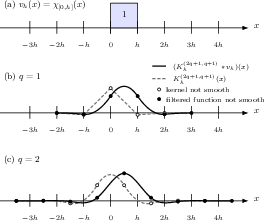
The paper rigorously describes the algebraic structure generated by SIAC convolution for piecewise polynomial data, noting that the SIAC-filtered function exhibits a piecewise higher-degree polynomial structure with breakpoints derived from the support of the B-splines and the underlying mesh:
Figure 1: Piecewise polynomial structure of the SIAC-filtered function for vh(y)=χ[0,h](y) on an equidistant mesh.
This property guarantees that the filtered solution is amenable to analytic residual calculation—a critical point for computable a posteriori estimators.
Residual Splitting and Relative Entropy Framework
The stability analysis is underpinned by relative entropy identities, which require reconstructions regular enough for duality pairings. The authors introduce a space-time reconstruction uts by convolving the Hermite time-reconstruction with SIAC kernels. The main novelty lies in the careful splitting of the spatio-temporal residual:
r=r1+εr2,r1∈Lt1Lx2,r2∈Lt2Hx−1,
decoupling convective and diffusive contributions. This strategy yields error estimators that avoid blowing up as ϵ→0, while preserving optimal scaling in h—a limitation of prior approaches.
The residual split is not operationally trivial: SIAC filtering (of one greater degree in the relevant coordinate) is used to reconstruct the derivatives in the auxiliary fluxes needed for the parabolic term, an adaptation of ideas from derivative post-processing and Thomee-type residual splitting.
Error Estimator Form and Rigorous Bounds
Concrete a posteriori bounds are established for linear and nonlinear PDEs and for hyperbolic/parabolic systems, including scalar advection-diffusion, viscous Burgers, and the diffusive ε≪10-system. These bounds take the abstract form:
ε≪11
where ε≪12 is problem-dependent but, crucially, uniform in ε≪13 when possible. For nonlinear systems, the exponential-in-time stability constants depend on Lipschitz constants related to the solution and its nonlinearity, but the mesh-dependent estimator part remains robust as ε≪14. The analysis covers both periodic and multidimensional setups.
Numerical Results
For the convection-diffusion equation, the SIAC-postprocessed reconstructed error converges at rates close to ε≪15, with estimator residuals closely tracking actual errors under mesh refinement, independent of ε≪16.
For nonlinear problems (2D viscous Burgers, ε≪17-system), the same superconvergent and estimator efficiency phenomena are corroborated.
Robustness as ε≪18 is confirmed numerically; the estimator's efficacy persists in the inviscid limit.
Tables in the appendix quantitatively report errors and experimental orders of convergence for representative test cases and illustrate that the estimator decay matches that of the actual error, confirming the method's effectiveness and absence of pre-asymptotic artifacts.
Theoretical and Practical Implications
The analysis rigorously demonstrates that SIAC-based reconstructions are optimal generators for entropy-compatible a posteriori estimates in multidimensional, convection-dominated regimes, pushing the application domain beyond existing theory (which primarily covered linear or one-dimensional models). This enables robust adaptive algorithms for nonlinear PDEs, where error estimation remains accurate even when the diffusive scale is negligible.
From a theoretical perspective, the decomposition of the residual in a manner amenable to sharp relative entropy stability is significant and generalizable, highlighting that analytic structure of reconstruction operators such as SIAC kernels is essential for optimal error estimation in the DG context.
Practically, the SIAC reconstruction enables both sharp a posteriori error control and post-processed solutions with enhanced regularity and accuracy, making it valuable for scientific computing tasks such as goal-oriented adaptation, uncertainty quantification, and time-stepping adaptivity in stiff convection-diffusion systems.
Limitations and Future Directions
While the estimator is proven to be reliable (upper bound), its efficiency (proximity to the true error, lower bound) is not rigorously established except through numerical exploration. Additionally, in nonlinear problems, exponential constants involving Lipschitz norms can degrade estimator utility over long times or in presence of sharp gradients. Rigorous extension to unstructured meshes, adaptive mesh refinement, nonconvex domains, and high-dimensional systems with entropy/entropy flux pairs is a valid direction. More sophisticated residual splittings or fully nonlinear SIAC-kernel analysis may further improve estimator sharpness. There is also room for improved computational efficiency in practical implementation, especially for large-scale problems.
Conclusion
The paper establishes a theoretically well-founded a posteriori error estimation framework for Runge-Kutta DG schemes in multidimensional, convection-dominated nonlinear PDEs using SIAC post-processing. The estimator exhibits optimal mesh scaling and vanishing-viscosity robustness, as supported by both analysis and comprehensive numerical study. This work provides an advanced and generalizable foundation for reliable adaptive discretization and post-processed output in convection-diffusion and hyperbolic PDE systems (2604.01200).
“Emergent Mind helps me see which AI papers have caught fire online.”
Philip
Creator, AI Explained on YouTube
Sign up for free to explore the frontiers of research
Discover trending papers, chat with arXiv, and track the latest research shaping the future of science and technology.Discover trending papers, chat with arXiv, and more.