- The paper establishes conditional channel entropy as the key limit in thermodynamic quantum processing, providing operational meaning through conditional min-entropy.
- The paper details one-shot and asymptotic transformation rates using conditional channel divergences to quantify resource interconversions under thermal constraints.
- The paper links conditional channel entropy to causal signaling and reversibility, setting benchmarks for quantum device performance and resource theory analysis.
Introduction and Overview
This paper establishes conditional channel entropy as a central quantity governing fundamental operational limits in thermodynamic quantum information processing. The authors introduce and rigorously analyze the resource theory of conditional athermality—addressing interconversions between bipartite quantum channels in the presence of a side channel (acting as memory) and under the restriction of conditional Gibbs-preserving superchannels. They derive one-shot and asymptotic rates for both distillation and simulation of identity gates from or to arbitrary quantum channels, linking these limits to conditional channel (min-)entropies.
Key implications include the attribution of operational meaning to the causal (signaling) properties of quantum processes, a demonstration of asymptotic reversibility for important channel classes, and the identification of the conditional channel entropy as a primitive in quantum information processing.
Resource Theory of Conditional Athermality
The framework frames bipartite quantum channels as resources for information processing under thermodynamic constraints. Free objects are channels of the form Tβ⊗Q—a fully thermalizing channel for subsystem A (outputting a Gibbs state at inverse temperature β) alongside an arbitrary side channel Q for B. The free operations are conditional Gibbs-preserving superchannels (CGPS), which map the set of such channels into itself. This captures the thermodynamically relevant transformations subject to local and non-signaling constraints.
The standard resource unit is the conditional identity channel (or any conditional unitary) in the case of a trivial output Hamiltonian. Thus, both formation (simulation) and distillation tasks are naturally defined as the conversion, under CGPS, between resource channels and collections of conditional identities.
The paper fully characterizes the optimal one-shot rates for both distillation and formation through channel divergences with respect to decoupled (thermal) channels. In the regime of trivial output Hamiltonians, where the Gibbs state is maximally mixed, the optimal rates are given in terms of conditional channel min-entropy and conditional channel hypothesis-testing entropy.
More precisely, the one-shot distillation rate is: Dist(1,ε)(N,Tβ)=21QinfDHε2[N∥Tβ⊗Q]
and formation rate: Cost(1,ε)(N,Tβ)=21QinfD∞ε[N∥Tβ⊗Q]
where DH and D∞ denote the (channel) hypothesis-testing and max-relative entropy, respectively.
The trade-off relation between distillation and cost is explicit: the formation cost cannot be lower than the distillation yield by more than a log term dependent on the acceptable error.
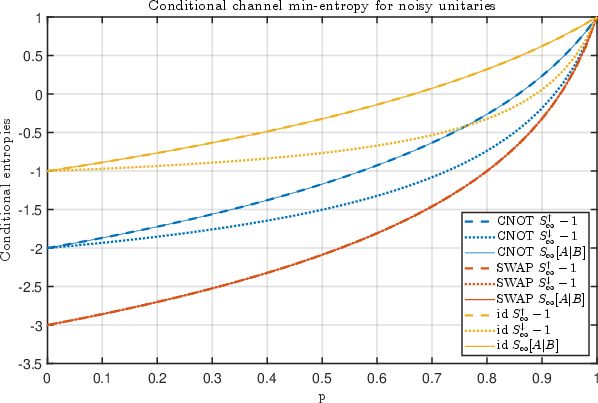
Figure 1: Plot showing the conditional min-entropy S∞, highlighting its role as a quantitative bound for quantum process manipulation.
In the asymptotic i.i.d. regime, the rates become governed by regularized (channel) relative entropy distances. For important channel classes (tele-covariant, or no-signaling from non-conditioning input to conditioning output), the asymptotic equipartition property holds and the conditional channel min-entropy converges to the conditional von Neumann entropy.
Causal Structure and Conditional Min-Entropy
A foundational result is that negative values of conditional channel min-entropy indicate signaling or entangling capabilities of the underlying channel. In particular, the paper establishes tight bounds for classes of bipartite quantum channels:
- For signaling channels from A0 to A1, A2.
- For entangling (NPT) channels, A3.
- For PPT-preserving and separability-preserving channels, A4.
- For maximally entangling "swap-like" channels, the minimal value is saturated.
The causal structure—principally, the presence or absence of signaling—establishes a hierarchy for possible values of conditional channel min-entropy. The position on this hierarchy directly quantifies the power of quantum processes to generate correlations and perform nontrivial information processing.
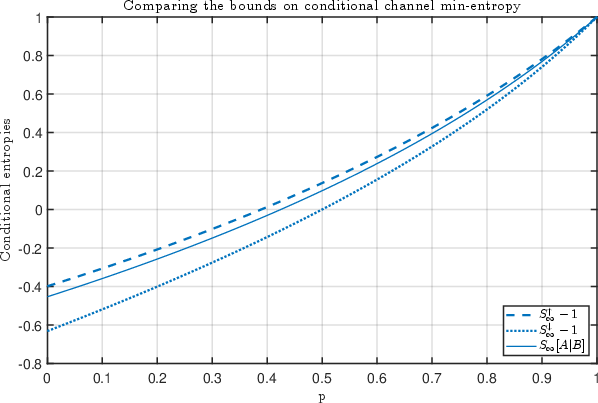
Figure 2: Plot showing the spectrum of conditional min-entropy for various bipartite channels, illustrating the relationship to signaling and entangling capabilities.
Asymptotic Reversibility and Superdense Coding Capacity
For tele-covariant and no-signaling channels, the resource theory becomes asymptotically reversible: the formation cost and distillation yield coincide and are both computable as
A5
where A6 is the conditional von Neumann entropy of the channel, with a single-letter formula.
Moreover, for tele-covariant channels, the conditional athermality (or purity) capacity is shown to be exactly half the superdense coding capacity of the corresponding Choi state. This precise quantitative connection provides a direct link between thermodynamic resource contents and foundational results in quantum communication theory.
Implications and Future Directions
This work has significant implications for both theory and experiment:
- Foundational: It provides a rigorous bridge between operational thermodynamics, quantum Shannon theory, and causal structures in quantum mechanics.
- Practical: It sets benchmarks for quantum device performance under thermodynamic constraints, showing when (and how much) reversibility can be obtained in quantum channel manipulations.
- Theoretical extensions: The techniques and quantities introduced (e.g., conditional channel entropy, CGPS) offer new tools for resource theory analysis, quantum communication, quantum thermodynamics, and the study of open quantum system dynamics.
Conclusion
The conditional channel entropy serves as a fundamental resource monotone, dictating the ultimate limits of thermodynamic quantum information processing. By revealing its operational meanings and tracing its intimate connection to the causal and correlation-generating structure of quantum processes, this work elevates conditional channel entropy to a central role in quantum information science and thermodynamics. The results deepen our understanding of the interplay between information, energy, and control in quantum dynamics and open new lines of investigation for reversible quantum process engineering (2604.01217).

