- The paper demonstrates that multi-instrument JWST observations yield robust molecular detections, overcoming biases inherent in single-instrument retrievals.
- It details advanced data reduction and retrieval methodologies combining JWST and HST data while quantifying instrument-specific contributions.
- The findings provide precise constraints on molecular abundances, cloud properties, and elemental ratios, setting a methodological benchmark for exoplanet atmospheric studies.
Information Content of JWST Transmission Spectroscopy for HAT-P-12b
Introduction
The paper "Information content of JWST transmission spectroscopy of the exoplanet HAT-P-12b from the optical to the mid-infrared" (2604.01219) presents an in-depth investigation into the atmospheric composition and structural properties of the warm sub-Saturn HAT-P-12b using James Webb Space Telescope (JWST) transmission spectroscopy, coupled with archival Hubble Space Telescope (HST) data. This work systematically evaluates the contributions and information content of each JWST instrument and combinations thereof, examines the robustness of molecular detections, explores the influence of reduction and retrieval choices, and places the findings in the broader context of exoplanet atmosphere characterization.
Data Acquisition and Reduction
HAT-P-12b was observed across a combination of JWST instruments: NIRISS/SOSS (0.6–2.83 µm), NIRSpec/G395M (2.84–5.18 µm), and MIRI/LRS (4.6–12.4 µm). The NIRISS reductions critically addressed technical artifacts including 1/f noise and background step effects, employing a multi-stage approach based on the ExoTEDRF pipeline, with specifically tuned background and noise corrections. The reduction pipeline's choices—especially for the NIRISS data—were isolated and quantified with respect to potential impact on the transmission spectrum and subsequent retrievals.
The lightcurve extraction and fitting methodology leveraged achromatic and spectrally-resolved approaches, robustly applying white and spectral lightcurve fits, with careful treatment of limb darkening, systematics, and instrumental jitter. NIRISS order-1 and order-2 white lightcurves demonstrated strong statistical agreement with the model fits with reduced χ2≈1.04, and the result of the extraction was consistent with archival HST/WFC3 spectra.
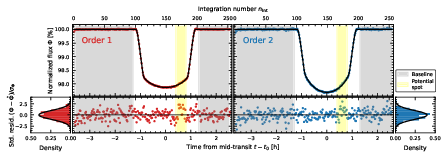
Figure 1: White lightcurves from JWST/NIRISS SOSS, including combined best-fit transit models and standardized residuals.
Joint Transmission Spectrum and Molecular Opacity Contributions
The acquired spectra were combined from all three JWST instruments, producing a continuous high-precision transmission spectrum spanning the optical to mid-infrared, and supplemented with HST/STIS and WFC3 data for cross-instrument consistency and sensitivity analysis. A model-driven decomposition of the spectrum highlighted the dominant opacity sources and revealed the wavelength-dependent influence of specific absorbers and cloud opacity.
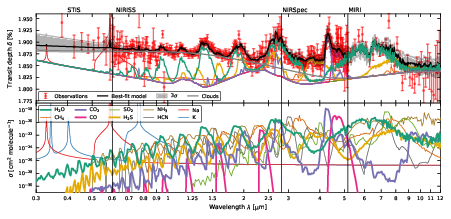
Figure 2: Combined transmission spectrum for HAT-P-12b with atmospheric model and contributions from individual opacity sources.
Retrieval Framework and Instrument Combination Analysis
Atmospheric retrievals were performed with the ARCiS framework, featuring a five-point T-P profile, isochemical molecular abundances, and a non-gray cloud opacity parametrization. The retrievals included a nested sampling treatment of instrument-dependent transit depth offsets and robust upper and lower bounds for all major atmospheric parameters, alongside extensive leave-one-out and physics assumption variant tests.
The paper systematically analyzed seven JWST instrument combinations, as well as parallel retrievals substituting NIRISS with HST/WFC3. The comparison quantitatively demonstrated the necessity of multi-instrument wavelength coverage for robust molecular abundance constraints. Notably, single-instrument retrievals—though sometimes attaining high statistical molecular detections—often yielded systematically biased mixing ratios relative to joint retrievals, especially for H2O (overestimated by NIRISS-only) and CO/CO2 (overestimated by NIRSpec-only).
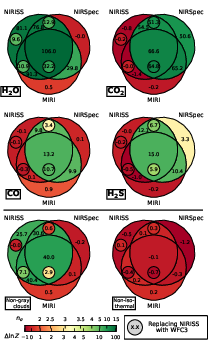
Figure 3: Detection significances for key molecular species and preference for cloud model assumptions as a function of JWST instrument combinations.
Four species (\ce{H2O}, \ce{CO2}, \ce{CO}, \ce{H2S}) surpass the 3σ detection significance threshold, and all but H2O demand NIRSpec coverage for positive identification. H2O detection with NIRISS alone is extremely robust (>12σ) due to coverage of multiple features, whereas CO, CO2, and HT0S require NIRSpec's sensitivity to fundamental bands between 3–5 µm.
The preference for non-gray (sloped) cloud opacity is strongly dictated by the presence of NIRISS data, with the model selection significance exceeding T1 only for combinations including NIRISS. MIRI, for the specific case of HAT-P-12b, primarily sharpens upper limits on undetected minor species (e.g., SOT2, NHT3, HCN), but has little impact on the constraints for the major absorbers due to the planet’s atmospheric properties.
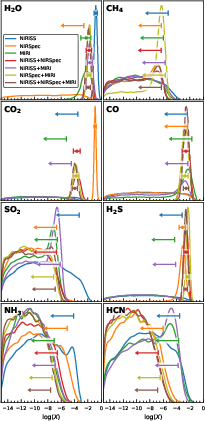
Figure 4: Marginal posterior distributions of chemical abundances for all included molecules, demonstrating instrument-dependent constraints and joint retrieval convergence.
Atmospheric Structure and Cloud Properties
The retrievals establish strong constraints on the cloud deck location and the spectral slope parameter (T4), with all NIRISS-inclusive retrievals favoring sub-Rayleigh slopes (T5). The cloud top pressure is inferred to be below T6 bar, requiring optically thick clouds to extend into the observable atmospheric layers. Marginal and joint posteriors across various instrument combinations show that combinations lacking NIRISS or with limited coverage yield posterior distributions closely resembling the priors, underscoring their limited constraining power.
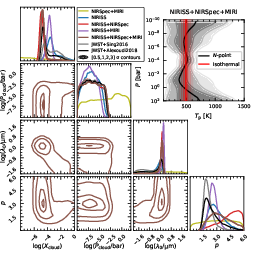
Figure 5: Posterior distributions for cloud model parameters, illustrating the impact of dataset selection and the degree of parameter degeneracy.
Elemental Abundances and Reduction Sensitivity
The study calculates C/O and metallicity proxies based on retrieved molecular abundances. Combined JWST spectra generally point to metallicities in the range T7–T8 solar, and a C/O ratio substellar for the adopted NIRSpec reduction, but this ratio is highly sensitive to subtle differences in the NIRSpec data processing pipeline. Consistent with studies for WASP-39b, single-instrument retrievals severely overestimate metallicity due to biased molecular abundance posteriors.
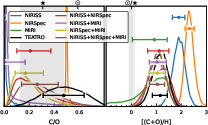
Figure 6: Marginal posteriors for C/O and metallicity ratios for each JWST instrument combination and data reduction pipeline.
Optical Slope, Cross-Instrument Consistency, and Stellar Contamination
Combining STIS with JWST data resolves the previous literature controversy on the optical slope, favoring a moderate, distinctly sub-Rayleigh slope regardless of the STIS reduction adopted. The inclusion of NIRISS is essential for constraining cloud properties and the slope; WFC3 as a substitute does not suffice to break the degeneracy between clouds and haze in the optical.
Comparison of the NIRISS transmission spectrum to HST/WFC3 demonstrates excellent agreement after a minor absolute offset correction, indicating successful cross-instrument calibration.
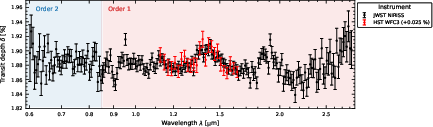
Figure 7: Direct comparison of the NIRISS and HST/WFC3 transmission spectra.
Implications, Comparison to Other JWST Benchmarks, and Future Prospects
The information content analysis for HAT-P-12b parallels analogous studies for WASP-39b, validating the necessity of broad (0.6–12.4 µm) spectroscopic coverage for robust atmospheric characterization in sub-Saturns and extending similar conclusions to a colder, lower-mass target class. The finding that multi-instrument retrievals converge and single-instrument retrievals are unreliable is robust across planetary targets.
A significant result is the lack of evidence for required T9-point (non-isothermal) P0-P1 profiles, in contrast to WASP-39b, and a general insensitivity of retrieved abundances to P2-P3 model complexity except for single-instrument cases. This underscores planetary variation in atmospheric structure retrievability and motivates tailored retrieval infrastructure for future comparative exoplanetology.
The work highlights several outstanding issues, including the need for more sophisticated treatment of potential stellar contamination (e.g., unocculted spots, faculae), implementation of equilibrium and disequilibrium chemistry constraints, and extension to a broader parameter space of planetary archetypes.
Conclusion
The paper establishes a detailed, quantitative foundation for interpreting JWST transmission spectra of temperate sub-Saturns, demonstrating that:
- Four molecules (\ce{H2O}, \ce{CO2}, \ce{CO}, \ce{H2S}) are robustly detected only with sufficiently broad spectral coverage.
- NIRSpec coverage is mandatory for carbon-bearing molecules; NIRISS is essential for cloud property constraints.
- Single-instrument retrievals can yield precise but systematically biased results; only multi-instrument joint analyses converge to robust, reduction-insensitive abundance and elemental ratio constraints.
- The derived metallicity for HAT-P-12b is moderately super-solar, and the atmospheric C/O ratio remains reduction-dependent and should be interpreted with caution.
- The study provides an exemplar for the information content analysis of exoplanet transmission spectra and sets the methodological standard for generalizing atmospheric inference from JWST observations.
These results reinforce the imperative of simultaneous, multi-instrument observation strategies and comprehensive cross-instrument calibration for the next phase of atmospheric retrieval and comparative exoplanetology with JWST.