- The paper introduces a unified framework for classical shadows by generalizing measurement protocols using arbitrary compact group representations.
- It employs centralizing bases to achieve analytical measurement channel inversion and derive explicit variance bounds for quantum state estimation.
- The work unifies prior protocols, such as Clifford and matchgate shadows, and guides optimal protocol design based on representation-theoretic visibility factors.
Classical Shadows with Arbitrary Group Representations: A Unified Framework
Overview and Motivation
The paper "Classical shadows with arbitrary group representations" (2604.01429) establishes a comprehensive representation-theoretic framework for classical shadows (CS) protocols, crucial for efficient quantum state property estimation. Traditional CS protocols often rely on group actions—random unitaries drawn from local/global Clifford groups, SU(2), orthogonal, symplectic, matchgate circuits, etc.—paired with specific measurement bases. These were previously analyzed on a case-by-case basis, each requiring tailored measurement channel inversion and variance bounding. Existing results such as Chen et al. for multiplicity-free representations left many important group representations unaddressed.
Here, the authors generalize and unify CS: they characterize analytically invertible measurement channels for arbitrary compact groups G with possibly non–multiplicity-free representations. The key innovation is identifying and leveraging centralizing bases—those adapted to an abelian (commuting) subgroup H⊆G with a non-degenerate simultaneous eigenbasis—yielding measurement channels whose action on isotypic components is scalar. Explicitly, the measurement channel becomes constant on each isotypic, enabling efficient channel inversion and variance analysis.

Figure 1: Schematic overview of the unified group-representation framework, illustrating the transition from a general group representation and commuting subgroup to analytically tractable measurement channels and exact channel inversion.
Theoretical Foundations
The authors’ formalism exploits the structural interplay between group representations, subgroup eigenspaces, and the operator space of quantum states:
- Protocol structure: For a Hilbert space H with an unknown state ρ, apply a random U∈G (3-design), measure in a basis W, and record the snapshot (w,U). Estimation for an observable O is performed via the average of o^w,U=Tr[M−1(U†∣w⟩⟨w∣U)O], where G0 is the “measurement channel” from averaging over G1 and basis G2.
- Representation decomposition: G3 decomposes into isotypic components under G4. Operator space G5 inherits a corresponding decomposition.
- Centralizing bases: A basis G6 is centralizing if, for each isotypic component, G7 acts as a scalar. For a non-degenerate commuting subgroup eigenbasis (NDCSE), response factors (visibility coefficients) G8 (dimension of G9 invariants in irrep H⊆G0 divided by its total dimension) analytically determine channel action.
Consequently, H⊆G1 and its inverse are explicitly given: H⊆G2
where H⊆G3 projects onto the visible isotypic components.
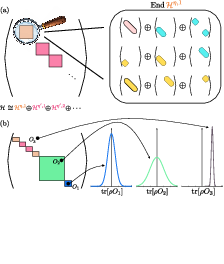
Figure 2: The subspace of H⊆G4-diagonal operators and their mapping to irreducible H⊆G5-modules under the centralizing shadows protocol.
Variance Bounds and Sample Complexity
A central theoretical result ties estimator variance—and thus sample complexity—directly to representation-theoretic visibility factors. The variance for estimating H⊆G6 is bounded above by: H⊆G7
For observables H⊆G8 highly overlapping with large H⊆G9-modules (small H0), one incurs prohibitive sample complexity, quantifying when classical shadows become intractable.
Further, for centralizing bases, inversion and variance analysis remain efficient even for highly non–multiplicity-free cases (e.g., H1 tensor representations), as demonstrated by explicit bounds.
Protocol Instantiations and Results
The unified approach encompasses and generalizes many prior protocols:
- Clifford-based shadows: Both local and global Clifford shadows fall under this framework, yielding well-known measurement channels and variance scalings.
- Fermionic Gaussian unitaries (matchgates): Measurement in an NDCSE delivers variance bounds for estimating Majorana monomials; for fixed-degree monomials, visibility factors scale polynomially with system size—efficient, but for high-degree observables, visibility drops exponentially, making estimation impractical.
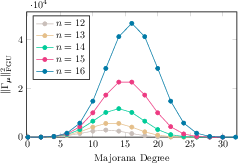
Figure 3: Squared shadow norm for Majorana monomials vs. degree and system size, illustrating polynomial vs. exponential scaling as visibility drops.
- Symplectic and orthogonal shadows: Sampling from H2 or H3 with weight bases allows for efficient channel inversion and variance bounds matching or improving upon earlier ad hoc derivations.
- Permutation-symmetric H4 shadows: For permutation-invariant H5-qubit observables, variance scales as H6, enabling efficient estimation irrespective of irrep multiplicities.
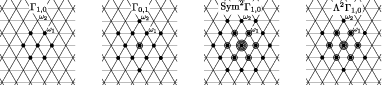
Figure 4: Weight diagrams visualizing the isotypic structure in symplectic and orthogonal shadows protocols.
- Novel group protocols: The framework straightforwardly extends to protocols based on the symmetric group H7 and exceptional Lie groups H8, providing automatic measurement channel characterization and variance bounds.
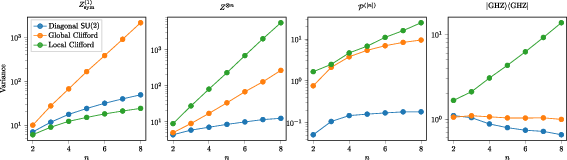
Numerical Evidence and Protocol Comparison
Empirical studies corroborate the theoretical bounds:
Implications and Future Directions
This work provides substantial theoretical and practical implications:
Conclusion
The paper delivers a principled, representation-theoretic methodology for classical shadows, enabling analytical characterization, efficient inversion, and explicit variance bounds for arbitrary compact group representations. It unifies diverse protocols, supports new protocol design for unexplored groups and representations, and clarifies the role of symmetry and visibility in quantum tomography. The direct connection between sample complexity and ρ3-submodule structure offers both theoretical insight and practical guidance for quantum information tasks, promising further developments in adaptive, entangling, and resource-aware measurement strategies.