- The paper presents a novel framework employing AR and MAG copulas to decouple marginal and serial dependence in time series.
- It extends classical ARMA models by incorporating non-linear, asymmetric, and heavy-tailed dependencies through the use of vine copula constructions.
- Empirical applications, such as forecasting wind power, demonstrate the framework’s practical advantages despite challenges in MLE estimation and non-identifiability.
Copula-Based Time Series for Non-Gaussian and Non-Markovian Stationary Processes
Introduction and Model Construction
The paper "Copula-Based Time Series for Non-Gaussian and Non-Markovian Stationary Processes" (2604.01500) offers an extensive theoretical and empirical investigation into time series models utilizing copula functions to capture serial dependencies beyond the Gaussian and Markovian settings. The framework generalizes the classical ARMA structure by constructing univariate time series with rich, flexible non-linear behaviors and arbitrary stationary distributions, achieved through the use of autoregressive (AR) and moving aggregate (MAG) copulas.
A key feature is the separation of marginal (unconditional) and dependence structure modeling, which is realized by expressing (p+1)-dimensional joint distributions of consecutive time points as products of the stationary marginal and a copula capturing serial dependence. This decoupling allows for non-linear, asymmetric, and heavy-tailed dependence structures and enables the modeling of clustering in extremes and long-range memory—phenomena poorly handled by linear Gaussian ARMA models.
The general model is constructed via two update equations:
Ut=h(εt,…,εt−q+1,Wt−q),Wt=g(εt,Wt−1,…,Wt−p),
where g and h are conditional quantile functions from the AR and MAG copulas, and {εt} are i.i.d. U(0,1). Vine copula constructions are used to specify both AR (stationary D-vine/Toeplitz vine) and MAG (q-dependent D-vine) components, balancing model flexibility and tractable dependence.
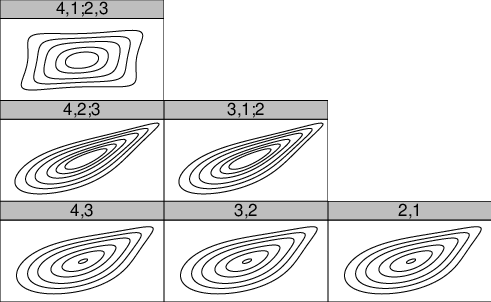
Figure 1: Contour plots of a stationary D-vine copula representing an autoregressive copula-based time series of order p=3.
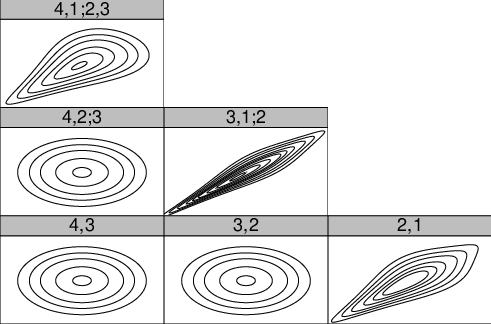
Figure 2: Contour plots of a MAG D-vine illustrating the q-dependent structure of the moving aggregate copula.
Relation to Gaussian ARMA and Extensions
A central theoretical contribution is the precise characterization of the relationship between this copula-based model and the classical Gaussian ARMA process. If both the AR and MAG copulas are Gaussian and the time series is transformed via the Gaussian quantile function, the resulting process is a subset of Gaussian-ARMA(p,q+p−1), not ARMA(p,q). The discrepancy in the MA order arises from the serial structure encoded in the copula composition (details provided in closed form), which introduces additional memory into the process.
Moreover, with specific copula choices, the authors show the model readily recovers the distributions and update equations of Gaussian ARCH(1) and GARCH(1,1) processes through non-linear transformations of the latent innovations and standardized volatilities:
- For ARCH/GARCH, conditional quantile mappings encode volatility clustering.
- The flexibility to model arbitrary marginal distributions while maintaining GARCH-type volatility is demonstrated, but estimation becomes numerically involved since the copula’s parameters may be related in a non-trivial (even implicit) fashion to the underlying ARMA or GARCH parameters.
Dependence Properties, Tail Structure, and Model Identifiability
The effective dependence induced by the copula construction, especially in the MAGUt=h(εt,…,εt−q+1,Wt−q),Wt=g(εt,Wt−1,…,Wt−p),0 (i.e., moving aggregate of order 1) case, is explored in depth. Numerical integration, simulation, and analytic results reveal significant findings:
- Serial Dependence Limitation: For a wide range of absolutely continuous copulas (e.g., Gaussian, Gumbel, Ut=h(εt,…,εt−q+1,Wt−q),Wt=g(εt,Wt−1,…,Wt−p),1, Clayton), the lag-1 dependence (e.g., Spearman’s Ut=h(εt,…,εt−q+1,Wt−q),Wt=g(εt,Wt−1,…,Wt−p),2) between consecutive observations is bounded by Ut=h(εt,…,εt−q+1,Wt−q),Wt=g(εt,Wt−1,…,Wt−p),3, an extension of classic results for linear MA(1) processes.
- Tail Dependence: The tail dependence coefficients for these stationary processes are rarely large; for several copulas, the upper bound for serial lag-1 tail dependence is Ut=h(εt,…,εt−q+1,Wt−q),Wt=g(εt,Wt−1,…,Wt−p),4 for the Fréchet copula and, empirically, vanishes for many “standard” copulas.
- Non-Identifiability: The (Gaussian) MAG(1) model possesses the same non-identifiability as the classical Gaussian MA(1): two equivalent parameterizations exist related by a transformation of the innovation sequence. The likelihood function thus exhibits minima at both the true and reciprocal parameter values, with critical parameter thresholds delineating identifiability regimes.
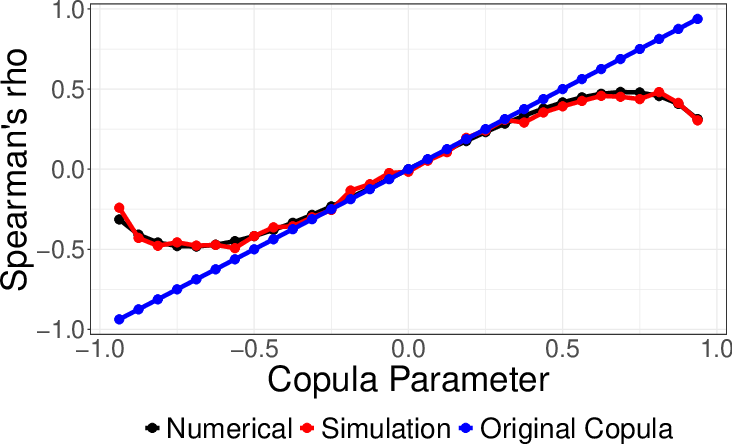
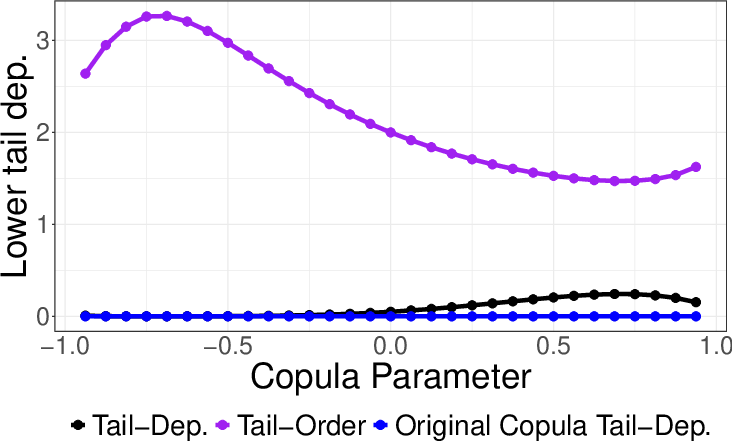
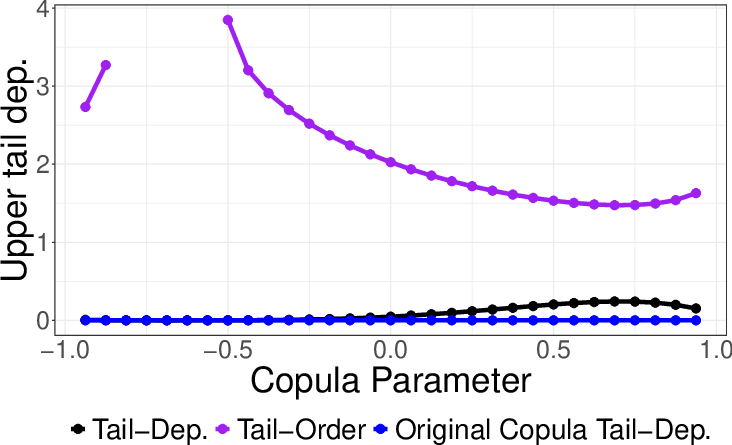
Figure 3: Estimated Spearman's Ut=h(εt,…,εt−q+1,Wt−q),Wt=g(εt,Wt−1,…,Wt−p),5 for Gaussian-MAG(1), highlighting the upper bound in absolute lag-1 dependence.
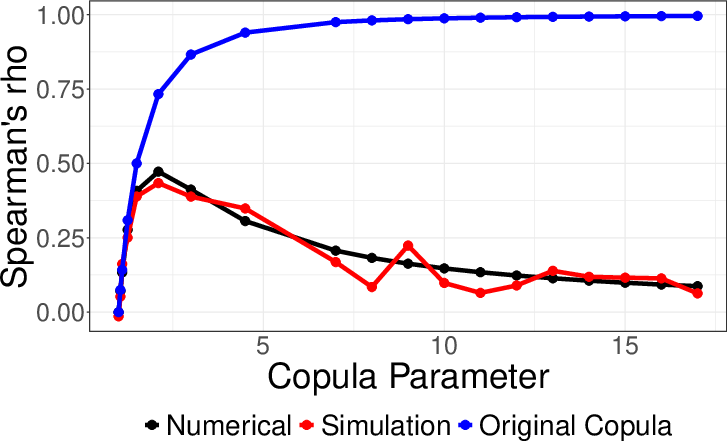
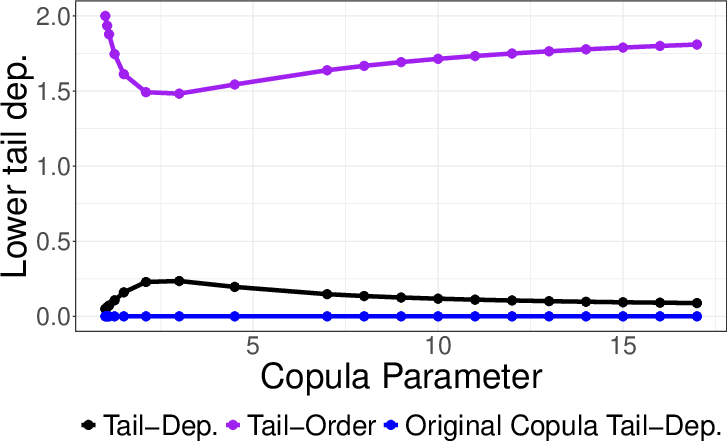
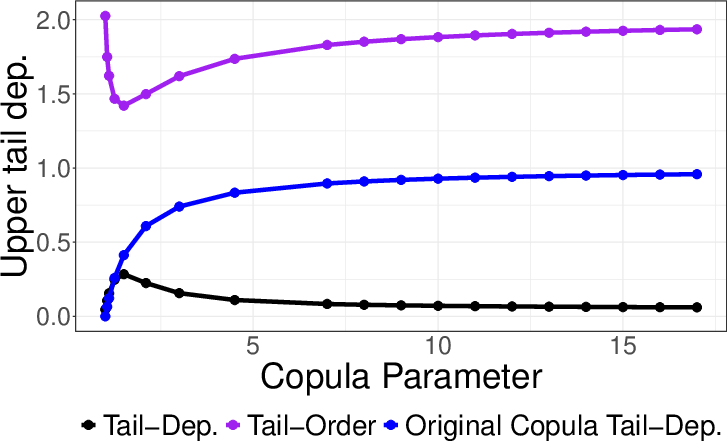
Figure 4: Estimated Spearman's Ut=h(εt,…,εt−q+1,Wt−q),Wt=g(εt,Wt−1,…,Wt−p),6 for Gumbel-MAG(1) processes, reinforcing the dependence bounds and variability with copula choice.
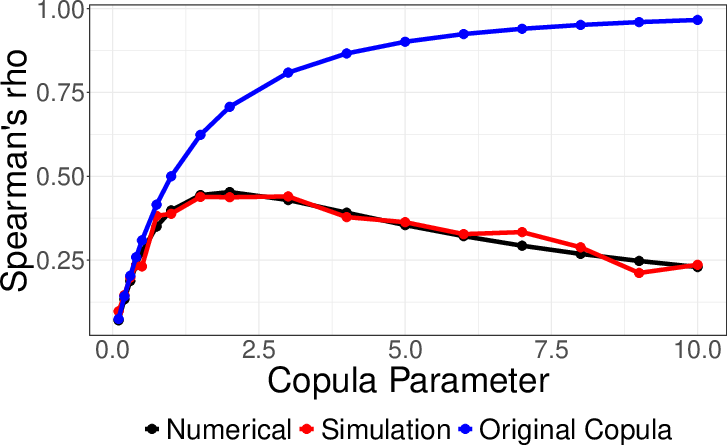
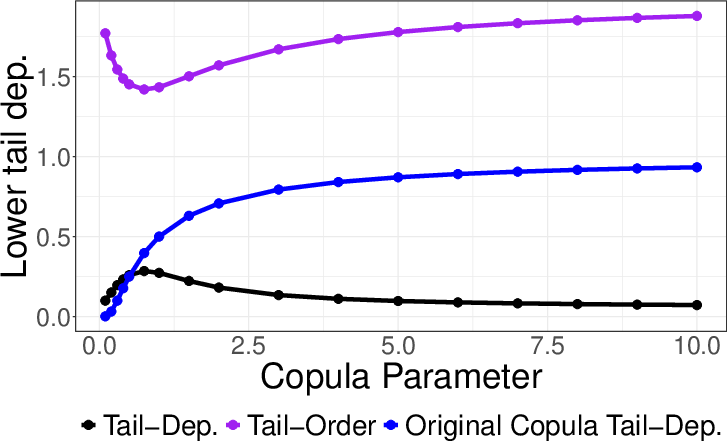
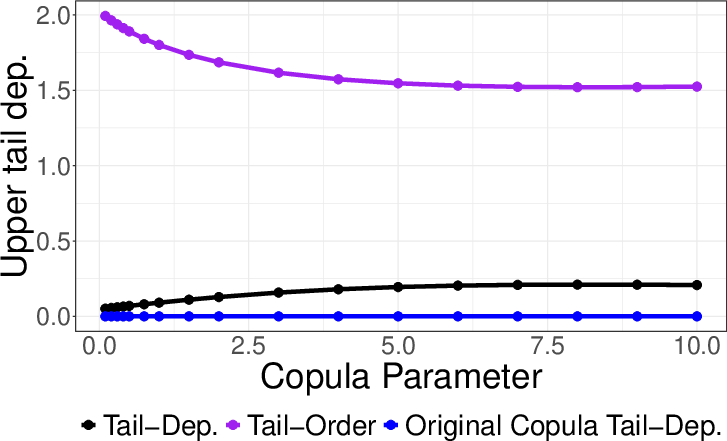
Figure 5: Estimated Spearman's Ut=h(εt,…,εt−q+1,Wt−q),Wt=g(εt,Wt−1,…,Wt−p),7 for Clayton-MAG(1) illustrating limitation in attainable serial dependence.
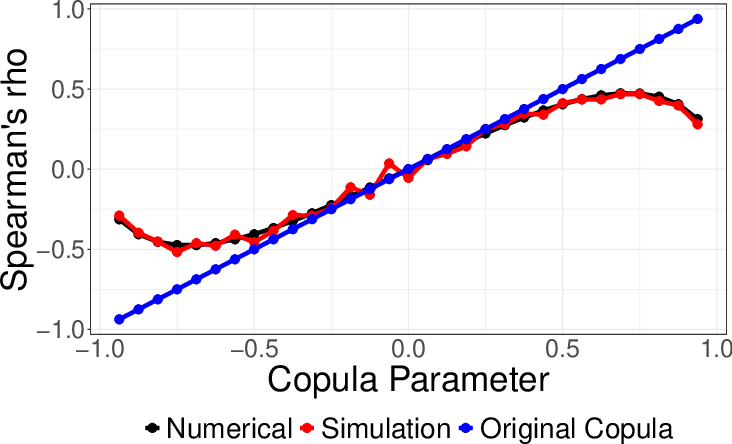
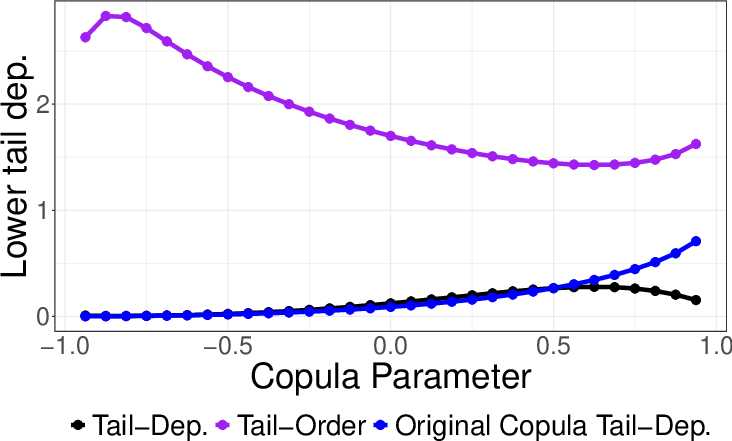
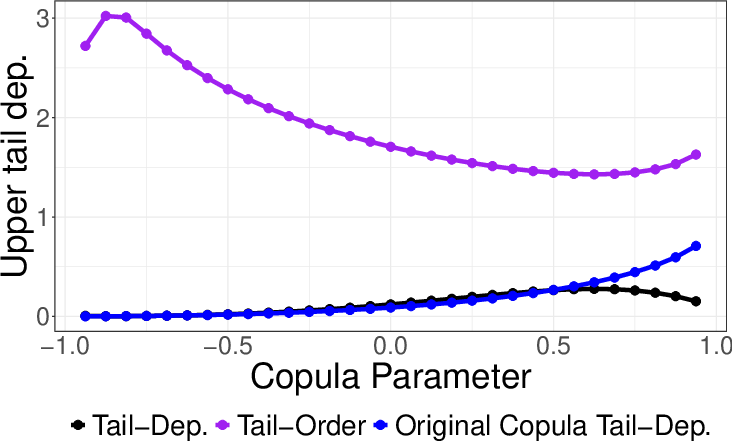
Figure 6: Estimated Spearman's Ut=h(εt,…,εt−q+1,Wt−q),Wt=g(εt,Wt−1,…,Wt−p),8 for Ut=h(εt,…,εt−q+1,Wt−q),Wt=g(εt,Wt−1,…,Wt−p),9-MAG(1), showing analogous behavior as above.
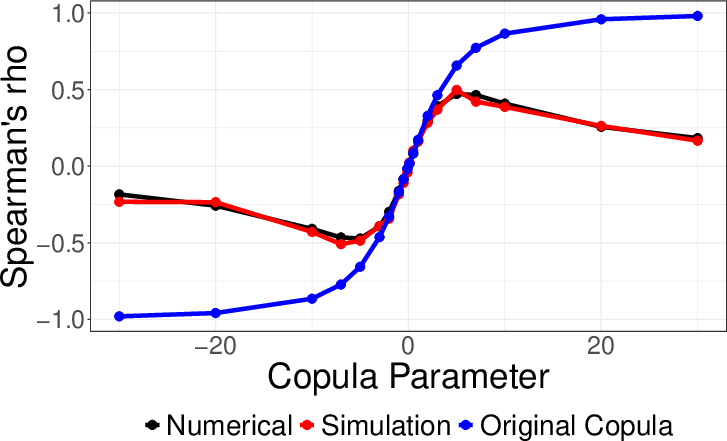
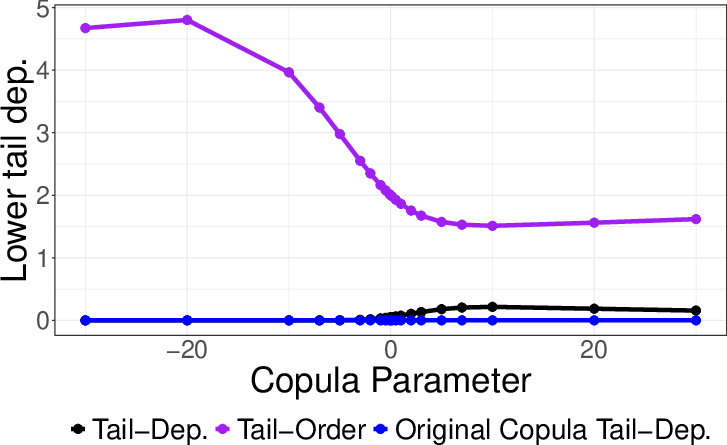
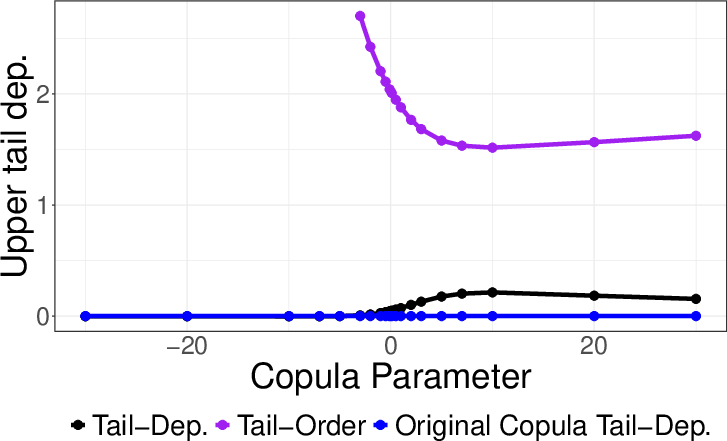
Figure 7: Estimated Spearman's g0 for Frank-MAG(1), supporting the general conclusion of constrained serial dependence.
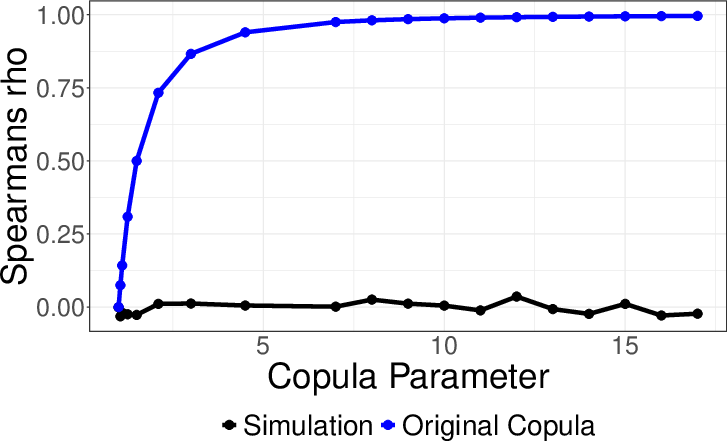
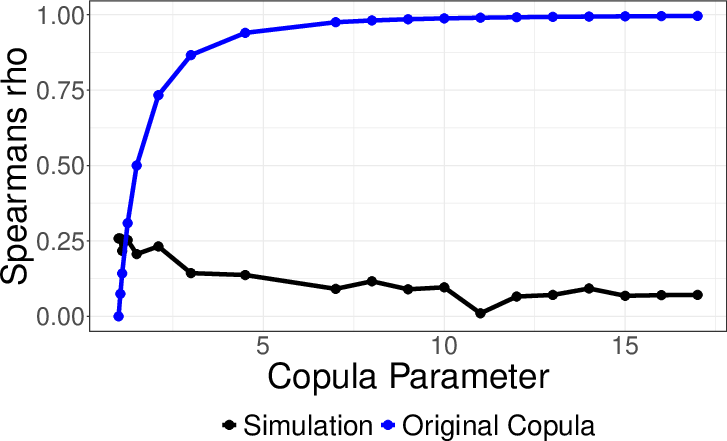
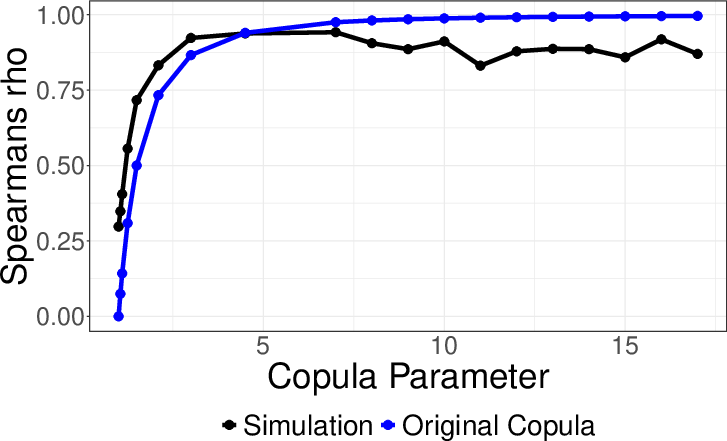
Figure 8: Log-likelihood surface as a function of the MAG(1) parameter, revealing non-identifiability in Gaussian-MAG(1).
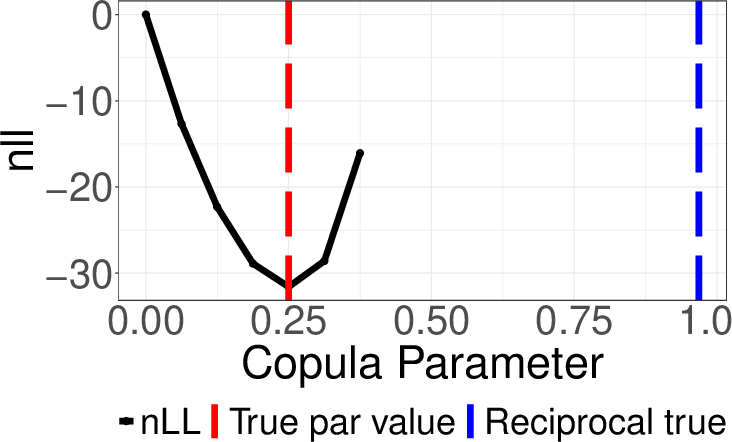
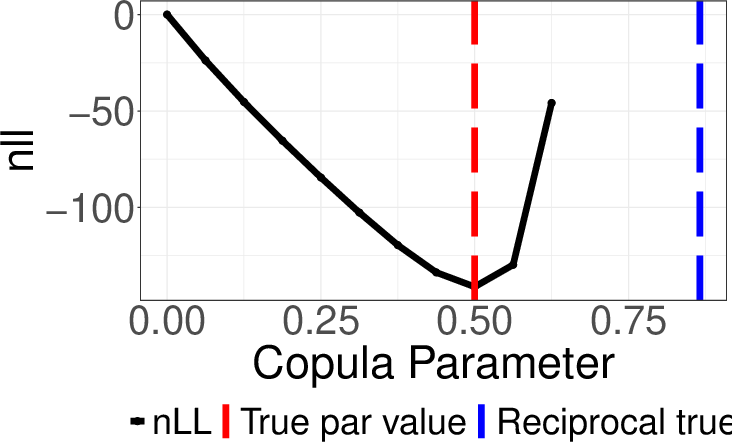
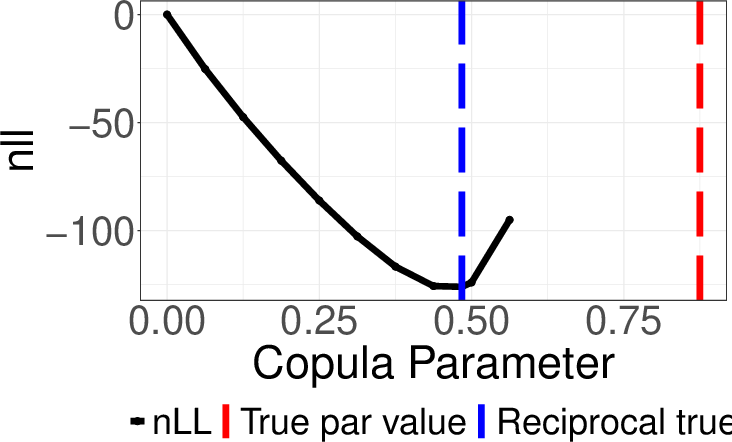
Figure 9: Negative log-likelihood (NLL) curve for MAG(1) with true parameter g1, showing identifiability at the parameter and its reciprocal.
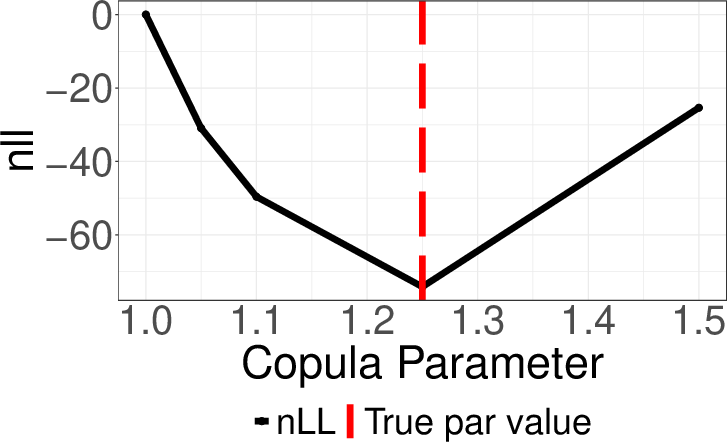
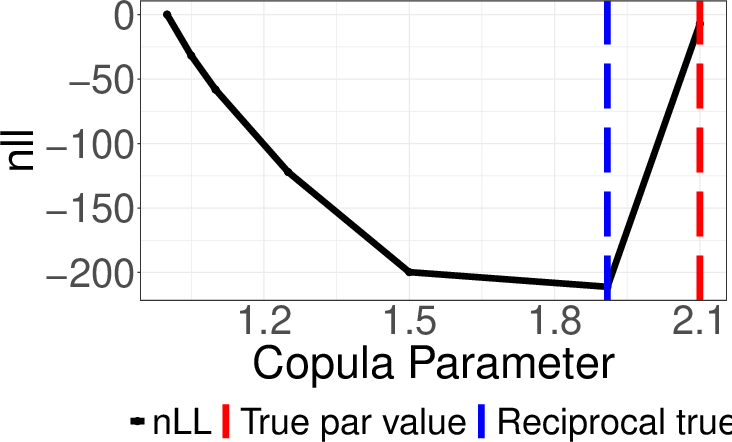
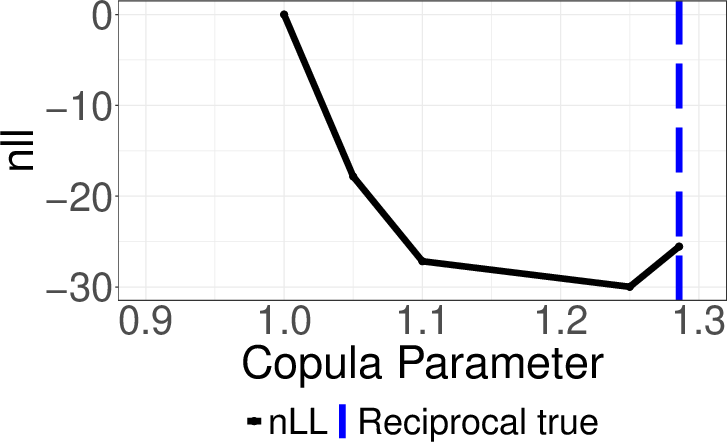
Figure 10: NLL profile for MAG(1) with true parameter g2, exhibiting nontrivial likelihood structure associated with identifiability.
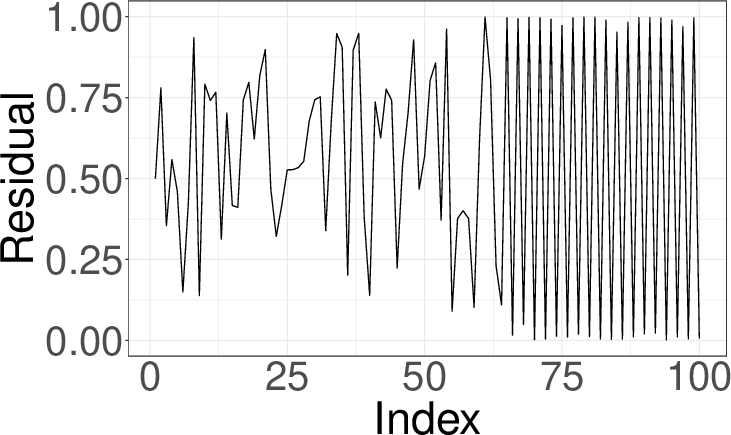
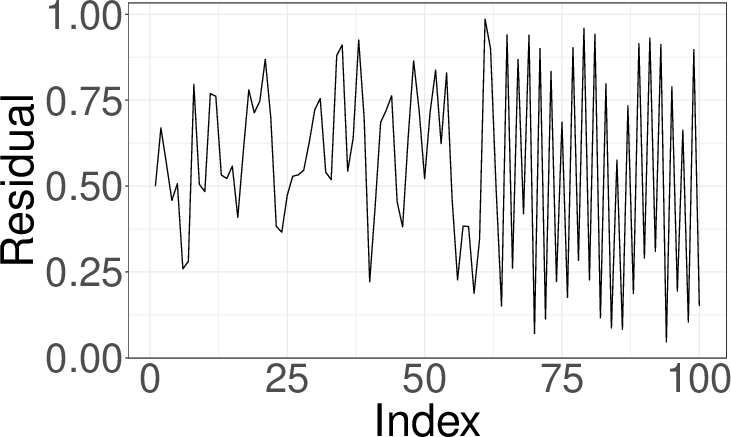
Figure 11: NLL for a Gumbel-MAG(1) process, illustrating the effect of copula family on identifiability and likelihood landscape.
Estimation and Inference
Maximum likelihood estimation (MLE) for these models is non-trivial because the likelihood involves iteratively computing latent states and pseudo-innovations via the copula-defined conditional quantile functions. The paper supplies iterative estimation algorithms, implemented efficiently using the rvinecopulib R package.
Consistency of the MLE hinges on stationarity and ergodicity of the inferred latent process for all parameters in the search space. For the Gaussian copula, the parameter region must be restricted to guarantee contraction properties and avoid the non-ergodic zone associated with non-identifiability in the MA(1) context (e.g., g3).
The authors discuss translation of these high-level regularity conditions (e.g., stochastic recurrence, contraction-on-average) to explicit bounds and parameter constraints in copula families—a nontrivial open problem for general copula-based time series.
Empirical Forecasting: Applications and Results
To assess practical performance, the models are applied to probabilistic forecasting for US inflation (quarterly) and German wind power (daily aggregates). For each dataset, copula-based models (with both kernel and Gaussian marginals), as well as Gaussian ARMA benchmarks, are fit and compared using CRPS, NLL, pinball scores, RMSE, and MAE metrics.
- US Inflation: Due to the small sample size and suspected time variation in dependence properties, no method uniformly outperforms others; Gaussian ARMA models are competitive on NLL and tail quantile metrics, while copula models offer similar point forecast (MAE/RMSE) performance. Model risk from small sample KDE-marginal estimation is documented.
- German Wind Power: The copula-based models with nonparametric marginals achieve better fit and forecasting accuracy, outperforming Gaussian ARMA in CRPS, NLL, and quantile scoring rules. This demonstrates the value of flexible marginal modeling in practical settings with strong marginal skewness, heteroskedasticity, and non-linearity.
Theoretical and Practical Implications
The copula-based generalization of ARMA processes yields stationary, ergodic time series models with exceedingly flexible marginal and serial dependence structure. The decoupling of marginal and dependence from the ARMA tradition is potent, enabling accurate modeling of processes where extremes, asymmetry, and non-linearity dominate.
However, not all dependence structures are attainable—critical limitations exist in the attainable serial dependence and tail dependence, inherited both from the one-dependence construction and the choice of copula class. For Gaussian copulas, serial non-identifiability must be carefully addressed via parameter constraints. For more general copulas, implications for invertibility, tail behavior, and estimation consistency are less readily characterized and merit further theoretical work.
The estimation and forecasting studies confirm the practical value in high-noise or non-Gaussian processes (e.g., wind), while also highlighting the challenges in low-data regimes (e.g., inflation), especially when using nonparametric marginal estimators.
Conclusion
The examined copula-based time series models provide a concrete strategy for modeling stationary, non-Gaussian, and non-Markovian processes via flexible copula constructions. The theory developed in the paper establishes conditions under which classical time series (ARMA, ARCH, GARCH) can be embedded as special cases, and elucidates the limitations and inherent identifiability issues, particularly for low-order moving average processes.
Numerical and empirical results demonstrate the model class is well suited for practical time series exhibiting complex marginal and serial dependence, especially when linear or Gaussian structures are inadequate. Future research should pursue more general conditions for ergodicity, tractable estimation for high-order models, and the development of diagnostic tools for copula-based time series identification and selection.
References
Sven Pappert, Harry Joe. "Copula-Based Time Series for Non-Gaussian and Non-Markovian Stationary Processes" (2604.01500)