- The paper establishes that infinitely many persistent elements exist in nontrivial knot groups, remaining nontrivial under every nontrivial Dehn filling.
- It uses Baumslag-Solitar relations, stable commutator length estimates, and hyperbolic rigidity to construct and analyze these persistent elements.
- The study characterizes subgroup behavior by showing that persistent elements populate every finite-index subgroup while being absent from the normal closure of peripheral elements.
Ubiquity and Structure of Persistent Elements in Knot Groups under Dehn Filling
Introduction
This work rigorously investigates the persistence phenomenon of group elements in knot groups G(K) under Dehn fillings, advancing both the algebraic understanding of 3-manifold topology and knot theory. An element is said to be persistent if it remains nontrivial in every nontrivial Dehn filling of the knot complement. The study is motivated by and extends the consequences of the Property P conjecture, which asserts that the meridian of a nontrivial knot is always persistent and is fundamental for the structure of G(K). The research systematically explores the existence, abundance, distribution, and structural properties of persistent elements in various classes of knot groups, especially those associated with hyperbolic knots without torsion surgery.
Persistent Elements: Definitions and Motivations
Persistent elements are characterized via the set-valued function S(g), where for g∈G(K), S(g) is the set of rational slopes r such that g becomes trivial in π1(K(r)) after r-Dehn filling:
$\mathcal{S}(g) = \{ r \in \mathbb{Q} \mid g \ \textrm{becomes trivial after %%%%9%%%%--Dehn filling} \}$
An element is persistent if G(K)0. The classical Property P conjecture, reformulated in this context, demonstrates that the meridian G(K)1 is always persistent for any nontrivial knot. However, the central question is whether such persistence extends beyond the meridian, possibly permeating the group structure to a larger extent.
Main Results: Existence and Pervasiveness
The paper establishes several central results:
- There exist infinitely many persistent elements in the knot group G(K)2 of any nontrivial knot with disjoint automorphic orbits not containing powers of the meridian.
- For torsion-free hyperbolic knots (i.e., hyperbolic knots admitting no finite or reducing surgery), persistent elements are generically abundant: every nontrivial subgroup not contained in the normal closure of a peripheral element contains persistent elements, and persistent elements exist outside every proper subgroup.
- A broad class of subgroups can be characterized entirely based on the presence or absence of persistent elements.
The construction of persistent elements leverages Baumslag-Solitar-type relators and exploits rigidity properties of 3-manifold groups, incorporating the advanced group-theoretic framework provided by hyperbolic geometry.
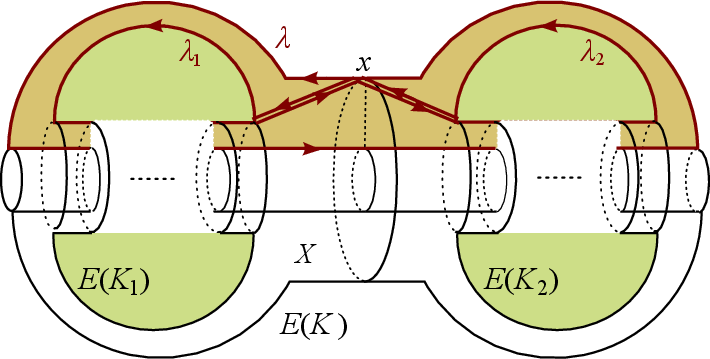
Figure 1: Longitudes G(K)3, G(K)4, and G(K)5 as relevant to constructions of nontrivial persistent elements in connected sum knot groups.
Techniques and Theoretical Framework
The core methodology uses detailed algebraic properties of Dehn filling and the action of automorphisms on G(K)6. Crucial technical components are:
- Baumslag-Solitar Relations and Shalen's Theorem: These relationships ensure that certain specifically constructed words in G(K)7 cannot be trivialized under Dehn filling, except possibly for a highly controlled (finite) set of surgery slopes. Persistent elements of the form G(K)8 are shown to survive all Dehn fillings when G(K)9 and S(g)0 is the meridian.
- Stable Commutator Length (scl) Estimates: Quantitative group-theoretic invariants derived from scl are employed to control intersection properties of sets S(g)1, facilitating inductive constructions of minimizers and persistent elements in general subgroups.
- Mostow-Prasad Rigidity and Peripheral Structure: Peripheral and non-peripheral element dynamics under group automorphisms and hyperbolic manifold homeomorphisms are central in distinguishing automorphic orbits.
- Full Residual Finiteness: The property that knot groups are fully residually finite ensures a vast supply of subgroups for the analysis of how persistence distributes in the group.
Characterizations and Applications to Subgroup Structure
A pivotal contribution is an exact characterization theorem: for torsion-free hyperbolic knots, a subgroup S(g)2 of S(g)3 contains a persistent element if and only if it is not contained in the normal closure of any peripheral element. This yields an effective dichotomy for subgroup analysis with deep consequences, including:
- Every proper subgroup omits some persistent elements, and persistent elements can always be found outside any proper subgroup.
- Every finite-index subgroup contains a persistent element.
- Fundamental (surface) subgroups, including those corresponding to incompressible Seifert surfaces, typically contain persistent elements unless obstructed by special geometric or surgery properties.
These results demonstrate that, generically, persistence is not an exceptional or rare property but a structural ubiquity in knot groups, revealing a rigid core that remains insensitive to all but the most degenerate Dehn fillings.
Persistent Elements Versus Pseudo-Meridians
A detailed comparison is made between persistent elements and pseudo-meridians (elements normally generating S(g)4 but not automorphic to the meridian). While all pseudo-meridians are persistent, the converse need not hold. Examples are constructed in connected sum knot groups—by exploiting the latitude-longitude structure (see Figure 1)—where a persistent element is automorphically equivalent to a non-persistent element, especially in presence of amphicheiral components and automorphisms not induced by homeomorphisms of the knot complement.
Open Questions and Theoretical Implications
The study concludes with precise open questions regarding the existence and density of persistent subgroups—especially free subgroups of rank two in hyperbolic cases—and the natural density of persistent elements in the Cayley ball growth. These questions bridge geometric group theory and low-dimensional topology, suggesting directions for future research:
- Is the set of persistent elements a net, or even generic, with respect to word metrics?
- What is the precise asymptotic density of persistent elements for non-abelian knot groups?
- What additional geometric or topological features influence the distribution of persistent elements in S(g)5?
Conclusion
The analysis uncovers a pervasiveness of persistent elements in knot groups, tightly linking algebraic, topological, and geometric aspects of 3-manifolds under Dehn filling. The results illuminate a structurally rigid core within knot groups, raising further questions on subgroup profiles and the implications for 3-manifold topology, residual properties, and the theory of group actions. These findings are expected to have enduring influence on the study of algebraic invariants in low-dimensional topology, the structure of 3-manifold groups, and the interplay between group theory and geometric topology.