- The paper rigorously demonstrates that the existence of weak solutions in cross-diffusion systems is established by adapting the JKO scheme for Wasserstein gradient flows.
- It employs advanced compactness techniques, including strong L² convergence and BV estimates, to overcome challenges posed by non-geodesic convexity in multi-species models.
- The review contrasts the Busenberg–Travis and SKT models, and extends the methodology to fourth-order and nonlocal systems, highlighting both limitations and future research directions.
Compactness Methods for Cross-Diffusion Systems as Wasserstein Gradient Flows
Introduction and Theoretical Context
This work reviews the mathematical theory and compactness techniques underpinning the existence analysis for multi-species cross-diffusion systems that can be formulated as Wasserstein gradient flows, with a focus on the Busenberg–Travis model and selected fourth-order extensions (2604.01819). Parabolic cross-diffusion models emerge naturally in the modeling of multi-component transport phenomena, including gas mixtures, population dynamics, and reaction–diffusion systems. Recent advances in optimal transport have clarified the interpretation of certain cross-diffusion PDEs as gradient flows in the Wasserstein metric space of probability measures, following the paradigm set by the Jordan–Kinderlehrer–Otto (JKO) scheme.
A central technical and structural challenge addressed in the paper is the non-geodesic semi-convexity of interaction energies relevant for coupled cross-diffusion when viewed under the Wasserstein geometry, which prevents direct application of classic Ambrosio–Gigli–Savaré (AGS) theory for gradient flows. The review systematically develops the analytical tools necessary for proving weak solution existence, discussing both parabolic and hyperbolic–parabolic systems, and providing a comprehensive summary of methods such as the flow interchange technique and strong L2 compactness arguments.
Wasserstein Gradient Flow Structure and Energetic Landscape
The prototypical N-species cross-diffusion system considered has the structure
∂tui=div(ui∇∂ui∂E(u))
subject to mass-conserving (no-flux) boundary and initial conditions. The energy E is typically a quadratic form (or generalization thereof) in the species densities. Such systems admit a metric gradient flow interpretation in the Wasserstein space P2(Ω)N.
Despite the formal analogy with dissipative evolution equations (e.g., porous medium, Fokker–Planck), the quadratic interaction energy E(u)=21i,j=1∑N∫Ωaijuiujdx fails, in general, to be λ-geodesically convex in P2(Ω)N unless all off-diagonal aij vanish. This is proven via a constructive contradiction, demonstrating a lack of the McCann convexity principle for such energies in the presence of true cross-diffusive coupling, which is central in multi-species systems.
Compactness and Existence via the JKO Scheme
The central methodological ingredient for existence is the time-discretization by minimizing movements (the JKO scheme), generating piecewise constant approximations: uk+1=argu∈P2(Ω)Nmin{2τ1W22(uk,u)+E(u)}.
The paper delivers a thorough compactness analysis of the resulting sequence, leveraging equicontinuity in the Wasserstein metric, uniform N0 estimates stemming from positive definiteness of the diffusion matrix, and gradient bounds obtained via the flow interchange technique: a Lyapunov-dissipation argument using auxiliary (entropic) gradient flows. Additionally, a strong compactness result in N1 is achieved by adapting a generalized Aubin–Lions type theorem (Rossi–Savaré) compatible with Wasserstein distances.
The time regularity of the approximating sequence and the non-expansiveness of the energy along (discrete) solutions ensure, via Arzelà–Ascoli type arguments, the precompactness necessary for passage to the limit and construction of a weak solution.
Parabolic and Hyperbolic–Parabolic Busenberg–Travis Systems
For positive-definite coupling matrices, existence of weak solutions with strong N2 compactness and gradient control is obtained. The analysis reveals—in stark contrast to the scalar porous medium equation—that the interaction energy's lack of Wasserstein convexity fundamentally limits chain rule and evolution variational inequality applications, necessitating nonstandard compactness and structural estimates.
Conversely, for degenerate or non-invertible interaction structures (yielding hyperbolic–parabolic normal forms), the entropy method is insufficient for individual gradient control. The paper innovatively recasts solutions as curves of probability vectors constrained by a pressure variable evolving via a porous-medium subdynamics. Existence in this setting is guaranteed by constructing solutions on fiber bundles over the pressure field and controlling the metric derivative via a projection argument.
Fourth-Order and Nonlocal Variant Systems
The review extends the compactness approach to fourth-order cross-diffusion systems, incorporating gradient penalizations in the energy and leading to equations including terms such as N3. The passage to the limit in higher Sobolev spaces is facilitated by additional regularity generated by higher-order energies and reinforced via the Gagliardo–Nirenberg interpolation and elliptic regularity. Boundary conditions, such as no-flux, are crucial for establishing necessary estimates.
One-Dimensional BV Compactness and the Five Gradient Inequality
The work reviews sharp BV (bounded variation) compactness for one-dimensional two-species systems. Here, the transformation to total density N4 and relative density N5 allows the equations to decouple into a porous-medium equation for N6 and a transport equation for N7 along the gradient flow, reminiscent of a Lagrangian formulation. The five gradient inequality is exploited to obtain monotonicity in total variation, ensuring compactness and admitting a strong limit in N8.
Complementary Effects: SKT Model, Nonlocal Dynamics, and Correlation
The review contrasts the Busenberg–Travis model with the Shigesada–Kawasaki–Teramoto (SKT) system, which features an additional self-diffusion term. The nonlocal correlation effects generated by microscopic interactions in the particle system setting are illustrated via a two-species setup.
The figures provide numerical insight:
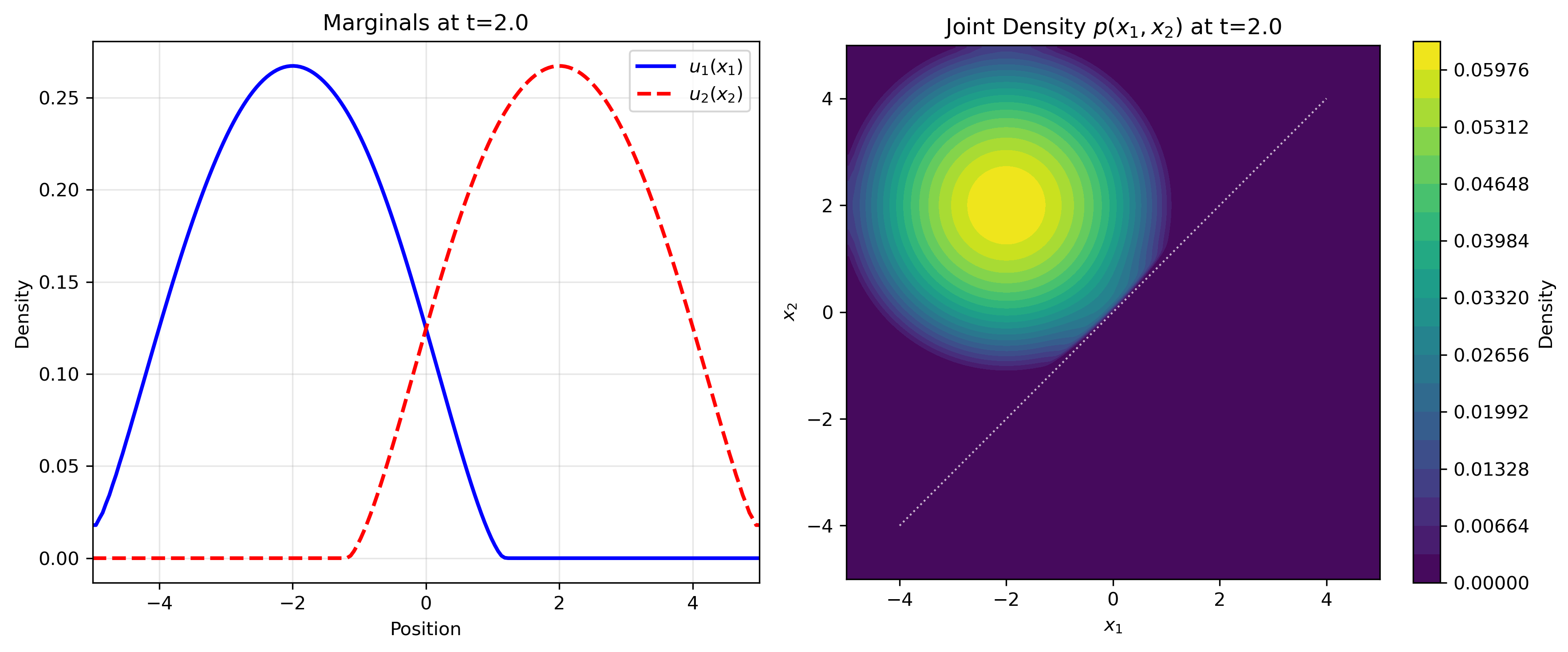
Figure 1: Marginals N9, ∂tui=div(ui∇∂ui∂E(u))0 (left) and joint density ∂tui=div(ui∇∂ui∂E(u))1 (right) at time ∂tui=div(ui∇∂ui∂E(u))2, demonstrating the evolution of correlation in the microscopic particle system.
A simulation with initially uncorrelated data (product measure) demonstrates the emergence of nontrivial correlation under coupled dynamics, as evidenced by the time evolution of the relative entropy.
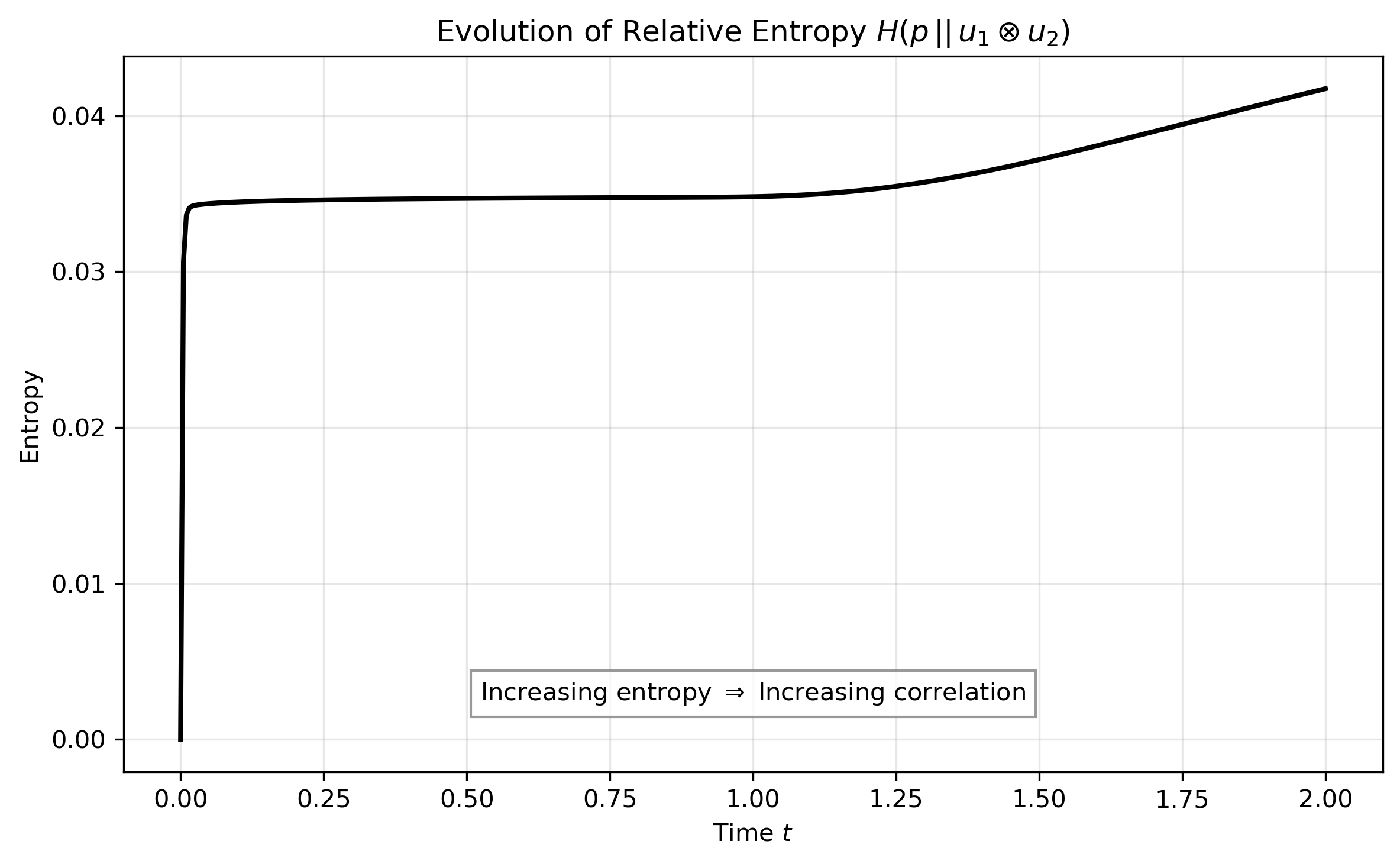
Figure 2: Relative entropy ∂tui=div(ui∇∂ui∂E(u))3, highlighting the loss of initial chaos and decorrelation due to collisional interactions.
Theoretical closure is discussed via a limiting process with stiff collision terms enforcing decorrelation. This yields nonlocally coupled quadratic porous-medium systems, the existence of which is ensured via a compactness-based JKO scheme argument, despite the lack of full geodesic structure in product Wasserstein spaces under non-product metrics.
Implications, Limitations, and Future Directions
This review underscores the structural limitations of standard Wasserstein gradient flow theory in the analysis of vector-valued cross-diffusion PDEs, especially regarding energetic convexity and the chain rule. The adaptation of entropy methods, subtle compactness techniques, and geometric insight is indispensable for existence proofs.
The lack of uniqueness for certain formulations and the non-convexity of the underlying cost function remain critical challenges. The methodologies reviewed are applicable to a broad class of coupled systems, including those with nonlocal or higher-order terms, subject to careful adaptation of compactness and structural arguments. Open problems include extension to fully nonlinear energies, multidimensional BV compactness, and rigorous derivation of effective PDEs from multi-species interacting particle systems in singular limits.
Conclusion
The paper provides a comprehensive examination of compactness methods for cross-diffusion systems in the Wasserstein gradient flow framework (2604.01819). The analysis bridges energetic, geometric, and functional-analytic perspectives, providing robust tools for existence proofs in the absence of classical convexity and suggesting avenues for future research in PDE theory and applications in particle and population dynamics.