- The paper introduces a novel two-stage blowup mechanism where degenerate initial data first trigger an L∞ blowup, followed by a singular Lp blowup.
- Its dynamic rescaling and adaptive meshing techniques rigorously capture the evolution of both regular and singular self-similar profiles.
- The results provide explicit examples and stability analysis that enhance understanding of singularity formation in fluid dynamics and related 3D Euler models.
Self-similar Finite-time Blowup with Singular Profiles in the 1D Hou-Luo Model and 2D Boussinesq Equations
Introduction
This work investigates the formation of singularities through self-similar finite-time blowup with singular profiles in the 1D Hou-Luo (HL) model and the 2D Boussinesq equations. The HL model abstracts essential vorticity dynamics from the 3D axisymmetric Euler equations near boundaries. While classical studies and analytic reduction have established self-similar blowups with regular (bounded) profiles for non-degenerate data, this paper presents novel evidence for singular self-similar profiles arising from degenerate initial conditions, supported by large-scale adaptive numerical computations.
The study demonstrates that, under particular symmetry and degeneracy constraints on the initial data, the HL model and the 2D Boussinesq system can exhibit a robust two-stage blowup: first, a local L∞ blowup at a point away from the symmetry origin; subsequently, upon continuation in a weak sense, a second blowup with a singular Lp profile is transported to the origin. Both stages show strong asymptotic self-similarity. These results generalize previously known singularity scenarios and provide explicit examples of finite-time singular profiles with continuous scaling-invariant evolution, raising critical theoretical implications for singularity formation in fluid equations and further motivating investigation in the 3D Euler context.
Dynamic Rescaling and Blowup Mechanism
The work adopts a dynamic rescaling formulation for both the HL model and the Boussinesq equations. This transforms the search for finite-time blowup into the analysis of stability and convergence to stationary self-similar profiles in rescaled space-time. The rescaling selects normalization parameters so that, as the critical blowup time is approached, the solution profile contracts and the dynamic variables converge (if possible) to a steady state in the rescaled frame.
The study identifies two main classes of initial data:
- Odd-symmetric, non-degenerate: Rescaled profiles are smooth; the peak approaches the origin and the solution converges to a regular, bounded steady profile.
- Degenerate (vanishing derivatives at the origin, possibly breaking symmetry): The peak splits, and the solution exhibits a two-stage singularity evolution, with eventual convergence to explicit unbounded singular profiles.
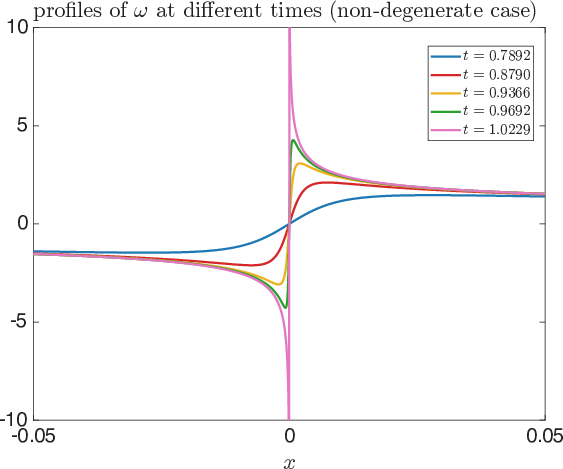
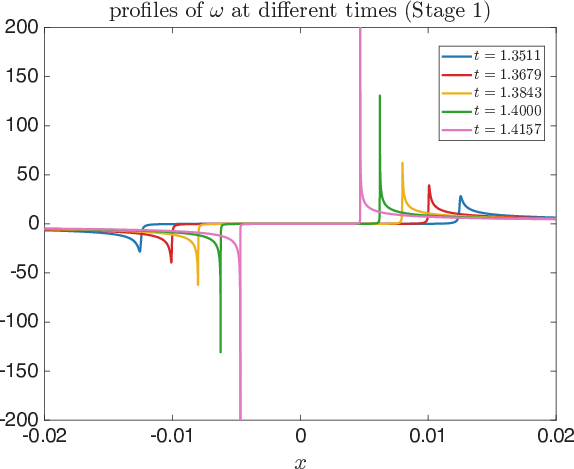
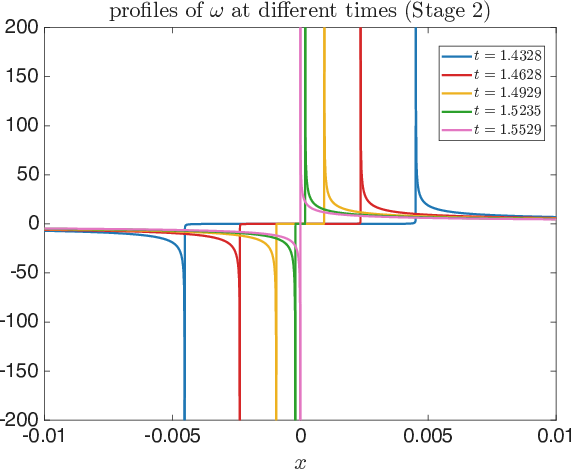
Figure 1: Evolution of (⋅,t) starting from odd-symmetric non-degenerate initial data; the spatial profile of ω concentrates at the origin, with the L∞ norm exhibiting rapid growth.
Two-Stage Blowup with Singular Self-similar Profiles
The core discovery is a two-stage blowup for degenerate initial data in both the HL model and 2D Boussinesq equations:
Stage 1: Regular Profile L∞ Blowup
Numerical integration of the rescaled equations shows that the solution, starting from smooth degenerate data, first forms a local maximum away from the symmetry center. This maximum increases rapidly in magnitude, resulting in L∞ blowup at a point x∗=0 (in HL) or (x1∗,0) (in Boussinesq). The inner profile near the blowup point, after suitable rescaling, stabilizes to a regular but non-symmetric self-similar profile.
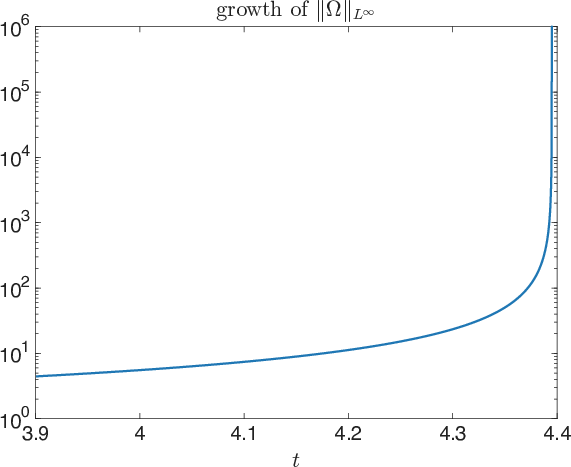
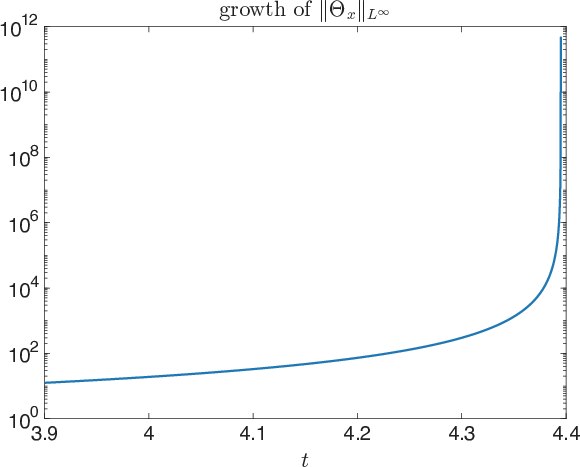
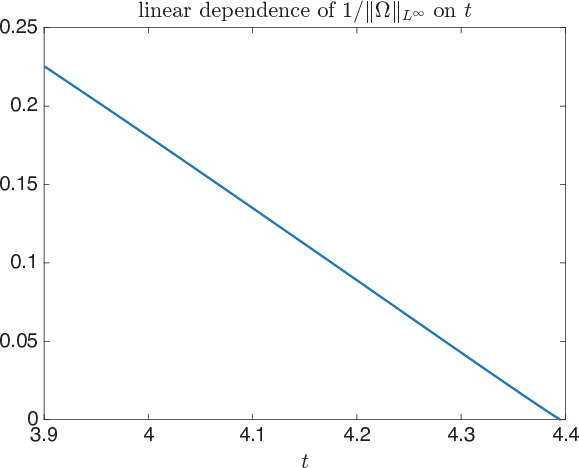
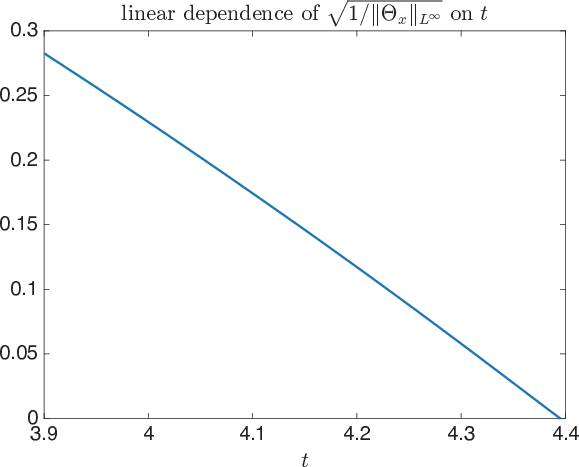
Figure 3: Time evolution of ∥Ω∥L∞ and Lp0 in the odd symmetry case; the top row shows rapid growth, while the bottom row demonstrates that both quantities' inverses decay linearly with time, indicating self-similar scaling.
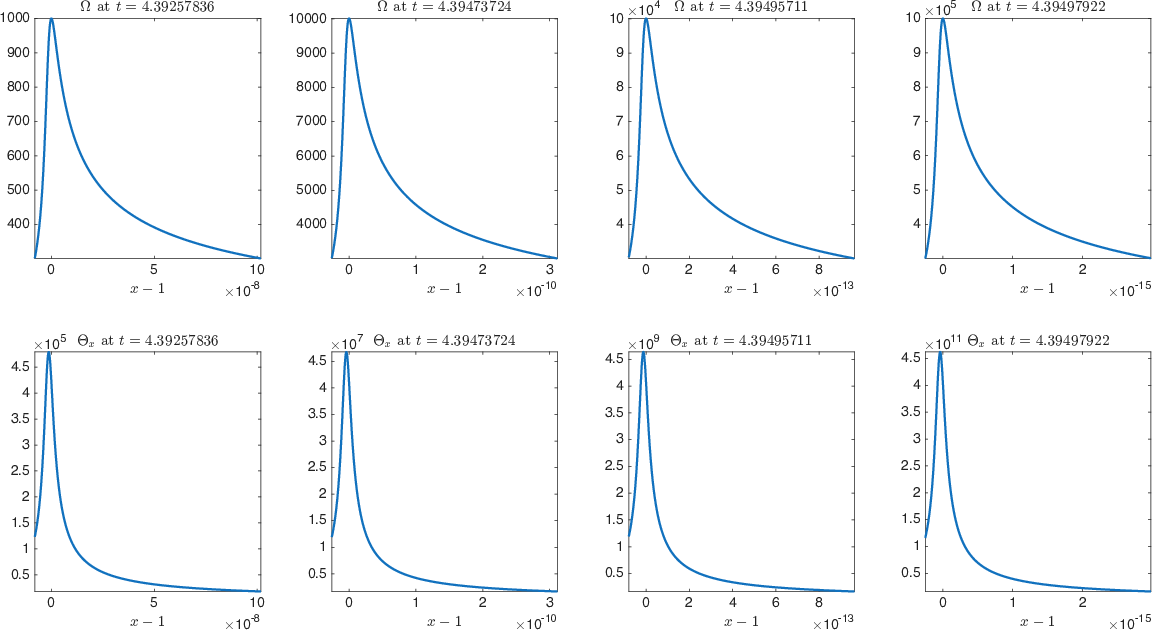
Figure 5: Inner profiles of Lp1 (top) and Lp2 (bottom) in the odd symmetry case; after rescaling, the profiles stabilize near the blowup time, confirming asymptotic self-similarity.
Stage 2: Singular Profile Lp3 Blowup
Following the Lp4 blowup, the solution continues in the weak sense, and the peaked singular region is transported toward the origin by the flow. Ultimately, the rescaled profile converges to a stationary distribution with an explicit singularity—e.g., Lp5 for the HL model's one-sided case—characterizing an Lp6 blowup with Lp7 strictly less than infinity (e.g., Lp8 or Lp9 depending on scaling). The numerical solution matches the derived singular steady states with high accuracy.
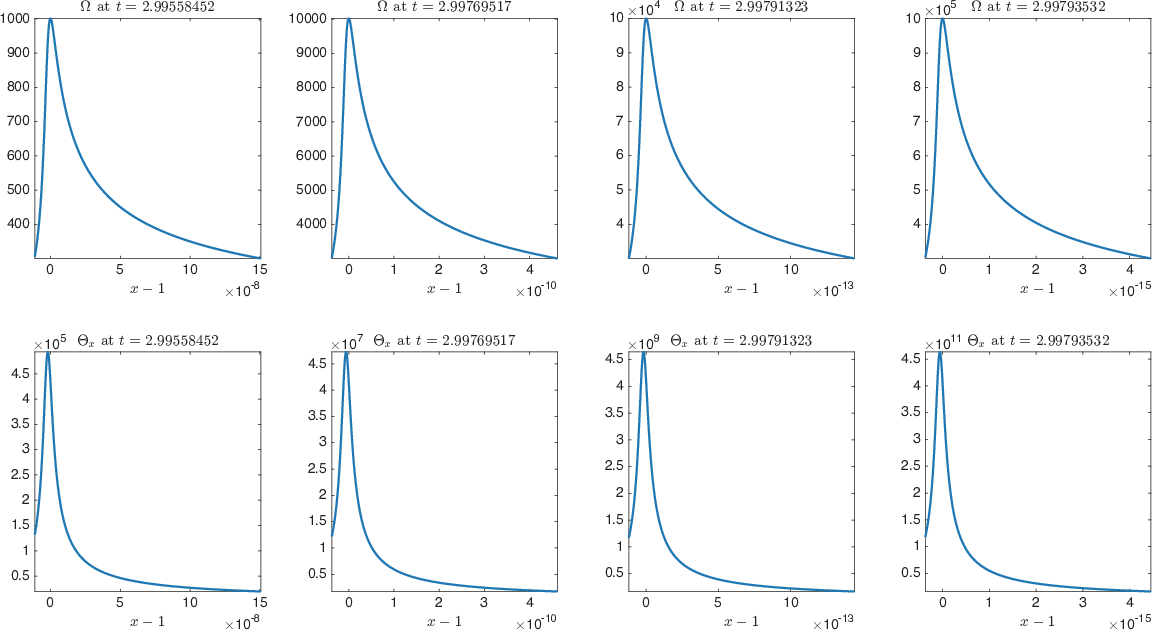
Figure 7: Inner profiles of (⋅,t)0 and (⋅,t)1 in the one-sided, degenerate case; after rescaling, all inner profiles stabilize, confirming convergence to a singular steady state as (⋅,t)2.
Explicit Construction and Stability of Singular Self-similar Profiles
For the HL model, the work provides a direct construction of one-sided singular steady solutions: (⋅,t)3
These satisfy the distributional steady state equations, with the Hilbert transform evaluated carefully across the singular point. Numerically, the solution starting from nearby degenerate initial data robustly converges to these singular profiles, both for odd-symmetric and one-sided cases. The stability of the singular profile is supported by the alignment of scaling exponents (e.g., (⋅,t)4 as predicted) and the spatial localization of the developing singularity.
Two-stage Blowup in the 2D Boussinesq System
The authors extend the investigation to the 2D Boussinesq equations in the upper half-plane with boundary conditions, using an analogous dynamic rescaling approach. The numerics reveal that degenerate initial data also exhibit the same two-stage scenario.
- Stage 1: A regular, non-symmetric, strongly focusing (⋅,t)5 blowup forms at a point on the boundary.
- Stage 2: The singularity propagates toward the boundary origin, ultimately yielding a singular (⋅,t)6 profile (empirically, (⋅,t)7).
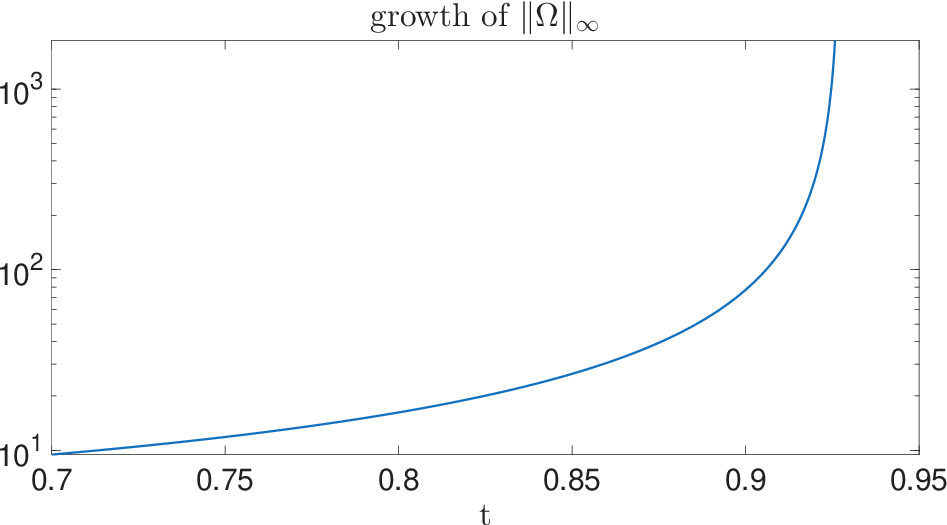
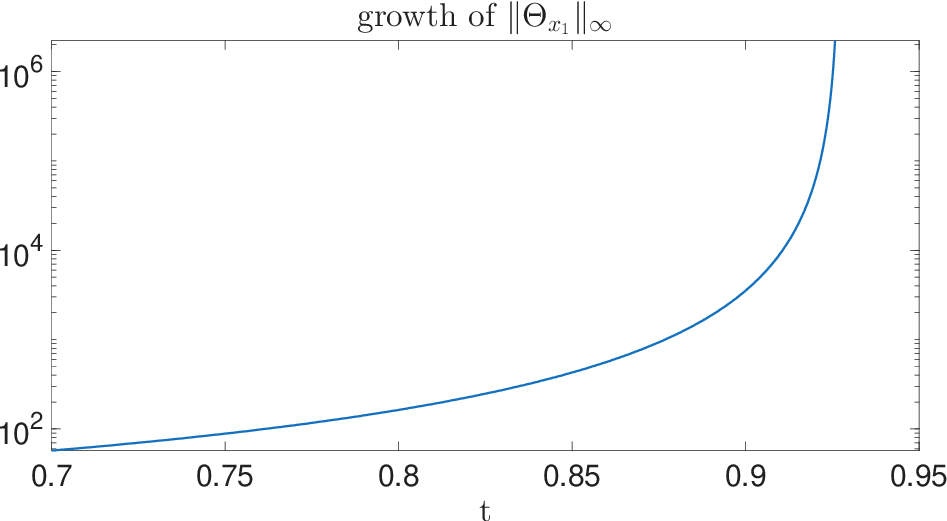
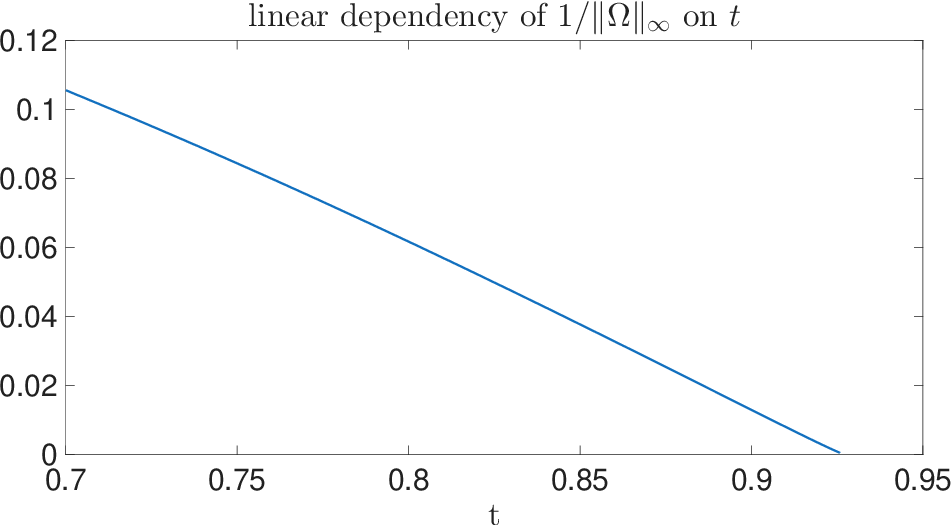
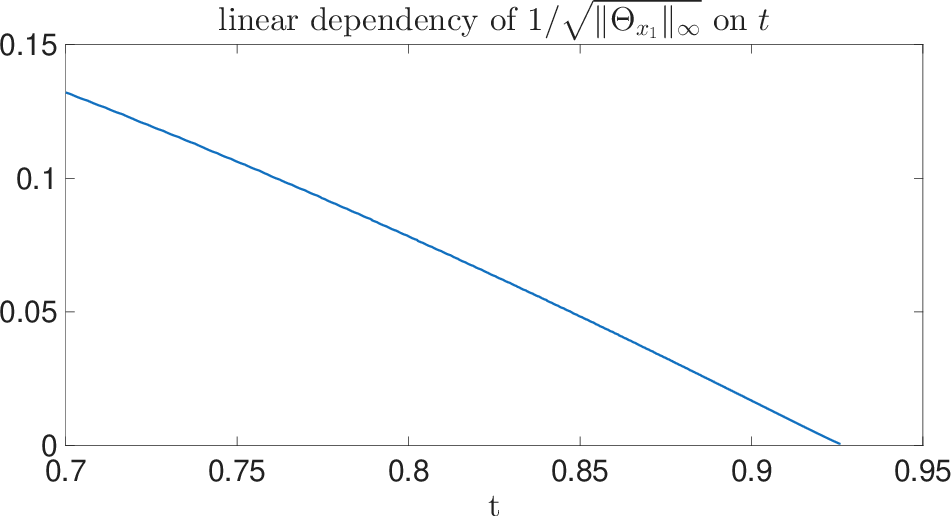
Figure 9: Time evolution of (⋅,t)8 and (⋅,t)9 for the 2D Boussinesq scenario; top row demonstrates rapid growth, bottom row indicates self-similar scaling.
Strong agreement is found between the inner profiles in the first stage of both HL and Boussinesq, supporting the universality and robustness of the mechanism identified.
Comparison of Inner and Global Profiles
Inner profiles extracted during the first (regular) blowup and the limiting profiles of the steady-state rescaled equations show a strong match when rescaled appropriately, confirming the dynamical attractor property of the corresponding self-similar solutions.
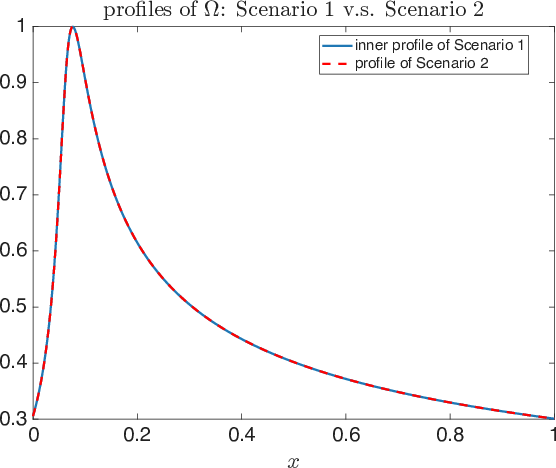
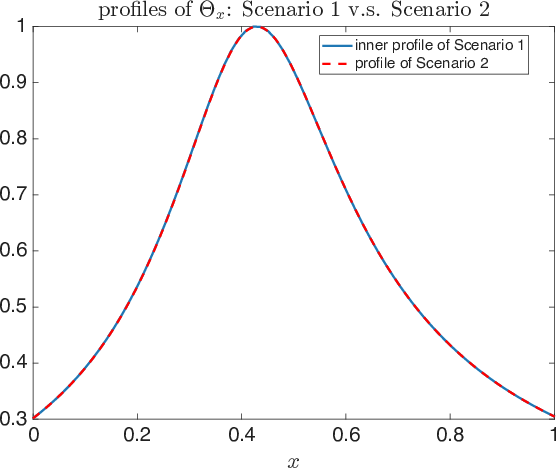
Figure 2: Comparison between the inner profile from the odd symmetry case in Scenario 1 at ω0 and the limiting profile in Scenario 2 for the HL model; rescaled profiles coincide, confirming self-similar attractor behavior.
Numerical Algorithmic Implementation
The study utilizes high-resolution adaptive meshing, dynamic stretching, spline-based Hilbert transforms for 1D models, and a hybrid finite-element/WENO scheme for the 2D system to resolve near-singular gradients. Careful validation, mesh convergence, and residual control measures are conducted to substantiate the robustness of the numerical observations.
Theoretical and Practical Implications
The results highlight several important consequences:
- Degeneracy in initial data is a mechanism for singular self-similar profile selection in nonlocal transport models.
- The self-similar attractor structure persists beyond symmetry constraints, with explicitly parameterized singular steady states robust under perturbations.
- For the 2D Boussinesq system, the multi-stage self-similar blowup likely reflects generic possibilities for boundary-induced singularity in higher-dimensional flows.
- The connection to recent advances in the 3D Euler singularity literature suggests that similar organizing blowup structures may be relevant in more realistic fluid dynamics models, especially in axisymmetric or boundary-influenced geometries.
Conclusion
This study delivers comprehensive numerical and analytic evidence for the existence of robust, asymptotically self-similar finite-time blowups with singular profiles in the HL model and the 2D Boussinesq equations. The discovered two-stage blowup mechanism—regular ω1 blowup localized away from the origin, followed by propagation and formation of singular ω2 profiles at the origin—expands the canonical picture of self-similar singularity formation. The findings provide explicit examples and rigorous characterization of singular blowup attractors in critical transport-stretching systems, yielding insight into the delicate interplay between nonlinearity, symmetry, and degeneracy in the emergence of fluid singularity phenomena.
Reference: "Novel Self-similar Finite-time Blowups with Singular Profiles of the 1D Hou-Luo Model and the 2D Boussinesq Equations: A Numerical Investigation" (2604.01868)