- The paper demonstrates that spectropolarimetric observations reveal the disappearance of the BLR during the type-2 phase, challenging traditional obscuration models.
- It employs nine-epoch VLT/FORS2 data with rigorous starlight corrections to quantify weak, flat polarization and identify dual, orthogonal scattering regions.
- The study rules out binary SMBH scenarios by showing that the observed rapid, low-amplitude QU variability is inconsistent with predicted periodic polarization swings.
Spectropolarimetric Dissection of the Changing-Look AGN NGC 1566: Geometry, Variability, and Constraints on Binary SMBH Scenarios
Introduction and Motivation
NGC 1566, a prototypical "changing-look" active galactic nucleus (AGN), represents a unique laboratory for probing the physical processes governing AGN variability and spectral transitions. Recurrent shifts between type-1 and type-2 spectroscopic classifications, with episodic appearances and disappearances of broad emission lines, prompt fundamental questions about the structure, orientation, and evolutionary state of the BLR and the central engine. Previous explanations—occultation, eccentric accretion disks, turbulent BLRs, and binary SMBH systems—are underconstrained without direct geometric probes. This work leverages nine-epoch optical spectropolarimetry from VLT/FORS2 (Aug–Sep 2025) to dissect the physical and geometric origin of the variability in NGC 1566, explicitly testing these scenarios.
Observational Strategy and Data Synthesis
Linear spectropolarimetry was conducted using FORS2/300V and 300I grisms, spanning 3500–10000 Å. Careful combination of exposures, selection of extraction apertures (targeting nucleus while minimizing host contamination), and quantification and correction for interstellar polarization (ISP) ensures the intrinsic AGN polarization signature is accurately recovered. The median and mean combination of Stokes parameters are shown to yield consistent flux and polarization estimates within <0.5%. The ISP around NGC 1566 is shown to be negligible (<0.05%, Figure 1), removing a significant source of potential systematic error.
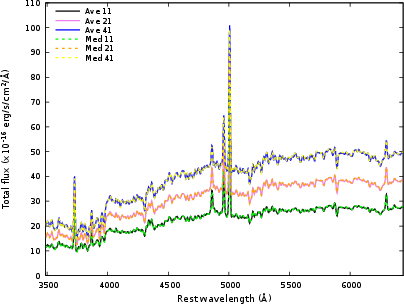
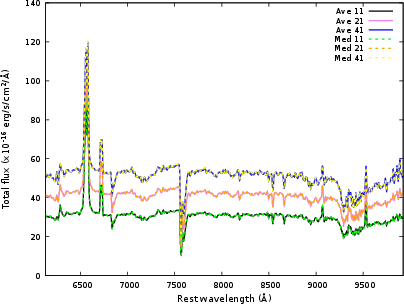
Figure 2: Total-flux spectra for NGC 1566 extracted with different slit lengths and statistical combination methods; results are consistent at the sub-percent level.
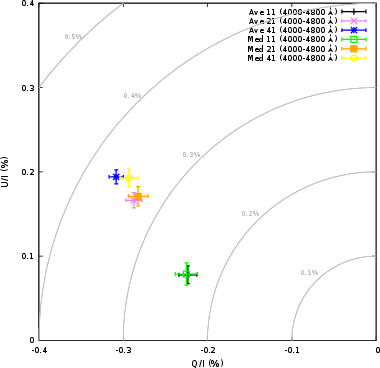
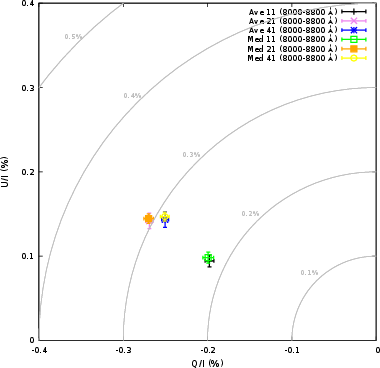
Figure 3: Polarization Stokes parameters (Q/I and U/I) for NGC 1566; all slit lengths and statistics yield consistent polarization within uncertainties.
Key Spectropolarimetric Results
Flux and Polarization Properties
The coadded spectra (Figure 4) demonstrate NGC 1566 in a type-2 state, with total continuum flux a factor ∼10 lower than in historical type-1 outbursts. No broad Hα or Hβ components are present in total or polarized flux. All permitted and forbidden emission lines are narrow. Notably, the continuum polarization is low (0.22–0.24%), wavelength-independent (4000–9900 Å), and the polarization angle is nearly constant at 77–80°, inconsistent with both typical type-1 and type-2 AGN expectations.
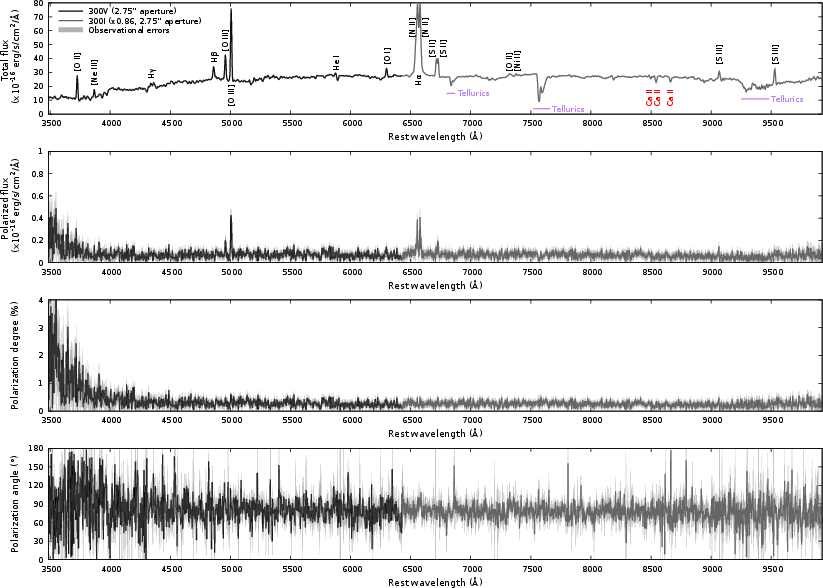
Figure 4: Multi-panel view of total flux, polarized flux, polarization degree, and polarization position angle for NGC 1566 during the campaign.
A strong polarization rise (∼2%) blueward of 4000 Å is observed—possibly an "echo" of stronger historical activity, as BLR photons scattered and delayed by extended regions (e.g., NLR or polar dust). The polarized continuum and forbidden lines share identical polarization, suggesting a common scattering geometry.
Host Dilution and Intrinsic Polarization
Spectral decomposition with the starlight code yields a host galaxy contribution from 50% (UV) to 78% (near-IR). Correction for dilution boosts the nuclear polarization to 1–2% (Figure 5), consistent with polar scattering in a near pole-on geometry. The absence of broad lines in polarized flux decisively favors true disappearance of the BLR over simple occultation scenarios.
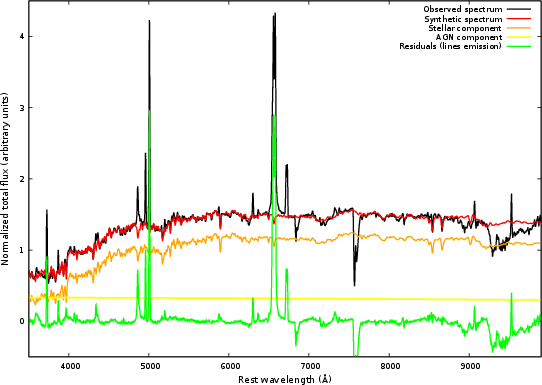
Figure 6: Fits to the observed spectrum of NGC 1566 decomposing the starlight and AGN components.
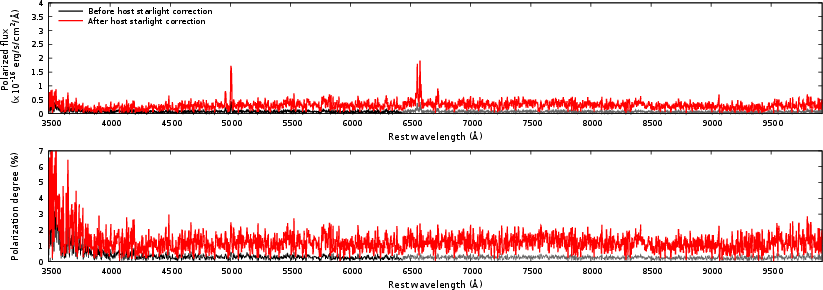
Figure 5: Comparison of diluted and host-corrected polarized flux and polarization degree—correction demonstrates the intrinsic, electron-scattered AGN polarization.
Temporal Analysis: Variability in Total and Polarized Light
Total Flux Variability
Nine-epoch spectra reveal 20% variability in the total continuum, consistent with Seyfert-1-like nuclear variability, not starlight or observing systematics. Emission line profiles, however, show only scaling, not structural changes, reinforcing the disappearance of the BLR.
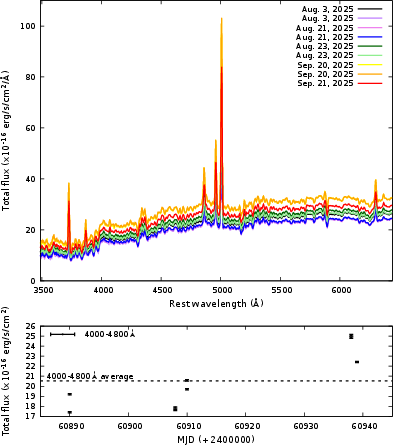
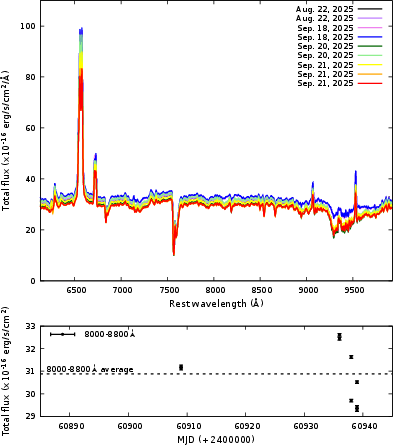
Figure 7: Total flux spectra and integrated broadband light curves over time, showing continuum variability but robust line profile stability.
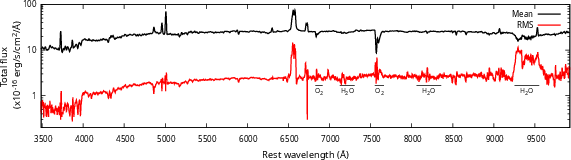
Figure 8: Mean (black) and rms (red) spectra; rms highlights lack of intrinsic broad line variability.
Polarization Variability
Stokes Q/I, U/I diagrams (Figure 9) show vectorial polarization changes up to 0.15% on intra-day timescales. Orthogonal tracks in 300V/300I (blue/red) bands (Figure 10) suggest two distinct, perpendicular scattering regions: an equatorial and a polar or extended NLR scatterer. These timescales and amplitudes are incompatible with binary SMBH-driven symmetry changes; rather, they imply rapid evolution of asymmetric circumnuclear material or scattering region illumination.
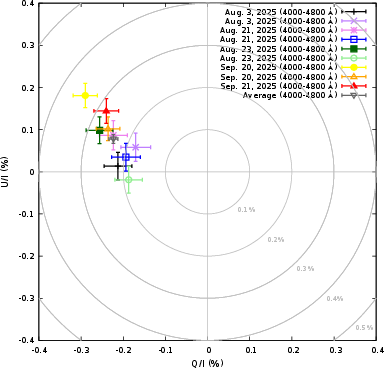
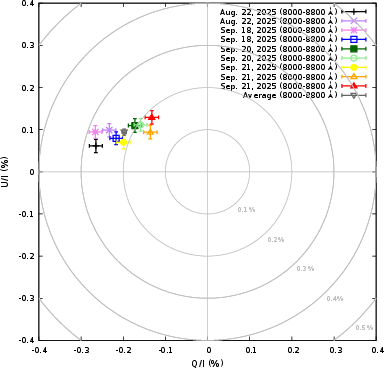
Figure 9: Stokes QU diagrams for the nine epochs, indicating polarization variability along preferential axes indicative of distinct scattering zones.
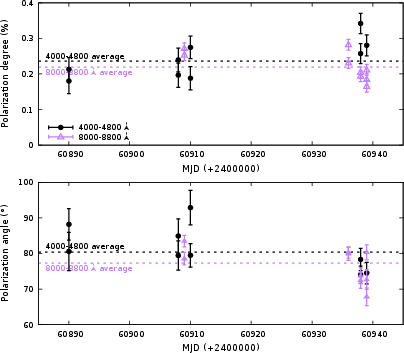
Figure 10: Temporal evolution of polarization degree and angle for blue (4000–4800 Å, black) and red (8000–8800 Å, purple) bands.
Discussion: Physical Implications and Constraints on Competing Scenarios
Rejection of Pure Obscuration and Standard Unified Model Predictions
Standard unified models predict higher polarization and perpendicular position angle in type-2 states due to dominant polar scattering. In contrast, NGC 1566 shows higher polarization in bright, type-1 states and polarization variations orthogonal to the expected axis. Occultation models are excluded: electron scattering would preserve BLR features in polarized flux even when hidden in total flux.
Disfavoring the Binary SMBH Hypothesis
While velocity- and time-dependent polarization across broad lines is a key prediction of close binary SMBH models [Savic et al. 2019], the observed polarization variability lacks the required periodicity, amplitude, and phase behavior, and is on incompatible timescales and orientation for expected lensing events given the pole-on geometry (Figure 11). Recent claims of binary-induced lensing outbursts [Kollatschny & Chelouche 2024] are inconsistent with these constraints.
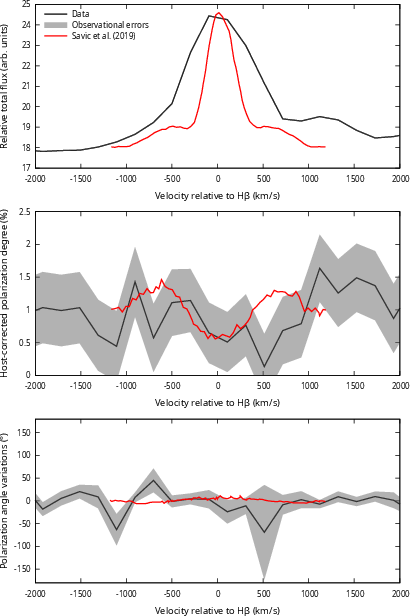
Figure 11: Observed Hβ velocity profile (black) vs. binary SMBH model prediction (red); polarization patterns are inconsistent with model expectations.
Accretion-Driven and Structural Change Scenarios
The multi-epoch polarization and spectrophotometric results support an evolving, asymmetric structure in the inner accretion flow and BLR. The data are consistent with an eccentric accretion disk, turbulent disk-dominated BLR, or the impact of recurrent stellar tidal disruption events introducing episodic accretion rate surges and modifying the local geometry. The existence of multiple, temporally variable and misaligned scattering zones (equatorial, polar) is preferred, pointing to a fundamentally non-stationary configuration.
Theoretical and Practical Implications
This spectropolarimetric dissection provides robust constraints on AGN internal geometry and changing-look behavior not accessible via flux-only studies. The rejection of occultation and standard unified geometry for NGC 1566, alongside the exclusion of binary SMBH symmetry-driven variability in polarization, demands revision of models for changing-look AGN. Polarization monitoring emerges as a critical tool for decomposing AGN structure evolution and discerning between competing drivers of type transitions.
Future progress depends on spectropolarimetric monitoring across state changes (type-2 → type-1), which will directly reveal the geometric and physical reassembly of the BLR and enable the measurement of scattering region evolution in tandem with accretion state changes. The interplay of dynamic inner accretion flow, time-variable BLR illumination, and multiscale scattering zones sets the immediate agenda for observational and theoretical efforts to understand changing-look AGNs.
Conclusion
The comprehensive nine-epoch spectropolarimetric investigation of NGC 1566 in a type-2 (faint) state demonstrates:
- No evidence for occulted but present BLR (absence of broad lines in polarized flux).
- Intrinsic polarization properties incompatible with both standard unified AGN models and binary SMBH symmetry change scenarios.
- Support for dynamically evolving, asymmetric accretion flow and BLR structure, manifesting as distinct, orthogonally oriented scattering regions with rapid, non-periodic variability.
- The necessity for temporally resolved spectropolarimetry during type transitions to definitively map the evolution of AGN geometry and test physical models for changing-look behavior.
This work provides direct experimental constraints on AGN structural evolution and the mechanisms driving changing-look phenomena, and sets a new standard for the spectropolarimetric diagnosis of AGN inner workings.
Reference:
"Spectropolarimetry of the changing-look active galactic nucleus NGC 1566 and its potential link to supermassive black hole binaries" (2604.01872)

