- The paper presents a semi-explicit construction of entropy weak solutions for hydrological scalar conservation laws, capturing sub-threshold and saturation-excess regimes.
- It introduces analytic frameworks using advection, rarefaction, and integral matching to address up-crossing and down-crossing initial configurations.
- Results benchmark numerical schemes and offer extensions to multidimensional problems for enhanced hydrological modeling.
Semi-explicit Entropic Solutions for a Generalised Riemann Problem in Hydrological Scalar Conservation Laws
The paper investigates the scalar conservation law
∂tu+∂x(Gc,ρ(u))=0
where
$G_{c,\rho}(y) = ((1-\rho)c - y)\mathds{1}_{\{y>c\}} - \rho y \mathds{1}_{\{y \leqslant c\}}$
with threshold c>0 and transmissivity coefficient ρ∈(0,1). The model emerges as the hydrological limit of conceptual reservoir dynamics, where u represents water storage, c is the saturation threshold, and ρ characterizes sub-threshold flow. The flux function encapsulates two regimes: below threshold, a fraction ρ of stored water is mobilized downstream; above threshold, saturation-excess outflow dominates. The PDE is considered on R×R+, and two initial data configurations are examined: “up-crossing” (initially below c then above) and “down-crossing” (initially above $G_{c,\rho}(y) = ((1-\rho)c - y)\mathds{1}_{\{y>c\}} - \rho y \mathds{1}_{\{y \leqslant c\}}$0 then below), each generalizing classical Riemann problems.
Analytical Construction of Entropy Weak Solutions
Down-Crossing Case: Explicit Solution via Advection and Rarefaction
For initial profiles $G_{c,\rho}(y) = ((1-\rho)c - y)\mathds{1}_{\{y>c\}} - \rho y \mathds{1}_{\{y \leqslant c\}}$1 ($G_{c,\rho}(y) = ((1-\rho)c - y)\mathds{1}_{\{y>c\}} - \rho y \mathds{1}_{\{y \leqslant c\}}$2) and $G_{c,\rho}(y) = ((1-\rho)c - y)\mathds{1}_{\{y>c\}} - \rho y \mathds{1}_{\{y \leqslant c\}}$3 ($G_{c,\rho}(y) = ((1-\rho)c - y)\mathds{1}_{\{y>c\}} - \rho y \mathds{1}_{\{y \leqslant c\}}$4), the evolution admits a fully explicit representation by superposing constant-speed advections and establishing a rarefaction plateau in $G_{c,\rho}(y) = ((1-\rho)c - y)\mathds{1}_{\{y>c\}} - \rho y \mathds{1}_{\{y \leqslant c\}}$5:
$G_{c,\rho}(y) = ((1-\rho)c - y)\mathds{1}_{\{y>c\}} - \rho y \mathds{1}_{\{y \leqslant c\}}$6
The entropy conditions are verified by decomposing the domain into transport subproblems, invoking Kr\v{u}zhkov's entropy criteria and the explicit advection solution structure.
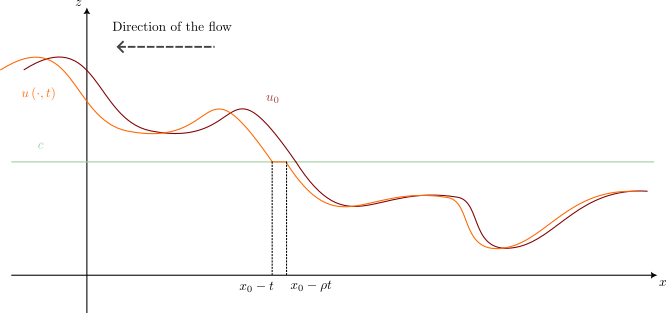
Figure 1: Evolution of an initial down-crossing profile under the scalar conservation law; rarefaction appears in the interval $G_{c,\rho}(y) = ((1-\rho)c - y)\mathds{1}_{\{y>c\}} - \rho y \mathds{1}_{\{y \leqslant c\}}$7.
For $G_{c,\rho}(y) = ((1-\rho)c - y)\mathds{1}_{\{y>c\}} - \rho y \mathds{1}_{\{y \leqslant c\}}$8 ($G_{c,\rho}(y) = ((1-\rho)c - y)\mathds{1}_{\{y>c\}} - \rho y \mathds{1}_{\{y \leqslant c\}}$9) and c>00 (c>01), the propagation speed mismatch between regimes yields non-trivial shock dynamics. The solution is constructed semi-explicitly using auxiliary functions c>02, c>03 for integral balance, yielding a pair c>04, c>05 defined by area matching:
c>06
and c>07, c>08. The shock front is parametrized as c>09, yielding the solution
ρ∈(0,1)0
Rigorous entropy verification employs domain partitioning (ρ∈(0,1)1 vs. ρ∈(0,1)2), change of variables, and careful handling of cases where the integral bounds become finite or infinite.
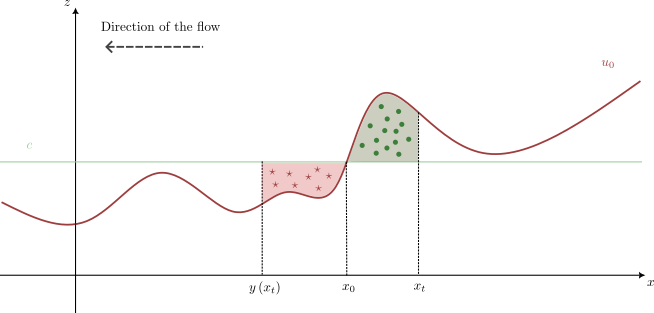
Figure 2: Visual depiction of implicit area matching and shock formation for the up-crossing case; the green and red regions enforce integral equality for shock tracking.
Numerical Examples and Riemann Problem Recovery
Two instructive examples are presented: (1) a smooth transition ρ∈(0,1)3 yielding explicit ρ∈(0,1)4 and ρ∈(0,1)5, and (2) the classical discontinuous Riemann setup ρ∈(0,1)6, with ρ∈(0,1)7, recovering the canonical Rankine-Hugoniot jump condition:
ρ∈(0,1)8
The methodology yields explicit solutions even outside conventional scalar conservation law settings, demonstrating versatility in hydrological or engineering applications.
Theoretical and Practical Implications
The results provide quasi-closed-form entropy weak solutions for threshold-interacting scalar conservation laws under prototypical hydrological initial data. The dual regime structure ensures both existence and uniqueness by construction. Explicit formulae serve as valuable benchmarks for numerical schemes, particularly where standard methods lack analytic tractability.
From a modeling standpoint, the approach captures key hydrological phenomena: sub-threshold drainage, saturation-excess runoff, rarefaction, and shock formation. The frameworks generalize to scalar conservation laws encountered in traffic, sedimentation, and irrigation channel modeling.
Future extensions to multidimensional settings are noted. Here, flow velocities may depend jointly on location and threshold regime, requiring generalizations of the auxiliary integral constructs (ρ∈(0,1)9, u0, u1, u2) and more involved entropy admissibility verifications. This progression has direct relevance for catchment-scale hydrology where overland and subsurface flows coexist and interact.
Conclusion
The paper furnishes an analytical solution strategy for a class of hydrologically relevant scalar conservation laws with thresholded, piecewise-affine flux. The explicit (or semi-explicit) entropy weak solutions under up-crossing and down-crossing initial data configurations bridge the gap between classical conservation law theory and hydrological modeling requirements, offering clarity both for theoretical analysis and practical simulation tasks. Extensions to higher dimensions promise substantial modeling advances, pending further investigation.