- The paper establishes that for every t ≥ 2, all {P6, K2,t}-free graphs have a bounded tree-independence number, confirming a case of a broader conjecture.
- It introduces a detailed combinatorial framework using pyramid structures to derive explicit bounds and develop balanced separator strategies.
- The findings extend algorithmic metatheorems, enabling efficient computation of subgraph problems in denser graph classes beyond traditional treewidth limitations.
Tree-Independence Number in Graphs Forbidding P6 and (2,t)-Bicliques
Introduction and Problem Setting
The paper studies bounds on the tree-independence number—a graph width parameter closely related to treewidth, but measuring the independence number of bags in a tree decomposition—within hereditary classes defined by forbidden induced subgraphs, specifically, graphs excluding both the path on six vertices (P6) and the complete bipartite graph K2,t. The motivation largely follows algorithmic metatheorems akin to Courcelle's theorem, especially as treewidth's algorithmic power is limited to sparse graph classes, while tree-independence number often generalizes to denser families relevant for expressive algorithmic problems (2604.01999).
The central result affirms, for all t≥2, the existence of a finite bound s(t) such that every {P6,K2,t}-free graph G has tree-independence number at most s(t). Crucially, this result verifies a specific instance of a broader conjecture concerning the boundedness of tree-independence number in classes forbidding both long induced paths and certain bicliques.
Background and Previous Work
Generalizing treewidth, the tree-independence number of G, denoted (2,t)0, is the minimum, over all tree decompositions of (2,t)1, of the largest independent set contained in any single bag. Several algorithmic metatheorems have shown that bounded tree-independence number suffices for efficient computation of induced subgraphs of bounded treewidth satisfying certain logical properties [Lima et al., LimaMMORS:2024].
Previous literature established boundedness for families forbidding smaller paths and bicliques, e.g., (2,t)2-free graphs, but left open various cases starting at (2,t)3 and (2,t)4 with moderate-sized forbidden bicliques. The conjecture by Dallard et al. [DallardKKMMSW:2024] posits that forbidding both (2,t)5 and (2,t)6 suffices to bound the tree-independence number, though it was recently shown this does not hold for arbitrary hereditary classes, depending on the set of forbidden induced subgraphs.
Main Theorem and Technical Framework
The main technical result establishes:
(2,t)7
The proof relies on a structure-driven separator strategy. The fundamental idea is to show that in any such graph, every normal vertex-weighted model admits the existence of balanced separators whose independence numbers are uniformly bounded as functions of (2,t)8. This employs the following key components:
- For all pairs of non-adjacent vertices, there exists a small-independence-number separator separating them.
- For any induced connected subgraph, there exists either a vertex whose (closed) neighborhood, possibly augmented by a further small set, forms a balanced separator.
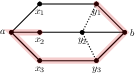
Figure 1: The situation in the proof of Lemma 3.1, illustrating a pyramid realizing a structural obstruction in (2,t)9-free graphs.
These conditions are synthesized by the application of Lemma 3.1 (see (2604.01999), Lemma 3.1), which allows the conclusion that bounded tree-independence number follows from this doubly local separator property. A critical new ingredient is a detailed combinatorial analysis of "pyramids"—specific induced subgraphs reminiscent of subdivided bicliques and stars—whose structure is instrumental in both discovering separators and excluding long induced paths or bicliques.
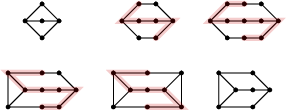
Figure 2: The six structural cases from the proof of Lemma 3.2, displaying the intersection patterns (e.g., stars, their subdivisions, and their line graphs) central to pyramid analysis.
Analysis of Pyramid Structures
To facilitate the separator construction, the paper introduces and exploits the structural concept of a P60-pyramid: a configuration comprising one apex, P61 "spokes," and P62-clique "bases," where adjacency and independence relationships closely mirror forbidden P63s and P64s. The existence (or forced absence) of such pyramids in P65-free graphs proves to underlie the possible large independent sets in separators.
The proofs about pyramids involve:
- Showing that under certain extremal conditions (i.e., when standard neighborhood-based separators are not small), the graph must contain a large-enough pyramid or else a forbidden substructure appears.
- Analyzing possible separator positions and demonstrating that the only way to sustain large independent sets in separators is for highly specific adjacency patterns to emerge, which in turn can be excluded by further structural decompositions.
This pyramid-based reasoning allows the authors to prove that, ultimately, all minimal separators in these classes have independence number bounded as a (linear) function of P66, and the same holds for weighted balanced separators, as needed.
Quantitative Bounds and Algorithmic Implications
The explicit bounds derived are of order P67, where P68 is an explicit function constructed via the analysis of pyramids and minimal separators. While these bounds are not tight, they are polynomial in P69 and suffice for the existential claims required for the main theorem. The result confirms, for this family, the reduction of algorithmically tractable problems on graphs outside the field of traditional treewidth-bounded classes, leveraging the more flexible tree-independence number.
From an algorithmic perspective, the results expand the applicability of metatheorems for K2,t0-free graphs, leveraging known results about efficient algorithms parameterized by tree-independence number (e.g., for problems expressible in K2,t1 logic).
Open Problems and Future Directions
The work leaves open several significant cases, notably when larger paths or larger bicliques (K2,t2, K2,t3; or K2,t4, K2,t5) are involved. Determining (un)boundedness in classes such as K2,t6-free or K2,t7-free graphs remains open.
The theoretical implications suggest further research directions:
- Developing sharper, possibly tight, dependencies of K2,t8 on K2,t9.
- Extending the approach to other graph parameters (e.g., induced matching treewidth).
- Investigating classes closed under more general graph minors or induced minors, generalizing techniques to settings involving more complex forbidden substructures.
Conclusion
This paper advances the structural theory of graph width parameters by showing that, for every t≥20, the class of graphs forbidding both t≥21 and t≥22 has bounded tree-independence number. The central technique is the recursive use of separator theorems grounded in detailed analysis of pyramid subgraphs, which play a key role in precluding both long induced paths and large bicliques. These results have direct consequences for algorithmic graph theory, extending the frontiers of tractable classes for problems parameterized by more expressive width measures than treewidth. The paper lays essential groundwork for future combinatorial and algorithmic developments in the area.