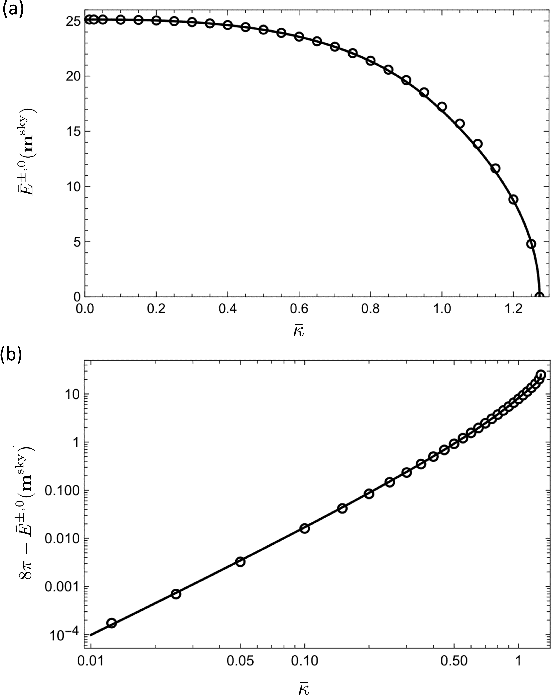
- The paper demonstrates that antisymmetric ferromagnetic bilayers can sustain 8–15 nm skyrmions with energy barriers exceeding 60 k_BT, validated through analytic and numerical methods.
- The study develops a compact micromagnetic model using reduced DMI strength and film thickness to precisely predict collapse and bursting energy barriers.
- The work highlights that bilayer configurations offer broader stability regimes and greater robustness against thickness variations compared to SAFs and monolayers.
Optimal Skyrmion Stability in Antisymmetric Ultrathin Ferromagnetic Bilayers
Introduction and Motivation
Magnetic skyrmions—topological solitonic spin textures—have emerged as prime candidates for ultra-dense, energy-efficient information storage and unconventional computing architectures. Achieving robust, compact (∼10 nm diameter) skyrmions at zero applied field with high thermal stability in transition metal multilayers remains a formidable materials physics challenge. The limiting factors include intrinsic energetic competition between the Dzyaloshinskii-Moriya interaction (DMI) and magnetostatic stray fields, which tend to destabilize compact skyrmions in ultrathin ferromagnetic monolayers and multilayers.
This work presents a comprehensive analytical and numerical investigation of skyrmion stability in exchange-decoupled antisymmetric ferromagnetic bilayers. The study demonstrates that specifically engineered antisymmetric stacks can leverage the synergistic effect of DMI and the dipolar interaction, creating a regime where both contribute simultaneously to enhanced skyrmion stability and lifetime, in contradistinction to conventional monolayers and synthetic antiferromagnetic (SAF) stacks.
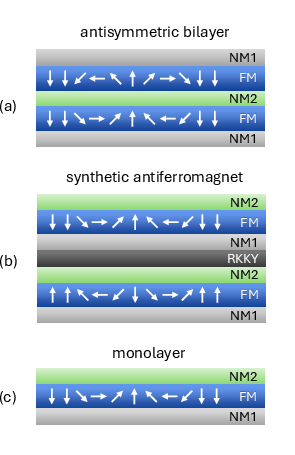
Figure 1: Schematics of the ferromagnetic multilayer structures with a skyrmion present: (a) antisymmetric ferromagnetic bilayer, (b) synthetic antiferromagnet (SAF), (c) single ferromagnetic monolayer.
Micromagnetic Energy Reduction and Dimensionless Parameterization
The authors derive a thin-film micromagnetic description for multilayered ferromagnetic structures, incorporating exchange, perpendicular anisotropy, interfacial DMI, and magnetostatic contributions. For N-layer stacks, the energy is reduced via an ultrathin limit, resulting in two key dimensionless parameters:
- Reduced DMI strength κˉ
- Reduced film thickness δˉ
For antisymmetric bilayers, symmetry constraints impose opposite DMI in the two ferromagnetic layers (top/bottom), separated by a non-magnetic spacer. This unique configuration enables antiphase in-plane magnetization, substantially altering stray field effects.
Analytical Phase Diagram and Stability Criteria
The analytic treatment identifies the existence and stability boundaries for skyrmion solutions in the (κˉ, δˉ) plane. Through a combination of asymptotic formulae and variational techniques, the study derives:
- The skyrmion collapse barrier (ΔEˉ2c), governing topological annihilation,
- The skyrmion bursting barrier (ΔEˉ2b), dictating instabilities towards stripe or bubble formation,
- An optimal stability condition where both barriers are equal, representing maximal thermal stability.
The analytical model reveals that, in antisymmetric bilayers, the DMI and dipolar stray field energies cooperatively enhance the energy barriers against both collapse and bursting across a broad parameter domain, as opposed to the mutual competition observed in monolayers.
Numerical Micromagnetic Simulations
Extensive micromagnetic simulations using {\sc Mumax3} validate the analytic phase boundaries and provide quantitative data for the skyrmion radius, energy, and associated energy barriers throughout the relevant parameter ranges. Notably, skyrmion solutions persist for broad intervals in both κˉ and δˉ, and the bursting threshold exhibits strong agreement with analytic predictions.
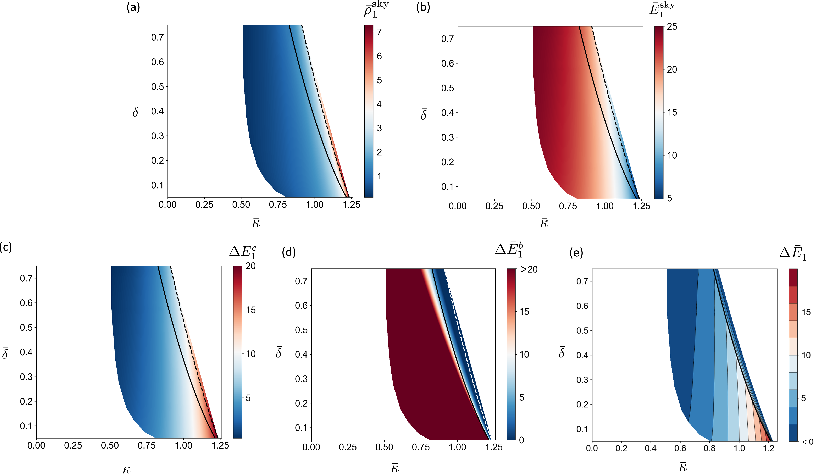
Figure 2: Summary of the numerical results obtained from {\sc Mumax3} for antisymmetric ferromagnetic bilayers: skyrmion radius, energy, collapse/bursting barriers, and effective energy barrier in the (N0, N1) plane.
Comparison: Bilayers, SAF, and Monolayers
A quantitative comparison among antisymmetric bilayers, SAF, and monolayer configurations reveals several decisive differences:
- Antisymmetric bilayers show a wide regime where N2-scale, zero-field skyrmions achieve effective energy barriers in excess of N3, covering a much larger parameter space than monolayers, and requiring less stringent material fine-tuning. This effect results from the combined stabilizing action of DMI and dipolar interaction unique to these stacks.
- SAF bilayers display vanishing stray field energy due to antiparallel interlayer coupling. Skyrmion stability is high and scales with thickness, but solutions are much more sensitive to critical DMI values and thickness, requiring precise tuning and exhibiting rapid drop-off in barriers outside the optimal line.
- Ferromagnetic monolayers are most susceptible to destabilization by magnetostatic effects, with a much narrower wedge in phase space where compact, stable skyrmions exist at technologically useful energy barriers.
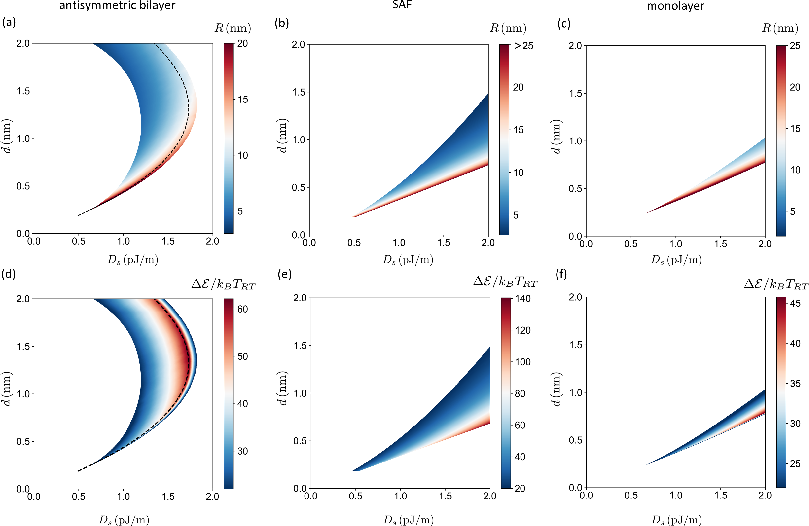
Figure 3: Skyrmion radius N4 and effective energy barrier N5 (in N6 units) as functions of interfacial DMI and ferromagnetic layer thickness for: (a,d) antisymmetric bilayer, (b,e) SAF, (c,f) monolayer. The dashed lines indicate analytically predicted optimal stability lines.
Key Numerical and Analytical Results
Practical and Theoretical Implications
The findings imply that antisymmetric ferromagnetic bilayers represent a promising experimental platform for realizing sub-10 nm, zero-field skyrmions with lifetimes viable for information storage and spintronic logic. This is achieved without requiring extremely high DMI or ultra-fine tuning of thickness. The mechanism—cooperative stabilization via both DMI and dipolar interaction—adds a new dimension to skyrmion materials design.
Theoretically, the analysis introduces a compact dimensionless landscape on which stack-specific engineering for skyrmion stabilization can proceed, suggesting broad applicability in predicting stability regimes in diverse materials and architectures. The approach is extensible to more complex multilayer stacks, further inform material selection strategies in future device proposals.
Future Directions
Follow-up experimental efforts can exploit the analytic phase diagrams as predictive maps for fabrication. Extending this methodology to multi-layered artificial structures with tunable DMI and dipolar coupling will likely yield further enhancement in both skyrmion size and stability. On the computational side, incorporating finite temperature effects and dynamical disorder in multilayer systems will refine the practical regimes for device design.
Conclusion
This paper establishes, through tightly coupled analytical and numerical approaches, the regime of optimal skyrmion stability in antisymmetric ultrathin ferromagnetic bilayer systems. These bilayers enable synergy between interfacial DMI and dipolar interactions, facilitating compact, room-temperature-stable skyrmions suitable for next-generation spintronic implementations. The analytic and numerical predictions provide a robust foundation for both understanding and experimental realization of robust, small skyrmions in technologically accessible materials (2604.02070).
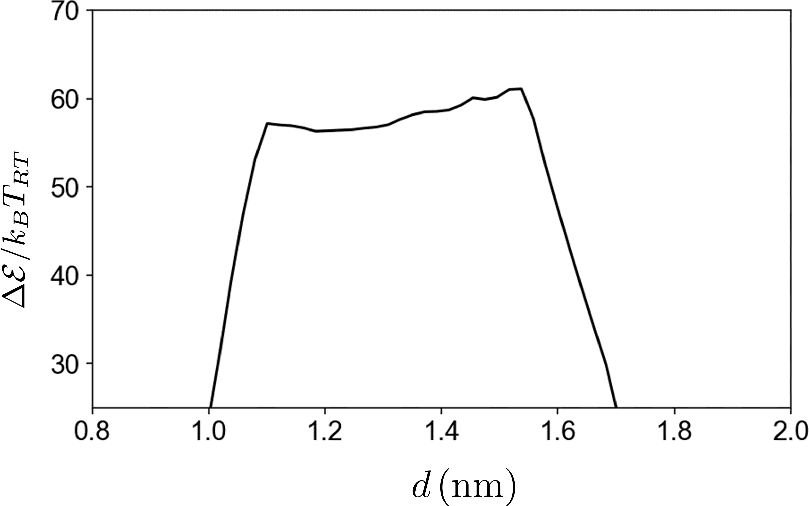
Figure 5: Effective energy barrier N9 in the units of κˉ0 as a function of thickness, illustrating the broad region of high skyrmion stability in antisymmetric bilayers.