- The paper introduces an oscillator-echo protocol that embeds a squeezing operation between echo steps to cancel shot-to-shot force noise, restoring both mean and covariance to quantum-limited values.
- It utilizes analytical solutions of the driven quantum Langevin equation and phase-space mappings to validate the noise cancellation, with experimental evidence from levitated nanoparticle setups.
- The method has significant implications for high-fidelity quantum state preparation and ultra-sensitive force detection in optomechanical systems.
Shot-to-Shot Noise Cancellation for Parametric Oscillators
Introduction and Motivation
Parametric protocols that utilize stepwise resonance modulation of harmonic oscillators are central to recent advances in quantum optomechanics and state engineering. These methods are widely employed for squeezing the motional state of mechanical oscillators, with optically levitated nanoparticles serving as a prominent platform due to their substantial control flexibility and isolation from environmental decoherence mechanisms. Achieving strong quantum squeezing and ground-state cooling in these systems is essential for exploring quantum foundational questions and enabling ultra-sensitive force detection. However, such protocols are fundamentally constrained by fluctuations that slowly vary between, but remain constant within, individual experimental runs—a phenomenon termed shot-to-shot noise. These fluctuations, originating in, e.g., stray electric fields acting on a charged particle, induce run-to-run variations in motional outcomes, effectively masking quantum-induced uncertainty and limiting state purity. Standard averaging fails to resolve this issue, necessitating new strategies beyond simply improving hardware stability.
Decoupling Protocol — The Oscillator Echo
Drawing inspiration from dynamical decoupling and spin-echo techniques in NMR and spin resonance physics, the authors propose the oscillator-echo protocol, a decoupling method that, under ideal conditions, cancels shot-to-shot force noise in parametric state expansion experiments. This protocol embeds the central squeezing operation between two "echo" steps, such that inhomogeneous force offsets accumulated during one decoupling phase are precisely unwound in the final step. The essential insight is that by choosing modulation amplitudes and phases appropriately, the ensemble broadening imposed by shot-to-shot force distributions is geometrically returned to zero.
The protocol's operation is visualized using state-space trajectories (Figure 1). Here, the displacement induced by a constant but random force between shots leads to a family of ellipsoidal orbits for different realizations, each centered on a force-dependent point in phase space. Averaging these orbits introduces additional covariance, i.e., increased noise, over the quantum noise floor imposed by backaction.
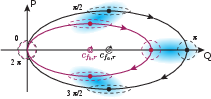
Figure 1: Illustration of phase-space evolution for two distinct constant shot-to-shot force values, showing how averaging over different force realizations results in an enlarged effective covariance.
The oscillator-echo consists of three steps (Figure 2): an initial frequency drop to an intermediate value for a time corresponding to half a period, a further reduction for a variable interval (squeezing operation), and a final reversal to the initial setting. By analytically solving the driven quantum Langevin equation for this sequence, one finds that there is an optimal ratio of frequency jumps which guarantees that both the mean and covariance after the entire protocol are independent of the fluctuating force offset. The evolution can be succinctly described as a mapping that exactly cancels the contributions from the piecewise-constant force, leaving only quantum and technical heating to limit the final state.

Figure 2: Steps of the oscillator-echo protocol, with the initial, squeezed, and refocused state distributions for two initial force offsets, demonstrating complete cancellation of shot-to-shot broadening.
Experimental Realization
The protocol was implemented with an optically levitated silica nanoparticle in ultra-high vacuum (Figure 3). Detection was performed via interferometric measurements of the nanoparticle's motion, with active feedback cooling applied to reach occupation n∼1.
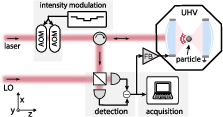
Figure 3: Schematic of the experimental setup: trapped nanoparticle, interferometric detection, feedback cooling, and acousto-optic modulation for trap frequency control.
Experimental realizations involved hundreds of repetitions of the parametric squeezing protocol with controlled modulation of the optical trap's stiffness. The principal noise source identified was Coulomb force from fluctuating stray electric fields acting on the particle's residual charge, leading to significant shot-to-shot force variance. Using the oscillator-echo protocol, the authors recorded the state evolution at multiple points during the sequence, reconstructing phase-space distributions and associated covariance matrices for each shot (Figure 4).
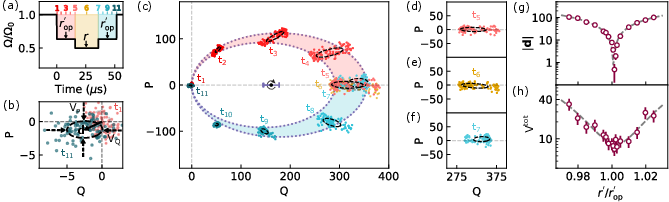
Figure 4: Experimental measurement of state evolution through the oscillator-echo protocol; narrowing of shot-to-shot distribution to the backaction limit is indicated by the final minimal covariance ellipse.
Quantitative analysis confirms that without decoupling, the shot-to-shot force noise increases the effective phase-space area and thus the motional state's mixedness. With the optimized echo protocol, the ensemble-averaged mean is restored to its initial value and covariance is reduced to be limited by quantum backaction heating. The experimental determinant of the covariance matrix at the end of the protocol matches well with theoretical predictions for the measurement backaction-limited case, verifying the efficacy of the decoupling scheme. Minor discrepancies are traced to frequency tuning imperfections and residual within-shot noise.
Theoretical and Practical Implications
The suppression of ensemble broadening due to slowly varying but static-in-shot noise sources is critical for high-fidelity quantum state preparation in levitated optomechanical systems. The demonstrated protocol enables the observation of quantum squeezing and high-purity motional states in scenarios where slow technical drifts or fluctuating stray fields would otherwise preclude meaningful quantum uncertainty measurements. This is particularly important for protocols that employ charged particles, where stray field noise is unavoidable.
Practically, the method extends to any harmonic oscillator system where parametric modulation is feasible and noise sources change on timescales longer than an individual protocol shot. The results bear directly on proposals for macroscopic quantum superposition tests, non-Gaussian state generation, ultra-sensitive force and acceleration detection, and fundamental tests for new physics such as dark matter searches. The analogy drawn to spin-echo and dynamical decoupling bridges control theory between atomic, spin, and mechanical oscillator quantum technologies.
Outlook and Future Directions
The formalism invites generalization, notably to more complex Hamiltonian modulation (e.g., time-varying or inverted potentials), and to correlated multi-mode systems as in molecular or multi-particle optomechanics. Integrating such noise-cancelling protocols with feedback or adaptive filtering may yield even higher sensitivities and state purities. Application to non-Gaussian state engineering—including Schrödinger cat-state preparation—or in force detection protocols approaching the quantum Cramér-Rao limit, is expected. The analogy to dynamical decoupling suggests the potential for entire families of echo-like noise compensation techniques for Gaussian and non-Gaussian state protocols.
Conclusion
The oscillator-echo protocol provides an experimentally validated, analytically transparent solution for cancelling shot-to-shot force noise in parametric oscillator experiments. By embedding squeezing evolutions between tailored decoupling steps, the protocol enables noise suppression to the quantum backaction floor, thus unlocking the full potential of quantum state engineering, metrology, and macrorealism tests with levitated mechanical systems. Its adoption will enhance the interpretability and fidelity of future quantum optomechanical experiments and noise-limited precision sensing applications.
For further details and technical derivations, see "Shot-to-shot noise cancellation for parametric oscillators" (2604.02175).