- The paper demonstrates that substrate-induced strain selectively enhances Jahn-Teller splitting (ΔJT) by elongating the outer Ni-O bonds, which is critical for tuning superconductivity.
- It employs first-principles DFT, tight-binding modeling, and ICOHP analysis to quantitatively link strain effects with modifications in orbital energies and hopping parameters.
- The study reveals a clear connection between strain-tuned Fermi surface changes, Hall coefficient variations, and superconducting phase enhancements in La3Ni2O7 thin films.
Jahn-Teller Distortion as a Central Tuning Parameter in Strained La3Ni2O7 Thin Films
Introduction
Recent reports of high-temperature superconductivity in bilayer nickelates, especially La3Ni2O7, have sparked substantial interest in the interplay of structural, electronic, and orbital degrees of freedom in these systems. While the primary focus has been on the role of multi-orbital eg physics and interlayer dz2 hybridization, the influence of Jahn-Teller (JT) distortions—specifically, the splitting ΔJT between dx2−y2 and 20 states—has remained comparatively underexplored. This study provides a detailed theoretical analysis, integrating density functional theory (DFT), tight-binding (TB) modeling, and experimental comparison, to elucidate how epitaxial strain in thin films selectively enhances JT splitting, establishing it as a decisive microscopic parameter for tuning superconductivity in bilayer nickelate platforms (2604.02191).
Structural Response to Epitaxial Strain
The bilayer structure of La21Ni22O23 introduces significant local symmetry reduction from 24 to 25, due to the inequivalence of inner (26) and outer (27) apical oxygen sites. Crucially, biaxial compressive strain in the 28-plane elongates the Ni-O29 outer bonds, while the Ni-O70 inner bond remains almost unaffected.
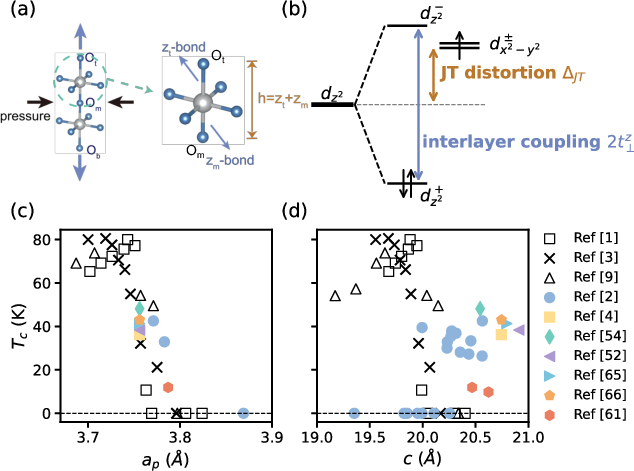
Figure 1: The NiO71 octahedral network in strained La72Ni73O74 thin films, relevant orbital level diagram, and empirical relation of 75 with in-plane and out-of-plane lattice constants.
This asymmetric structural response translates into highly selective modification of the local crystal field environment. With decreasing in-plane lattice constant, the octahedral elongation is dominated by an increase in the 76 bond length, directly enhancing the JT splitting 77. The interlayer hopping 78, set by the inner oxygen 79, shows minimal variation.
First-Principles Modeling and TB Parameter Extraction
Ab initio calculations were performed using meta-GGA functionals within VASP, targeting an infinitely thick film geometry to best represent the experimental situation. By fixing the in-plane parameter 30 and letting 31 relax (mimicking substrate control), the calculations reveal:
- 32 increases significantly with decreasing 33,
- 34 is robust against strain,
- 35 increases rapidly as 36 decreases (linear slope 37),
- 38 remains almost unchanged (linear slope 39 for 20-axis changes).
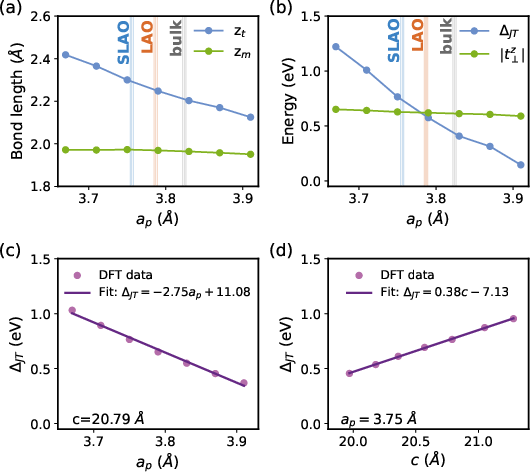
Figure 2: Evolution of apical bond lengths, 21, and 22 under changing 23; demonstration of strong selective strain sensitivity for JT splitting.
The ICOHP analysis confirms that the enhanced Ni-O24 bond weakening is responsible for the selective increase in 25.
Electronic Structure, Fermiology, and Hall Coefficient
The TB models parameterized against DFT provide insight into substrate-tuned Fermiology. Two representative substrates—SLAO (strong compressive strain) and LAO (weaker)—show marked differences:
- SLAO: Two Fermi pockets (26—electronlike, 27—holelike); experiment/theory agreement.
- LAO: Additional 28 (holelike) pocket emerges due to weaker JT splitting.
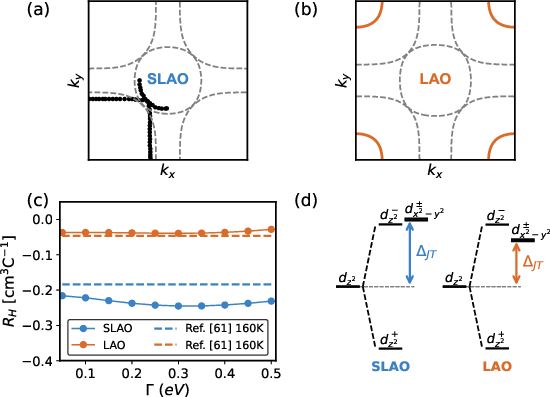
Figure 3: Calculated Fermi surfaces for SLAO and LAO substrates, experimental ARPES comparison, Hall coefficient evolution, and local orbital configuration changes with strain/JT distortion.
These Fermi surface changes result in a pronounced modulation of the Hall coefficient 29. The magnitude of 70 is far more negative for SLAO, mirroring the carrier compensation imposed by the strain-enhanced JT splitting. Quantitative trends in 71 are in qualitative agreement with recent experimental data.
Theoretical Implications for Superconductivity
The orbital-resolved evolution—with anti-symmetric 72 descending relative to 73 as 74 grows—positions the system near an optimal regime for two-orbital molecular Mott physics. This regime, previously posited to stabilize high-75 superconductivity via superexchange-mediated pairing [2025Zhange], is maximally accessed when 76 and 77 are comparable but not too large or too small.
The substrate-dependent 78 enhancement across the LAO→SLAO transition correlates with the theoretical 79 shift, supporting the assertion that JT splitting, not the interlayer hopping, is the critical tuning knob for superconductivity in strained Laeg0Nieg1Oeg2 films.
Comparison With Bulk Hydrostatic Pressure
Distinct from thin-film strain, hydrostatic pressure in the bulk compresses both inner and outer apical bonds uniformly, causing both eg3 and eg4 to change simultaneously and comparably.
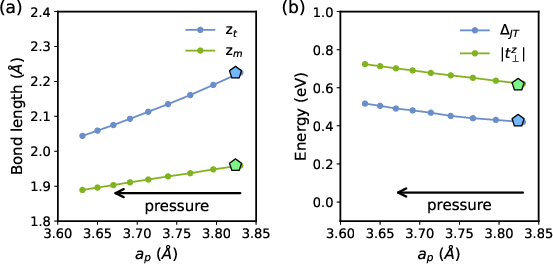
Figure 4: Response of apical bond lengths, eg5, and eg6 to bulk hydrostatic pressure—depicting the lack of selective JT enhancement compared to thin-film strain-tuning.
This differentiation elucidates why thin films offer a cleaner avenue for isolating the role of JT physics; pressure inevitably convolutes changes in orbital energies and interlayer coupling.
Implications and Future Prospects
This work shifts the focus from interlayer hopping as the principal superconductivity tuning parameter to Jahn-Teller splitting, as directly controlled by substrate strain. A practical implication is the prescription to target compressive epitaxial strain to maximize eg7 for enhanced eg8 in nickelate heterostructures. Theoretical models of unconventional superconductivity in this class must thus incorporate strain-driven orbital polarization and its influence on Mott physics and pairing channels.
From a materials engineering perspective, these findings suggest that substrate selection and interface design offer considerable leverage for tuning the phase diagram, Fermi surface topology, and correlated electronic responses. The approach and analysis can be generalized to related Ruddlesden-Popper nickelates, where symmetry breaking and differential bond responses may provide routes to customizable orbital splitting and, potentially, higher eg9.
Conclusion
This systematic theoretical investigation establishes JT distortion, quantified by dz20, as the dominant microscopic parameter determining the electronic structure and superconducting propensity of Ladz21Nidz22Odz23 thin films under epitaxial strain. Selective elongation of the outer Ni-O bond enhances dz24 with minimal change to dz25, driving substrate-dependent changes in Fermiology and Hall responses in agreement with experiment. These results highlight the necessity of incorporating explicit JT physics in future models of nickelate superconductivity and underscore the utility of strain as a direct, spectroscopically verifiable tuning parameter in complex oxide electronics.