- The paper introduces a feedforward OPL architecture that achieves phase noise suppression exceeding 30 dB over 10 kHz–10 MHz, verified experimentally.
- It details a dual-laser setup employing real-time demodulation and EOM correction, minimizing latency and avoiding sideband penalties.
- The approach simplifies integration with existing quantum metrology systems, enabling robust, scalable, and cost-effective coherence cloning.
High-Bandwidth Coherence Cloning using Optical-Phase-Locking Feedforward
Introduction
Ultra-narrow-linewidth lasers with robust high-frequency phase noise suppression are central to quantum metrology, quantum control, optical clocks, and precision spectroscopy. Standard optical phase-locking (OPL) techniques realize high-fidelity coherence transfer but are fundamentally limited at Fourier frequencies beyond the feedback bandwidth, typically in the MHz regime, due to loop latency and bandwidth constraints. The present work introduces and experimentally validates a feedforward architecture that supplements OPL with real-time phase noise cancellation, yielding phase-noise suppression exceeding 30 dB across a 10 kHz–10 MHz frequency range without the complexity or losses of prior sideband-based techniques (2604.02218).
Feedforward OPL Architecture and Principle
The feedforward architecture builds upon a conventional OPL scheme by demodulating the residual master-slave beat and applying a feedforward correction via a fiber EOM. The master optical field Eref and the slave Esla after phase-lock acquisition yield a beat note
Vbeat(t)=Abeatcos(Δωt+ϕr(t))
where ϕr(t) is the unsuppressed residual phase noise. Demodulation with a synchronized local oscillator LO2—whose phase is actively stabilized—yields an error signal directly proportional to ϕr(t) at high frequencies outside the OPL bandwidth. This error signal, after flat-band amplification, modulates the slave output via a single EOM with minimal latency.
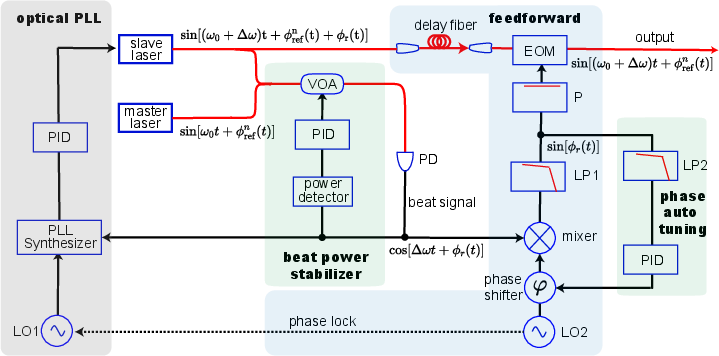
Figure 1: Schematic of the feedforward OPL scheme. Demodulation of the master-slave beat is used for high-frequency noise extraction and correction via EOM, with amplitude and phase stabilization of the feedforward path.
The architecture avoids deleterious sidebands (in contrast to MZM-based schemes) and minimizes insertion loss. Two feedback channels stabilize beat amplitude (via VOA) and demodulation phase (via PID on LO2) for robust operation.
Experimental Setup and Optimization
A dual-laser system (master: narrow-linewidth fiber laser; slave: cat-eye ECDL) is locked at Δω=100–240MHz. The master-slave beat is detected and split three ways: (1) OPLL with MHz-class feedback bandwidth, (2) feedforward phase noise demodulation and EOM drive, and (3) amplitude stabilization via an RF power detector regulating the VOA. Optimization involves:
- Injection of calibrated phase modulation via a secondary EOM for calibration and alignment,
- Vector network analysis for temporal synchronization and latency compensation,
- Automatic nulling of DC offset in demodulation for quadrature accuracy.
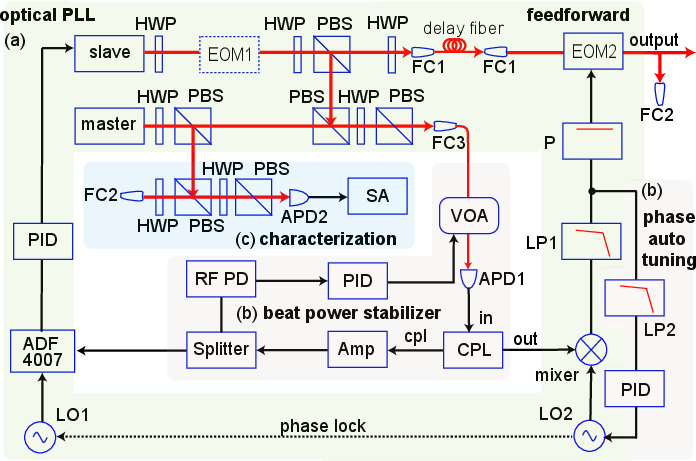
Figure 3: Complete experimental setup showing OPLL, feedforward, beat amplitude/phase stabilization, and characterization modules.
Phase noise suppression is benchmarked by injecting single-tone phase modulations at varying frequencies and comparing beat spectra with and without feedforward enabled. Peak suppression exceeding 50 dB is achieved near 1.9 MHz, remaining above 30 dB across 10 kHz–10 MHz—a regime largely inaccessible to prior OPL or PDH-based feedforward schemes due to either feedback loop latency or cavity bandwidth restrictions.
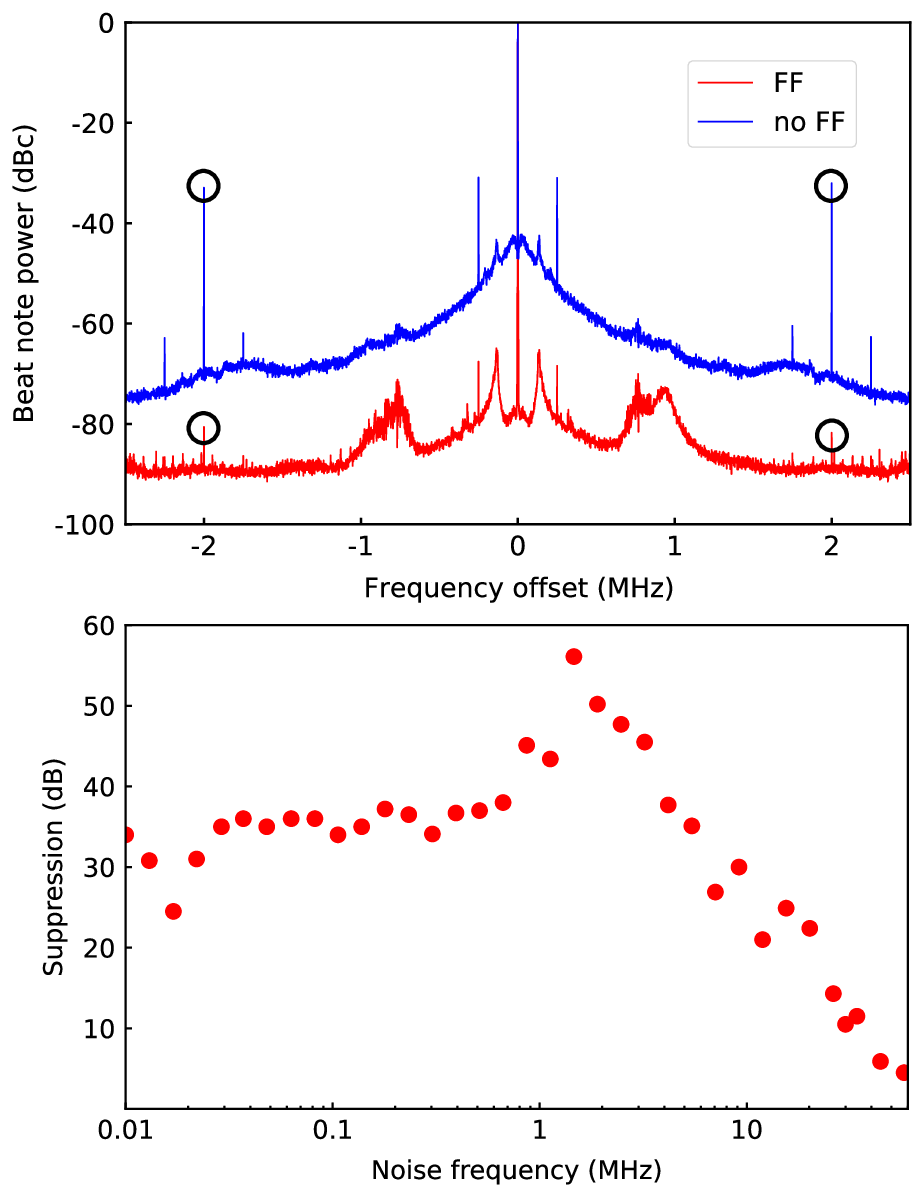
Figure 4: Beat spectra around 240 MHz for different injected modulation frequencies, with (FF) and without (no FF) feedforward. Suppression exceeds 30 dB up to 10 MHz.
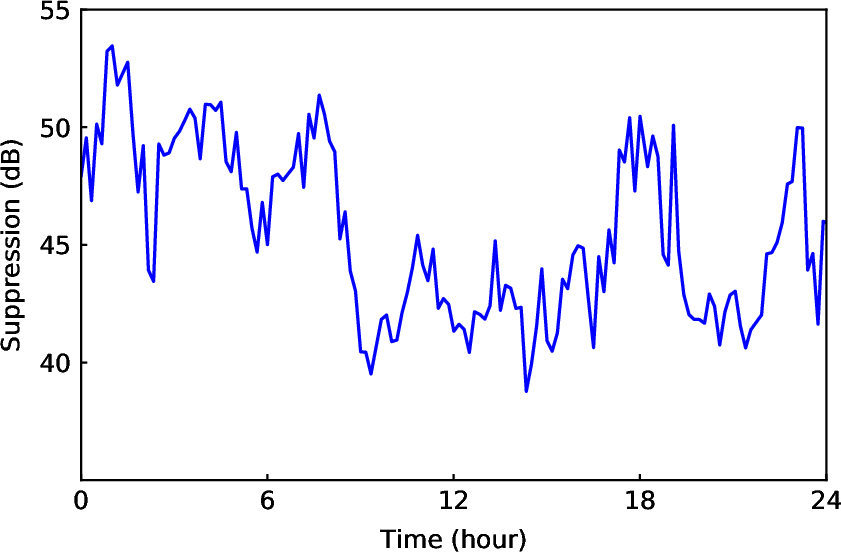
Figure 5: Suppression at 1 MHz persists above 39 dB over 24 hours, demonstrating practical long-term robustness with dual feedback stabilization.
Tuning the master-slave offset Δω between 100 and 240 MHz shows negligible performance degradation. Suppression is bounded primarily by electronic bandwidth and component gain flatness, with minimal recalibration required for multi-decade frequency span operation.
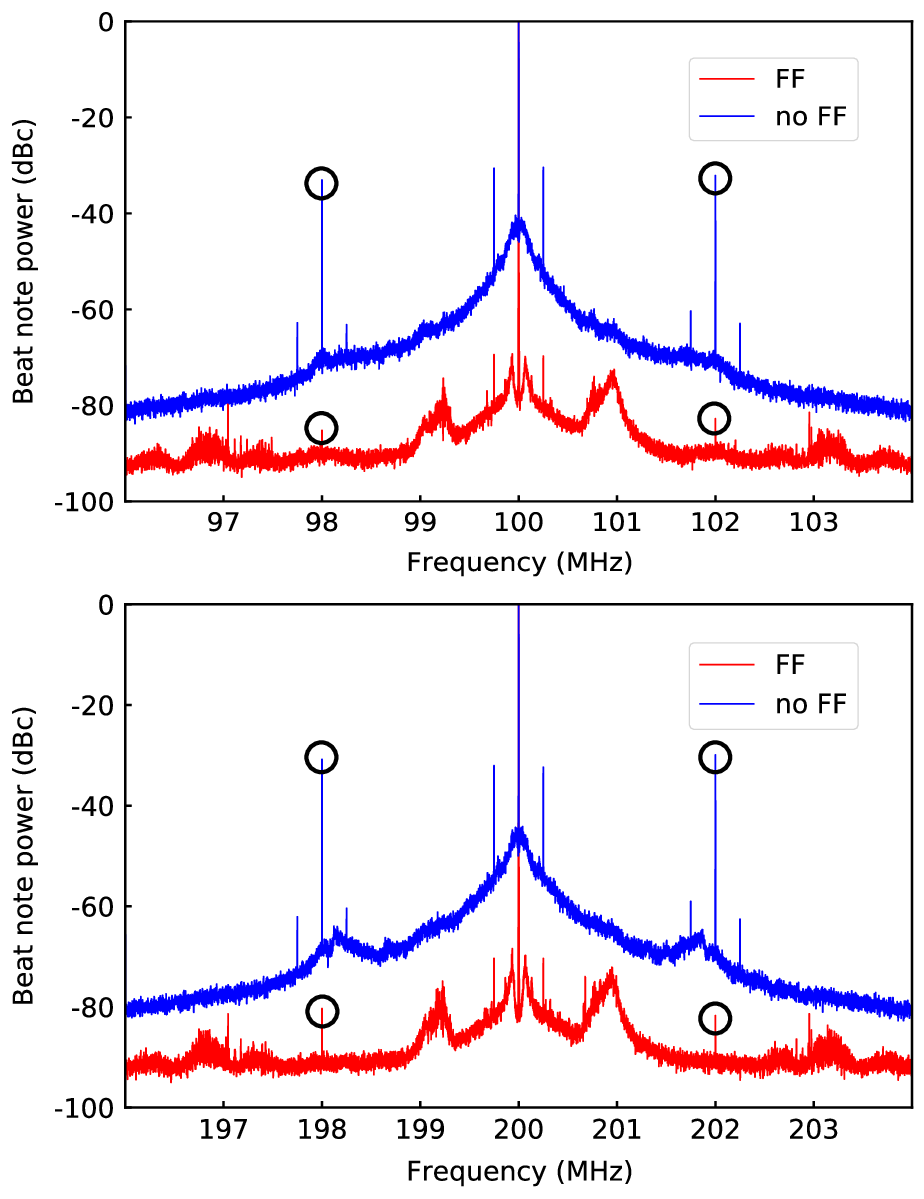
Figure 2: Consistent feedforward performance for Δω=100 MHz and $200$ MHz, demonstrating offset agility.
Comparative Analysis with Other Feedforward Schemes
Delayed self-homodyne, PDH-cavity, and heterodyne beat-based feedforward architectures represent major approaches to high-bandwidth laser phase noise suppression. Delayed self-homodyne techniques are fundamentally bandwidth limited by arm imbalance; PDH-based schemes require high-finesse cavities and suffer low-frequency rolloff. Beat-based feedforward, as demonstrated here, provides the best suppression at low to intermediate frequencies without the sidetone and DC power penalties inherent to sideband-based methods.
The architecture is compatible with straightforward OPL setups. A single EOM suffices for broad-bandwidth correction, while automated phase and amplitude stabilization mitigate open-loop drift and environmental sensitivity.
Practical and Theoretical Implications
This feedforward OPL strategy enables the transfer of high-coherence properties from a master laser to lasers at arbitrary offsets within MHz–GHz without relay cavities, AOFS, or complex modulators, simplifying and cost-reducing quantum control architectures. Typical application domains include:
- High-fidelity neutral atom and ion qubit operations, where phase noise in the MHz regime limits gate error floors,
- Frequency shifting of ultrastable clock lasers for multiplexed metrological or communication applications,
- Photonic microwave/THz generation where high-frequency phase noise is a limiting factor.
Theoretically, the results reinforce the efficacy of direct phase error extraction from heterodyne beats for real-time high-bandwidth correction, and provide a reference model for future broadband coherent cloning systems. Extensions are readily envisaged to offsets in the multi-GHz range and continuous ramping scenarios.
Conclusion
The demonstrated feedforward OPL approach achieves robust, hardware-efficient, high-bandwidth phase noise suppression with straightforward integration into standard OPL systems. Its practical impact is evident for scalable, frequency-agile quantum control and metrology platforms, offering both performance and architectural simplicity without sideband, cavity, or AOFS drawbacks. The technique forms a compelling basis for noise-cancelling links and future photonic quantum information infrastructures.
(2604.02218)

