- The paper introduces trace invariants corresponding to D-colored graphs that generate the full algebra of LU-invariant polynomials for multipartite systems.
- It establishes a recursive graphical calculus that enables systematic classification of entanglement and the construction of operational measures like Rényi entropies and negativity indicators.
- The analysis reveals that large-N tensor states exhibit structural rigidity unlike bipartite cases, highlighting the inherent combinatorial complexity in multipartite entanglement.
Tensor Invariants for Multipartite Entanglement Classification
Overview and Theoretical Context
This work provides a comprehensive investigation of tensorial (trace-)invariants for the classification of multipartite entanglement structures, systematizing and extending the combinatorial framework connecting LU-invariant polynomials to the combinatorics of colored graphs. Unlike the bipartite case, where the entanglement spectrum (Schmidt decomposition) fully characterizes entanglement up to local unitaries and is operationally accessible via a finite set of polynomial invariants (matrix power traces), the multipartite scenario lacks such a canonical object: the invariant theory is governed by high-rank tensors, yielding a vastly more intricate structure of invariants.
The central insight is the identification of trace-invariants, directly corresponding to D-colored (bipartite) graphs, as generators for the algebra of LU-invariant polynomials in multipartite systems. These objects parameterize the orbits of the local unitary group on pure multipartite states, and their combinatorial structure underpins practical and theoretical questions in multipartite entanglement theory.

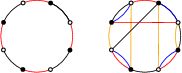
Figure 1: Graphical representation of ψ and $#1{\psi$ as white (tensor) and black (conjugate tensor) D-valent vertices with colored half-edges.
The authors formalize the construction of trace-invariants as follows: Given a pure state ψ in H1⊗⋯⊗HD, a trace-invariant of order k contracts k copies of D0 and D1 copies of D2 along index legs corresponding to the same color. This prescription admits a graphical representation as a D3-regular, bipartite, D4-edge-colored graph with D5 white and D6 black vertices. Each labeling of the graph corresponds to a tuple of permutations in D7 (one per color), modulo simultaneous conjugation.
It is established that:
This graphical language is leveraged systematically: separability, partial separability, and finer resource-theoretic orderings (LO, LOCC) are all recast in terms of trace-invariant properties of the associated graphs.
Practical Consequences for Entanglement Classification
The authors provide several key technical results with strong practical implications:
- Separability and Partial Separability: Genuinely LU3-partite trace-invariants (graphs where each color acts nontrivially and all permutation tuples are pairwise disjoint) characterize full separability: their modulus is unity if and only if the state is fully separable. Partial separability under arbitrary coarse-grainings is similarly addressed via the absence of certain graph patterns under subsystem partition.

Figure 3: A graph in LU4 and corresponding trace-invariant evaluating index contractions for LU5.
- Resource Theories: The authors extend the trace-invariant formalism to local operations (LO), classical communication (LOCC), and shared randomness, constructing large families of monotones. These include multipartite generalizations of Rényi entropies and more exotic invariants, such as those corresponding to partial transpositions (negativity-type measures), realignment criteria, and multi-entropy/reflected entropy, all with explicit graph correspondences and known operational role in entanglement detection.
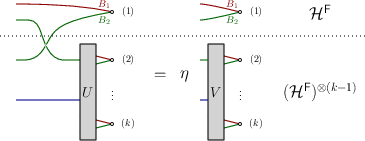
Figure 4: Structure of a LU6-partite trace-invariant and its graphical decomposition under coarse-graining.
Asymptotic Structures, Haar-Random States, and Large-LU7 Limit
A pronounced focus is placed on the large-LU8 (dimension) asymptotics, both for deterministic reference families (products of multipartite GHZ states and Bell pairs) and Haar-random pure states. In this regime, combinatorial techniques from random tensor theory—enumeration of faces, Gurau degree, compatibilities of colorings—become computationally powerful.
Key results include:
- The scaling behavior of invariant averages (e.g., over Haar measure or Gaussian tensors) is controlled by face counts and the Gurau degree of the graph. Factorization phenomena known from random matrix theory fail generically in random tensors: the leading order of disconnected invariants does not always equal the product of leading orders for each component.
- For LU9, random tensor states (Haar-typical) cannot, in the large-ψ0 limit, be mimicked at the scaling level by any deterministic state—even on the level of invariant evaluation—demonstrating structural rigidity absent in bipartite entanglement.
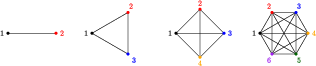
Figure 5: Visual representation of a Bell pair (left), triangle state (middle left), and their generalized multipartite extensions (center/right), as product states of GHZ and Bell building blocks over subsystems.
Reference States and Operational Distinctions
To manage the combinatorial explosion, the authors introduce a well-structured infinite family of reference states, formed as tensor products of GHZ states of varying dimensions and subsystem support, graphically encoded as hypergraphs. Under local unitary equivalence, each reference state is uniquely specified by a function ψ1 on multisets ψ2 (with ψ3), encoding the number of GHZ states supported on each block.
Critical developments include:
Combinatorial and Graph-Theoretical Insights
A strong technical innovation is the detailed combinatorial analysis of families of graphs/invariants, including:
Implications and Future Directions
This toolbox of tensor invariants and their graphical combinatorics offers:
- Efficient diagnostics for multipartite entanglement classification within practically relevant state families, sidestepping the full invariant algebra explosion.
- A platform for the systematic development of new entanglement monotones beyond polynomials accessible via the entanglement spectrum.
- A rigorous connection between field-theoretical tensor models, random geometries, and operational entanglement theory, where combinatorial objects structurally govern both state distinguishability and resource-theoretic constraints.
- The revealing of sharp structural differences (notably, the absence of large-$#1{\psi$0 factorization for tensors) between multipartite systems and their matrix ($#1{\psi$1) analog.
The theory suggests future lines of inquiry: design and classification of new invariants with prescribed monotonicity and operational meaning, deeper connections to algebraic and geometric invariants (e.g., triangulation theory), and generalization to mixed-state and operational settings (LOCC, catalytic transformations). The companion publications (see (2604.02269)), as well as works cited therein, promise further advance on the role of tensor invariants for multipartite entanglement, including richer families of monotones and the asymptotic structure of random tensor states.
Conclusion
By establishing the centrality of trace-invariants and their explicit combinatorial/graph-theoretic structure, this work defines a rigorous framework for multipartite entanglement classification. The translation of intractable algebraic invariant problems into tractable, visually and algorithmically navigable graphical calculus, together with their operational and asymptotic analysis, marks a significant step towards a systematic understanding and practical exploitation of multiparty quantum resources.

Figure 8: Recursive construction of a melonic 3-colored graph, illustrating the principle of melonic insertions central to both invariant enumeration and $#1{\psi$2 expansion scaling.