- The paper establishes analytically and numerically that correlation-induced power-law localization persists under TRS breaking up to a critical threshold.
- It reveals a sharp localization-delocalization transition where the eigenstate decay shifts from algebraic to delocalized behavior as the hopping exponent and TRS-breaking parameter vary.
- The findings provide a framework for understanding unconventional localization in engineered quantum systems, with implications for diffusive dynamics in materials and photonic platforms.
Robust Correlation-Induced Localization Under Time-Reversal Symmetry Breaking
Introduction
The study "Robust Correlation-Induced Localization Under Time-Reversal Symmetry Breaking" (2604.02321) provides an analytic and numerical examination of Anderson localization in one-dimensional (1D) disordered quantum systems with long-range, correlated hopping terms, explicitly probing the consequences of breaking time-reversal symmetry (TRS) via complex hopping amplitudes. The paper precisely delineates the static and dynamical phase diagrams as functions of the hopping exponent a and the TRS-breaking parameter θ, invoking both analytical machinery (notably the matrix inversion trick, MxIT) and large-scale numerics. The results establish fundamental limits on the robustness of correlation-induced localization, reveal distinct algebraic localization regimes, and identify novel dynamical phenomena as the system is tuned across the localization-delocalization transition.
The work investigates a 1D tight-binding model with random onsite disorder and fully translation-invariant, complex, power-law decaying hopping:
H=n∑ϵn∣n⟩⟨n∣+n=m∑jn−m∣n⟩⟨m∣,jn−m=∣n−m∣aeiθsign(n−m)
where ϵn are i.i.d. Gaussian onsite energies, a>0 controls the decay of long-range hopping, and the parameter θ∈[−π/2,π/2) continuously tunes the degree of TRS breaking via the complex phase. For θ=0, the model is TRS-preserving; for θ=0, TRS is explicitly violated.
Static Phase Diagram: Localization–Delocalization Transition
The core result is the analytic and numerical determination of the static phase diagram in the (a,θ) plane. Correlation-induced power-law localization, robust to conventional wisdom from the PLBRM and related models, survives breaking of TRS up to a critical value:
∣θc∣=πa/2
Above this, a genuine transition to spectral delocalization occurs for θ0. The eigenstates' spatial decay derives from a nontrivial interplay of TRS breaking, spectral support topology, and correlations in hopping.
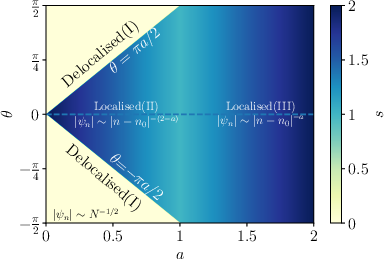
Figure 1: Phase diagram in the θ1 plane, showing regimes of algebraic localization and delocalization, with the phase boundary θ2 and the corresponding power-law decay exponent θ3.
Three distinct regimes emerge:
- Regime I (θ4, θ5): Spectrally delocalized states.
- Regime II (θ6, θ7): Correlation-induced power-law localization, decay θ8.
- Regime III (θ9): Conventional Anderson localization, decay H=n∑ϵn∣n⟩⟨n∣+n=m∑jn−m∣n⟩⟨m∣,jn−m=∣n−m∣aeiθsign(n−m)0.
The phase boundary's H=n∑ϵn∣n⟩⟨n∣+n=m∑jn−m∣n⟩⟨m∣,jn−m=∣n−m∣aeiθsign(n−m)1-dependence yields a vanishing robustness window for H=n∑ϵn∣n⟩⟨n∣+n=m∑jn−m∣n⟩⟨m∣,jn−m=∣n−m∣aeiθsign(n−m)2, consistent with analytic expectations for the Russian Doll and Richardson models.
Eigenstate numerics confirm this sharp transition: for H=n∑ϵn∣n⟩⟨n∣+n=m∑jn−m∣n⟩⟨m∣,jn−m=∣n−m∣aeiθsign(n−m)3, the wavefunction exhibits system-size independent power-law localization for H=n∑ϵn∣n⟩⟨n∣+n=m∑jn−m∣n⟩⟨m∣,jn−m=∣n−m∣aeiθsign(n−m)4, while for H=n∑ϵn∣n⟩⟨n∣+n=m∑jn−m∣n⟩⟨m∣,jn−m=∣n−m∣aeiθsign(n−m)5 all states are delocalized.
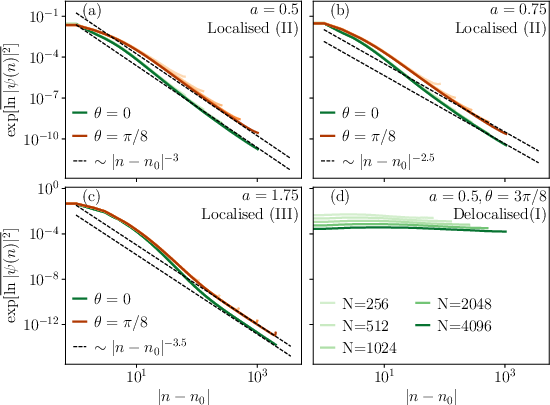
Figure 2: Typical eigenstate decay in the bulk; algebraic localization collapses for all system sizes below the critical H=n∑ϵn∣n⟩⟨n∣+n=m∑jn−m∣n⟩⟨m∣,jn−m=∣n−m∣aeiθsign(n−m)6, giving way to delocalization above.
Analytical Mechanism: Matrix Inversion Trick and TRS
The localization-delocalization transition is explicated via a refined application of the matrix inversion trick (MxIT) [Nosov et al., Phys. Rev. B 99, 104203 (2019)], generalized to TRS-broken systems. For H=n∑ϵn∣n⟩⟨n∣+n=m∑jn−m∣n⟩⟨m∣,jn−m=∣n−m∣aeiθsign(n−m)7 and H=n∑ϵn∣n⟩⟨n∣+n=m∑jn−m∣n⟩⟨m∣,jn−m=∣n−m∣aeiθsign(n−m)8, the momentum-space single-particle spectrum is one-sided unbounded; MxIT maps the Hamiltonian to a dual model with effective hopping decaying as H=n∑ϵn∣n⟩⟨n∣+n=m∑jn−m∣n⟩⟨m∣,jn−m=∣n−m∣aeiθsign(n−m)9, with the corresponding Levitov's resonance criterion now satisfied, ensuring localization. For ϵn0, the spectrum becomes two-sided unbounded, the MxIT fails, and perturbative control is lost—marking delocalization.
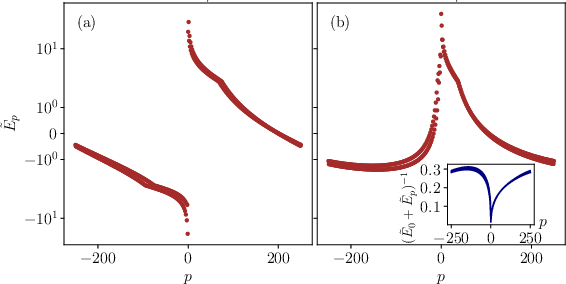
Figure 3: Momentum-space hopping spectrum ϵn1 for ϵn2; a single-sided divergence for ϵn3 versus a two-sided divergence for ϵn4 sets the topological criterion for localization.
Dynamical Phase Diagram: Wavepacket Spreading and Correlation Effects
The dynamics of initially localized wave packets further demarcates the static and dynamical regimes. The mean-squared displacement (MSD) exhibits a rich temporal window structure, with scaling exponents depending intricately on ϵn5 and ϵn6. Notably, for the correlation-induced localized regime (II), the intermediate time scaling crosses over from subdiffusive (ϵn7 for ϵn8) to diffusive (ϵn9 for any a>00), signaling an immediate instability of anomalously slow transport to TRS breaking.
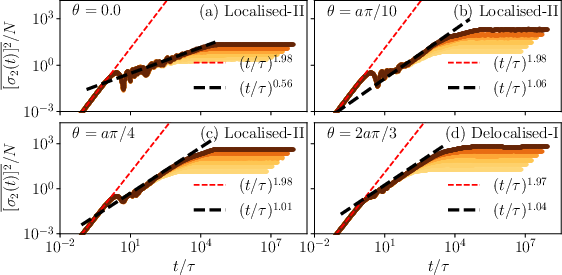
Figure 4: Wave-packet width for a>01, varying a>02. For TRS (a>03), a clear subdiffusive window is seen; introducing TRS breaking restores diffusive dynamics even well inside the static localized regime.
A schematic overview summarizes the full set of dynamical scaling exponents and the time windows (ballistic, (sub-)diffusive, saturated).
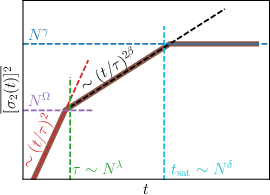
Figure 5: Schematic of dynamical regimes and scaling exponents (a>04) for different a>05 windows.
The late-time saturated width can grow as a power law with system size a>06 in the delocalized regime, as evidenced by both analytic calculations and finite-size scaling analysis:
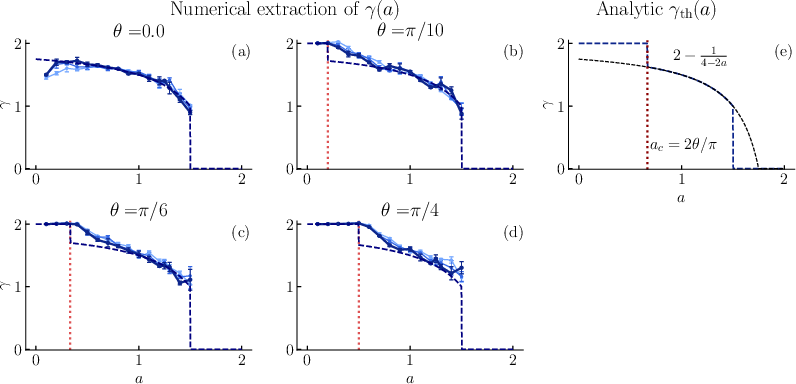
Figure 6: Scaling exponent a>07 for the saturation scale of a>08, revealing the crossover controlled by a>09 and θ∈[−π/2,π/2)0.
Spectral and Dynamical Regimes: Detailed Numerical Results
Additional cuts in the θ∈[−π/2,π/2)1 plane show, for example, that at fixed θ∈[−π/2,π/2)2, diffusive scaling of MSD is observed for any finite TRS breaking, and for larger θ∈[−π/2,π/2)3 the dynamical windows persist in width as θ∈[−π/2,π/2)4 increases—but the eventual late-time localization remains robust.
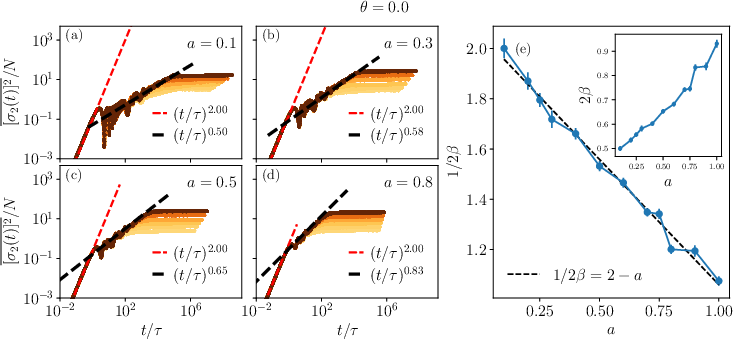
Figure 7: MSD dynamics for the TRS line (θ∈[−π/2,π/2)5) as a function of θ∈[−π/2,π/2)6; the subdiffusive-to-diffusive transition is apparent.
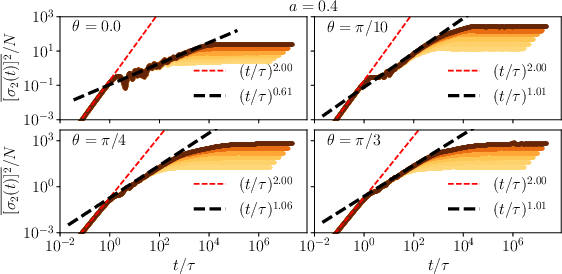
Figure 8: MSD dynamics for θ∈[−π/2,π/2)7 and varying θ∈[−π/2,π/2)8. Any θ∈[−π/2,π/2)9 restores diffusive transport.
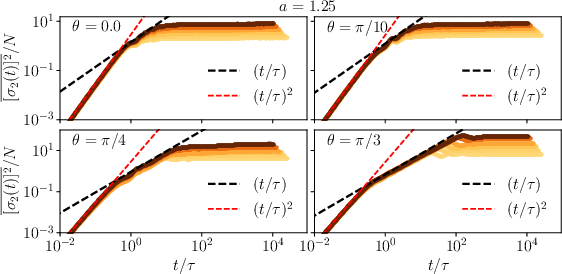
Figure 9: For θ=00, the diffusive window broadens with increasing θ=01 but the late-time width remains subextensive for all θ=02.
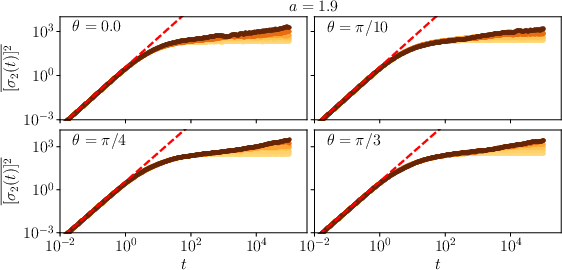
Figure 10: For θ=03, the wavepacket quickly saturates to an θ=04-independent value, indicating strong localization.
Implications and Perspectives
The results demonstrate that correlation-induced localization—rooted in precise algebraic interference sustained by nontrivial correlations in long-range hopping—can survive TRS breaking up to a sharply defined threshold. Beyond this threshold, even weak randomness in the phases suffices to destabilize all localized states, restoring ergodic delocalization compatible with the standard PLBRM paradigm. This provides an analytic resolution to debates about the resilience of nontraditional localized phases in the presence of coherent symmetry breaking.
From an experimental perspective, these phenomena are highly relevant for, e.g., engineered quantum platforms (cold atom arrays, photonic lattices, superconducting qubits) where correlated long-range couplings and synthetic gauge fields (TRS breaking) can be tuned independently. Furthermore, the connection to light localization in three dimensions suggests avenues for realizing unconventional Anderson transitions protected by correlation effects in photonic materials.
The work also opens new conceptual directions. The breakdown of the MxIT under TRS breaking foregrounds the role of spectral topology and global constraints in non-ergodic quantum phases, which may have further implications in non-Hermitian generalizations and many-body localization contexts. The intricate dynamical window structure, where diffusive transport can coexist with static power-law localization for long yet finite times, raises questions about the universality of anomalous transport in complex quantum systems with correlated disorder.
Conclusion
This study rigorously characterizes the stability and limits of correlation-induced localization under controlled TRS breaking in 1D disordered systems with long-range, structured hopping. By linking spectral topology, correlations, and symmetry to localization phenomena, it enriches the taxonomy of quantum phases in disordered systems, provides analytic tools for predicting phase boundaries, and delivers new insights into the dynamical signatures of ergodic and non-ergodic regimes. The analytic framework and numerical demonstrations lay the groundwork for future investigations of correlated disorder in both equilibrium and out-of-equilibrium quantum dynamics.