- The paper provides the first JWST/MIRI secondary eclipse detection of GJ 3473 b with a measured depth of 186 ±45 ppm.
- It employs advanced PSF modeling, aperture optimization, and Bayesian model comparison to assess the planet's atmospheric versus bare-rock state.
- Results exclude thick CO2 atmospheres (>1.2–6.5 bar) at 95% confidence while highlighting degeneracies inherent in single-band photometry.
JWST/MIRI Secondary Eclipse Observations of GJ 3473 b: Atmospheric Constraints and Surface Degeneracies
Introduction
The work presents the first JWST/MIRI F1500W secondary eclipse photometry for GJ 3473 b, a rocky, highly-irradiated exoplanet orbiting an early-to-mid M dwarf. The core motivation is to address whether such planets retain atmospheres or are stripped bare—a question driven by theoretical uncertainties in volatile retention and atmospheric escape for close-in, low-mass planets. The wider context is the ongoing scrutiny of the "cosmic shoreline": the empirical and theoretical demarcation between exoplanets able to sustain atmospheres and those left airless. These results join the rapidly forming MIRI-based census of hot rocky planet emission and aim to empirically constrain the surface/atmospheric state of GJ 3473 b, leveraging the capability of JWST/MIRI to distinguish bare rocks from atmosphere-bearing planets via thermal emission in the mid-infrared.
Observational Strategy and Data Analysis
Four secondary eclipse events were observed using JWST/MIRI F1500W photometry, spanning two epochs in March and one in October 2024. The instrumental and astrophysical systematics inherent to MIRI time series photometry were characterized using both empirical trends and PSF properties. The data reduction involved advanced outlier rejection, pixel-level systematics modeling, and iterative background subtraction. A detailed analysis of detector settling revealed time- and position-dependent exponential ramps, explicitly quantified and compared across observation epochs.
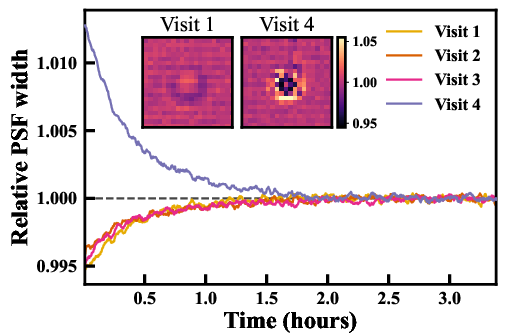
Figure 1: PSF width evolution and systematics during detector settling, revealing intra-observation ramping and inter-epoch variability that impact precise eclipse depth retrievals.
Optimal photometric extraction was determined via aperture analysis, motivating a 6-pixel radius as the best compromise between systematic suppression and statistical precision. The light curve modeling adopted a suite of parametric and nonparametric (Gaussian process) systematics corrections, jointly fitting all four visits and rigorously assessing the impact of instrumental and astrophysical variability. Bayesian evidence and Bayes factors were employed throughout to establish the detection significance and to compare model variants. The canonical fit yields a robust secondary eclipse detection with an average depth of 186±45 ppm.
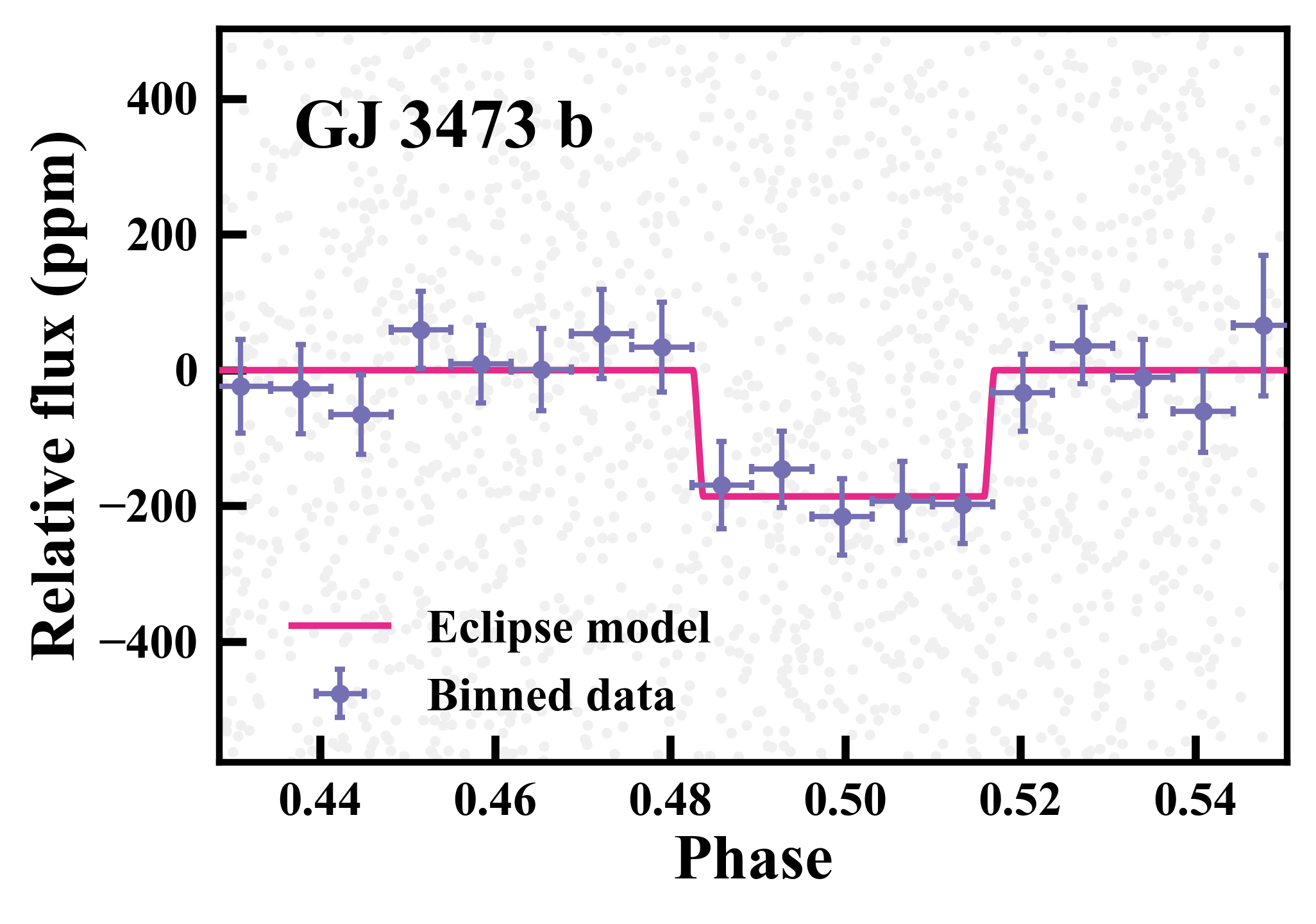
Figure 2: Phase-folded, systematics-corrected MIRI photometry and best-fit eclipse model for GJ 3473 b, demonstrating a statistically significant occultation signal.
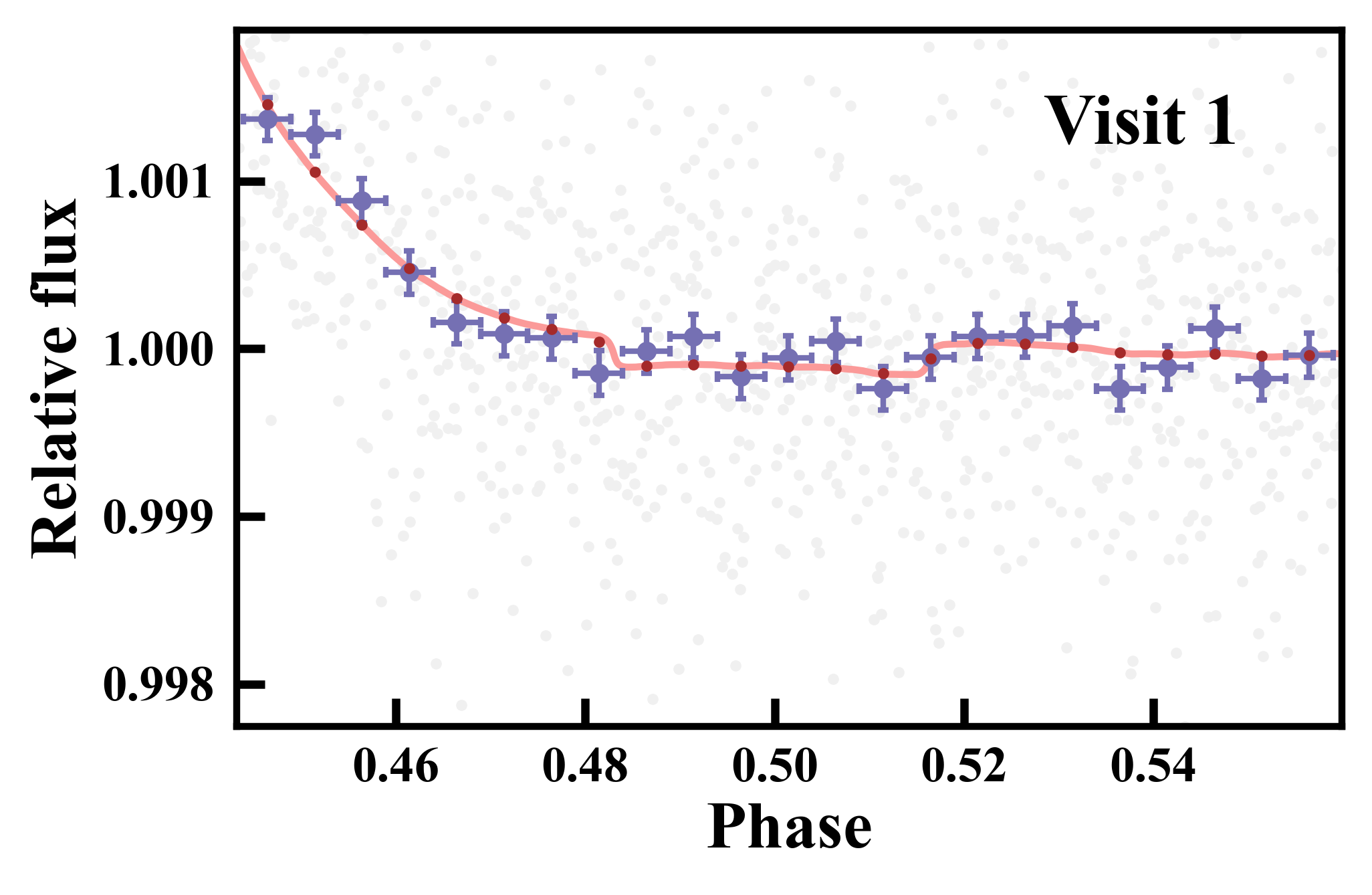
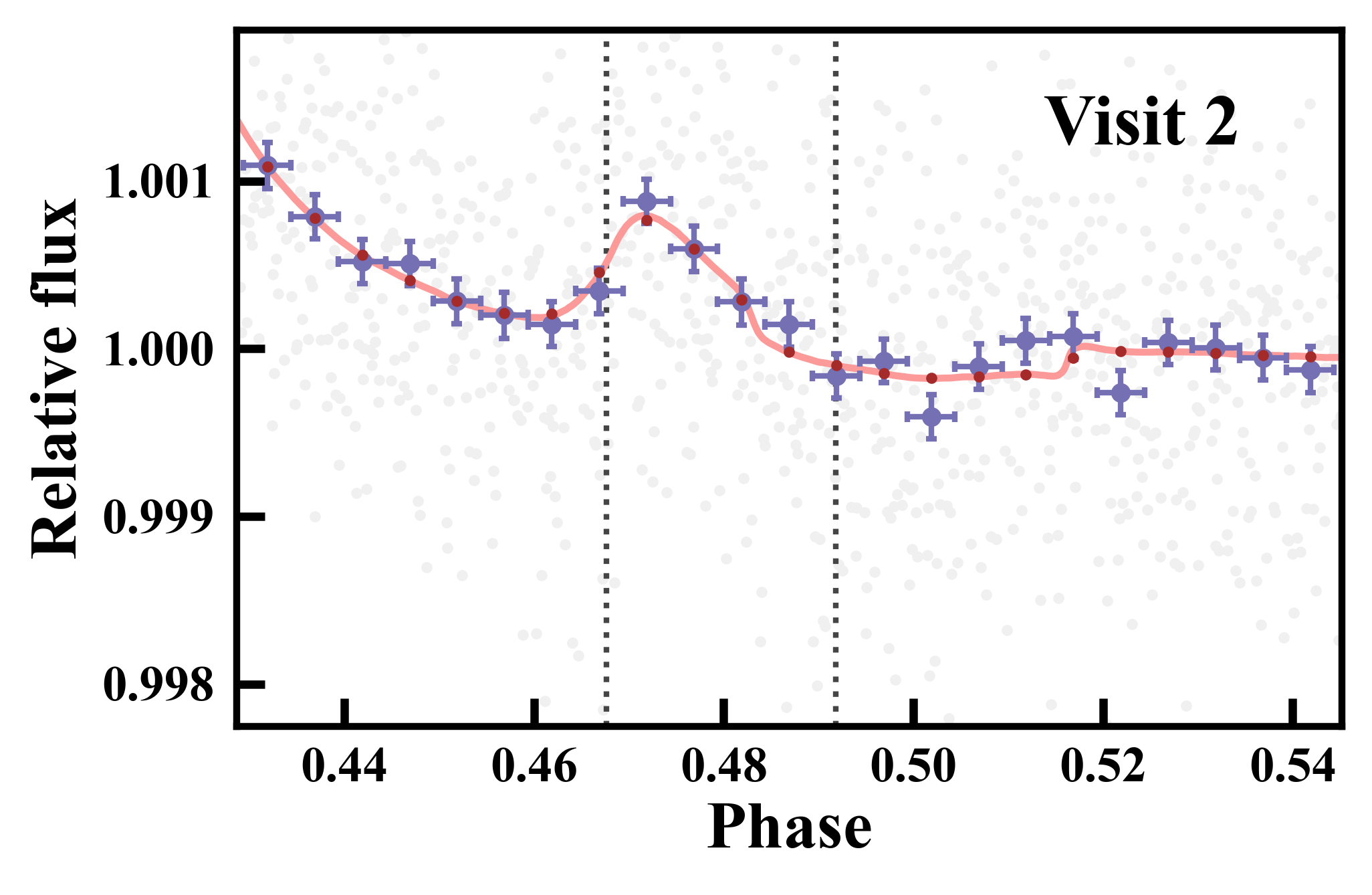
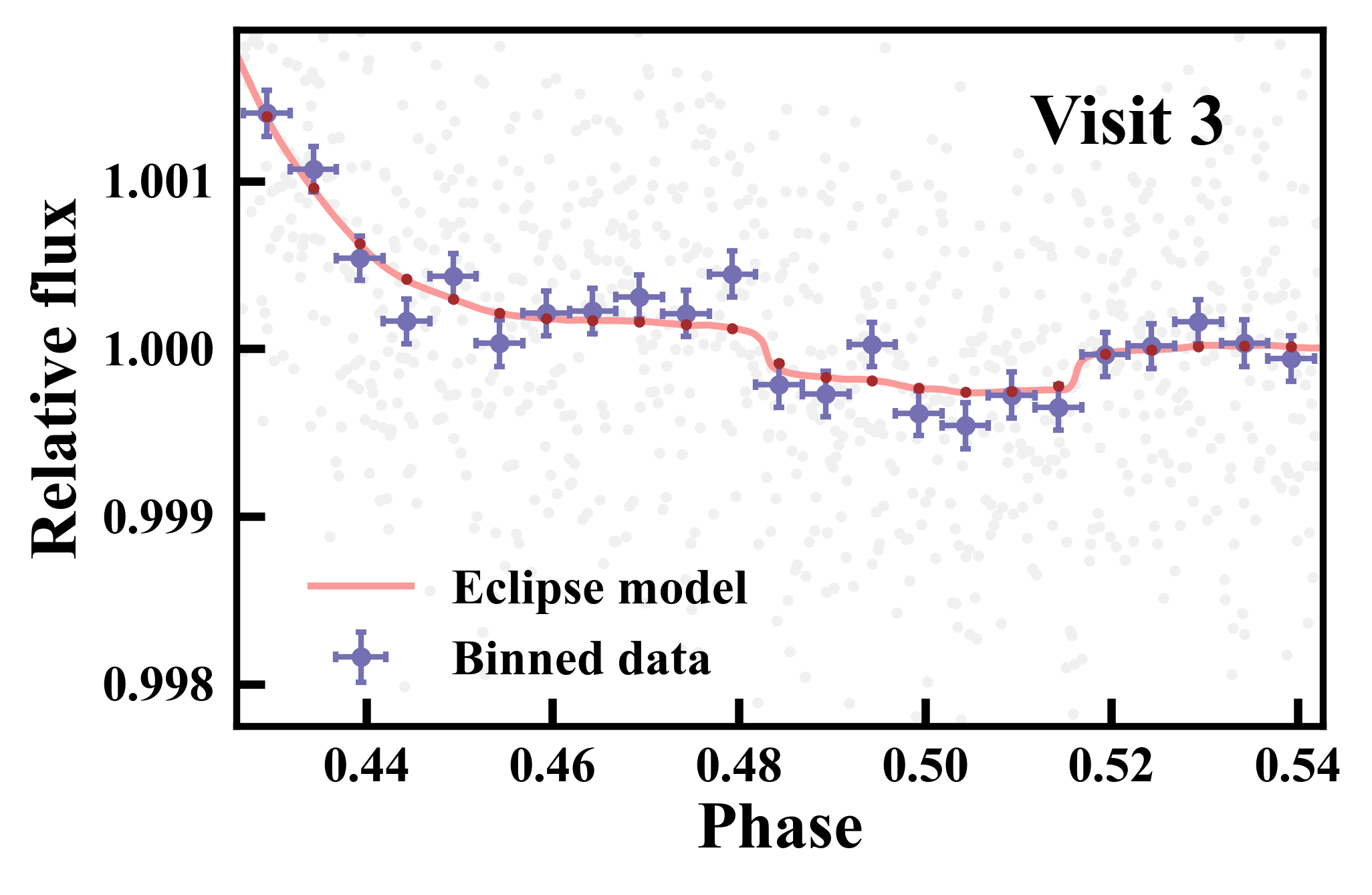
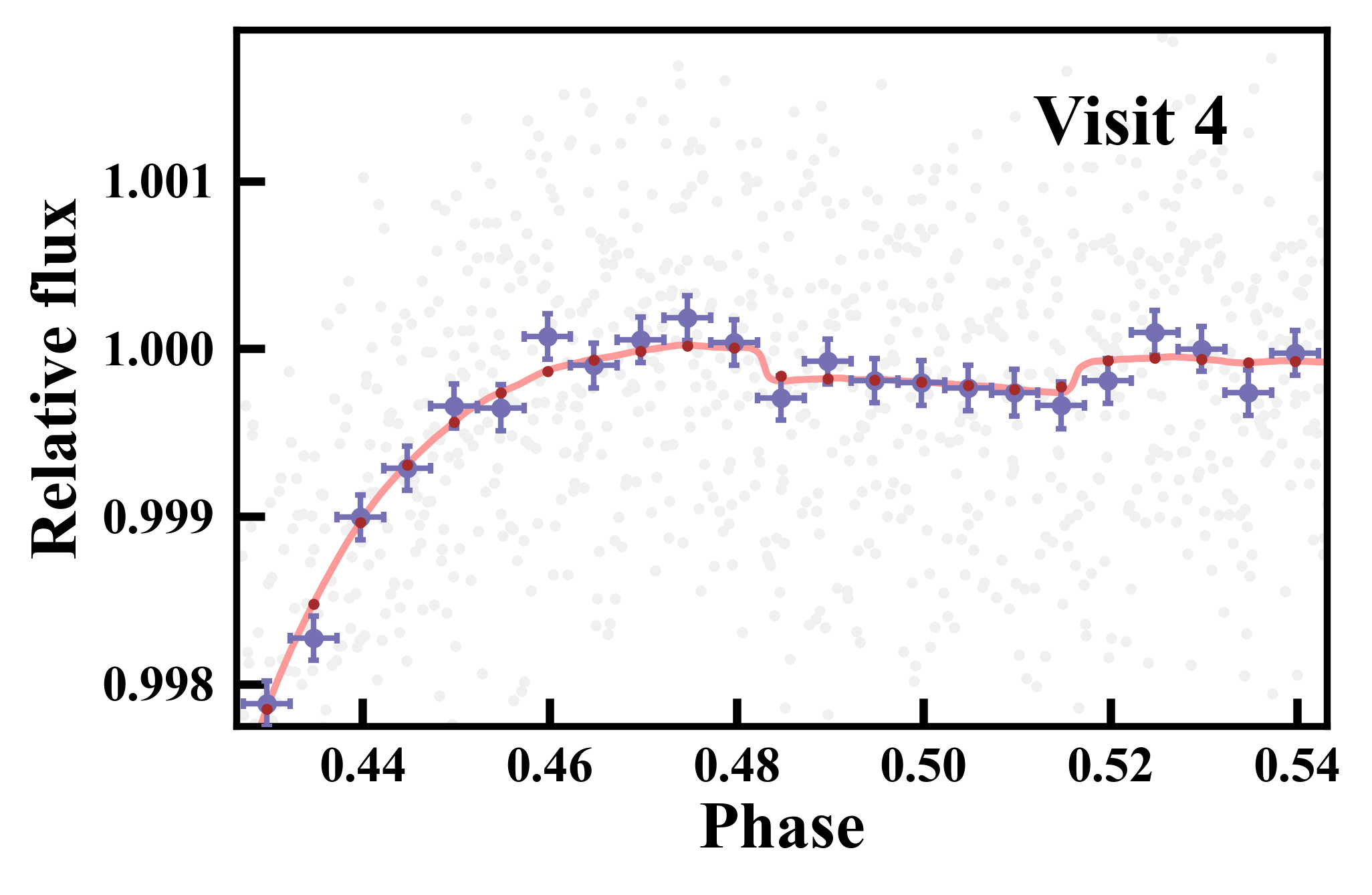
Figure 3: Individual visit light curves highlighting both raw and binned flux, with systematics and potential flare events, modeled as described in the appendices.
Forward Modeling: Surface and Atmospheric Interpretations
A diverse ensemble of surface models was constructed, covering ultramafic, mafic, feldspathic, and felsic (notably, granite) rock compositions, incorporating a range of texture and grain-scale properties. Space weathering was systematically parameterized using nanophase metallic iron and graphite admixture, altering both visible and thermal albedos following the Hapke formalism.
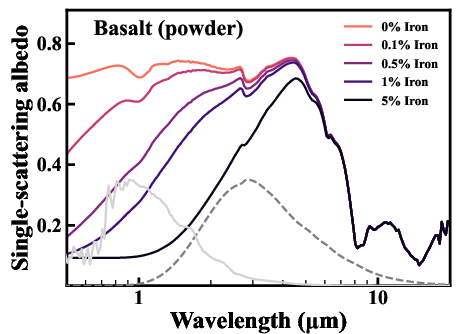
Figure 4: Variation of basalt reflectance and absorption with increasing space weathering by nanophase iron content, illustrating suppression of optical albedo and elevated thermal emission.
Atmospheric models were computed using the HELIOS 1D radiative-convective code for pure CO2 and H2O cases across a log-uniform surface pressure prior (10−4–102 bar), exploring redistribution factors informed by theory and restricting Bond albedo within physically motivated limits. The modeling pipeline computes the MIRI F1500W eclipse depth for each case, fully integrating across JWST/MIRI throughput.
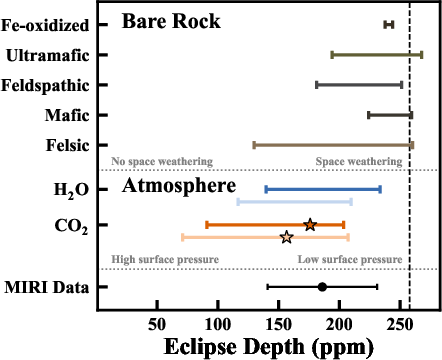
Figure 5: Parameter space of eclipse depths predicted for various bare-rock and atmospheric scenarios, showing overlapping regimes and the measurement uncertainty of GJ 3473 b.
The observed eclipse depth is consistent with a wide swath of surface types, particularly favoring highly reflective (felsic/granitoid) surfaces for low brightness temperatures, and with atmospheres having low to moderate surface pressures. However, thick (>1.2−6.5 bar) pure CO2 atmospheres are credibly excluded at 95\% confidence, depending on albedo, regardless of the specific modeling assumptions.
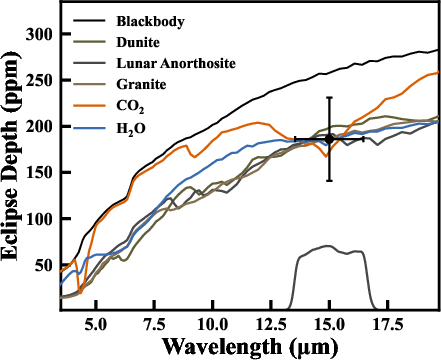
Figure 6: Spectral dependence of eclipse depths for best-fit bare rock and atmospheric models, underscoring the degeneracies present with single-band photometry.
Bayesian Model Comparison and Degeneracy Quantification
A formal Bayesian framework was implemented for model comparison, marginalizing over space weathering, composition, and atmospheric parameters. Under agnostic priors, the probability that GJ 3473 b retains an atmosphere remains indistinguishable from 50% given current data—directly reflecting the strong degeneracies between plausible surfaces and thinner atmospheres.
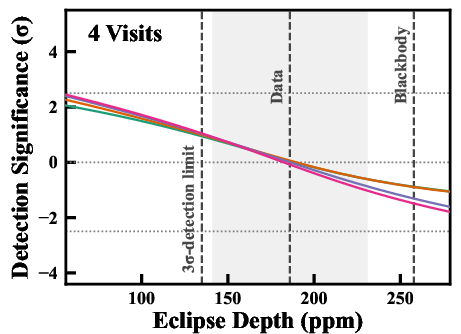
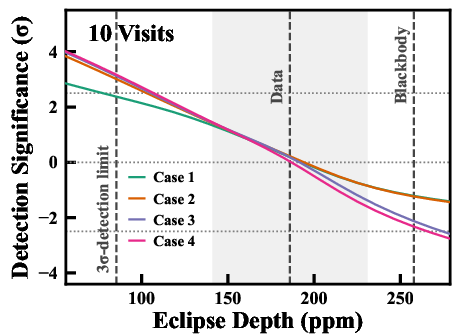
Figure 7: Detection significance for an atmosphere as a function of eclipse depth, illustrating that multiple MIRI photometric epochs are required to break composition–atmosphere degeneracies.
Expanding the prior space, even a ten-visit campaign is unlikely to robustly distinguish bare rock from atmosphere unless restrictive prior information or independent constraints are available (e.g., improbable presence of high-albedo felsic surfaces at >1000 K). The results demonstrate that single-band, broad-band photometric measurements with current uncertainties are structurally limited in discriminating atmospheric presence for GJ 3473 b and similar planets.
Atmospheric Collapse and Spin State Considerations
The analysis incorporates theoretical constraints on CO2 atmospheric collapse thresholds for synchronously rotating planets, yielding a ∼1 mbar minimum pressure for GJ 3473 b under nominal parameters. The inferred eclipse depth does not exclude atmospheres near this threshold. The study also highlights that asynchronicity or higher-order spin-orbit states could reduce dayside temperature and secondary eclipse amplitude, potentially confounding interpretations based solely on eclipse photometry.
Tentative Evidence for Eclipse Depth Variability
A detailed evaluation of the four measured eclipse depths reveals weak evidence for epoch-to-epoch variability, with measured depths spanning 20–21 ppm. The posterior probability for real variability remains inconclusive (22). This variability could arise from astrophysical processes (e.g., volcanic or atmospheric dynamics, or circumplanetary material) or from time-dependent stellar–instrumental systematics. The lessons from 55 Cnc e, where mid-IR variability is now established, underscore the critical need for temporal baselining in future hot rocky planet characterization.
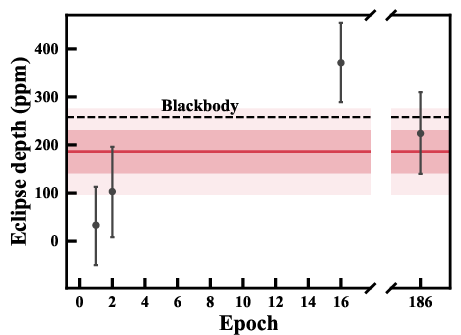
Figure 8: Epoch-resolved eclipse depths, indicating weak, not statistically decisive, evidence for temporal variability across the four JWST visits.
Technical Robustness: Systematics and Alternative Explanations
Comprehensive tests of photometric aperture, time-dependent systematics, PSF properties, and stellar flux calibration demonstrate that the results are not systematically sensitive to plausible variations in reduction or fitting methodology. The dataset enables high-precision absolute calibration (scatter 23), lending confidence to the absolute eclipse depth measurement. The study sets a benchmark for future MIRI analyses, rigorously evaluating reduction and modeling systematics.
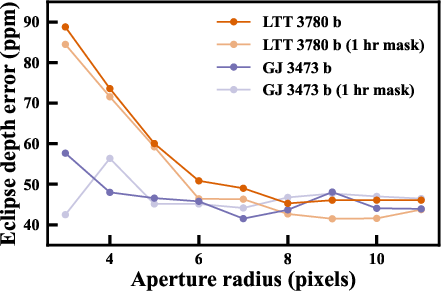
Figure 9: Eclipse depth uncertainty versus photometric aperture for GJ 3473 b and comparison target LTT 3780 b, illustrating stability of retrieved depths above the optimal aperture.
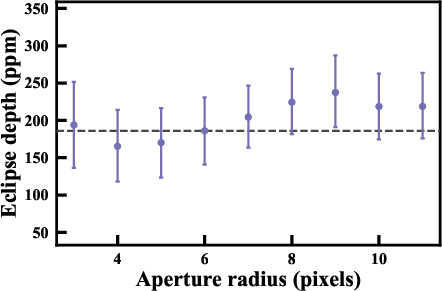
Figure 10: Consistency of measured eclipse depth as a function of aperture, supporting robustness of the extraction approach.
Conclusion
This study presents the first JWST secondary eclipse photometry of GJ 3473 b. The measured dayside flux is consistent with both atmosphere-free and atmosphere-bearing scenarios after marginalizing over plausible compositions, space weathering, and atmospheric parameters. The data allow strong constraints on thick CO24 atmospheres but cannot uniquely distinguish between a bare or thinly atmosphered planet using MIRI F1500W alone. Under broad and reasonable priors, the posterior probability for an atmosphere remains indeterminate. Investigation of possible eclipse depth variability yields only tentative evidence, motivating future temporal monitoring.
These results demonstrate the fundamental degeneracy in single-band mid-IR emission for hot rocky planets and highlight the necessity of spectroscopic, multi-wavelength, or phase-resolved follow-up for robust atmospheric characterization. The Bayesian methodology developed here establishes a statistical framework for future decision-making about atmosphere detection significance in the era of JWST and goes beyond point-estimate interpretations.
Future progress will rely on synthesis of high-cadence multi-epoch photometry with high-SNR emission and transmission spectra and on theoretical advances in predicting the surface–atmosphere boundary across the exoplanet population. This work sets a critical reference for interpreting mid-infrared secondary eclipse photometry in the context of rocky exoplanet atmospheric evolution.
References:
"Hot Rocks Survey V: Secondary Eclipse Photometry of GJ 3473 b with JWST/MIRI" (2604.02332)

