- The paper shows that synchronous condensers enhance grid stability in GFL-IBR systems by providing inertia, fault current, and voltage support.
- It employs high-fidelity PSCAD EMT simulations on an IEEE 9-bus system to assess impacts on frequency, angular stability, and transient damping.
- Results indicate that capacity scaling and strategic spatial deployment of SynCos are critical to mitigating oscillatory instabilities in low-inertia grids.
Synchronous Condensers for Stability Enhancement in GFL-IBR Dominated Power Systems
Introduction
The ongoing paradigm shift toward widespread inverter-based resources (IBRs) in modern power systems has instigated a fundamental rethink of grid planning, protection, and dynamic operation. Most large-scale IBR deployments employ grid-following inverters (GFLs), whose inability to independently form voltage and frequency leads to critical stability limitations, especially under high penetration scenarios where synchronous generators (SGs) are largely displaced. The paper "Synchronous Condensers: Enhancing Stability in Power Systems with Grid-Following Inverters" (2604.02622) critically reexamines the role of synchronous condensers (SynCos)—rotating electromechanical machines providing reactive power, short-circuit current, and inertia—as a mitigation strategy for emergent stability threats in low-inertia, GFL-prevalent networks.
A clear formalism underlies the paper's assessment of stability-supporting assets: the distinction between "grid-forming" and "grid-strengthening" functions. Grid formation requires an asset to inject power, independently regulate voltage magnitude, and independently establish voltage phase (frequency). GFLs are inherently incapable of these, relying instead on phase-locked loop (PLL) based tracking of externally provided voltage and frequency references. SynCos, while capable of forming and regulating voltage magnitude via their excitation systems, synchronize their frequency and phase directly to the grid and thus lack true grid-forming autonomy.
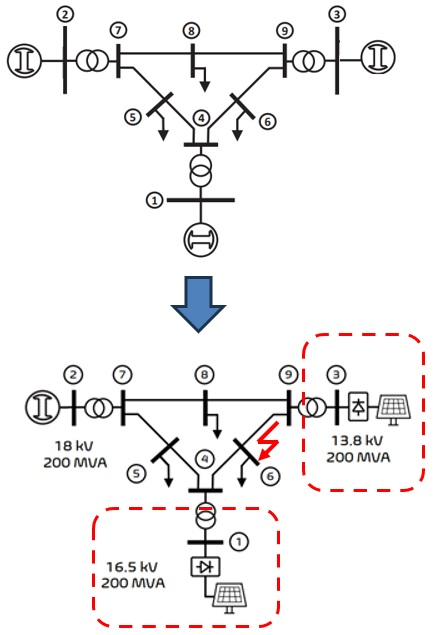
Figure 1: One-line diagram of the case study illustrating the IEEE 9-bus system used for simulation analysis.
Consequently, SynCos and GFLs both fall short of the grid-forming criterion, but SynCos differ fundamentally by contributing physical inertia and transient short-circuit current through their rotating masses and electromagnetic characteristics, supporting grid "strength"—the system's ability to withstand and recover from disturbances.
SynCon Contributions to Network Stability
Frequency and Angular Stability
SynCos supply kinetic energy via their spinning rotors, directly proportional to machine inertia. During disturbances (e.g., fault-induced active power imbalances), the resulting inertial response manifests as temporary momentum transfer that slows the grid frequency's rate of decline, thus temporarily improving frequency stability and buying time for primary controls and protection to activate. The exchange between kinetic energy and electromagnetic fields is governed by the classic swing equation, analogous to SG behavior but ultimately limited, as SynCos lack a prime mover for persistent generation.
Fault and Transient Support
During short-circuit faults, SynCos inject both active and reactive short-circuit current components, attributable to the excitation and armature winding-induced transient magnetic flux linkages. Their inherently lower subtransient reactance (Xd′′) compared to steady-state values allows significant short-circuit current delivery, supporting relay operation and network protection schemes, especially crucial as GFL-IBRs possess negligible short-circuit strength due to constraints of power electronic devices.
Voltage Regulation and Damping
Beyond inertia and fault current, the doubly excited nature of SynCos allows robust regulation of voltage magnitude and effective oscillation damping through both steady-state and transient periods. The subtransient dynamics, dictated by machine parameters (Xd′′, Tdo′′), are shown to mitigate adverse voltage and angular oscillations under post-disturbance conditions, particularly relevant in "weak grid" scenarios where traditional SGs are absent.
Simulation Studies and Key Results
The authors employ high-fidelity PSCAD-based EMT simulation of the IEEE 9-bus system—substituting SGs with GFL-IBRs and installing SynCos at strategic nodes—to quantitatively dissect the stabilizing influences of SynCos under various operating contingencies.
Simulation with all GFL-IBRs, both with and without SynCos, validated that neither topology can maintain a stable system following the trip of an auxiliary grid-forming generator; frequency collapses rapidly and IBRs shut down due to a lack of reference, underscoring the necessity of genuine grid-forming assets.
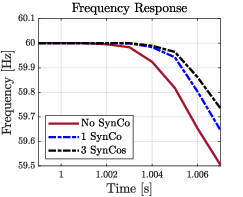
Figure 2: Frequency stability for three cases with all GFL-IBRs, demonstrating the inability of SynCos to maintain grid-forming capability after auxiliary generator removal.
Grid Strength Enhancement and Parametric Sensitivity
Transitioning to a configuration with one SG and two GFL-IBRs exposes endemic oscillatory instabilities following short-circuit disturbances. Inclusion of SynCos at GFL buses incrementally dampens these oscillations; however, only increasing SynCo capacity, rather than inertia alone, decisively stabilizes the system, providing evidence that phase angle instability was the dominant factor, not lack of inertial energy.
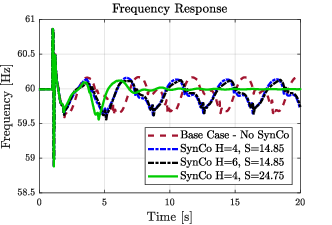
Figure 3: Frequency response for four cases showing dynamic improvements with increasing SynCo rating.
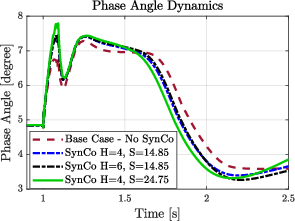
Figure 4: Phase angle fast dynamics for four cases, indicating capacity-driven mitigation of instability.
Active and reactive power flow traces reveal that higher-capacity SynCos supply greater short-circuit and dynamic support, directly alleviating stress on the remaining SG.
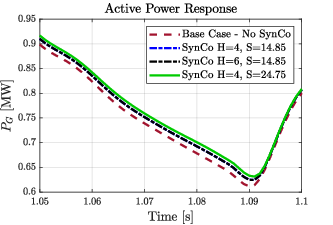
Figure 5: Active power transient response of the synchronous generator during fault, with reduced burden in high-capacity SynCo cases.
Inertia and RX Ratio Effects
Reducing the SG's inertia recapitulates instability, now dominated by frequency deviation; increasing SynCo inertia restores stability, confirming that inertia contributions are context-dependent and target frequency stability more than angular stability.
Varying SynCo subtransient reactance (RX) modifies the nature and severity of phase angle oscillations, affirming that SynCo design parameters must be tuned to local system oscillatory characteristics for effective stabilization.
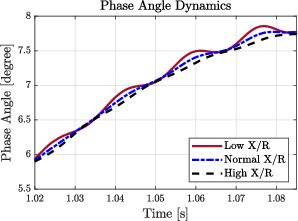
Figure 6: Phase angle fast transients for varied SynCo RX ratios, illuminating sensitivity to machine design.
(Figure 7, Figure 8)
Figures 8 and 9: Frequency responses capturing system dynamism as inertia is reduced and SynCo mitigation is applied.
Multi-SynCo Deployment and Spatial Distribution
Deploying multiple SynCos with different ratings and inertia constants reveals synergistic and antagonistic interactions. Specifically, spatial heterogeneity in SynCo size and inertia accelerates oscillation damping and ensures a more robust system restoration after large events; homogeneous deployments are less effective. Importantly, improper placement or sizing can even aggravate instability through adverse dynamic interactions.
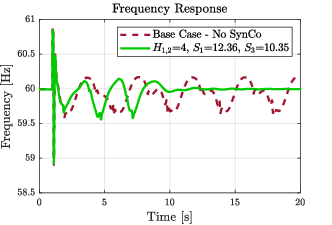
Figure 9: Frequency response demonstrating base case stabilization with two SynCos.
(Figures 11, 12, 13)
Figures 11, 12, and 13: Sensitivity analysis of frequency responses for different SynCo distributions and parameter heterogeneity in low-inertia network scenarios.
Implications for Power System Planning and Operation
The experimental and analytical findings from the study have several significant implications:
- SynCos are necessary but not sufficient for grid stability: They cannot replace the need for at least some truly grid-forming assets. Their role is strictly grid-strengthening, not grid-forming, particularly with regard to phase and frequency autonomy.
- Parameter selection and placement are critical: SynCo effectiveness depends not only on aggregate capacity and inertia, but also on detailed spatial deployment and dynamic tuning (RX, rating heterogeneity).
- GFL-IBRs rely on high-quality voltage and frequency references: SynCos indirectly facilitate GFL operation by delivering a robust reference, though they cannot establish the reference when it fundamentally fails.
- Future grids require careful co-optimization: The complex interactive dynamics between GFL-IBRs, SGs, and SynCos (possibly in large numbers) necessitate rigorous system-level planning and new optimization methodologies to avoid unintended instabilities or overly conservative investments.
Future Directions
The paper suggests open research avenues focusing on:
- Co-optimization of SynCo and grid-forming resource allocation
- Advanced spatiotemporal stability metrics and real-time control strategies for hybrid IBR-SynCo networks
- In-depth investigation of protection, black start, and restoration protocols as grid-forming resources diminish and SynCo penetration grows
Conclusion
This work rigorously establishes the delineation between grid-forming and grid-strengthening functions in IBR-rich power systems and systematically quantifies the critical value of synchronous condensers. SynCos are substantiated as essential tools for enhancing frequency stability, providing fault currents, and regulating voltage in predominantly GFL networks, but emphasized as fundamentally insufficient for grid-formation. Theoretical analyses and high-fidelity simulations converge on the necessity of prudent SynCo placement, capacity, and parameter tuning, as well as the continued deployment of grid-forming resources for robust and resilient power system operation (2604.02622).

