Wasserstein-Based Test for Empirical Measure Convergence of Dependent Sequences
Published 3 Apr 2026 in stat.AP | (2604.02700v1)
Abstract: We develop Wasserstein-based hypothesis tests for empirical-measure convergence in stationary dependent sequences. For a known candidate invariant measure $μ$, we study the statistic $T_n=\sqrt{n}\,W_1(\hatμ_n,μ)$ and establish asymptotic level-$α$ validity under the null, together with consistency under fixed alternatives. When the invariant measure is unknown, we derive the asymptotic law of the pairwise statistic $\sqrt{n}\,W_1(\hatμ_n{(i)},\hatμ_n{(j)})$ for independent trajectories and obtain a corresponding pairwise test, including Bonferroni control for multiple comparisons. Simulation experiments involving both linear and nonlinear dynamical settings illustrate both the coverage probability and the power of the tests.
The paper introduces a novel one-sample and pairwise test employing the W1 Wasserstein metric to assess empirical measure convergence in dependent sequences.
It leverages Gaussian process asymptotics to establish accurate level control and high power, even when invariant measures are unknown.
Simulation studies on MA, ARMA, and double-pendulum systems validate the method's robustness and practical relevance for ergodic dynamics.
Wasserstein-Based Testing for Empirical Measure Convergence in Dependent Sequences
Motivation and Theoretical Foundations
The paper "Wasserstein-Based Test for Empirical Measure Convergence of Dependent Sequences" (2604.02700) revolves around statistical testing for convergence of empirical measures generated by stationary dependent sequences. At the core, it addresses the foundational problem: given a trajectory from a stochastic process, does its empirical measure converge to a designated invariant distribution? The proposed methods depart from traditional metrics such as Kolmogorov-Smirnov, favoring the W1 Wasserstein metric due to its superior sensitivity to aggregate mass displacement in the state space—critical when evaluating steady-state properties or convergence in systems with spatial or geometric structure.
The authors leverage advanced limit theorems for Wasserstein distances in the dependent regime, building on Gaussian-process asymptotics articulated in prior works for α-mixing sequences. These asymptotics allow for hypothesis testing both when the invariant measure is known and, importantly, when it is unknown—achieved by comparing empirical measures across pairs of trajectories.
One-Sample Test for Known Invariant Measures
The first major contribution is a one-sample hypothesis test. For a stationary ergodic process with invariant measure μ, the test statistic is
Tn=nW1(μ^n,μ).
Under mild assumptions (including finite first moments), Tn admits an asymptotic distribution determined by the integral of a Gaussian process, providing level-α validity under the null and consistency under fixed alternatives. The test is operationalized by rejecting H0 when Tn exceeds the (1−α) quantile of the limiting distribution. Strong theoretical guarantees are substantiated: asymptotically, the acceptance probability converges to 1−α, and, under alternatives, the power approaches 1.
Pairwise Testing in Unknown Invariant Scenarios
Frequently, analytic forms of α0 are inaccessible, motivating the study of convergence using pairwise statistics. The authors rigorously extend asymptotic results to the distribution of the pairwise Wasserstein distance:
α1
where α2 and α3 are independent Gaussian processes with covariance structure induced by the sequences. This enables a pairwise test with quantile-based rejection, while maintaining strong asymptotic control over both coverage and power.
Multiple testing is addressed using a Bonferroni correction across pairs, maintaining familywise error rate at the pre-specified level.
Simulation Results: Numerical Validation
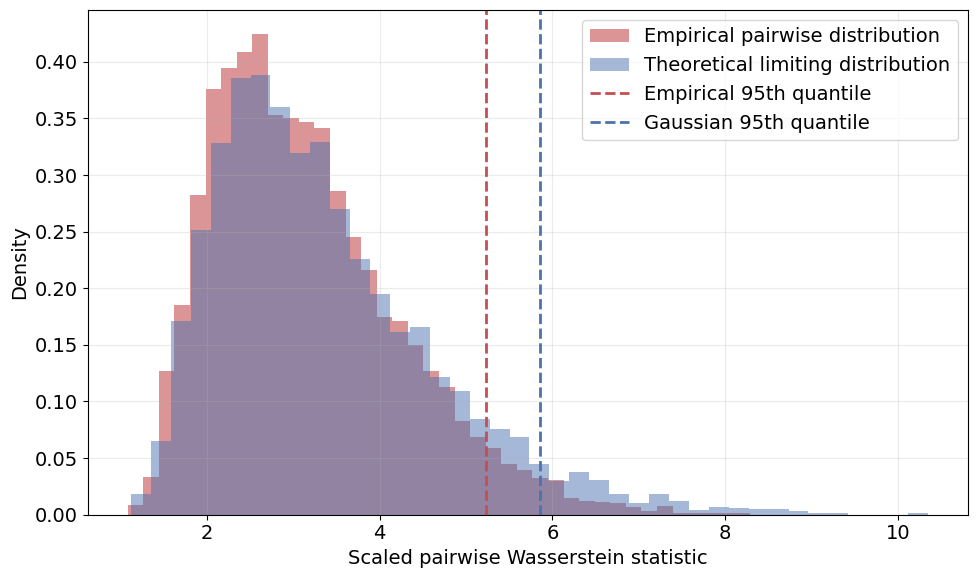
The effectiveness and calibration of the proposed tests are demonstrated via simulation studies in both linear and nonlinear dynamical systems. The first experiment utilizes a stationary MA(3) process with known finite-lag covariance. Under the convergent setting (trajectories generated with common mean), the empirical distribution of the pairwise statistics closely matches the theoretical Gaussian limit, especially at upper quantiles relevant for hypothesis testing.
Figure 1: Comparison of the distribution of the scaled empirical Wasserstein statistics α4 under both null and alternative cases for an MA(3) sequence.
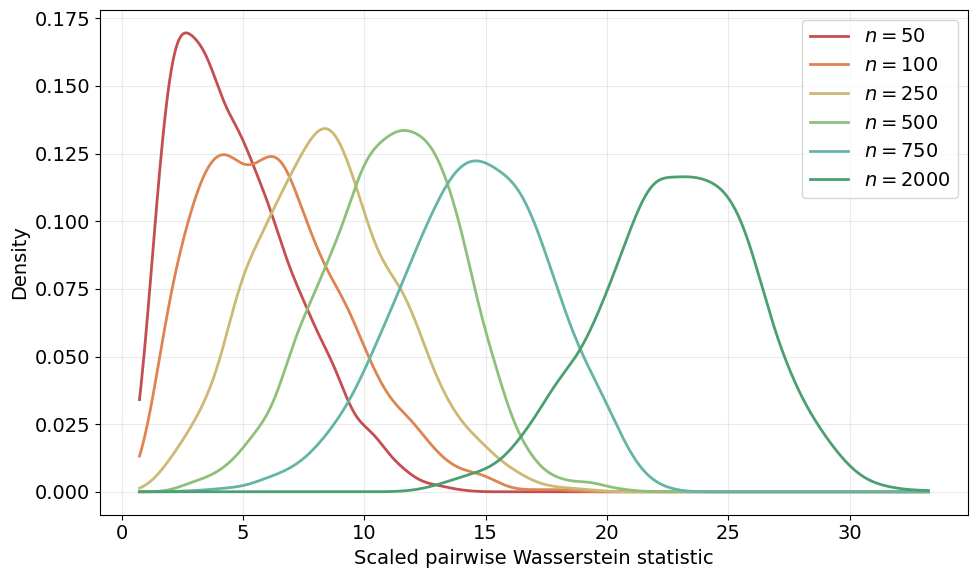
Under a divergent scenario (trajectories from groups with different means), there is rapid and substantial rightward drift in the distribution of α5, yielding empirical power of up to α6 at α7 for α8 (see Table 1 in the original text). This confirms consistency and illustrates the sensitivity of Wasserstein-based statistics to global distributional differences.
A second experiment addresses an ARMA(5,3) process with infinite covariance structure. The autocovariances are computed exactly and used to simulate the theoretical covariance kernel, avoiding empirical estimation. The results again reinforce the accuracy of asymptotic approximations in settings where the dependence structure is well-specified.
A third simulation considers the double-pendulum system, where the invariant measure and covariance kernel are unknown and must be empirically estimated. Ensembles are generated at fixed energy levels, and pairwise Wasserstein tests are performed across observables (angles and velocities). The results show conservative behavior (empirical quantiles below asymptotic quantiles in convergent cases) and pronounced multimodality in divergent cases, particularly for velocity observables at higher energy levels.
Figure 2: A kernel-density estimate of the sampling distributions of α9 in the divergent MA(3) setting, showing rightward drift as μ0 increases.
Practical Implications and Theoretical Impact
The methodological contributions facilitate model validation for systems where i.i.d. assumptions are violated, such as ergodic dynamics, time series models, and high-dimensional physical systems. The pairwise Wasserstein approach is particularly advantageous for simulated trajectories, where invariant distributions are unknown or analytically intractable. The tests' strong power and coverage properties persist even under moderate sample sizes, provided the covariance structure is accurately specified or well-estimated.
Finite-sample distortions, especially when covariance must be estimated, emphasize the necessity for advanced long-run covariance estimation techniques. The empirical evidence directs future research toward improved estimators that ensure validity of asymptotic limit rates. The framework is extensible to multi-trajectory ensembles, with rigorous multiple-testing correction available.
Conclusion
The paper advances the statistical theory and practice of empirical measure convergence testing for dependent sequences via Wasserstein metrics. By establishing rigorous asymptotic control for both one-sample and pairwise settings, and demonstrating robust numerical performance, it provides a principled toolkit for long-run validation of dynamical systems. Accurate specification or estimation of covariance structure is critical for performance; further developments in estimator theory will enhance application in complex, high-dimensional settings.