- The paper establishes that phonon MAM offers a symmetry-protected channel for converting angular momentum between electrons and phonons.
- A second-order Schrieffer–Wolff transformation is used to derive effective Hamiltonian corrections, resulting in observable k-dependent band splitting.
- The findings suggest that terahertz-driven phonon excitations can tune electronic orbital magnetism and chiral transport in helical materials.
Effective Electron Coupling to Phonon Mechanical Angular Momentum in Helical Systems
Introduction
This paper investigates the interplay between electronic and phononic degrees of freedom in chiral crystal environments, specifically focusing on electron–phonon coupling mechanisms intrinsic to systems with screw-rotational (helical) symmetry (2604.02716). It formalizes the concept of mechanical angular momentum (MAM) of phonons—distinct from previously studied crystal angular momentum (CAM)—and establishes a direct, symmetry-protected pathway for the interconversion between electronic and phononic angular momentum. Through a rigorous perturbative approach, the work demonstrates how phonon MAM, associated with atomic circular displacements, crucially influences electronic dynamics, extending the theoretical foundation for understanding angular momentum transfer processes in chiral condensed matter systems.
Theoretical Framework and Model
The analysis is anchored in a microscopic model of a single helical atomic chain, exemplified by chiral tellurium with space group P3121. The model explicitly incorporates both electronic and phononic degrees of freedom, each expressed in a symmetry-adapted basis labeled by wavenumber k and CAM m. The crucial technical advance is the construction of an electron–phonon coupling Hamiltonian that, unlike conventional translation-invariant approaches, retains both longitudinal and transverse phonon modes due to the explicit enforcement of screw-rotational symmetry. This allows phonons with nonzero angular momentum (axial phonons) to participate in electron–phonon coupling.
Importantly, the phononic Hamiltonian considers mechanical angular momentum arising from transverse atomic displacements—capturing "phonon spin"—which is characterized by a vector proportional to v−Γ×vΓ, where vΓ is the phonon eigenvector.
A second-order Schrieffer–Wolff (SW) transformation is performed to analytically derive the leading corrections to the electronic effective Hamiltonian due to electron–phonon interactions. The resulting second-order term encompasses both symmetric and antisymmetric (MAM-proportional) parts of the phonon polarization tensor. The critical insight is that the antisymmetric contribution, which is proportional to the phonon MAM, produces a term of the form:
LΓ=−2iℏv−Γ×vΓ,
directly coupling electronic transitions to the mechanical angular momentum carried by phononic excitations.
The mean-field treatment of phonon operators under the assumption of large ionic mass reduces the problem to evaluating thermal expectation values, revealing that only diagonal (in symmetry labels) components survive, systematically incorporating both equilibrium and thermally-excited phonon states.
Numerical Band Structure Effects
Direct computation of electronic band dispersions, using parameters relevant for chiral tellurium and incorporating only nearest-neighbor p-orbital overlap, illustrates the profound impact of the MAM-mediated electron–phonon coupling. The electronic bands, originally degenerate at symmetry-imposed momenta, experience a splitting and reshaping upon inclusion of the new coupling terms, particularly near resonance regions where electronic band splittings match phonon energies.
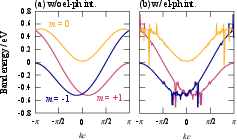
Figure 1: Electronic energy bands (a) without and (b) with the electron–phonon interaction, respectively, highlighting the modification of band structure by the inclusion of phonon MAM effects.
The figure demonstrates that inclusion of electron–phonon interaction—specifically the MAM channel—leads to k-dependent band shifts and splittings inaccessible to traditional models that neglect the transverse, angular-momentum-carrying phonon components.
Resonance Regimes and Angular Momentum Interconversion
For electronic states in resonance with phonon modes (Eγμ,γ−Γμ′≃±ℏωΓ), the SW expansion becomes insufficient. In these regimes, strong electron–phonon hybridization occurs, and eigenstates become mixed electron–phonon character with energy splitting dependent on the MAM magnitude. This regime predicts efficient and potentially tunable interconversion between phononic and electronic angular momentum, mediated by the axial phonons.
Implications for Electronic Orbital Angular Momentum
The formalism directly connects to the modification of the electronic orbital angular momentum (OAM), essential for orbital Hall effects and chirality-induced phenomena. Analytical expressions show that the inclusion of MAM-coupled electron–phonon terms alters intersite electronic hopping matrices and thus modulates the OAM expectation values. The mechanism suggests experimental signatures accessible via modulation of OAM by targeted circularly-polarized phonon excitation in the terahertz regime.
Implications and Prospective Directions
The findings have broad implications for the microscopic understanding and control of angular momentum in chiral materials. The explicit demonstration that MAM, not merely CAM, couples to electronic states identifies new channels for angular momentum transfer, essential for phenomena like chirality-induced spin selectivity and the phonon-mediated modification of orbital or spin polarizations. Practically, this suggests that terahertz or optical manipulation of phonon angular momentum can be harnessed to control electronic angular momentum and associated responses, including magnetoelectric and spintronic functionalities in chiral conductors and semiconductors.
On the theoretical side, the symmetry-grounded formalism provides a template for extending these results to multi-helix chiral systems, low-symmetry molecules, and heterostructures, while higher-order perturbative and nonperturbative expansions will be essential near resonance and strong-coupling regimes.
Conclusion
This work establishes, within a rigorous symmetry and microscopic framework, the foundational role of phonon mechanical angular momentum in mediating electron–phonon interactions in chiral, helical systems. The direct consequence is a previously underappreciated avenue for angular momentum interconversion between vibrational and electronic sectors, with calculable and potentially controllable consequences for electronic structure, orbital magnetism, and chiral transport phenomena. Future developments will focus on generalizing to broader classes of chiral systems and exploring experimental detection and control of these effects, with immediate relevance for ultrafast and optically-driven quantum materials science.

