- The paper presents a novel DR-EKF that unifies noise model uncertainty and linearization residuals by leveraging Wasserstein ambiguity.
- It reformulates state estimation as a convex SDP, enabling recursive robust gain updates and providing deterministic MSE certificates.
- Empirical evaluations demonstrate significantly reduced MSE and collision rates in navigation tasks under high nonlinearities.
Residual-Aware Distributionally Robust EKF: Absorbing Linearization Mismatch via Wasserstein Ambiguity
Introduction and Motivation
The extended Kalman filter (EKF) is the dominant state estimation mechanism for nonlinear stochastic dynamical systems due to its recursive structure and computational tractability. However, EKF's performance deteriorates significantly under model mismatch—particularly when (1) the noise distribution is misspecified and (2) linearization (Taylor expansion) error accumulates. These two rich sources of estimation error have traditionally been treated separately. The work "Residual-Aware Distributionally Robust EKF: Absorbing Linearization Mismatch via Wasserstein Ambiguity" (2604.02749) proposes a unified treatment by casting both noise-model uncertainty and linearization residuals within a Wasserstein-based distributionally robust state estimation (DRSE) framework.
The core technical innovation is the reinterpretation of Taylor linearization residuals as an effective source of uncertainty: these local nonlinear errors are absorbed into a stagewise Wasserstein ambiguity set, so that EKF robustness can be certified jointly with respect to distributional noise mismatch and to the nonlinearity-induced error. The result is a DR-EKF retaining an efficient recursive structure and provable mean squared error (MSE) certificates, all derived from a tractable semidefinite programming (SDP) reformulation.
Unified Distributionally Robust EKF via Wasserstein Balls
The paper recasts the stagewise minimum mean-squared error (MMSE) estimation problem for nonlinear stochastic systems, given noisy observations and unknown noise distributions, into a minimax optimization over a Wasserstein ball of noise distributions. The ambiguity set Dϵ,t(θt) at stage t is defined as all distributions within radius θt (in the W2-Wasserstein metric) centered at a nominal Gaussian noise model, with block-diagonal covariance reflecting state and measurement noise independence at the nominal level. Critically, this ambiguity set is then inflated to cover the additional uncertainty induced by local linearization (Taylor) errors.
At each recursion, the nonlinear system is locally approximated by an affine surrogate, yielding linear-like prediction and innovation equations perturbed by residual nonlinearities rtf, rth. These are upper-bounded in L2 norm using local Jacobian/Lipschitz constants, allowing deterministic control over the corresponding expansion of the Wasserstein radius.
The estimation becomes a robust MMSE problem over all distributions within the inflated ambiguity set. This minimax problem admits a tractable equivalence to a convex SDP with decision variables the prior and posterior covariances, noise covariance matrices, and cross-terms. The solution supplies not only robustified EKF gains and posterior means/covariances but also (via dual certificates) upper bounds on the true nonlinear system's estimation MSE in closed form.
Recursive Residual-Aware Certificate and Algorithm
A technical challenge is the mutual coupling of the residual bounds and error certificate: the Wasserstein inflation required for the linearization error depends on the estimation error itself. The authors resolve this with a deterministic recursive envelope, upper-bounding posterior MSE by propagating tight surrogate MSE trajectories coupled to the residual inflation terms.
The residual-aware DR-EKF thus admits deterministic stagewise certificates on both prior and posterior MSE. Key components include:
- Explicit computation of the Wasserstein radius inflation terms using local Lipschitz constants and surrogate MSE envelopes.
- A recursive algorithm alternating between innovation gain update (via SDP), posterior state/covariance update, and deterministic prior/posterior propagation.
- Fully explicit deterministic bounds for the effective uncertainty at every time step, covering both misspecified noise and accumulation of Taylor nonlinearities.
The approach maintains the recursive computational-paradigm of EKF, with the only addition being tractable SDPs for the robust gain updates, and determination of the inflation coefficients based on (possibly conservative) local curvature constants.
Empirical Evaluation: Robustness and Safety
Coordinated-Turn Radar Tracking
The method is tested on a classical coordinated-turn target tracking problem (planar position, velocity, and turn rate; nonlinear but exactly known dynamics) under deliberate covariance misspecification. Comparison is made between the standard EKF (using nominal covariance), and the proposed DR-EKF (using the inflated ambiguity set and robust update).
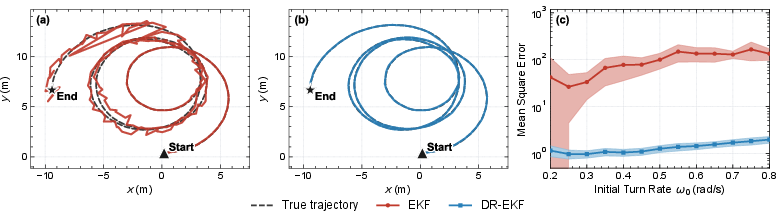
Figure 1: Coordinated-turn experiment under nominal covariance misspecification, showing (a) EKF and (b) DR-EKF trajectories, and (c) average MSE versus initial turn rate, where increased ∣ω0∣ amplifies nonlinearity-induced errors.
Results demonstrate that the DR-EKF significantly reduces average state estimation MSE relative to the standard EKF, with improvements becoming more pronounced as the initial turn rate ∣ω0∣—and hence nonlinearity— increases. The figure illustrates both individual trajectory closeness and MSE robustness, with the DR-EKF maintaining stability even when standard EKF diverges as nonlinearity dominates.
Obstacle-Avoiding Navigation via Uncertainty-Aware MPC
The practical impact of improved posterior covariance is tested in a goal-oriented navigation problem where a unicycle robot must avoid a static obstacle. The downstream controller is an uncertainty-aware model predictive controller (MPC) which sets adaptive safety margins proportional to the filter's posterior covariance.
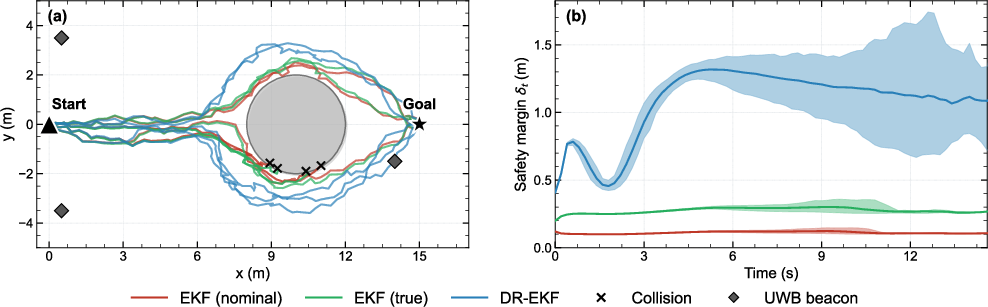
Figure 2: Closed-loop navigation under uncertainty-aware MPC: (a) representative trajectories (collisions marked as crosses), (b) time evolution of the safety margin δt.
Empirical results show that the DR-EKF reduces collision rates dramatically (from 77% for nominal EKF to 1%) by better anticipating estimation errors, resulting in a more informative and responsive safety margin. Posterior covariance tracks system state uncertainty more tightly under misspecification and nonlinearity, resulting in improved safety.
Crowd-Aware Navigation with Pedestrian Prediction
The framework is further validated in a complex scenario— navigation of a robot in crowd scenes (ETH/UCY ZARA02 dataset), with pedestrian motion prediction and uncertainty-aware MPC for both static and dynamic (pedestrian) obstacle avoidance.

Figure 3: Closed-loop navigation under uncertainty-aware MPC with pedestrian prediction. (a) shows multiple trajectories and collision events; (b) shows the evolution of the adaptive safety margin.
The DR-EKF achieves a 34% reduction in collision rate relative to both nominal and true-parameter EKFs in the presence of state-dependent nonlinearities and multi-modal future uncertainties. The robust filter's uncertainty inflation yields more conservative and accurate covariance, directly improving safety for navigation in shared human-robot environments.
Implications and Prospective Developments
Strong technical results include (1) a theoretically justified deterministic upper bound on the true nonlinear state estimation MSE and (2) empirical reductions in collision rates (from 77% and 43% to 1% in navigation, and from 100% to 66% in dynamic scenes) under realistic misspecification and challenging nonlinearities.
The approach unifies several threads in robust estimation, connecting distributionally robust optimization via optimal transport–Wasserstein ambiguity [NEURIPS_DRKF, (Jang et al., 6 Dec 2025)] to the nonlinear state estimation literature, and offering explicit safety and performance guarantees under both statistical and parametric uncertainty.
Long-term, these techniques are likely to impact:
- Safe AI systems: Distributionally robust filtering supporting safety-critical perception (autonomy, robotics) by providing quantitative safety margins tied directly to estimation uncertainty.
- Resource-efficient robust estimation: Recursive SDP-based formulations are computationally tractable and suitable for real-time deployment in embedded systems.
- Reinforcement learning and stochastic control: The approach can be combined with data-driven ambiguity-set calibration, and provides a path forward for robustification of nonlinear observers used in partially observable or adaptive RL [e.g., (Jang et al., 6 Dec 2025, Kargin et al., 2024)].
Future work suggested by the authors includes further tightening of certificates (less conservative inflations) and extension to hardware validation, potentially leveraging recent advances in sample-efficient ambiguity calibration and scalable robust optimization solvers.
Conclusion
This work establishes a mathematically rigorous framework for absorbing both noise-model and nonlinear approximation errors into a single stagewise distributionally robust filter architecture. The result is a tractable, certifiable, and adaptive robust EKF solution with demonstrable gains in accuracy and operational safety (2604.02749). The techniques and analysis create new opportunities for robust, safe state estimation in nonlinear, misspecified, and multi-agent dynamical systems.