- The paper introduces a covariant manifold surgery approach that isolates gravitational singularities via matching spacetimes at matter horizons.
- It derives an effective stress-energy tensor incorporating geometric backreaction, which naturally leads to flat rotation curves in galaxies.
- Numerical analyses confirm that the backreaction term mimics MOND-like behavior, offering a scale-bridging framework within the context of General Relativity.
Spacetime Backreaction as a Source of Flat Rotation Curves
Motivation and Context
Modeling the nonlinear clustering of matter in the universe within General Relativity (GR) is fundamentally handicapped by the standard point-particle approximation (PPA), which leads to propagation on fixed background spacetimes and is known to introduce spacetime singularities. While cosmological N-body simulations and effective field theory approaches are successful on large or quasi-linear scales, they remain unable to properly account for post-caustic, strongly nonlinear regimes. This work introduces a first-principle, covariant approach that isolates gravitational singularities via manifold "surgery" anchored in the matter horizon concept. It constructs a covariant backreaction term from spacetime boundary contributions, which, when included in the effective stress-energy tensor, naturally yields flat galaxy rotation curves without invoking dark matter particles (2604.02775).
Breakdown of the Point-Particle Approximation and Emergence of Matter Horizons
The PPA—modeling matter as worldline-localized Dirac masses—breaks down when the characteristic scales of clustering approach the sizes of physical substructures, leading to caustic formation and the ill-definition of standard geodesic propagation. The key insight leveraged is that before caustics form, geodesic expansion Θ vanishes, which defines a spacetime or "matter" horizon at proper time τ⋆ and spatial radius R⋆ where the region locally ceases to participate in the Hubble flow.
The standard geodesic deviation equation and its covariant irreducible decomposition show that, due to shear and energy conditions, the volume element for a bundle of geodesics (i.e., the determinant of the Jacobi map) inevitably decreases to zero—signaling the need for a non-perturbative extension beyond the PPA.
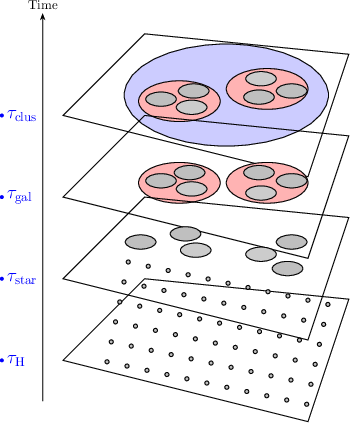
Figure 1: Hierarchical sequence of nested sub-regions and timescales, illustrating clusters, galaxies, and stars evolving on distinct characteristic dynamical timescales.
Manifold Surgery: Matching Spacetimes at Matter Horizons
To regularize the dynamical evolution past matter horizons, the paper employs a technique analogous to matched asymptotic expansions at the level of the action, using covariant manifold surgery. Specifically, two distinct spacetime regions—interior (M−) and exterior (M+) to the matter horizon defined by R⋆—are glued along this shared boundary by a discrete transformation. The induced metrics and extrinsic geometry on either side are related by conformal transformations.
The variational principle (including Gibbons-Hawking-York terms and Hayward corner contributions) is used to derive the piecewise Einstein equations and the resulting effective energy-momentum tensor, which possesses additional backreaction terms entirely determined by the geometry of the boundary and the extrinsic curvature.
Covariant Backreaction and Its Structure
The effective energy-momentum tensor after boundary regularization decomposes as: τab±≈ℓ∑[ρmℓu±ℓau±ℓb+δ(R(x±)−Rℓ⋆)Z~ℓab±]
where Z~ab± encapsulates geometric backreaction contributions expressible in terms of the boundary extrinsic curvature and its cross-terms. Written as a fluid, this leads to emergent effective density, pressure, energy flux, and anisotropic stress terms.
The backreaction density and pressure admit the concise form: ρ~±=κ1u±au±bσ~⟨ab⟩,P~±=31ρ~±
which, upon spatial averaging, yields the "fluid" effective matter content at a chosen resolution scale.
Implications for Rotation Curves and the "Dark Matter" Phenomenology
Specializing to spherical symmetry and galaxies on the Θ0-hypersurface, the modified Euler equation integrates the covariant backreaction into the rotation velocity formula: Θ1
Here, Θ2 is the Newtonian potential sourced by baryons, while Θ3 solves a nonlocal, integro-differential equation determined by the backreaction density. Functions Θ4 and Θ5 encode the subdominant corrections from velocity dispersion and bias.
The authors demonstrate numerically that this additional (purely geometric) term in the gravitational potential generically generates flat or even slowly rising rotation curves in the outskirts of galaxies, closely resembling the observed diversity in dwarf and massive spirals. The result is robust with respect to baryonic density profiles (e.g., Hernquist vs. NFW), and through the variation of the matter horizon scale (Θ6) and velocity dispersion parameters, the model spans the full range of observed rotation curve morphologies.
The resultant net gravitational acceleration displays a functional form reminiscent of MOND, with the backreaction acting as an "apparent" dark matter component determined fully within GR.
Theoretical and Practical Implications
This framework substantiates that the emergent "dark" matter effect on galactic and sub-galactic scales can be understood as a spacetime backreaction phenomenon—a direct physical consequence of enforcing regularity on finite-resolution domains in GR, rather than as evidence for new forms of non-baryonic matter. The hierarchical, multi-scale prescription also allows consistent embeddings of galaxy-scale regularization within larger, cluster or cosmological scales, potentially providing a covariant, scale-bridging modeling framework for structure formation.
Furthermore, the formulation is general enough to incorporate anisotropy, vorticity, and dissipation (e.g., via bulk and shear viscosities), and thus could offer a fertile ground for studying the statistical and thermodynamic properties of cosmic structures from first principles.
Directions for Future Research
Open questions include the precise calibration of the matter horizon Θ7 for various galaxy types and evolutionary histories, the extension to fully general density and velocity fields beyond spherical symmetry, and systematic comparison with high precision, spatially resolved rotation curve data. The approach can, in principle, be generalized to relativistic simulations of cluster mergers, cosmic web filaments, and virialization processes.
Beyond direct astrophysical interpretation, the variational regularization at substructure boundaries may inspire new numerical cosmological methods circumventing singular behavior in collisionless matter codes.
Conclusion
The paper provides a rigorous, variationally well-posed framework for incorporating the finite, discrete, and hierarchical nature of real cosmic structure within GR. The geometric backreaction sourced by spacetime boundaries at matter horizons constitutes an effective energy-momentum component that, without additional fields or exotic particles, accounts for the flattening of rotation curves. This multiscale prescription challenges the necessity of explaining galactic dynamics with particulate dark matter and has significant implications for both numerical cosmology and the theoretical interpretation of gravitational clustering (2604.02775).