- The paper demonstrates successive phase transitions from a quasi-antiferroelectric to a long-range antiferroelectric state, followed by antiferromagnetic order at 30 K using detailed NMR spectroscopy.
- It employs angle-dependent NMR shift analysis and relaxation dynamics to quantify hyperfine couplings, exchange interactions, and critical exponents, aligning with 3D Heisenberg universality.
- The study reveals how local symmetry breaking due to Cu ion displacements creates inequivalent P sites, serving as a diagnostic tool for probing spin-lattice coupling in van der Waals magnets.
Microscopic NMR Evidence for Successive Antiferroelectric and Antiferromagnetic Orders in CuCrP2S6
Structural Overview and Phase Sequence
CuCrP2S6, a member of the quasi-2D van der Waals thiophosphate family (T2P2S6), exhibits intricate structural and magnetic ordering phenomena closely coupled via charge, lattice, and spin degrees of freedom. The crystal structure is characterized by Cr3+ ions forming a two-dimensional triangular magnetic lattice within a network of [P2S6]60 units, and Cu61 ions situated in distorted sulfur octahedra. At room temperature, the system is in a monoclinic 62 space group with Cu ions distributed over partially occupied sites. On cooling, this system undergoes a sequence of transitions: from a high-temperature paraelectric phase to a quasi-antiferroelectric (QAFE) regime near 185 K, followed by a long-range antiferroelectric (AFE) state below 150 K, and finally antiferromagnetic (AFM) order on the Cr63 sublattice below 64 K.
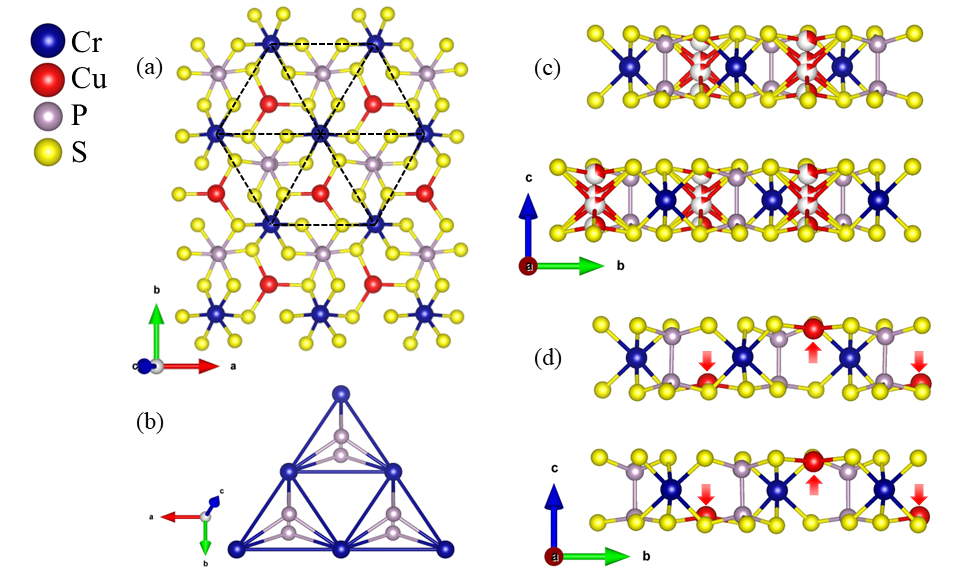
Figure 1: Crystal structure of CuCrP65S66 revealing Cr67 triangular lattices, P--P dimers, alternately displaced Cu ions, and quasi-2D stacking.
The low-temperature AFE phase is defined by antipolar ordering of Cu68 ions that occupy alternating up- and down-displaced positions along 69, resulting in cancellation of macroscopic polarization but distinctly inequivalent local environments. The transition to AFM order manifests as ferromagnetic alignment within 20-planes and antiferromagnetic stacking along the 21-axis, forming an A-type structure validated via neutron diffraction and thermodynamic measurements.
NMR Spectroscopy Across Structural and Magnetic Transitions
Comprehensive 22P and 23Cu NMR measurements provide microscopic resolution of these phase transitions. In the high-temperature phase, 24P NMR spectra show a single sharp resonance, confirming crystallographic equivalence of P atoms and the absence of detectable Pake doublet due to broad magnetic linewidths. Angle-dependent measurements of the NMR shift at room temperature reveal moderate anisotropy and nonzero asymmetry parameter (25), indicating deviation from uniaxial symmetry compared to other thiophosphates.
Upon cooling, spectra evolve significantly: below 26180 K (QAFE regime), line broadening and asymmetry signal loss of local symmetry and precursor fluctuations of Cu displacements. Below 27 K, two distinct 28P resonance lines emerge, evidencing two inequivalent P sites due to symmetry breaking. The progressive growth of line splitting, normalized by the susceptibility, delineates the order parameter evolution associated with the AFE transition and confirms the first-order character.
Hyperfine Coupling and Shift Analysis
NMR shift 29 tracks local spin susceptibility and its evolution through structural transitions. Above 60, 61 and bulk susceptibility 62 are linearly proportional; below 63, two shifts (64 and 65) reflect site-specific hyperfine field variations.
Shift versus susceptibility (66--67) analysis yields nearly isotropic transferred hyperfine coupling constants for both principal field orientations (68~T/69, T20~T/T21). The orbital shift T22 remains nearly identical for both sites, signifying that electronic environments of P atoms are unaltered by structural transition. The NMR shift anisotropy arises primarily from the dipolar hyperfine contribution, a stark contrast to MnT23PT24ST25 and NiT26PT27ST28 which exhibit stronger, more anisotropic transferred couplings due to distinct electronic configurations and bonding pathways.
Relaxation Dynamics and Criticality
Spin-lattice (T29) and spin-spin (20) relaxation rates are direct probes of local magnetic fluctuations and structure-dynamics correlations. At high temperatures, 21 is exchange-narrowed and nearly constant, governed by fast Cr22 spin fluctuations. Across the AFE transition, 23 splits into two rates associated with inequivalent P sites, quantitatively explained by differing hyperfine couplings, while sharing identical dynamical responses. Below 24, 25 and 26 exhibit critical divergence as the system approaches AFM order, captured by power-law fits yielding a critical exponent 27. This exponent is consistent with 3D Heisenberg universality, ruling out lower-dimensional magnetic criticality.
Spin-spin relaxation reveals oscillatory, Gaussian-modulated echo decays at high temperatures attributable to dipolar coupling in P--P dimers, which are strongly damped and ultimately replaced by pure exponential decay below the AFE transition, reflecting the freezing of dipolar fluctuations and establishment of static order.
Exchange Interactions and Theoretical Implications
Extraction of exchange constants from Curie--Weiss analysis and ESR data yields 28 K (ferromagnetic intralayer) and 29 K (antiferromagnetic interlayer) for Cr60 triangular lattices. Moriya-type calculations of 61, incorporating cross-correlation effects within the P--P dimer, account for the factor-of-two enhancement in the symmetric relaxation channel compared to single-site theory—a manifestation of coordinated local field fluctuations.
The observed nearly isotropic transferred hyperfine coupling and predominant dipolar shift anisotropy indicate unique Fermi contact interactions restricted by Cr62 63 orbital configuration and 64-bonding, in contrast to anisotropic, 65-bonding dominated systems.
Implications and Future Perspectives
The findings underscore CuCrP66S67 as a prototypical vdW magnet with intimately coupled electric-dipole and magnetic order, accessible via local probes such as NMR. The confluence of paraelectric, quasi-antiferroelectric, antiferroelectric, and antiferromagnetic phases, as well as the direct spectral and relaxation evidence for symmetry breaking and criticality, provide pivotal benchmarks for understanding multiferroic and low-dimensional magnetic systems.
Figure 1: Crystal structure of CuCrP68S69 revealing Cr3+0 triangular lattices, P–P dimers, alternately displaced Cu ions, and quasi-2D stacking.
These insights will inform future theoretical modeling of spin-lattice interactions, dimer-fluctuation physics, and electric-magnetic coupling in van der Waals materials. Practically, the NMR fingerprint across transitions offers a diagnostic paradigm for characterizing ferroic and multiferroic materials with potential applications in spintronics and magnon-based information technologies. Further investigation into monolayer or heterostructure variants may elucidate the evolution of these coupled orders at reduced dimensionality and interface-driven environments.
Conclusion
This work provides comprehensive microscopic NMR documentation of successive antiferroelectric and antiferromagnetic ordering phenomena in CuCrP3+1S3+2, resolving inequivalent P sites and quantifying hyperfine couplings, exchange constants, and critical exponents characteristic of 3D Heisenberg universality. The results establish the unique interplay of structure and magnetism in CuCrP3+3S3+4 and position NMR as an essential tool in probing coupled order parameters in layered van der Waals systems (2604.02898).