- The paper introduces the Countoscope methodology, extending equilibrium fluctuation analysis to active particle systems by deriving analytic expressions for number correlations and the intermediate scattering function.
- The paper employs a perturbative Fokker-Planck expansion and a continued fraction representation to systematically capture non-Gaussian dynamics across ABP, RTP, and AOUP models.
- The paper demonstrates how number fluctuation measurements can extract key dynamic parameters such as propulsion speed, rotational diffusion, and the Péclet number from experimental data.
The Countoscope: Analytical Number Fluctuations for Self-Propelled Particles
Introduction
The paper "The Countoscope for self-propelled particles" (2604.02907) rigorously extends number fluctuation analysis—previously limited to equilibrium diffusive systems—to quantitatively characterize the dynamics of active matter. Through the introduction of the "Countoscope" methodology, the authors systematically derive time-resolved number correlations and fluctuations for canonical non-interacting active matter models: Active Brownian Particles (ABP), Run-and-Tumble Particles (RTP), and Active Ornstein-Uhlenbeck Particles (AOUP). The approach leverages a perturbative expansion of the Fokker-Planck equation (FPE) and establishes connections to the intermediate scattering function (ISF), offering a unified analytical framework that captures all relevant dynamical regimes and non-Gaussian features of self-propelled motion.
Particle number fluctuations in virtual observation boxes, N(t), serve as sensitive measures of underlying dynamics, especially in systems where direct tracking is infeasible—such as dense active matter or biological collectives. For diffusive particles, the Smoluchowski framework links the decay of number autocorrelations to the diffusion constant, an idea revisited in this work for out-of-equilibrium (active) suspensions. The Countoscope samples particle counts across boxes of varying L to probe different dynamic length-scales, and focuses on two main statistics: the time correlation function CN(t)=⟨N(t)N(0)⟩−⟨N⟩2 and the mean squared number difference (NMSD) ⟨ΔN2(t)⟩=⟨(N(t)−N(0))2⟩.
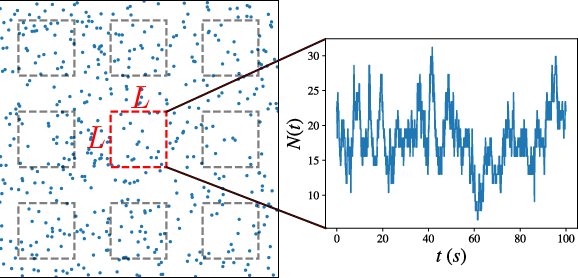
Figure 1: Illustration of the Countoscope approach, probing particle number fluctuations in virtual observation boxes for either images or simulations.
The theoretical reduction expresses CN(t) as a real-space integral over the propagator, or equivalently as a k-space weighted average of the self-ISF F(k,t), mapping the analysis of number fluctuation statistics to established methodologies in scattering theory. The approach treats the initial configuration and integrations over box placement, leading to analytic and computationally tractable expressions.
Modeling Self-Propelled Particle Dynamics
The study considers three archetypal active particle models:
- Run-and-Tumble Particles (RTP): Discrete orientation jumps at rate α with constant speed v.
- Active Brownian Particles (ABP): Continuous angular diffusion with rotational diffusion Dr and speed L0.
- Active Ornstein-Uhlenbeck Particles (AOUP): Gaussian colored noise-driven velocity dynamics parameterized by correlation time L1.
For all models, the MSD exhibits three generic regimes: short-time diffusion (L2), intermediate-time ballistic motion (L3), and long-time enhanced diffusion, with the Péclet number (L4) as the key dimensionless parameter controlling regime crossover.
AOUP: Gaussian Closure
AOUPs permit direct analytical progress via a cumulant expansion since their position PDF is Gaussian; the ISF is simply an exponential of the MSD,
L5
allowing closed-form expressions for number correlations.
ABP and RTP: Continued Fraction Representation
General non-Gaussian models require systematic treatment of orientational degrees of freedom. Here, the FPE is expanded in Fourier harmonics of the orientation angle, yielding an infinite hierarchy (the "hydrodynamic closure" or mode truncation), ultimately recast as a continued fraction for the Laplace/Fourier-space propagator. For RTPs, the continued fraction converges to an exact, analytic form:
L6
For ABPs, controlled truncation at order L7 accurately interpolates between limiting behaviors across Péclet number regimes, with higher L8 yielding enhanced accuracy.
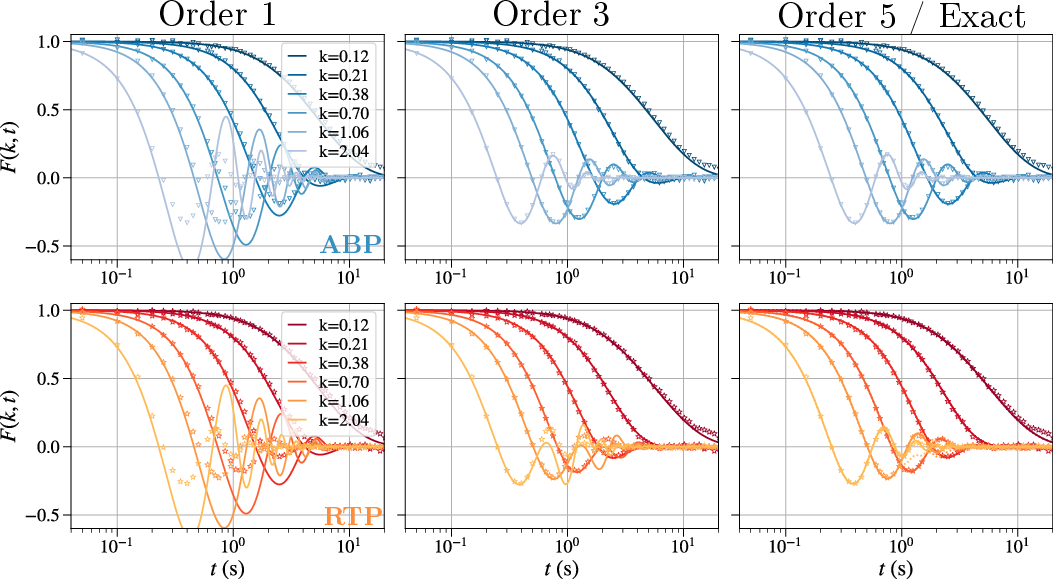
Figure 2: Intermediate Scattering Functions (ISFs) for ABP (top) and RTP (bottom) versus time, for various L9-values and truncation orders, showing oscillatory and non-monotonic features absent from Gaussian AOUP statistics.
Oscillations in the ISF, prominent for ABP and RTP at moderate-to-large CN(t)=⟨N(t)N(0)⟩−⟨N⟩20, encode persistent reorientation and are accurately captured at increasing truncation order.
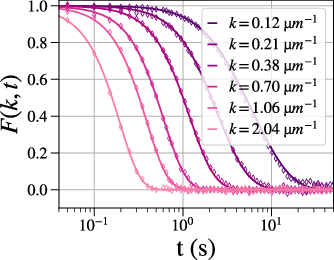
Figure 3: ISF for AOUP, showing monotonic exponential decay without oscillatory features—reflecting its Gaussian statistics.
Analytical and Numerical Results for Number Fluctuations
Number fluctuations and their correlation functions reveal clear transitions between dynamical regimes. The NMSD, CN(t)=⟨N(t)N(0)⟩−⟨N⟩21, exhibits CN(t)=⟨N(t)N(0)⟩−⟨N⟩22 growth in diffusion-dominated regimes (short and long times), ballistic scaling (CN(t)=⟨N(t)N(0)⟩−⟨N⟩23) at intermediate times (advective regime), and ultimately saturates at its equilibrium variance plateau. Explicit limiting forms are derived for both Gaussian and non-Gaussian models.
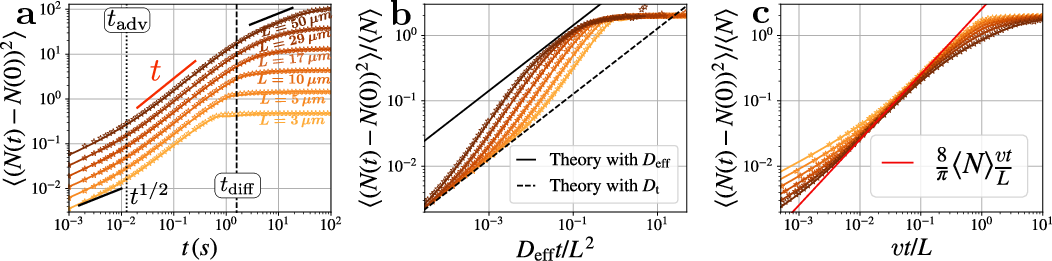
Figure 4: NMSD for RTPs as a function of lag time and box size CN(t)=⟨N(t)N(0)⟩−⟨N⟩24; multiple time/size rescalings highlight crossovers between diffusive and advective scaling regimes.
A geometric argument, leveraging propagators for deterministic (no reorientation or translational noise) motion, explicitly links the short/intermediate-time scaling of CN(t)=⟨N(t)N(0)⟩−⟨N⟩25—the probability a particle remains within the same box—to the observed advective regime prefactors. Averaging over orientations distinguishes ABP/RTP (fixed speed) versus AOUP (Rayleigh-distributed speed) statistics, accounting for the small but robust differences in ballistic-regime prefactors.
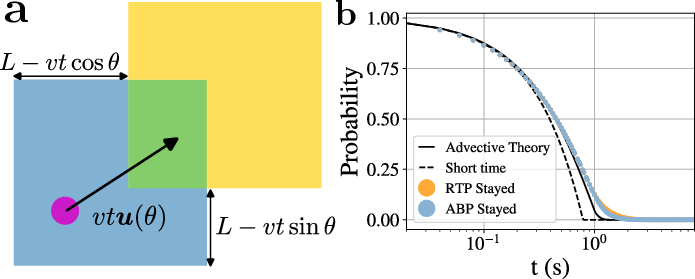
Figure 5: Analytical/numerical agreement for CN(t)=⟨N(t)N(0)⟩−⟨N⟩26, comparing simulation with geometric predictions for advective (ballistic) dynamics across models.
Péclet Number Effects and Truncation Convergence
Higher truncation order in the continued fraction is necessary for accuracy as CN(t)=⟨N(t)N(0)⟩−⟨N⟩27 increases—especially for RTPs, where abrupt orientation changes enhance non-Gaussianity. Analytical theory converges quickly for moderate CN(t)=⟨N(t)N(0)⟩−⟨N⟩28, with order CN(t)=⟨N(t)N(0)⟩−⟨N⟩29 or ⟨ΔN2(t)⟩=⟨(N(t)−N(0))2⟩0 being sufficient for most practical cases in NMSD, but higher orders or exact expressions are necessary for precision in correlation function tails and for large ⟨ΔN2(t)⟩=⟨(N(t)−N(0))2⟩1 and small boxes.
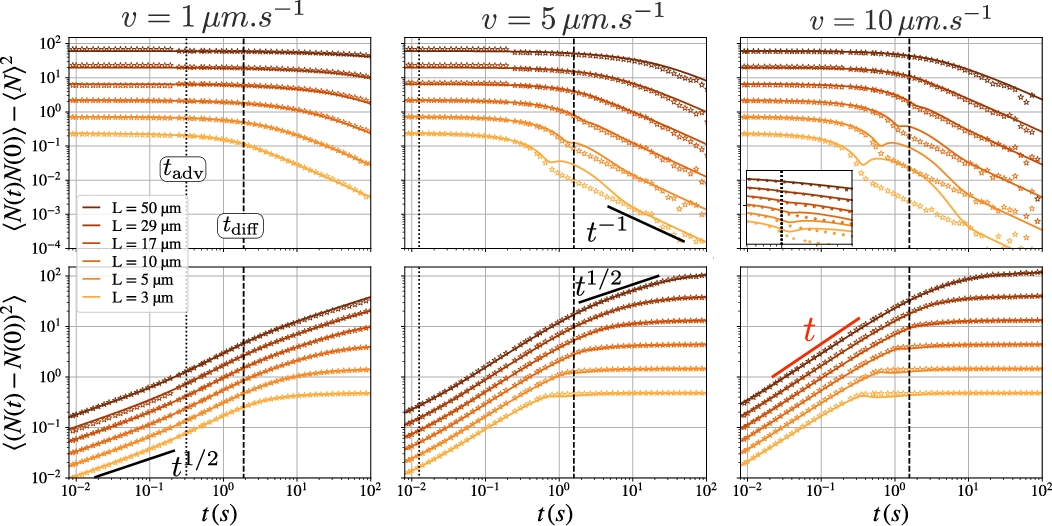
Figure 6: Number correlations ⟨ΔN2(t)⟩=⟨(N(t)−N(0))2⟩2 and NMSD for RTPs at increasing ⟨ΔN2(t)⟩=⟨(N(t)−N(0))2⟩3 (Péclet number); correspondence between theory and simulation degrades for large ⟨ΔN2(t)⟩=⟨(N(t)−N(0))2⟩4 and small ⟨ΔN2(t)⟩=⟨(N(t)−N(0))2⟩5, but recovers with higher truncation.
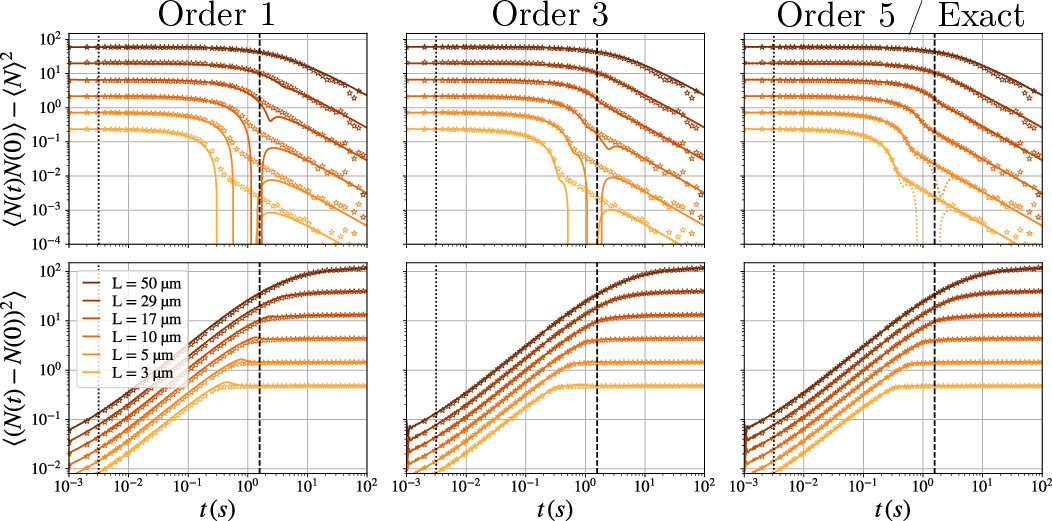
Figure 7: Comparison of theory and simulation for ⟨ΔN2(t)⟩=⟨(N(t)−N(0))2⟩6 and NMSD at truncation orders ⟨ΔN2(t)⟩=⟨(N(t)−N(0))2⟩7 (and exact), showing rapid convergence in the NMSD and the need for higher ⟨ΔN2(t)⟩=⟨(N(t)−N(0))2⟩8 for full agreement in ⟨ΔN2(t)⟩=⟨(N(t)−N(0))2⟩9.
The convergence of ballistic prefactor estimation is systematically examined, demonstrating rapid oscillatory convergence to the exact result, with numerical fits converging to within a few percent at moderate truncation.
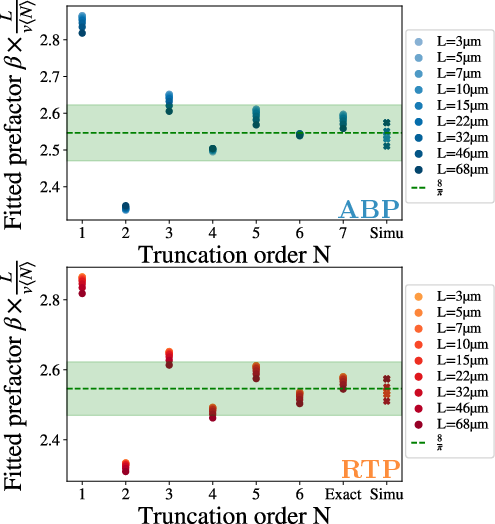
Figure 8: Fitted prefactor to ballistic regimes from truncated theory and simulation, converging to the analytic value CN(t)0 for both ABP and RTP.
Theoretical and Practical Implications
The Countoscope methodology offers a direct, robust route to extract active particle dynamical parameters from observation-window number fluctuations, including CN(t)1, CN(t)2/CN(t)3, and CN(t)4. The closed-form limiting laws and controlled truncation schemes permit efficient extraction of these parameters from experimental data, without single-particle tracking nor resorting to advanced image analysis pipelines.
Beyond practical measurement implications, the analytic treatment clarifies that:
- Oscillatory ISF and correlation signatures are direct consequences of persistent, non-Gaussian propulsion and are highly sensitive to the reorientational mechanism, providing a potential experimental fingerprint for distinguishing ABP/RTP/AOUP.
- Number fluctuations are subject to three dynamic regimes analogous to the MSD, but with distinct scaling (e.g., CN(t)5 in NMSD versus CN(t)6 in MSD for diffusion).
- While analysis is focused on non-interacting systems and 2D, the formalism is extensible in both respects: 3D generalization follows directly from the Gaussian/continued-fraction structure, and hydrodynamic field or kinetic approaches can incorporate interactions or collective effects.
- The approach bridges ISF/propagator analysis with real-space, experimentally accessible box-counting methods, making it amenable to data-rich modern microscopy and computational studies of dense active systems.
Conclusion
The analytical framework for number fluctuations in the Countoscope formalism yields deep theoretical insight and provides practical tools for dynamical parameter extraction in nonequilibrium active systems. The ISF-based expansion—culminating in exact or systematically improvable expressions for CN(t)7 and NMSD—covers all dynamic regimes and is validated across models and parameter regimes. The unification of theoretical structure, convergence analysis, and geometric/probabilistic reasoning sets a foundation for further translation to experimental contexts, including collective and interacting active matter where number fluctuation signals could probe emergent phenomena beyond single-particle dynamics.
Future work directions include extension to interacting (collective) systems, systematic experimental applications, and analysis for three-dimensional and anisotropic dynamics, as well as investigation of nontrivial correlations in high-density or phase-separated active suspensions.
References
- "The Countoscope for self-propelled particles" (2604.02907)

