- The paper’s main contribution is the development of a doubly geometric control framework that cancels both detuning and Rabi errors, achieving quartic error suppression.
- It employs a hierarchical level-n identity construction with composite pulse sequences to enforce simultaneous closure of geometric and error trajectories.
- Numerical simulations on superconducting transmons validate the approach by demonstrating robust gate fidelity under systematic and correlated noise.
Universal Robust Quantum Gates via Doubly Geometric Control
Introduction and Motivation
Geometric quantum computation (GQC) exploits the global character of geometric phases arising from closed parameter-space trajectories, offering intrinsic noise resilience essential for scalable quantum information processing. While non-adiabatic geometric quantum computation (NGQC) yields rapid, globally-defined gates, conventional proposals—especially in realistic, noisy environments—suffer from insufficient control over multi-source error accumulation. Systems subjected to various control imperfections typically see only partial or low-order error suppression, and to date no comprehensive geometric framework directly characterizing error accumulation and supporting scalable robust gate design for practical architectures has been established.
This work introduces a general analytic framework for universal doubly geometric quantum gates (UDOG), employing a hierarchical “level-n” identity construction. This systematic method directly quantifies error accumulation and eliminates significant geometric and structural constraints in prior proposals, thus enabling simultaneous high-order suppression of detuning and amplitude (Rabi) errors without reliance on model-dependent fidelity estimations.
The approach embeds target quantum operations within a parameterized family of “level-n” identity operations, each designed via composite pulse sequences. The control Hamiltonian is
Hc(t)=2Ω(t)[cosφ(t)σx+sinφ(t)σy],
where the pulse amplitude Ω(t) and driving phase φ(t) can be freely tailored. The geometric evolution tracks both the global geometric phase in the quantum trajectory and the “error curve” of accumulated noise-induced distortion in a three-dimensional Euclidean space, with errors modeled as Rabi miscalibration (scaling Hc by 1+ϵ) and stochastic detuning δσz/2.
By imposing simultaneous cyclicity in both the geometric-phase and error-curve spaces—closing trajectories in both domains—the framework enforces cancellation of leading-order errors. Specifically, control parameters are explicitly optimized such that the first-order Magnus expansion terms vanish for both error sources at the gate’s endpoint. Analytical conditions then guarantee the cancellation of accumulated control errors to quartic order in ϵ and δ, and the method is systematically extensible to higher-order error suppression (such as sixth order) by increasing the identity construction level.
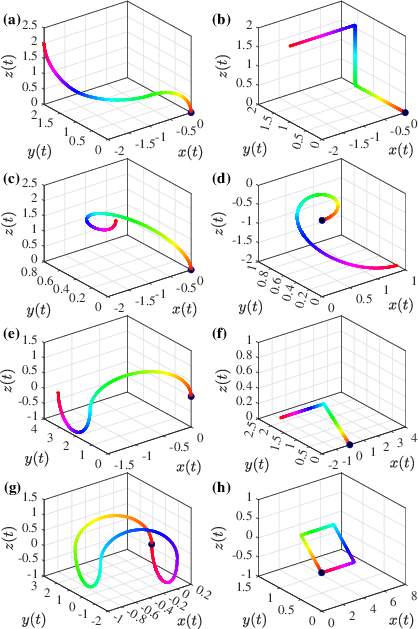
Figure 1: Comparison of S gate error curves: dynamical, non-cyclic geometric, traditional NGQC, and level-3 UDOG. Only UDOG completely closes the detuning and Rabi error curves.
Error distance n0 for error channel n1 provides a unified, geometry-compatible metric for quantifying gate robustness—rigorously relating operational fidelity to the geometric properties of the error trajectories.
Explicit Gate Construction and Analytical Robustness
The construction’s cornerstone is the “level-3 identity,” engineered as a composite of three n2 rotations with individually tunable phases. For target gates specified by geometric rotation angle and axis on the Bloch sphere, two auxiliary phase parameters are selected to enforce error-curve closure in both amplitude and detuning channels by solving a consistent set of algebraic equations in the control parameters. Notably, this construction admits arbitrary pulse shaping, supporting applicability across various physical hardware without further requirements on detuning control or pulse profile.
Strong analytical results stem from this design. The main fidelity expansion coefficients (see Table in the text) demonstrate that:
- Level-3 UDOG cancels Rabi and detuning errors to n3 in gate infidelity.
- Moving to a level-5 identity, the approach extends suppression to n4 without incurring additional systematic constraints.
Numerical results show that error curves are fully closed only for UDOG implementations, in contrast to dynamical, non-cyclic, and traditional NGQC sequences (Figure 1). This conveys the unique capability of UDOG to simultaneously nullify both error channels to high order across the full geometric control landscape.
Numerical Verification of Robustness and Physical Implementation
Comprehensive simulation data confirm the theoretical predictions. For example, the fidelity profiles of the level-3 UDOG n5 gate under systematic detuning and Rabi amplitude errors remain flat and close to unity over significant error ranges, indicating pronounced resilience. Corresponding filter function spectra reveal strong suppression of low-frequency (quasi-static, n6-type) noise, a central limitation in contemporary superconducting and spin-based qubit systems.
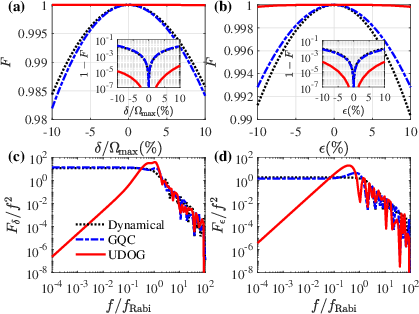
Figure 2: Gate fidelity of the level-3 S gate as a function of detuning (n7) and Rabi (n8) errors, with accompanying filter functions confirming dominance of high-order error protection.
Implementation in superconducting transmon hardware is evaluated, including not just gate robustness to local amplitude and detuning errors but also to residual n9 crosstalk—one of the key scalability bottlenecks in large multi-qubit modules. The UDOG protocol maintains high fidelity for both single-qubit and entangling gates in these simulations, and further outperforms both purely dynamic and prior geometric approaches (NGQC).
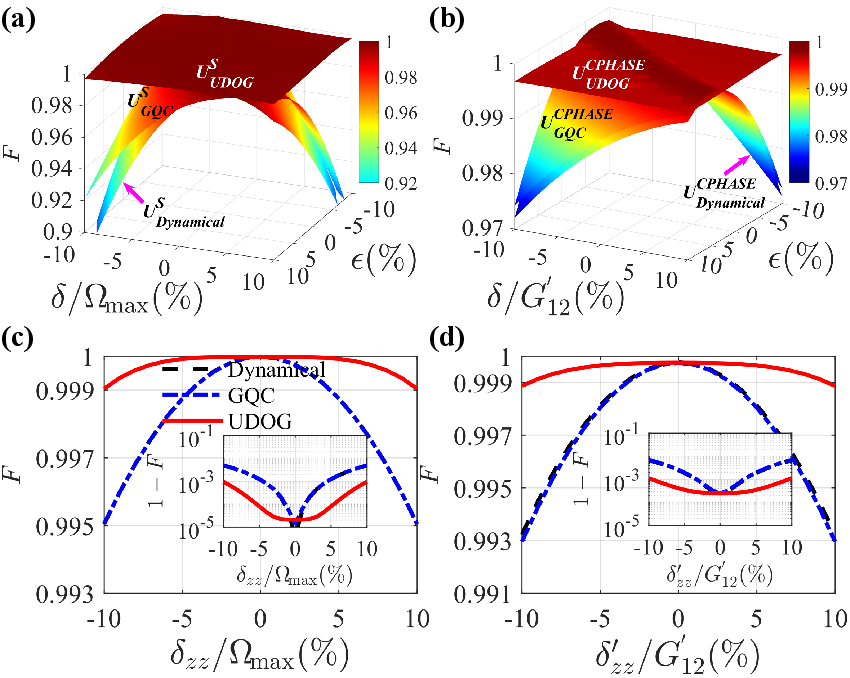
Figure 3: Gate fidelity for level-3 S and CPHASE gates (a, b) and X and iSWAP gates (c, d) with Hc(t)=2Ω(t)[cosφ(t)σx+sinφ(t)σy],0 crosstalk, demonstrating UDOG’s superior resilience.
Implications, Theoretical Significance, and Prospects
The analytic framework for UDOG exposes the geometric and algebraic underpinnings of error suppression in quantum gate design, bridging geometric control theory and practical error analysis. By systematically increasing the identity sequence level, the protocol is directly extensible—optimizing control resources for the required noise environment and hardware limitations. The approach is universal for leading quantum hardware platforms, with particular efficacy for superconducting transmons and semiconductor spin qubits where slow, correlated noise often dominates.
From a fault-tolerant quantum computation perspective, enhancing the suppression order of physical gate errors from quadratic to quartic or higher without substantial overhead yields a direct reduction in logical error rates. This is particularly relevant for scalable surface code architectures, effectively increasing the code distance at fixed resource cost and thereby enabling robust, hardware-efficient quantum error correction.
Furthermore, the geometric insight gained here can inform robust protocol design for NISQ-era applications such as quantum phase estimation, variational eigensolvers, and QAOA, where noise mitigation remains a primary challenge.
Conclusion
The paper establishes a scalable, analytic scheme for constructing universal quantum gates with simultaneous, high-order suppression of detuning and amplitude errors via doubly geometric control. The theoretical developments are strongly corroborated by numerical and hardware-level simulations, showing state-of-the-art robustness in operational fidelity across diverse error models in realistic quantum processors. This framework thus significantly advances geometric quantum control, setting a versatile foundation for robust large-scale quantum computing and algorithm development (2604.02962).