- The paper demonstrates that incorporating energy balance and water conservation yields a fourth-order vegetation PDE which robustly predicts pattern wavelength scaling with aridity.
- The model integrates gradient expansions and physically justified sign constraints to isolate key pattern-forming instabilities validated through nonlinear simulations.
- The study reveals that dryland vegetation patterns, including band migration on slopes, can be explained by precise energy and water-feedback mechanisms.
Energy-Balance-Constrained Modeling of Dryland Vegetation Patterns
Introduction and Motivation
The study presents a physically constrained framework for modeling vegetation pattern formation in semi-arid ecosystems, where periodic bands, spots, and labyrinths emerge due to feedbacks among vegetation, soil moisture, and energy balance. Prior reaction-diffusion models have relied extensively on phenomenological postulates for nonlinearities and spatial coupling, complicating the isolation of mechanism-essential features from model-dependent artifacts. This work introduces a modeling paradigm integrating energy balance and water conservation as first-principles constraints, significantly narrowing the permissible model structure before closure assumptions are invoked. The formalism yields a family of semilinear closures; an Euler–Lagrange (EL) representative leads to a fourth-order vegetation PDE with quasi-steady water transport, enabling systematic identification and decomposition of pattern-forming instabilities.
Three layers of physical and mathematical constraint underpin the model construction:
- Energy-Balance Sign Constraints: The functional form of local energy mismatch for both soil and vegetation subsystems is restricted by physically justified sign constraints. For bare, dry soil, solar input exceeds dissipation; vegetation intercepts radiation (negative sensitivity to u) while increased soil moisture accelerates energy loss via evaporation (negative sensitivity to w).
- Gradient Expansion for Spatial Structure: The nonlocal dependence of energy budgets on surrounding vegetation is resolved into a gradient expansion, justified when the spatial interaction range is short compared to observed pattern wavelengths. On hillslopes, left-right symmetry is broken, allowing asymmetric derivative terms.
- Water Conservation with Gradient-Expanded Flux: Water dynamics are governed by exact conservation laws, with loss terms and gradients expanded and sign-constrained according to semi-arid hydrology. Importantly, vegetation gradients deflect overland flow—a term absent in some classic models.
A key regime assumption is timescale separation, with water assumed quasi-steady relative to the slow vegetation dynamics: water equilibrates instantaneously to a given vegetation field via an elliptic PDE.
Semilinear Closures and the Euler–Lagrange Framework
Within these structural constraints, the family of semilinear closures is defined by evolution laws linear in the energy mismatch functional and its lower spatial derivatives. The Euler–Lagrange representative is obtained by extremizing a score functional comprised of biomass accumulation and energy mismatch penalties, yielding a fourth-order evolution equation for vegetation coupled with quasi-steady water.
The EL closure enforces a unique, even-in-wavenumber local dispersion symbol, forcing the quartic coefficient regulating short spatial scales to be nonpositive. This yields robust Turing-type instability regularization independent of fine-tuned parameters—directly analogous to variational pattern-forming systems (e.g., Swift–Hohenberg, Cahn–Hilliard), yet with the crucial distinction that water remains an external, dissipative field.
Linear Stability and Instability Mechanisms
Linear stability analysis of the coupled system identifies three distinct mechanisms capable of driving finite-wavelength instabilities:
- Water-Mediated Feedback: Vegetation modifies local water balance, which in turn feeds back onto plant growth via the energy mismatch. Its contribution is wavenumber-dependent, encapsulated in a nonlocal transfer function derived from the coupled equations.
- Energy-Balance Spatial Coupling: The variational structure yields a Dk2 term whose sign and magnitude depend on both the amplitude and symmetry of the spatial coupling kernel. This mechanism allows for pure energy-driven patterning in the absence of water-mediated feedback under appropriate parameter regimes.
- Water Deflection by Vegetation Gradients: Arising from gradient expansion of water flux, this mechanism amplifies water response at finite k and can significantly shift the instability characteristics, especially when asymmetric interactions are suppressed.
The full dispersion relation decomposes as
σ(k)=A+Dk2+Ek4+B(k)Φ(k),
with all odd-in-k terms entering exclusively via water coupling. Thus, propagation (migration of bands) is strictly a consequence of non-conservative water dynamics and topography, not energy-imbalance asymmetry.
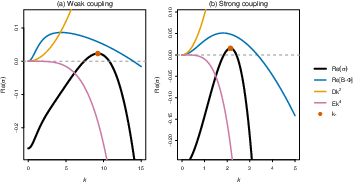
Figure 1: Dispersion relation Re[σ(k)] decomposed into local even polynomial, water coupling, and fourth-order cutoff contributions across representative regimes.
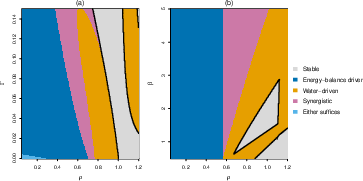
Figure 2: Mechanism classification in parameter space, identifying regions where pattern formation critically depends on energy-balance coupling, water feedback, or both.
Nonlinear Simulations and Verification of Linear Theory
Direct numerical simulation of the nonlinear PDE system verifies the linear predictions and further characterizes bifurcation structure, migration, and wavelength selection:
- The model robustly captures the observed empirical trend that pattern wavelength increases with aridity (lower rainfall), aligning with remote sensing data.
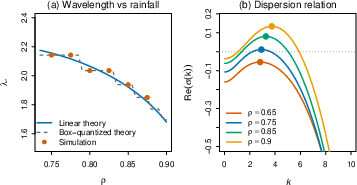
Figure 3: Dominant pattern wavelength versus dimensionless rainfall---linear theory, box-quantized admissible wavelengths, and nonlinear simulation results are in strong quantitative agreement.
- Band migration is present only on sloped terrain, with migration velocities in simulations closely matching linear theoretical values. Flat domains produce stationary patterns, consistent with field observations.
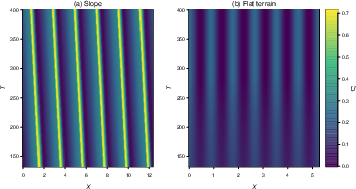
Figure 4: Spacetime plots of U(X,T) demonstrate uphill band migration on slopes (diagonal stripes) versus stationary bands on flat terrain.
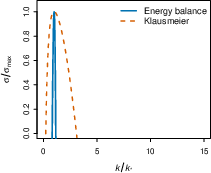
- The model exhibits a sharp, narrow instability band in wavenumber, implying robust wavelength selection, in contrast to the broader instability bands of classical Klausmeier-type models.
- Continuation of patterned steady states across rainfall parameter values reveals hysteresis and a narrow subcritical bifurcation window, as expected of fourth-order regularized systems.
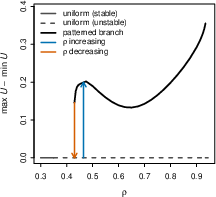
Figure 5: The nonlinear bifurcation diagram reveals a narrow hysteresis interval, with clear separation between monostable and bistable pattern regimes.
Comparison with Classical and Three-Feedback Models
A structural comparison with both the Klausmeier and Gilad–Meron frameworks yields several notable distinctions:
Theoretical and Practical Implications
The energy-balance-constrained modeling framework tightly restricts permissible nonlinearities and spatial couplings, clarifies mechanism essentiality, and enables the partitioning of pattern-forming instabilities into physically interpretable classes. Practically, this provides concrete predictions for the scaling of pattern wavelength with ecophysiological parameters—particularly interaction length scales directly related to canopy structure—and clarifies the role of topography in pattern propagation. The approach motivates new empirical investigations, such as direct estimation of plant interaction scales, testing of energy budget sign constraints, and measurement of water deflection effects in field campaigns.
On the theory side, the connection to classic variational PDEs (Swift–Hohenberg, Cahn–Hilliard) suggests that the rich mathematical apparatus of pattern formation can be extended to vegetation systems with physically justified closures, possibly enabling new analytical results on existence, selection, and stability.
Conclusion
This paper establishes a rigorous, physically motivated framework for modeling vegetation pattern formation in drylands using energy balance, water conservation, and gradient expansion as organizing principles. The consequent semilinear closures, especially the Euler–Lagrange representative, provide enhanced mechanistic clarity, robust wavelength selection, and direct connections to empirical observables. The analytical decomposition and nonlinear simulations together argue that energy-balance constraints are indispensable for the structural understanding of ecosystem patterns, and provide promising directions for both mathematical and ecological advances.