- The paper establishes a universal two-phase tidal track, showing early dark matter stripping followed by rapid stellar mass loss once a critical mass threshold is met.
- It employs high-resolution COLIBRE simulations with robust baryonic physics to distinguish between slowly stripped survivors and extreme mass loss channels.
- The findings improve satellite galaxy modeling, informing predictions on dark-matter-deficient galaxies and the suppression of faint-end stellar populations.
Tidal Evolution of Satellite Galaxies in COLIBRE: A Detailed Analysis
Simulation Methodology and Objectives
This study utilizes the COLIBRE suite of cosmological hydrodynamical simulations to interrogate the tidal evolution of satellite galaxies in cluster environments. The highest resolution L200m6 run is employed, featuring a sophisticated treatment of baryonic physics and a large cosmological volume. The combination of a high DM particle oversampling (4:1 relative to baryons) and a refined ISM/star formation model ensures a reliable representation of both the DM and baryonic substructures. The hbt-herons subhalo finder is used for robust tracking of subhalo and stellar mass loss even in heavily stripped systems.
Evolutionary Pathways and Universal Tidal Tracks
The study identifies two canonical evolutionary channels for satellite galaxies post-infall: a slowly stripped, "resolved" population and an "extreme mass loss," eventually disrupted or unresolved population. Fig. 1 presents case studies of representative satellites from these distinct evolutionary tracks, with clear diversity in mass loss histories and final outcomes.
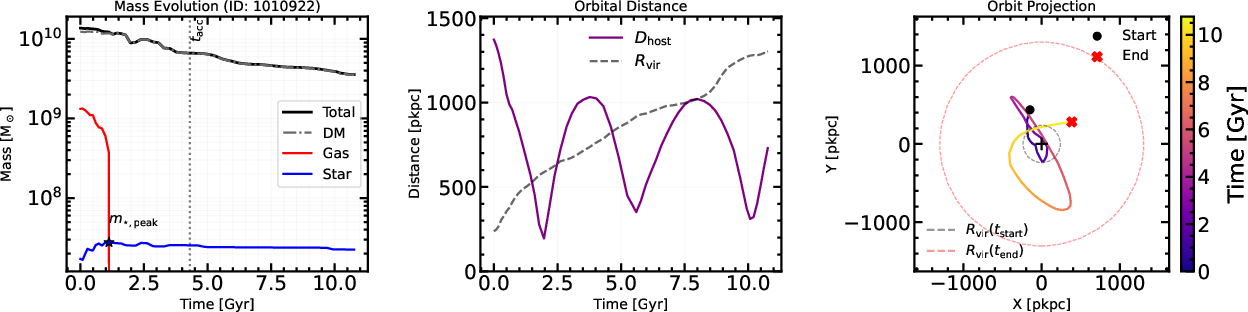
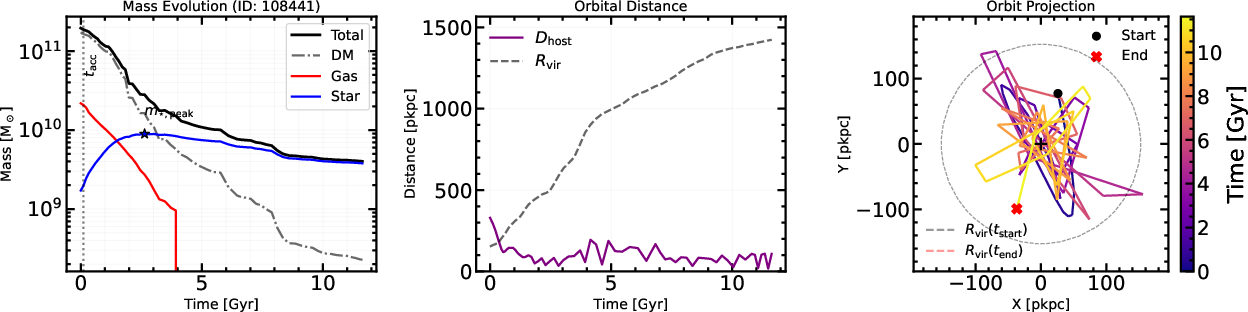
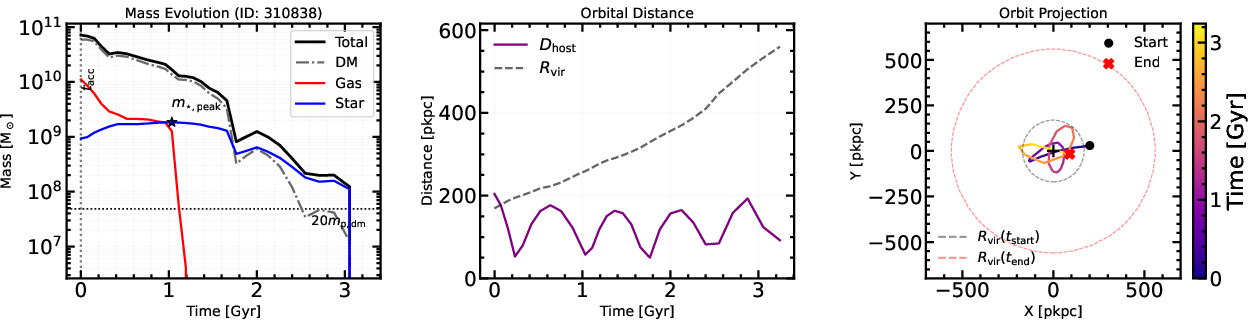
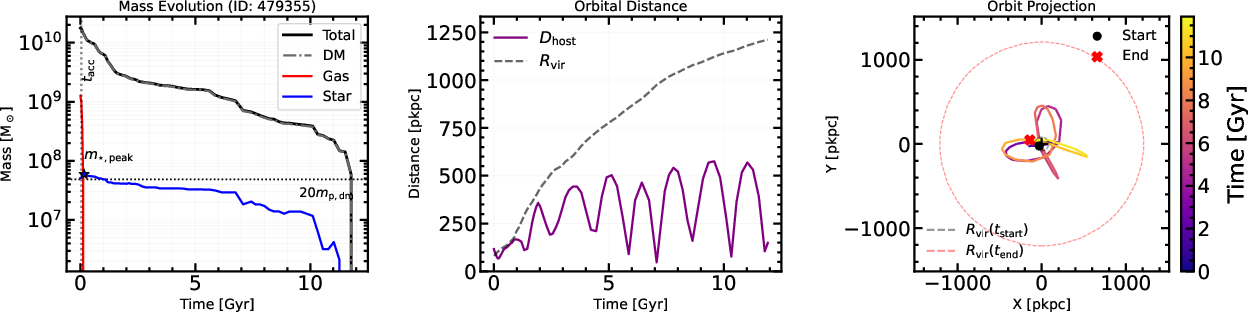
Figure 1: The mass and orbit evolution of example satellite subhaloes after reaching their peak mass msub,peak, showing differences in stripping efficiency, orbit, and survival.
Central to the analysis is the identification of a universal, two-phase tidal track relating the fractional remaining subhalo mass to the fractional remaining stellar mass. The stellar component remains robust against tidal disruption until the subhalo has lost the majority of its original mass, after which stellar stripping commences more efficiently. This two-phase behavior is captured by a flexible model with a transition parameter fd and a late-phase stripping efficiency governed by b. Statistical fits yield a median fd≈0.057 and b≈0.9, with both parameters displaying log-normal scatter.
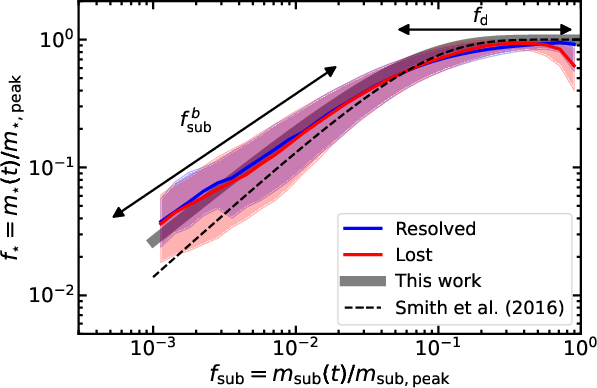
Figure 2: The stellar evolutionary (from right to left) tidal tracks of satellite galaxies in clusters with Mhost>1014M⊙ from COLIBRE L200m6.
The bimodal nature of the final outcomes is demonstrated: satellites with modest mass loss predominantly retain their peak stellar mass, while those on the extreme mass-loss channel typically experience full disruption and the destruction of the embedded galaxy.
Parameter Distributions and Dependence
The population-level distribution of the tidal track parameters (fd, b) is measured for thousands of satellites, revealing substantial but physically interpretable scatter. The typical range for fd is narrow compared to the dynamic range of subhalo mass loss, indicating a robust stellar resilience threshold across diverse initial conditions.
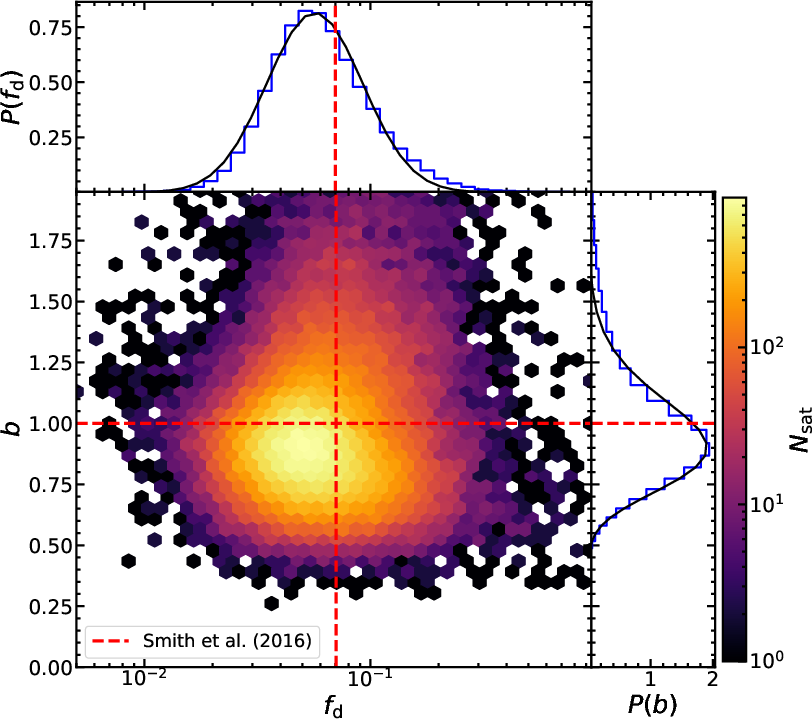
Figure 3: Joint and marginal distributions of the tidal track parameters fd and fd0 for satellites in the L200m6 simulation.
The onset of stellar mass loss (fd1) is further shown to correlate broadly with the compactness of the stellar system relative to the host subhalo virial radius, though significant intrinsic and environmental scatter remains (see Fig. 11).
Bimodal Fate and Subhalo Population Statistics
Through direct and model-extrapolated tracking, the satellite subhalo population is confirmed to bifurcate into two distinct phases: "slow-stripping" survivors and "rapid-stripping" lost systems. The mass loss rate distribution is strongly bimodal, with the resolved subhaloes typically losing 15% of their mass per Gyr and the lost population experiencing up to 90% mass loss per Gyr.
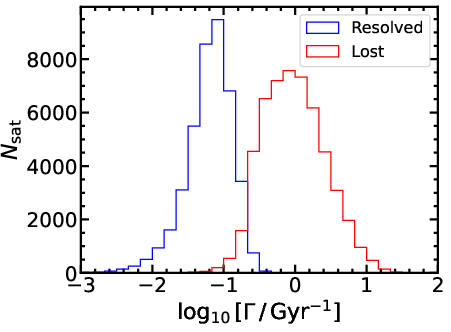
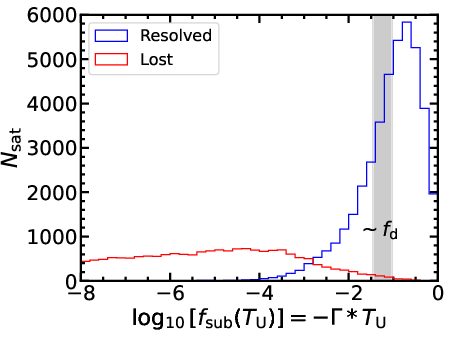
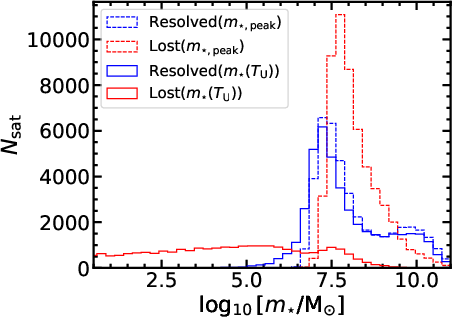
Figure 4: Distribution of the average mass loss rate fd2 for subhaloes with fd3 in cluster haloes.
The extrapolation procedure reveals that while subhalo mass functions remain largely robust to numerical disruption at these resolutions, the stellar mass function is nontrivially suppressed by the premature loss of satellites with surviving, tightly bound stellar cores. Specifically, the study finds up to a 20% deficit at fd4 and 50% at fd5—values that are significant for faint-end galaxy demographics and clustering analyses.
Emergence of Dark-Matter-Deficient Galaxies (DMDGs)
The model naturally predicts the formation and survival statistics of DMDGs (defined as satellites with fd6 at fd7), dependent on the interplay between the initial stellar-to-halo mass ratio and the amplification factor along the tidal track.
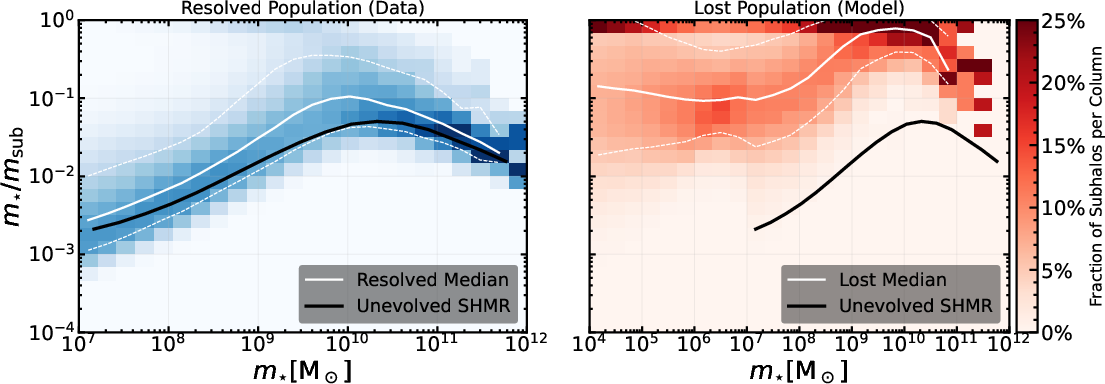
Figure 5: The evolved stellar-to-subhalo-mass ratio at fd8 for resolved (left, blue) and extrapolated lost (right, red) satellite populations.
The abundance of DMDGs peaks in the stellar mass range fd9--b0 and is extremely sensitive to both the numerical resolution and the adopted baryonic physics models. Notably, COLIBRE simulations identify b1 resolved DMDGs at b2, yielding a volume-corrected number density orders of magnitude higher than previous EAGLE results.
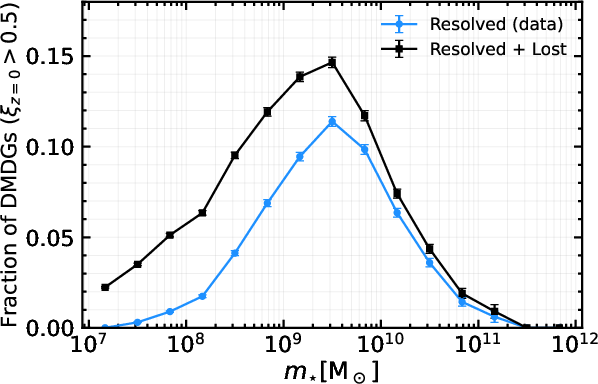
Figure 6: The fraction of DMDGs as a function of stellar mass, showing the increased incidence in both resolved and extrapolated populations.
Robustness and Resolution Convergence
A comprehensive convergence analysis is conducted, comparing different COLIBRE mass resolutions. The key result is that while absolute convergence on an object-by-object basis is unattainable due to the stochasticity of baryonic processes, the ensemble tidal track and associated parameter distributions converge when comparing populations selected at identical (or particle-matched) thresholds.
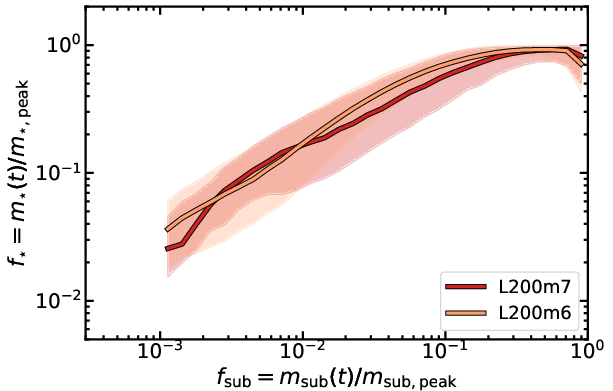
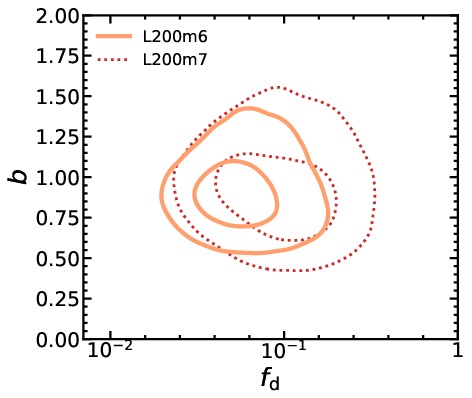
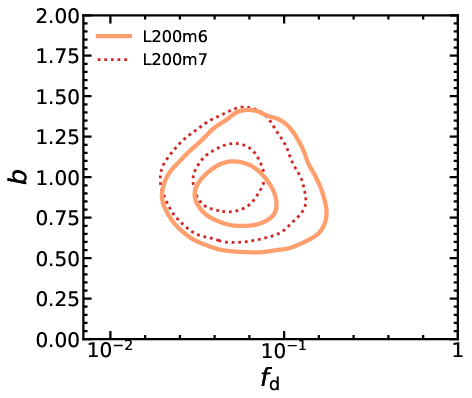
Figure 7: Resolution convergence test for satellite galaxies, showing robust median stellar tidal tracks and statistical parameter distributions across multiple simulation resolutions.
Gas Stripping Versus Stellar and DM Stripping
Analysis of gas evolution demonstrates that satellite gas is preferentially and rapidly stripped after infall, on significantly shorter timescales than either DM or stars. For the majority of resolved satellites, gas mass is depleted long before any substantial DM or stellar mass loss, whereas in heavily stripped/lost satellites, gas and DM loss track closely, indicative of dominant tidal (rather than hydrodynamic) removal.
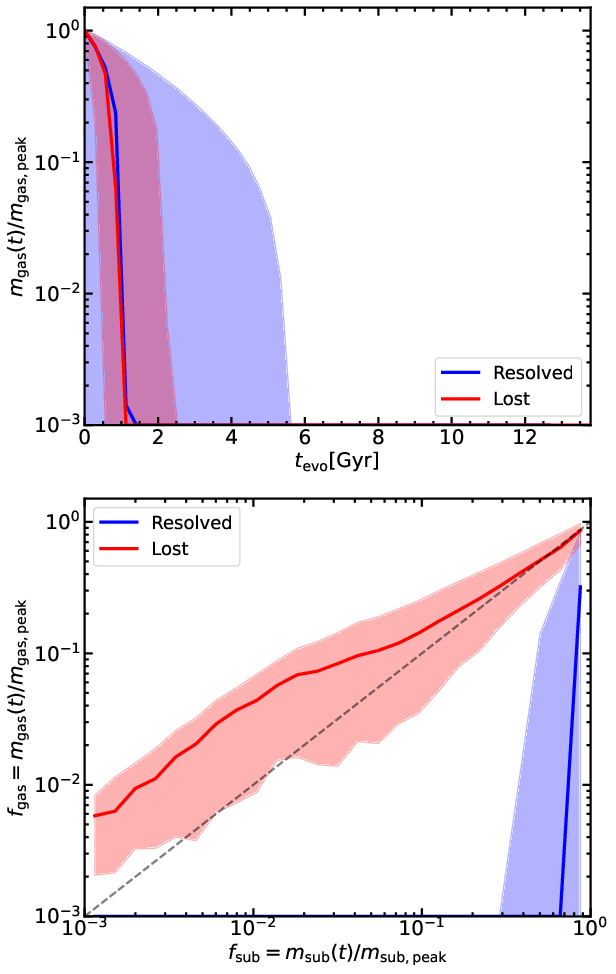
Figure 8: The evolution of gas mass for the sample of satellites, contrasting rapid gas loss with more prolonged DM and stellar stripping.
Implications and Future Directions
The study provides a robust tidal track model that can be directly incorporated into SAMs and galaxy-halo connection models to improve predictions for satellite galaxy statistics in the low-mass regime. The explicit quantification of artificial disruption effects, the mapping of subhalo bimodality onto the satellite stellar distribution, and the characterization of DMDG formation pathways all have immediate bearing on interpreting observed satellite abundances, clustering, and stellar-halo mass relation evolution.
Future work should refine the modeling of numerical and physical disruption, extend analyses to lower mass regimes, leverage higher-resolution volumes, and systematically compare with both observational data (e.g., JWST, ELVES, SAGA) and alternate simulation suites (e.g., TNG, EAGLE, NIHAO).
Conclusion
This work establishes the existence of a universal two-phase stellar tidal track for satellite galaxies in the COLIBRE simulations and quantitatively links the fate of embedded stellar populations to subhalo disruption channels. The results highlight the importance of numerical resolution, baryonic feedback, and orbital histories in dictating the abundance and properties of DMDGs and faint satellites. The calibrated analytic framework provided will be indispensable for next-generation studies of satellite galaxy formation, cosmological inference, and galaxy–halo coevolution.