- The paper introduces ibDET, a novel embedding framework that reduces computational scaling while maintaining chemical accuracy in charged excitation predictions.
- It employs a systematic construction of interacting bath orbitals—including static, dynamical, and natural orbitals—to capture both short- and long-range electron correlations.
- Benchmarks on nanoclusters and conjugated molecules show errors near or below 0.1 eV, validating its efficiency compared to full-space methods.
Low-Scaling Many-Body Green's Function Calculations for Molecular Systems via Interacting-Bath Dynamical Embedding Theory
Overview of ibDET: Motivation and Theoretical Framework
Interacting-bath Dynamical Embedding Theory (ibDET) is advanced in this work as a Green's function embedding framework for the prediction of charged excitation spectra in molecular and nanomaterial systems, leveraging GW and EOM-CCSD impurity solvers. The approach targets bottlenecks in scaling and accuracy that limit traditional many-body Green’s function simulations for large-scale systems, particularly when extending from solid-state materials to finite molecular domains. The central concept is to construct systematically improvable bath spaces that efficiently capture both short- and long-range electron correlation, allowing for highly accurate quasiparticle energies with substantially reduced computational cost relative to full-system calculations.
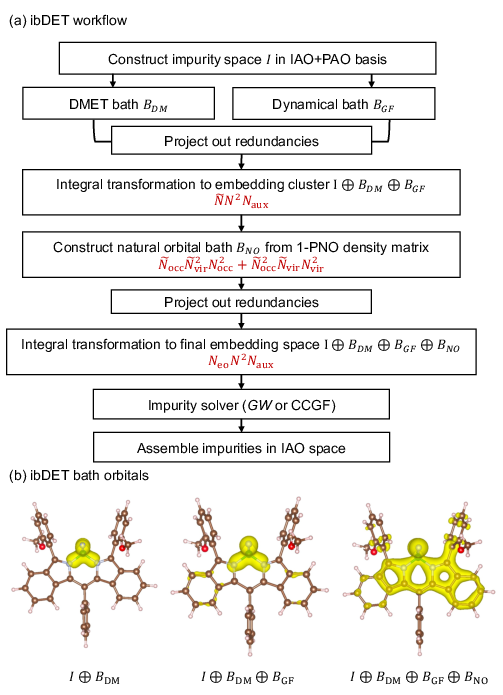
Figure 1: (a) Schematic of the ibDET algorithm and highlighting integral transformation scaling; (b) Visualization of embedding space electron density as the occupied space is systematically increased in BODIPY.
The ibDET scheme starts from a mean-field Hartree-Fock reference and defines atom-centered impurity fragments using a local orthogonal orbital framework (IAO+PAO). The method produces three classes of bath orbitals: static density-matrix-based (BDM), dynamical Green’s function-based (BGF), and cluster-specific natural orbitals (BNO) derived via a new efficient 1-PNO construction for the MP2 density matrix. This multitier strategy enables the inclusion of frequency-dependent entanglement and nonlocal correlation, while the size of the embedding space remains tunable via occupation thresholds. The Hamiltonian is projected into the embedding space, and self-energies computed via the solver are assembled into the system self-energy using democratic partitioning for off-diagonal components.
The first suite of numerical benchmarks addresses nanomaterial systems including a silicon nanocluster (Si32H44) and phosphorene nanosheets, using the G0W0@HF level. Rapid convergence of quasiparticle (HOMO/LUMO) energies is achieved with respect to embedding size, with only 103–309 orbitals per embedding problem required to recover full-space GW reference data to within ∼0.01–0.03 eV for ionization potentials and electron affinities.
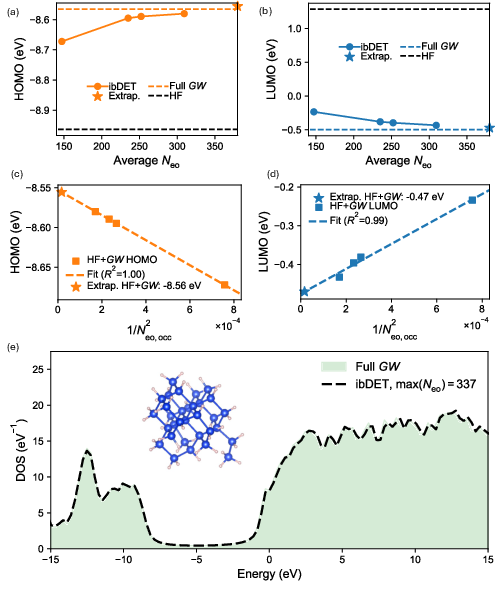
Figure 2: (a,b) Convergence of HOMO, LUMO quasiparticle energies vs. embedding size for Si nanocluster; (c,d) Linear extrapolation to full-space limit; (e) ibDET vs. full-space BDM0 density of states.
Extrapolative schemes, linear in the inverse square of average occupied embedding orbitals per fragment, enable further reduction in error. For size scaling, timings for phosphorene nanosheets (36–144 atoms) reveal that for modern embedding constructions, the bath construction dominates the computational cost and scales modestly (BDM1), with the actual impurity solver cost nearly constant per impurity. The empirical scaling (approx. BDM2) provides marked prefactor reductions over the full-space method but does not formally change the scaling exponent for BDM3.
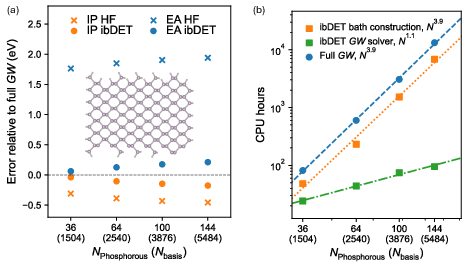
Figure 3: (a) Errors in HOMO/LUMO energies versus phosphorene nanosheet size. (b) Log-log plot of time requirements for bath construction and impurity solving as the system size grows.
Molecular Systems: Coupled-Cluster Solver Benchmarks
To probe the correlated regime at higher formal accuracy and cost, ibDET is paired with an EOM-CCSD impurity solver for medium-sized conjugated molecules (BODIPY and quaterrylene). The BODIPY test features a full-space of 751 orbitals, where direct CC calculations become impractical, yet ibDET at an embedding size of 196 orbitals achieves errors of 0.046 eV (HOMO) and 0.191 eV (LUMO) compared to full IP/EA-EOM-CCSD references. Upon embedding-size extrapolation, errors drop to 0.002–0.015 eV. Comparable results are seen for quaterrylene, although for LUMO energies, the error is larger (0.228 eV, reduced to 0.131 eV after extrapolation), reflecting the challenge in treating molecules with extended delocalization and less favorable self-energy assembly error cancellation.
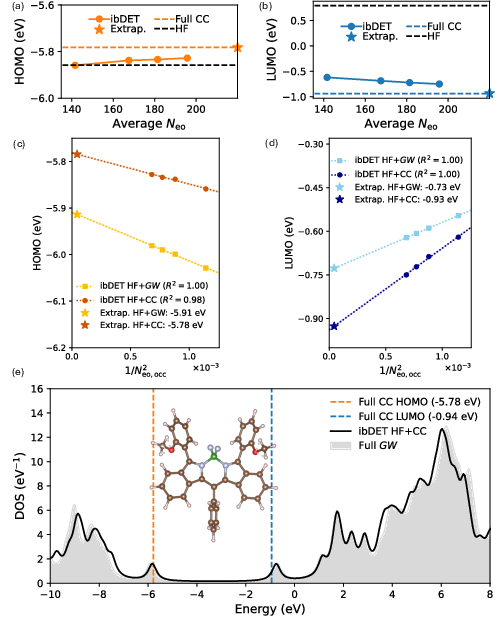
Figure 4: BODIPY molecule HF+CC ibDET benchmark: convergence and extrapolation of quasiparticle energies, and comparison of predicted densities of states (EOM-CCSD and BDM4 overlays).
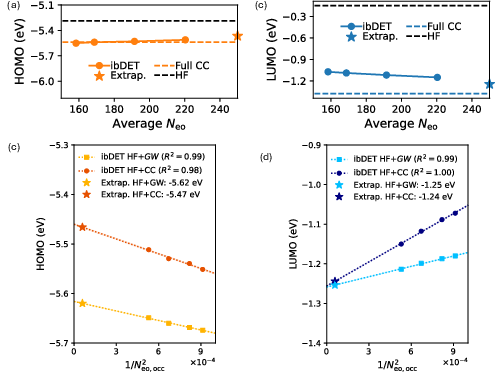
Figure 5: Quaterrylene molecule ibDET benchmark: error trends, convergence, and extrapolated results for HOMO/LUMO energies.
These molecular cases reveal that ibDET can deliver full-space EOM-CCSD accuracy for spectral predictions with embedding spaces representing less than one third of the total orbital count, and with errors near or below 0.1 eV in IP/EA calculations. The notable deviations in some systems are attributed to intrinsic limits set by electron delocalization and details of orbital localization/naturalization in the embedding construction.
Implications, Practicality, and Future Outlook
The primary implication of ibDET is the enablement of accurate many-body Green’s function simulations (including BDM5 and EOM-CCSD levels) for complex molecular and nanomaterial systems at costs orders of magnitude lower than canonical full-space implementations. Given the reduced size of embedding problems, the method is especially advantageous for post-BDM6 theoretical approaches (e.g., CC or ADC-based solvers), where scaling and memory bottlenecks otherwise make large-scale applications prohibitive.
The formal separation of impurity/bath construction and impurity solver cost places the dominant computational burden into steps that can benefit from ongoing developments in fast integral evaluation, density fitting, and machine-learning-based surrogate models. The theoretical framework bridges concepts from DMET/DMFT but avoids the limitations of non-interacting bath truncation by explicitly constructing interacting baths that systematically capture both short- and long-range correlation. The results demonstrate consistent recovery of charged excitation energies within chemical accuracy, supporting applications in spectroscopy and materials design.
Given these advances, immediate future directions may include:
- Hybridization with machine learning for bath selection and self-energy surrogacy [see also (Wang et al., 2024, Soleiman et al., 6 Jun 2025)].
- Extension to excited-state and optical properties via BSE@ibDET and time-dependent embedding variants.
- Application to increasingly complex molecular aggregates, heterogeneous interfaces, and strongly correlated fragments.
- Integration with stochastic, linear, or low-rank tensor approaches for further scaling improvements.
Conclusion
Interacting-bath Dynamical Embedding Theory generalizes and renders tractable many-body Green’s function predictions for extended molecular systems, providing a systematic, low-scaling route to high-accuracy quasiparticle properties at both BDM7 and EOM-CCSD levels. The practical performance is established across nanoclusters and challenging conjugated organics, demonstrating convergence to benchmark values with modest embedding spaces and errors near or below 0.1 eV. The theoretical and numerical advances of ibDET pave the way for scalable, accurate electronic structure calculations critical for predicting and designing spectral properties in molecular and nanoscale materials (2604.03137).