- The paper develops a novel tropical degeneration method to compute Maslov index two disk counts, extending disk potentials from toric to almost toric manifolds.
- It leverages combinatorial polyhedral decompositions and precise vertex multiplicities to encode singular contributions from focus-focus points and toric divisors.
- The results confirm mirror symmetry predictions by correlating tropical disk counts with mutable Laurent polynomial structures in del Pezzo surfaces.
Tropical Disk Potentials in Almost Toric Manifolds: A Rigorous Approach
Introduction and Motivation
This work develops a framework for computing disk potentials for Lagrangian tori in almost toric four-manifolds via tropical methods, extending classical results for holomorphic disks and spheres in toric and projective varieties to the more general almost toric setting. Using degeneration techniques, the authors obtain explicit tropical formulas that encode Maslov index two disk counts and generalize constructions previously limited to the toric context.
The construction of "tropical potentials" systematically encodes holomorphic disks via combinatorial and polyhedral data, reflecting both toric and focus-focus singularity contributions. The results substantiate and generalize predictions from mirror symmetry and the Gross–Siebert program, connecting these calculations to tropical and combinatorial structures governing mirror Laurent polynomials.
Almost Toric Manifolds and Polyhedral Decompositions
An almost toric manifold is a symplectic four-manifold with a Lagrangian torus fibration (also called an almost toric fibration), permitting not only the standard elliptic singularities of toric varieties but also focus-focus singularities. Such singularities account for the appearance of nodal fibers and are centrally important in the analysis of symplectic and mirror-symmetric phenomena.
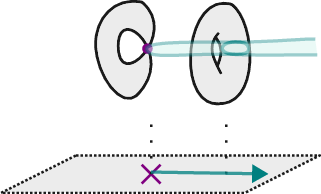
Figure 2: A focus-focus singularity, indicating the locus in the almost toric base where the fiber degenerates to a nodal torus.
The moment polytope of an almost toric manifold generalizes toric moment polytopes, acquiring additional combinatorial data in the form of branch cuts and marked points indicating singular fibers. These almost toric diagrams—essentially integral affine manifolds with prescribed singular sets—are the starting point for the paper's combinatorial analysis.
Almost toric diagrams for del Pezzo surfaces illustrate the diversity of these structures. The presence and choice of focus-focus points and branch cuts determines wall-crossing, Lagrangian mutation, and the corresponding mirror potentials.
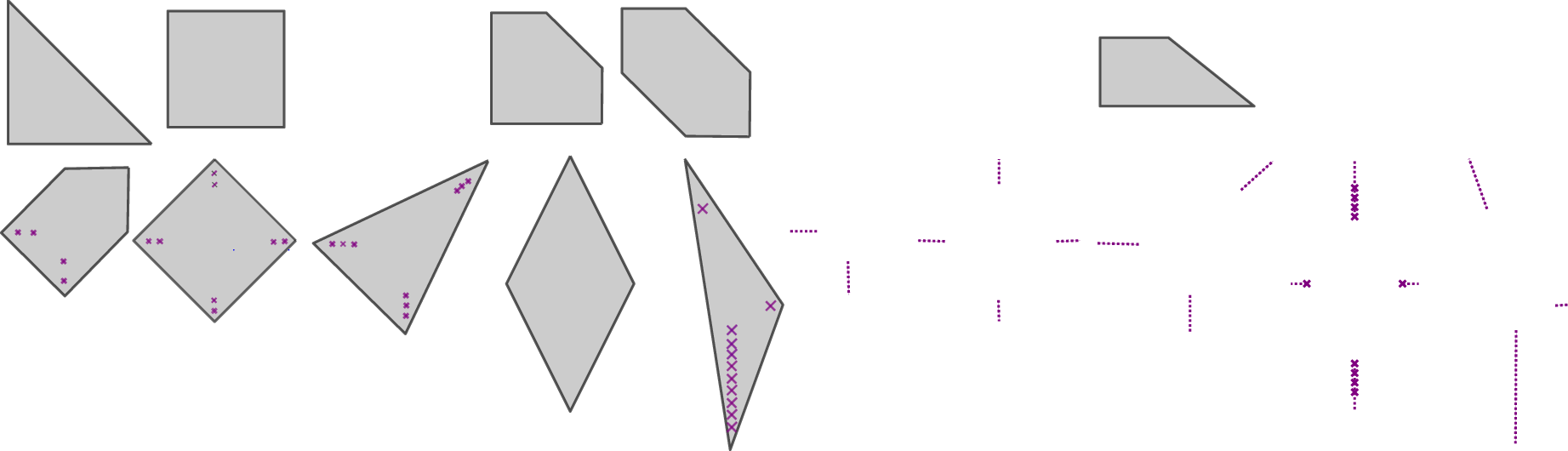
Figure 4: Almost toric diagrams for the del Pezzo surfaces, highlighting the configuration of focus-focus singularities and Lagrangian fibers.
Tropical Degeneration and the Disk Potential
The core technical contribution is a degeneration approach that replaces holomorphic disk counts in a smooth symplectic manifold with "broken" or "tropical" counts in a limit where the manifold decomposes into simpler pieces via a polyhedral decomposition. In the limit, holomorphic disks degenerate to combinatorial objects—tropical graphs—embedded in the dual complex associated with the polyhedral decomposition of the moment image.
For almost toric manifolds, the authors provide an explicit algorithm for assembling, enumerating, and weighting tropical graphs (and subgraphs) corresponding to disks of Maslov index two with boundary on a chosen Lagrangian torus. There is a precise description of how vertices of these graphs encode interactions with focus-focus points, toric divisors, and the Lagrangian itself, with attached multiplicity formulas adapting the Mikhalkin multiplicity, the Bryan–Pandharipande multiple cover formula, and Cho–Oh's formula for disks in toric varieties.
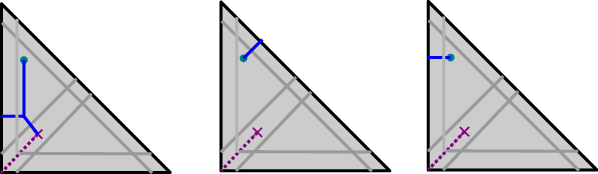
Figure 6: A polyhedral decomposition of an almost toric diagram and three Maslov-two broken disks; the colors indicate the relationship between the base, the cuts, and the tropical disks.
Product Structure on Moduli Spaces
A structural property is established: the moduli space for broken disks with polyhedral degeneration is typically a product of moduli spaces associated with the pieces. This is formalized in the description of distribution of constraints, crucial for reducing complicated enumerative problems to manageable lower-dimensional ones.
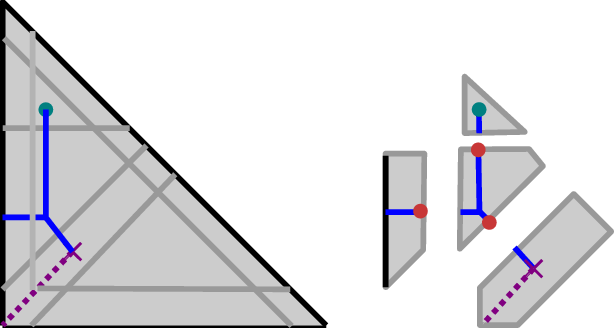
Figure 8: The moduli space as a product of moduli spaces for its pieces, illustrating the decomposition into local contributions.
Vertex Multiplicities and Local Models
For the full enumeration, the counting of disks is localized to pieces of the decomposition, which are of toric or focus-focus type. The corresponding local holomorphic curve counts are as follows:
- Toric regions: Holomorphic disks and spheres with boundary or intersection with toric divisors
- Near focus-focus singularities: Multiple covers of nodal fibers, with tropical ends in directions dictated by monodromy
- Boundary interactions: Holomorphic cylinders attached to boundary divisors
Each type's vertex multiplicity is precisely specified—trivalent vertices in a toric region acquire Mikhalkin-type determinants, univalent vertices near focus-focus points yield Bryan–Pandharipande multiple cover weights, while disks with boundary in the toric Lagrangian are counted as in Cho–Oh.
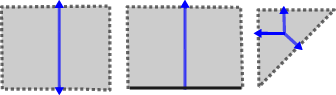
Figure 10: Holomorphic curves in the toric local models; these provide canonical building blocks corresponding to the vertices of tropical graphs.
Explicit Computations: Del Pezzo Surfaces and Mutation
An extensive suite of examples is provided, applying the machinery to compute disk potentials of monotone Lagrangian tori in del Pezzo surfaces—blowups of the projective plane at up to eight points. The combinatorics of the polyhedral decomposition and the tropical graphs are compared to the conjecturally mirror polynomials in the Gross–Siebert and Akhtar–Coates tables. The calculations establish:
- The disk potential, computed tropically, is a Laurent polynomial whose Newton polygon is dual to the moment polytope.
- The coefficients on the edges correspond to binomial coefficients, aligning with maximal mutability for Laurent polynomials.
- Mutation of the almost toric fibration (moving a focus-focus singularity across a Lagrangian torus) induces algebraic mutation of the disk potential, as in Pascaleff–Tonkonog wall-crossing.
These results are fully consistent with mirror symmetry predictions and the appearance of mutable Laurent polynomials for mirror partners to almost toric del Pezzo surfaces.
Theoretical and Practical Implications
The tropical degeneration and associated potential formulas serve as a powerful tool for explicit computation in symplectic topology and open Gromov–Witten theory. The method's compatibility with wall-crossing, mutation, and the appearance of binomial structure in coefficients provides structural confirmation for mirror symmetry predictions in the almost toric context.
Practically, the formalism bypasses analytic difficulties in transversality and virtual fundamental cycles typical in higher-genus and disk-counting problems by reducing the enumeration to rigid combinatorial data. The link to the Gross–Siebert program and explicitly computable mirror polynomials supports future advances in understanding the Fukaya category of log Calabi–Yau pairs and del Pezzo surfaces.
The extension to higher-dimensional (almost) toric manifolds is indicated; however, combinatorial complexity and the nature of singularities increase. The techniques inform potential categorifications in the context of the Fukaya category, the appearance of wall-crossing structures, and the enumeration relevant for SYZ mirror symmetry.
Conclusion
This paper achieves an overview of tropical, symplectic, and mirror-symmetric techniques in the enumerative geometry of Lagrangian disks, focusing on almost toric four-manifolds. The explicit tropical combinatorics developed here correctly model the disk potential, respect wall-crossing and mutation, and realize the expected mirror formulas for del Pezzo surfaces. The results constitute a rigorous step in connecting tropical geometry, symplectic topology, and mirror constructions in general, singular toric-type symplectic manifolds.
The methodology and results are positioned to further influence computations in open Gromov–Witten theory, the study of Fukaya categories, and the explicit mapping of the SYZ mirror correspondence beyond the toric paradigm.

