- The paper presents an experimental method to determine the ground state polarizability of 162Dy using zero-crossing detection of light shifts near 530 nm.
- Precision measurements using ToF expansion and Raman spectroscopy yield scalar, vector, and tensor polarizability values that match theoretical predictions.
- These results enable optimized optical trapping and cooling schemes for complex atoms like dysprosium in quantum simulations and metrology.
Experimental Determination of the Ground State Polarizability of 162Dy near 530 nm
Introduction
The paper "Determination of the ground state polarizability of 162Dy near 530 nm" (2604.03177) addresses the characterization of the dynamical polarizability of the 162Dy ground state in the vicinity of its J=8→J′=7 intercombination transition at λ0≈530.306 nm. Dysprosium, a lanthanide atom with a large angular momentum and a dense optical spectrum, exhibits significant vector and tensor polarizability contributions, in contrast to alkali metals whose ground-state polarizabilities are predominantly scalar. Accurate knowledge of these polarizabilities is crucial for designing optimized single-atom trapping protocols, particularly in optical tweezer arrays where differential polarizabilities determine trap geometries and cooling strategies.
Theoretical Framework
Dynamical polarizability α(ω) is expressed as a sum over dipole-allowed transitions, weighted by dipole matrix elements. Near resonant transitions, the total polarizability can be decomposed into a resonant component associated with the J→J−1 transition and a slowly varying background term accounting for all other transitions. For Dy, sizable vector (αv) and tensor (αt) contributions result in spin- and polarization-dependent optical potentials, requiring precise separation and measurement of these contributions.
The light shift for a ground-state manifold subject to an off-resonant field depends directly on these polarizability contributions and their polarization dependence. Specifically, for certain polarizations and detunings, the light shift can be canceled ("zero crossing"), allowing an unambiguous determination of the background polarizability independent of beam intensity calibration.
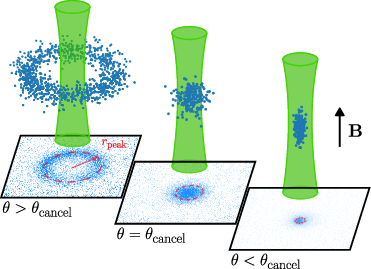
Figure 1: Schematic representation of polarization dependence of the light shift, illustrating repulsive and attractive optical potentials relative to the cancellation angle θcancel.
Experimental Approach
The authors use a narrow optical transition at 1620 nm to probe the ground-state polarizability of 1621Dy. The cancellation of the light shift for the lowest-energy Zeeman sublevel is detected using time-of-flight (ToF) expansion of a cold atomic cloud in the presence of a spin-dependent light-shift (SLS) laser beam, with polarization controlled via wave plates. For each detuning, the cancellation angle is identified by comparing the ToF expansion profiles with and without the SLS beam; the condition 1622 indicates zero light shift for the selected polarization and detuning.
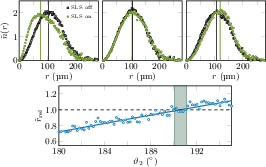
Figure 2: Zero-crossing of polarizability from ToF expansion in the presence of the SLS beam at 1623 GHz, showing attractive, vanishing, and repulsive potentials.
By systematically varying detuning and polarization, zero-crossing lines are mapped in the space of waveplate angles. These experimental points are globally fitted to extract the background scalar (1624), vector (1625), and tensor (1626) polarizabilities, with polarization transformations modeled via a Jones matrix.
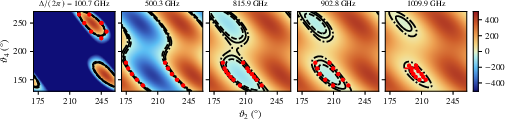
Figure 3: Polarizability cancellation maps for different detunings, comparing extracted zero crossings (red disks) with calculated zero-polarizability contours.
Absolute Calibration via Spectroscopy
To convert fitted polarizabilities to absolute units, the ordinary dipole matrix element 1627 and the transition linewidth 1628 are determined via Raman spectroscopy on the 1629 Zeeman sublevel. By measuring the SLS-induced light shift as a function of intensity and detuning, and comparing resonance frequencies across multiple conditions, the linewidth is accurately calibrated.
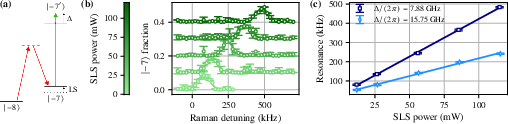
Figure 4: Calibration of the linewidth 1620 using Raman spectroscopy, showing the dependence of resonance frequency on SLS power and detuning.
The experimentally measured 1621 kHz yields 1622 and 1623, in agreement with tabulated and theoretical values within uncertainties.
Numerical Results and Comparison
The extracted background polarizabilities are:
- 1624
- 1625
These are consistent with calculated theoretical values 1626 and 1627, confirming that the sum-over-states approach—excluding the resonant 1628 nm transition—accurately predicts the polarizability in this spectral region. Notably, the data do not exhibit the deficiency in polarizability observed in previous measurements at 1629 nm, underscoring the importance of precise, state- and wavelength-dependent calibration.
Implications and Outlook
Robust determination of scalar, vector, and tensor polarizabilities near J=8→J′=70 nm enables reliable design of optical tweezer architectures for lanthanide atoms, facilitating advanced protocols for trapping, imaging, and cooling where differential light shifts are exploited. The methodology of extracting background polarizability via zero-crossing conditions minimizes experimental uncertainties associated with intensity calibration and is adaptable to other open-shell atoms and complex level structures. Accurate polarizabilities will underpin theoretical modeling of dipolar quantum gases and engineered gauge fields in synthetic dimensions.
From a theoretical standpoint, the confirmation of polarizability values and their behavior near prompt transitions resolves discrepancies in spectroscopic data and guides refinement of atomic-structure calculations for open-shell lanthanides. For practical applications, precise knowledge of polarizabilities will inform evaporative cooling and state-selective manipulation schemes in optical dipole traps, potentially improving control in quantum simulation and metrology experiments.
Conclusion
This work provides a comprehensive experimental and theoretical determination of the scalar, vector, and tensor components of the ground-state polarizability of J=8→J′=71Dy near 530 nm. The use of polarization-dependent zero-crossing conditions allows for precise extraction of background polarizabilities, independent of absolute intensity calibration. Results are consistent with atomic structure calculations and tabulated values, directly supporting optimized tweezer-based trapping and manipulation of dysprosium. The approach is broadly applicable to complex atomic species where polarization and state-dependent optical potentials are relevant.

